
 By Raul
Circle is a polished community platform that combines discussion spaces, courses, events, and monetization tools in a clean, modern interface. It works well for creators and businesses that want a ready-made community hub without much configuration.
But it is not the only option, and it is not the best fit for every use case.
Maybe you are running into scaling costs as your member count grows. Maybe you want deeper ownership over your platform and data. Or maybe you need a stronger all-in-one setup with built-in email marketing, sales funnels, or advanced automation that Circle does not offer natively.
Whatever the reason, there are solid alternatives worth considering. We present seven of the best alternatives to Circle and explain why you might want to look beyond it.
Why Not Circle?
Circle is one of the stronger community platforms available, but like any tool, it has drawbacks that may matter depending on your goals:
- Costs climb with growth. Circle’s pricing tiers are based on member count and features. As your community scales, the monthly bill can increase faster than your revenue, especially if you are not yet monetizing aggressively.
- Limited marketing stack. Circle handles community and courses well, but it lacks built-in email marketing, sales funnels, and advanced automation. You will need third-party tools (and more subscriptions) to run a complete creator business.
- No real ownership. Like most SaaS platforms, Circle is a closed system. Your content, your member data, and your community structure all live on Circle’s servers. If you want full control, you are out of luck.
- Transaction fees on some plans. Depending on your tier, Circle takes a cut of your transactions on top of the monthly subscription, which eats into margins for high-volume sellers.
- Community-first, not business-first. Circle is excellent at fostering discussion and engagement, but if your primary goal is selling digital products, running cohort programs, or managing a membership business with complex pricing, it can feel limited.
If any of these drawbacks are deal-breakers for your project, it is time to look at alternatives.
How the Alternatives Compare
| Platform | Best For | Starting Price | Courses | Native Mobile Apps |
|---|---|---|---|---|
| Mighty Networks | Community-first memberships | ~$49/mo | Yes (higher tiers) | iOS + Android |
| Skool | Cohorts and group programs | Flat mid-range SaaS | Yes | Web only |
| Kajabi | All-in-one knowledge business | Mid-to-high tier | Yes | Kajabi app |
| Podia | Budget-friendly creator business | Lower tier | Yes | Web only |
| Heartbeat | Modern community with automations | $40/mo (annual) | Yes | Web + apps |
| BuddyBoss | Full ownership on WordPress | Yearly license + hosting | Via LMS plugins | iOS + Android |
| Bettermode | Product and customer communities | Free tier available | No | Web (embeddable) |
7 of the Best Alternatives to Circle
The best Circle alternative depends on what is missing for you. Here are seven platforms that outperform Circle in one way or another:
1. Mighty Networks – Closest All-Round Replacement
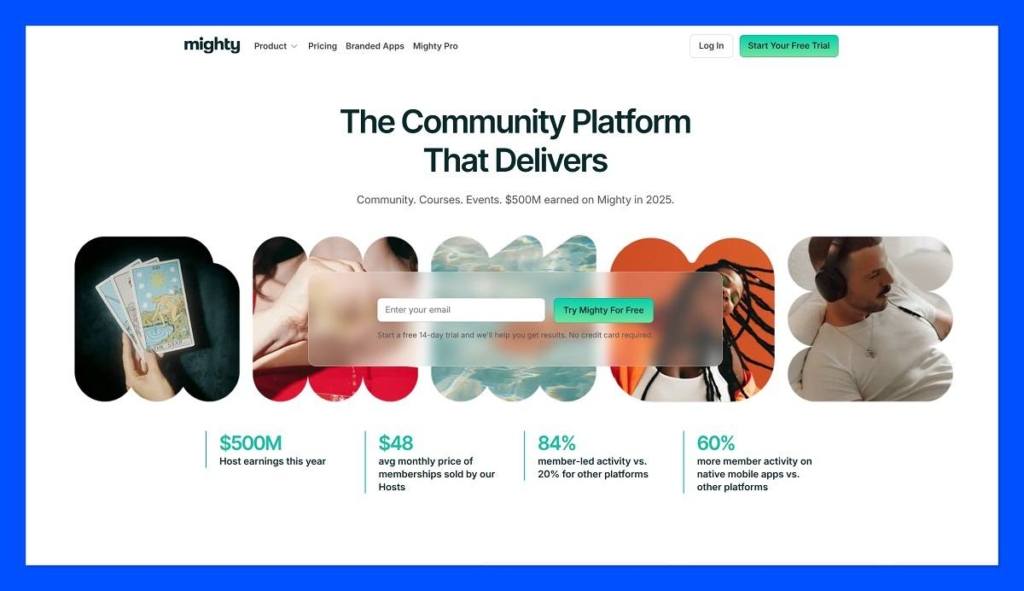
If you want a platform that does roughly what Circle does but with a longer track record and more built-in features, Mighty Networks is the most direct competitor. It combines community spaces, courses, events, live streaming, and private messaging in a single platform, and it has been doing so longer than most rivals.
Mighty Networks also gives you something Circle does not: branded native apps on iOS and Android. Members can access your community through a dedicated app with your branding, not just a mobile-responsive website. For communities where mobile engagement matters (which is most of them), that is a meaningful advantage.
The tradeoff is that Mighty Networks can feel heavier and less sleek than Circle. The interface has more going on, and the learning curve is a bit steeper for both admins and members. Power users will appreciate the depth, but if you liked Circle specifically for its simplicity, Mighty Networks may feel like a step in the wrong direction.
Pricing starts at around $49/month for the Community plan, with separate, higher-priced tiers for courses and advanced business features.
Pros
- Community, courses, events, and live streaming in one platform
- Branded native apps for iOS and Android
- Mature feature set with a long track record
- Built-in monetization with memberships and paid groups
Cons
- Interface can feel cluttered compared to Circle
- Steeper learning curve for admins
- Higher-tier plans needed for full course and business features
Mighty Networks is a good choice for community builders who want a feature-rich platform with native mobile apps and do not mind trading some of Circle’s simplicity for more depth. It is the closest thing to a like-for-like replacement.
2. Skool – Simplest Member Experience

Skool has gained a lot of traction among creator-educators, and the reason is simple: it strips community down to the essentials and makes the member experience extremely straightforward. You get community feeds, courses, and gamification (leaderboards, points) without the complexity that comes with platforms like Circle or Mighty Networks.
The design philosophy is deliberately minimal. There are no elaborate space configurations, no granular permission systems, no sprawling admin dashboards. You set up a group, add your course content, and let members engage. That simplicity is Skool’s biggest strength and its biggest limitation at the same time.
Skool uses flat pricing with no per-member tiers in the core plan, which makes costs predictable as you scale. It is particularly popular for cohort-based programs, group coaching, and paid communities where engagement and accountability matter more than feature depth.
If you need advanced customization, complex space hierarchies, or deep integrations, Skool will feel too constrained. But if your priority is getting members actively participating without friction, it is hard to beat.
Pros
- Extremely simple setup and member experience
- Built-in gamification with leaderboards and points
- Flat pricing without per-member scaling
- Strong for cohort programs and group coaching
Cons
- Very limited customization and branding options
- No native mobile app (web only, mobile-responsive)
- Not suited for complex community structures
Skool works best for educators and coaches who want a no-fuss community where members show up, participate, and progress through content. If you value engagement over customization, it delivers
3. Kajabi – Stronger Marketing Stack

Kajabi positions itself as an all-in-one platform for “knowledge businesses,” and it genuinely delivers on that promise better than Circle does. Where Circle focuses on community and layers in courses, Kajabi starts with courses, email marketing, sales funnels, landing pages, and payment processing, then adds community features on top.
If you are currently using Circle plus a separate email tool plus a funnel builder plus a landing page tool, Kajabi can replace most of that stack. The email marketing and automation features are particularly strong for a community platform, letting you build sequences, segment audiences, and trigger actions based on member behavior, all without leaving the platform.
The community features, however, are not as refined as Circle’s. Kajabi added community functionality relatively recently, and it shows. The discussion spaces are functional but lack the depth and polish of a community-first platform. You also get a Kajabi-branded mobile app, though it is not as customizable as what Mighty Networks offers.
Kajabi sits at the mid-to-high end of SaaS pricing with multiple plan tiers, so it is not the cheapest option. But if you factor in all the tools it replaces, it can actually save money compared to a Circle + email + funnels stack.
Pros
- Built-in email marketing, funnels, and landing pages
- Strong course creation and delivery tools
- Replaces multiple SaaS subscriptions
- Solid analytics and automation
Cons:
- Community features are less polished than Circle
- Higher price point
- Can feel overwhelming for simple community-only use cases
Kajabi makes the most sense for creators who are tired of stitching together multiple tools. If you want courses, email, funnels, and community under one roof and are willing to pay a premium for that convenience, it is a strong pick over Circle.
4. Podia – Budget-Friendly All-in-One:
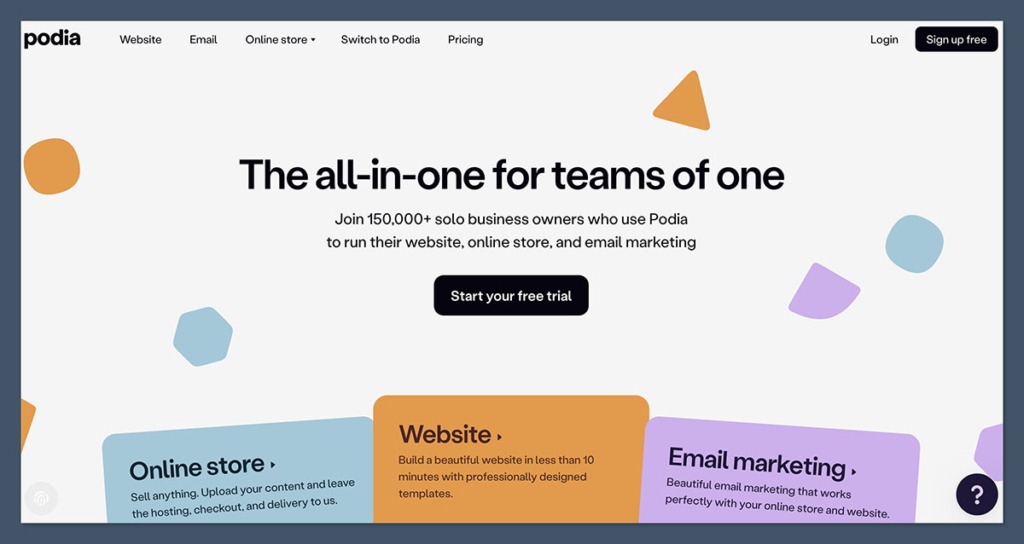
Podia targets solo creators who want courses, digital downloads, memberships, and community in a single platform without paying premium prices. Think of it as a simpler, more affordable version of Kajabi, with community baked into the core product rather than bolted on as an afterthought.
The platform handles the basics well: you can sell courses, offer memberships, host a community, and manage payments from one dashboard. For creators who are just starting to monetize or who run a relatively straightforward membership business, Podia covers the essentials without unnecessary complexity.
The catch is that community is a module inside Podia, not the center of it. The community features are more basic than what Circle offers. You will not find the same level of space customization, event management, or engagement tools. If community is the core of your business (not just a feature alongside your courses), Podia may feel thin.
Where Podia shines is pricing. Its tiers are lower than most competitors in this space, and community is bundled in rather than locked behind higher plans. For budget-sensitive creators, that makes it a compelling alternative.
Pros
- Affordable pricing with community included
- Courses, downloads, memberships, and community in one place
- Simple, clean interface
- Good for solo creators starting out
Cons
- Community features are basic compared to Circle
- Web only, no native mobile app
- Limited customization and automation
Podia is worth considering if you are a solo creator or small team that needs community, courses, and payments in one place without a steep monthly bill. It will not match Circle’s community depth, but for many creators, it covers enough at a price that is easier to justify.
5. Heartbeat – Modern Community OS
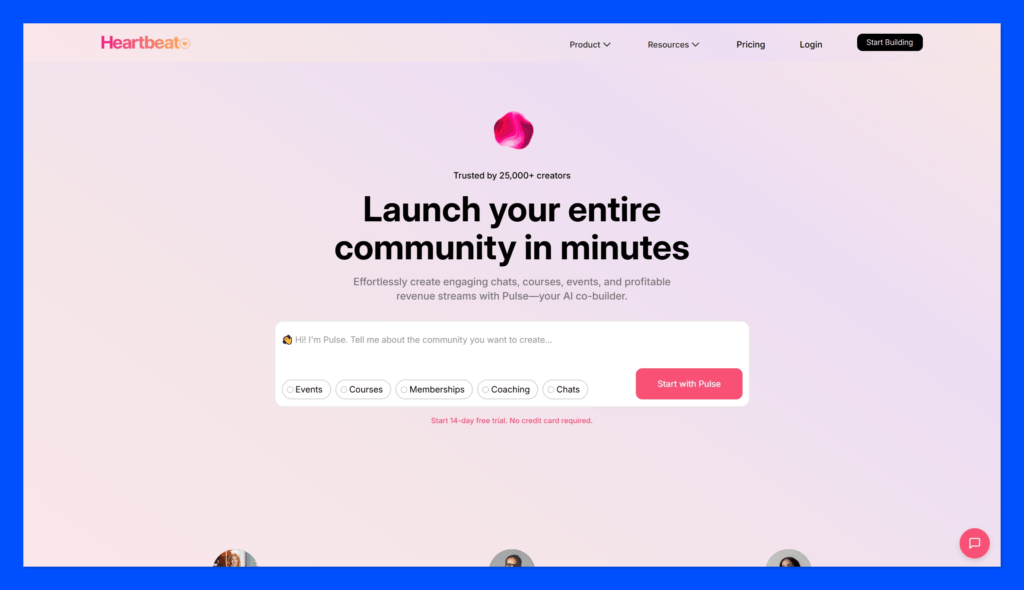
Heartbeat is a newer entrant that has quickly positioned itself as a direct Circle competitor, with transparent pricing and a modern feature set that matches most of what Circle offers: structured spaces, events, courses, chat, and automation tools.
What sets Heartbeat apart is its approach to pricing and automation. The Starter plan begins at $40/month (annual billing) for up to 1,000 members, which undercuts Circle’s entry price. The Growth plan at $108/month unlocks unlimited members and more advanced automation. The pricing is straightforward, with no hidden per-member surcharges.
Heartbeat’s automation features are notably strong for a community platform. You can build workflows that trigger based on member actions, automate onboarding sequences, and manage engagement at scale without manual intervention. For community managers who spend too much time on repetitive tasks, this is a real selling point.
The platform is still maturing, though. It does not have the same ecosystem of integrations or the same track record as Circle or Mighty Networks. Video hosting is an add-on rather than included, which can increase costs for course-heavy communities. But if you want a modern, well-priced platform with room to grow, Heartbeat is worth a serious look.
Pros
- Transparent, competitive pricing
- Strong automation and workflow tools
- Structured spaces, events, courses, and chat
- Modern interface with clean UX
Cons
- Newer platform with a smaller ecosystem
- Video hosting is an add-on
- Fewer third-party integrations than established competitors
Heartbeat is a solid option if you want most of what Circle offers at a lower, more predictable price point. The automation tools give it an edge for community managers who want to scale engagement without scaling their workload.
6. BuddyBoss – Full Ownership on WordPress
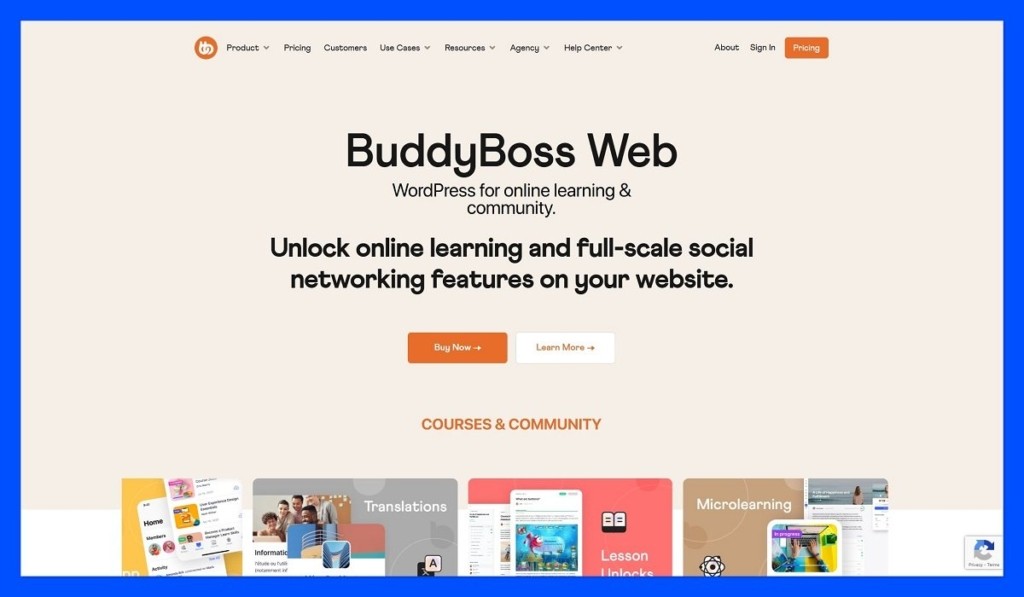
Every platform we have covered so far is a SaaS tool, which means you are renting space on someone else’s system. BuddyBoss takes a fundamentally different approach: it is a WordPress theme and plugin suite that turns a self-hosted WordPress site into a full community platform.
The advantage is ownership. You control your data, your branding, your hosting environment, and your costs. There are no per-member fees and no transaction fees. You pay a yearly license for the theme and plugins, then cover your own hosting and any additional tools you add (LMS, email, funnels). Over time, this can be significantly cheaper than SaaS alternatives, especially at scale.
BuddyBoss also offers native iOS and Android apps through its BuddyBoss App product, so you are not sacrificing mobile presence by going the self-hosted route. The flexibility to customize everything through WordPress themes, plugins, and code gives you a level of control that no SaaS platform can match.
The downside is complexity. Setting up BuddyBoss requires more technical knowledge than signing up for Circle. You need to manage hosting, security, updates, and plugin compatibility. The initial setup takes longer, and the UX depends heavily on how well you configure your plugin stack. It is the most powerful option on this list, but also the one that demands the most from you.
Pros
- Full ownership of data, branding, and infrastructure
- No per-member or transaction fees
- Native iOS and Android apps available
- Highly customizable through WordPress ecosystem
Cons
- Higher setup complexity and technical requirements
- You manage hosting, security, and updates
- UX quality depends on your configuration
- Need additional plugins for LMS, email, and funnels
BuddyBoss is the right move if ownership and long-term cost control matter more to you than convenience. It takes more effort to set up and maintain, but once it is running, you own everything and pay no recurring per-member fees.
7. Bettermode – Product and Customer Communities
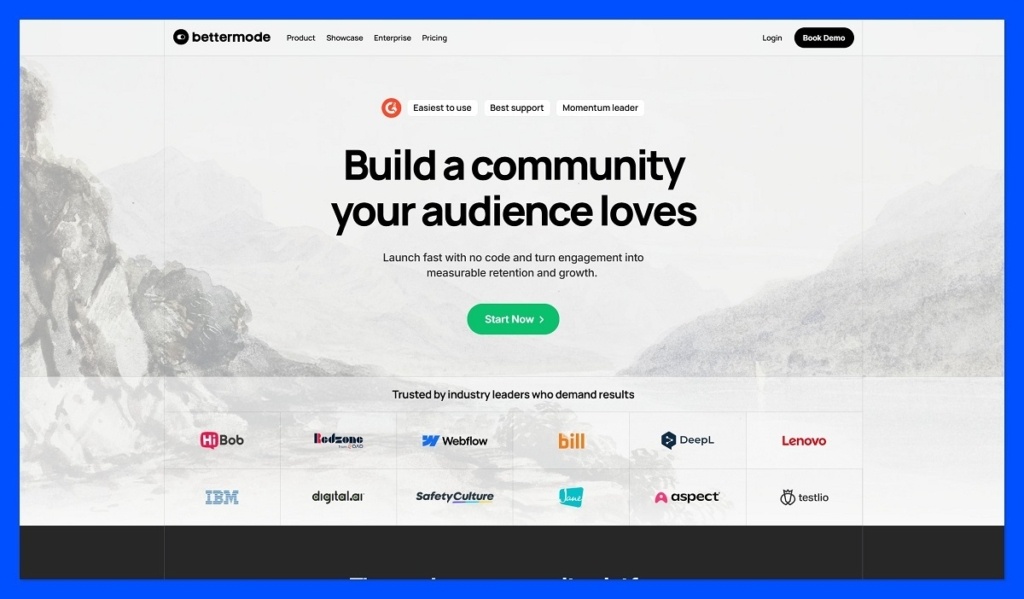
Bettermode (formerly Tribe) takes a different angle entirely. While Circle, Mighty Networks, and Skool are built for creator-led communities, Bettermode is designed for product-embedded and customer-facing communities. Think support forums, knowledge bases, customer feedback hubs, and community-powered help centers.
The platform integrates with CRM tools, help desk software, and product analytics in ways that creator-focused platforms simply do not. You can embed community features directly into your product’s interface, making the community part of the user experience rather than a separate destination.
Bettermode also offers a free tier for smaller communities, which makes it accessible for startups and early-stage products that want to build a user community without committing to a paid plan immediately. Pricing scales per admin and member for larger deployments.
If you are a creator selling courses or memberships, Bettermode is probably not for you. But if you are a SaaS company, an ecommerce brand, or any business that wants to build a community around its product for support, retention, and feedback, Bettermode handles that use case better than Circle.
Pros
- Built for product and customer communities
- Embeddable into your existing product or website
- Integrates with CRM, help desk, and analytics tools
- Free tier available
Cons
- Not designed for creator-led or course-based communities
- Less engaging for member-to-member social interaction
- Pricing can get complex at scale
Bettermode is the standout choice for businesses that want to embed community into their product experience. It is not competing with Circle for the same audience, but for SaaS companies and brands focused on customer retention and support, it does the job better.
Pricing Comparison
Community platform pricing can be tricky to compare. Some charge flat monthly fees, others scale by member count, and a few use yearly licenses with no recurring per-member costs.
The table below shows what you can expect to pay across all seven primary alternatives, plus Circle as a reference point.
| Platform | Free Plan | Entry Plan | Mid-Tier Plan | High-Tier Plan | Transaction Fees |
|---|---|---|---|---|---|
| Circle (reference) | No (14-day trial) | $49/mo (Basic, limited to 100 members) | $89/mo (Professional, unlimited members) | $199-$399/mo (Business / Enterprise) | 0.5%-4% depending on plan |
| Mighty Networks | No (14-day trial) | $49/mo (Community) / $41/mo annual | $99/mo (Courses) / $119/mo monthly | $179-$360/mo (Business / Growth) | 1%-3% depending on plan |
| Skool | No (14-day trial) | $9/mo (Hobby, 1 admin) | $99/mo (Pro, unlimited admins) | N/A (single-tier + Hobby) | 10% on Hobby, 2.9% on Pro |
| Kajabi | No (30-day trial) | $143/mo annual (Basic, 5 products) | $199/mo annual (Growth, 50 products) | $399/mo annual (Pro, unlimited products) | 0% via Kajabi Payments; 0.5%-2% surcharge on external Stripe |
| Podia | No (30-day trial) | $39/mo (Mover) / $33/mo annual | $89/mo (Shaker) / $75/mo annual | N/A (two-tier model) | 5% on Mover, 0% on Shaker |
| Heartbeat | No (14-day trial) | $40/mo (Starter) | $108/mo (Growth, unlimited members) | Custom pricing | Stripe processing (2.9% + $0.30) |
| BuddyBoss | No (14-day refund) | $228/yr (Theme, 1 site) | $299/yr (Theme + Platform Pro) | $219/mo (BuddyBoss App, separate) | 0% platform fees (only payment processor fees) |
| Bettermode | Yes (limited: 10 members, 5 spaces) | $49/mo annual (Starter) | $119/mo (Business) | Custom (Enterprise) | N/A (not a payment platform) |
A few things stand out.
Skool and Podia both use simple two-tier models, which makes cost projection easy.
Kajabi is the most expensive entry point at $143/month (annual), but it replaces several separate tools.
BuddyBoss is the cheapest long-term option for large communities since you pay a flat yearly license with no per-member fees, though you also need to budget for hosting and any LMS plugins.
Heartbeat undercuts Circle on its entry tier while matching most of its features, and Bettermode is the only one with a genuinely usable free plan.
Further Alternatives
The seven platforms above cover the main use cases, but they are not the only options. Depending on your specific needs, these are also worth considering:
- Disciple is built around branded, app-first communities. It gives you custom iOS and Android apps with paid memberships and gated content. It leans more enterprise than most creator tools and typically requires custom pricing.
- MemberPress is a WordPress plugin for memberships and paywalled content. Paired with an LMS plugin and a forum plugin, it can replicate much of what Circle offers, with full ownership. It uses yearly licensing rather than monthly SaaS fees.
- Memberful lets you add paid memberships to any existing website. It is lighter than Circle on community features but gives you more control over where and how your membership lives.
- MemberSpace turns pages on any existing website into gated, members-only content. It is ideal if you already have a site and want to add membership functionality without migrating to a new platform.
- Hivebrite targets professional associations, alumni networks, and institutional communities. It includes events, job boards, donations, and advanced analytics. It is overkill for solo creators but a strong fit for organizations.
- Slack and Discord work as real-time engagement layers. They are free (or cheap) and most people already know how to use them. But they lack native courses, paywalls, or structured content, so they work best as a complement to a proper membership platform, not a replacement.
- SchoolMaker is designed specifically around cohort-based courses with accountability and community features. It is a niche choice for educators who prioritize course completion rates over general community building.
Conclusion
Circle is a strong community platform, but it is not the only one worth considering, and depending on your priorities, it may not be the best one for you.
If you want the closest feature-for-feature replacement with native mobile apps, Mighty Networks is the most direct alternative.
If simplicity and member engagement are your top priorities, Skool strips away the complexity. For creators who need email, funnels, and courses in a single platform, Kajabi replaces an entire tool stack.
Podia covers the same ground at a lower price point, trading depth for affordability.
Heartbeat matches most of Circle’s features at a more transparent price and adds strong automation tools. BuddyBoss gives you full ownership and eliminates per-member fees, at the cost of higher setup complexity. And Bettermode serves an entirely different use case, building community into a product rather than around a creator.
The right choice depends on what matters most to your project: cost, control, simplicity, marketing tools, or mobile experience.
Most of these platforms offer free trials or free tiers, so there is no reason not to test the ones that fit your shortlist before committing.


