
 By Bogdan Rancea
Shopify and ThriveCart both help you take money from customers online, but they are not the same kind of product.
Shopify is a full ecommerce platform that hosts your storefront, catalog, inventory, and checkout. ThriveCart is a checkout and funnel tool that bolts a high converting cart onto whatever you already have.
We compared them across nine evaluation criteria, checking live pricing pages, payment terms, feature documentation, and plan limits for both platforms.
The short version: if you are building an online store, Shopify wins. If you sell a handful of digital products and hate monthly software bills, ThriveCart makes a strong case.
Shopify vs ThriveCart: Quick Verdict
- Shopify, best overall, ideal for anyone selling physical products or building a real storefront
- ThriveCart, best for digital product sellers, course creators, and coaches who want a one time fee
In this comparison, I will look at why Shopify wins for most ecommerce businesses, where ThriveCart genuinely outperforms it, and how the two stack up on pricing, sales features, checkout tools, design, ease of use, and support.
Quick Comparison: Shopify vs ThriveCart
| Feature | Shopify | ThriveCart |
|---|---|---|
| What it actually is | Full ecommerce platform with hosted storefront | Checkout, cart, and funnel tool |
| Entry price | $39 per month ($29 billed annually) | $495 one time |
| Recurring fees | Yes, monthly or annual subscription | None on Standard, $295 per year on Pro+ |
| Platform transaction fees | 0% with Shopify Payments, 0.6% to 2% with third party gateways | 0% on every plan |
| Card processing | 2.5% to 2.9% + 30c via Shopify Payments | Your processor’s rate (Stripe is commonly 2.9% + 30c) |
| Hosted storefront | Yes, with themes and a full product catalog | No, checkout and funnel pages only |
| Physical products | Full support: inventory, shipping rates, POS | Basic support, no real inventory or shipping engine |
| Digital products and courses | Supported via apps | Native, this is the core use case |
| Affiliate management | Third party apps only | Built in on Pro+ |
| Upsells and order bumps | Third party apps only | Built in, including one click upsells |
| App ecosystem | Thousands of apps | Integrations and Zapier, no app store |
| Free trial | 3 day free trial, then $1 per month for 3 months | No free trial, money back guarantee instead |
| Support | 24/7 chat and Help Center, phone for Plus | Help Center, AI assistant, email tickets, live chat is a paid add on |
Best for Pricing: ThriveCart
This is the section where ThriveCart earns its reputation. Shopify charges you every month, forever. ThriveCart charges you once.
Shopify’s Plans
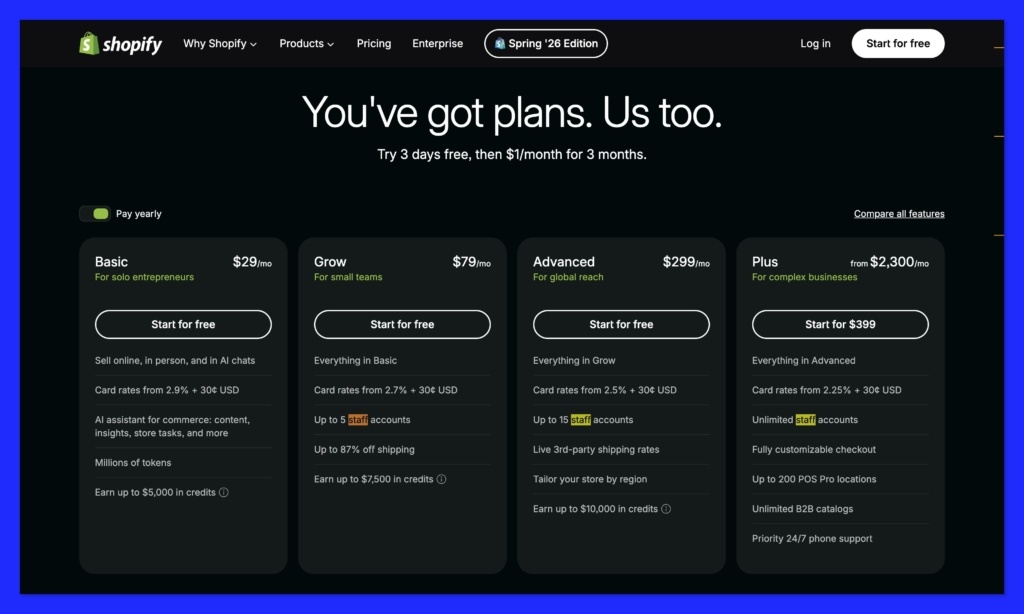
Shopify runs three core plans, with a 25% discount if you pay for the year upfront:
- Basic: $39 per month ($29 per month billed annually). A full store with unlimited products, abandoned cart recovery, and 2.9% + 30c online card rates.
- Grow: $105 per month ($79 per month billed annually). Adds up to 5 staff accounts, standard reports, and lower card rates at 2.7% + 30c.
- Advanced: $399 per month ($299 per month billed annually). Adds up to 15 staff accounts, custom report building, carrier calculated shipping, and the lowest card rates at 2.5% + 30c.
There is also a $5 per month Starter plan, but it only gives you checkout links, not a storefront, and Shopify Plus starting around $2,300 per month on a three year term for enterprise sellers.
Shopify offers a three day free trial, followed by an introductory rate of $1 per month for your first three months. That is a genuinely useful on ramp, because three days is nowhere near long enough to build a store.
One fee worth watching: if you use a third party payment gateway instead of Shopify Payments, Shopify adds a surcharge on top, roughly 2% on Basic, 1% on Grow, and 0.6% on Advanced.
ThriveCart’s Plans
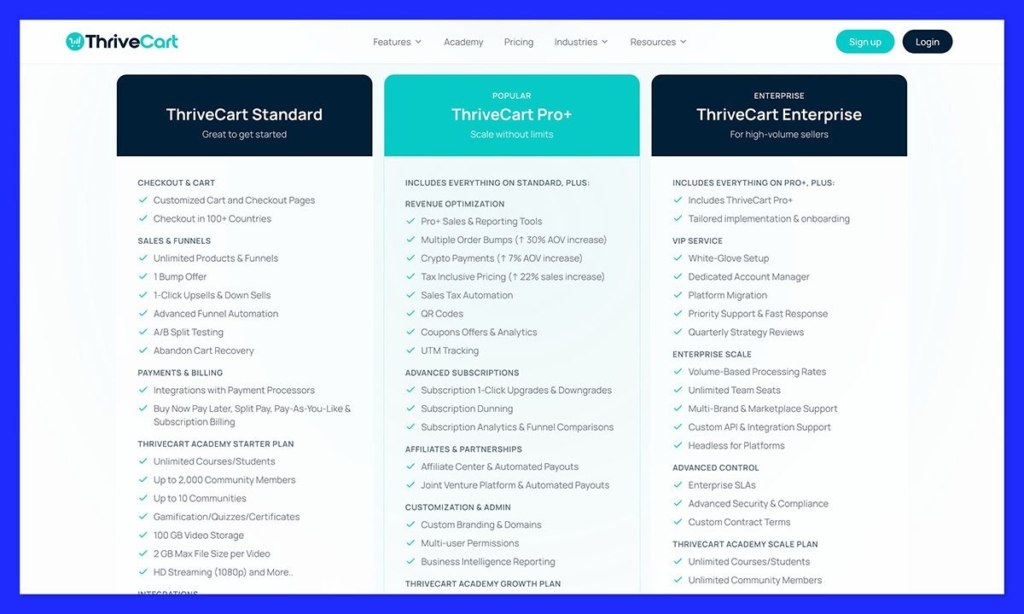
ThriveCart sells lifetime licences rather than subscriptions:
- Standard: $495 one time. Genuinely one time, with no recurring fee. You get unlimited products and funnels, one click upsells and downsells, A/B testing, cart abandonment recovery, and subscription billing.
- Pro+: $790 in year one, then $295 per year. This is the tier most people actually want. It adds affiliate management, subscription dunning, automatic sales tax calculation, custom domains, multiple order bumps, and team access.
- Enterprise: $985 one time, then $295 per year. Bundles Standard, the first year of Pro+, the Learn+ course add on, templates, and training.
The headline that matters most: ThriveCart charges 0% platform transaction fees on every plan. You still pay your processor (Stripe is commonly 2.9% + 30c), but ThriveCart takes no cut of your revenue.
Two caveats worth flagging. The “lifetime” label is only fully accurate on Standard. Pro+ and Ultimate renew at $295 a year from year two. And ThriveCart has no free trial. You pay $495 upfront and rely on the money back guarantee, so read those terms carefully before you commit.
The Real Cost Over Three Years
| Setup | Year 1 | 3 year total |
|---|---|---|
| Shopify Basic (annual) | $348 | $1,044 |
| Shopify Grow (annual) | $948 | $2,844 |
| Shopify Advanced (annual) | $3,588 | $10,764 |
| ThriveCart Standard | $495 | $495 |
| ThriveCart Pro+ | $790 | $1,380 |
Note that these figures exclude payment processing, apps, and themes on both sides. The gap is real, but it is not a like for like comparison, because ThriveCart is not giving you a storefront, a product catalog, or a shipping engine for that money.
The Winner: ThriveCart costs less, and it is not close
A $495 one time payment beats a subscription that never stops, and ThriveCart’s 0% platform fee means it never takes a slice of your sales. Just be honest about whether a checkout tool is all you actually need.
Best for Selling Online: Shopify
Pricing is one thing. What you can actually sell is another, and this is where the two platforms separate hard.
Product and Inventory Management
Shopify was built to run a store. You get a full product catalog with variants, collections, multi location inventory tracking, and unlimited products on every plan. You can manage stock across warehouses, set up real time carrier calculated shipping rates, handle tax, and sync everything with a point of sale system for physical retail.

ThriveCart can technically sell physical goods, and you can add weight and dimensions to a product, but there is no meaningful inventory system and no shipping rate engine. If you are selling anything you have to pick, pack, and post at volume, this is disqualifying.

Payment Options
Shopify connects to over 100 payment methods and has its own native gateway, Shopify Payments, which removes the extra third party transaction fee entirely. That native gateway is the single biggest reason Shopify’s fee structure works out cheaper than it first appears.
ThriveCart has no native payment gateway. It integrates with Stripe, PayPal, and Authorize.net, and that is essentially the list. ThriveCart is explicit that it is not a merchant of record and not a payment processor, which means tax liability and chargebacks land on you rather than on the platform.
Extending the Platform
Shopify’s app store is the largest in ecommerce, with thousands of integrations covering reviews, loyalty, subscriptions, email, search, and everything else. The trade off is that Shopify leans on apps for functionality that arguably should be built in, and many of those apps carry their own monthly fee. It is completely normal for a growing Shopify store to spend more on apps than on the Shopify plan itself.
ThriveCart has no app store. It integrates directly with the major email and membership platforms, and connects to everything else through Zapier and webhooks. Fewer moving parts, but also fewer escape hatches when you need something specific.
The Winner: Shopify is a store, ThriveCart is a checkout
Shopify handles inventory, shipping, taxes, POS, and multichannel selling natively. ThriveCart handles none of that. For anything resembling a traditional ecommerce operation, this is not a close call.
Best for Checkout and Conversion: ThriveCart
Here is where ThriveCart hits back hard. Its entire product is built around squeezing more revenue out of the traffic you already have, and it does that better than Shopify does out of the box.
What ThriveCart Includes Natively
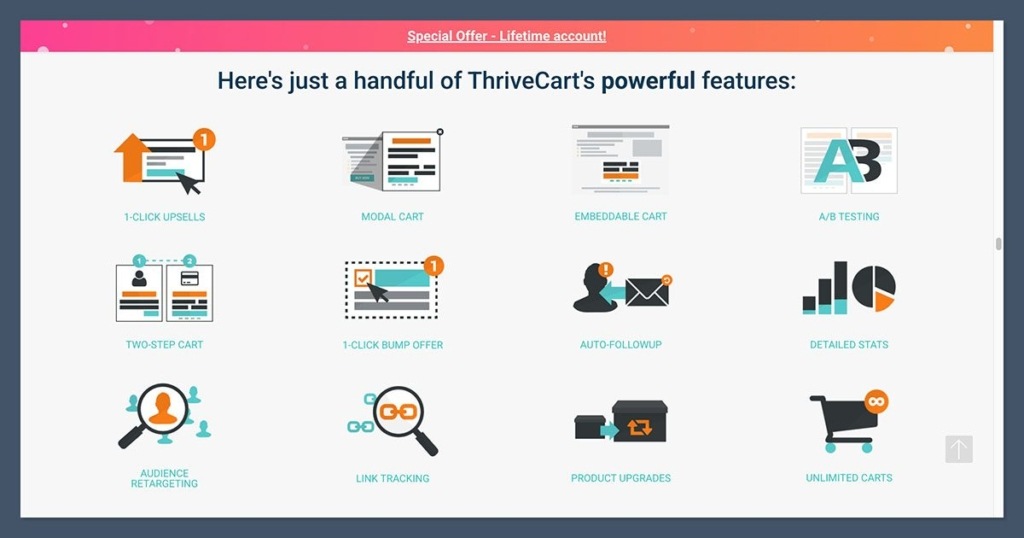
- One click upsells and downsells after the initial purchase, with no re entry of card details
- Order bumps on the checkout page itself (multiple bumps on Pro+)
- A/B split testing on checkout pages, included on Standard
- Cart abandonment recovery and automated follow up
- Subscription billing with payment plans, trials, and prorating
- Affiliate management with a partner portal, cookie tracking, and automated PayPal payouts (Pro+)
- Subscription dunning that retries failed payments and chases expiring cards (Pro+)
To get a comparable stack on Shopify, you are looking at three or four paid apps: an upsell app, an affiliate app, a subscription app, and often a dunning tool. That is easily $100 to $300 a month on top of your plan, every month.
Where Shopify Answers Back
Shopify’s checkout is arguably the best converting checkout in ecommerce, and Shop Pay’s accelerated checkout gives it an advantage that ThriveCart cannot replicate because it draws on Shopify’s shared network of saved customer payment details.
Shopify has also been folding more functionality in natively over time, including free A/B testing and native B2B tools that used to require enterprise plans or paid apps.
The Winner: ThriveCart gives you the conversion stack for free
Upsells, order bumps, affiliates, and dunning are all included rather than sold as separate apps. If your business runs on funnels rather than a browsable catalog, this is a serious advantage.
Best for Marketing Products: Shopify
Getting a checkout page live is one thing. Getting people to it is a completely separate problem, and Shopify has vastly more infrastructure for it.
Multichannel Selling
Shopify syncs your catalog to Instagram, TikTok, Facebook, Google, Amazon, and Etsy, and now syndicates product feeds into AI shopping surfaces including ChatGPT and Perplexity. Your products exist in one place and appear everywhere.
ThriveCart has no equivalent. It sells what you point traffic at. If you want to sell on a marketplace or a social channel, you are doing that somewhere else.
SEO and Content
Because Shopify hosts your storefront, you get product pages, collection pages, and a blog that can all rank in search. Sitemaps, alt text, meta fields, and structured data are all standard. That organic surface area compounds over years.
ThriveCart has no SEO story at all, because there is no site to optimize. Your checkout page is not a page you want ranking. This means you need a separate website (WordPress, Webflow, Squarespace, or similar) sitting in front of it, which is a real cost most ThriveCart comparisons quietly skip.
Email and Affiliates
Shopify includes Shopify Email for basic campaigns and connects to every serious email platform. ThriveCart has no email marketing of its own but integrates with the major ones, and its affiliate centre is genuinely one of the best at this price point, with commission rules, JV contracts, and automated payouts handled in house.
The Winner: Shopify gives you somewhere to send traffic from
Multichannel selling, SEO, a blog, and marketplace syncing are all native. ThriveCart’s affiliate system is excellent, but it assumes you have already solved traffic somewhere else.
Easiest to Use: ThriveCart
This one goes to ThriveCart, but only because it is doing far less.
Getting a ThriveCart checkout live is fast. You pick a template, set your price and payment options, connect Stripe or PayPal, add a bump offer, and publish. There is no theme to configure, no navigation to build, no shipping zones, and no product catalog to structure. Most people have a working checkout in under an hour.
Shopify’s onboarding is more guided but also much longer, because you are building an actual store. It walks you through describing your business, adding products, choosing a theme, and setting up payments and shipping. The setup checklist is genuinely useful, but you should expect days, not hours, before you have something you would be comfortable sending traffic to.
Both use section based editors rather than true drag and drop, which is simple to grasp but restrictive when you want something specific. ThriveCart’s cart editor is also noticeably rigid. If you want a checkout that looks meaningfully different from ThriveCart’s templates, you will hit walls fast.
The Winner: ThriveCart gets you selling faster
A working ThriveCart checkout takes about an hour. A Shopify store takes days. That gap exists because ThriveCart is a smaller product, not because Shopify is badly built.
Best Store Design and Templates: Shopify
This is not a fair fight, because ThriveCart does not really have templates in the way an ecommerce platform does. It has checkout page templates.
Shopify offers more than 190 themes, organized by industry, with around 13 free options including Dawn. Premium themes are a one time purchase, typically in the $100 to $400 range, on top of your subscription. They cover full storefronts: homepages, collection pages, product pages, blogs, and carts.
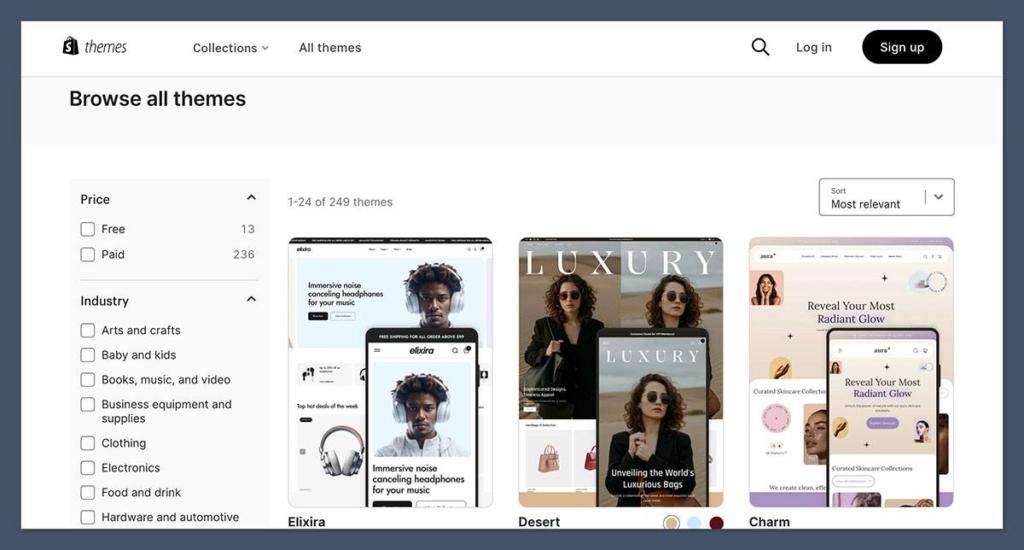
ThriveCart’s templates cover the cart and the funnel pages. They are conversion focused and perfectly functional, but they are not a website. The Ultimate Bundle throws in a pack of premium funnel templates, which is nice but does not change the fundamental scope.
If you buy ThriveCart, budget for a separate website builder to sit in front of it. That is an additional cost, an additional tool to learn, and an additional thing to keep on brand.
The Winner: Shopify designs your entire store, ThriveCart designs your cart
190+ themes covering full storefronts versus checkout page templates. If design and brand experience matter to you, ThriveCart alone will not get you there.
Best for Business Support: Shopify
Support is one of those things you ignore until your checkout breaks on a launch day, and then it is the only thing that matters.
Shopify Support
- 24/7 live chat through the Help Center, with escalation to a human Support Advisor
- 24/7 phone support for Shopify Plus merchants
- An extensive Help Center with guides, video tutorials, courses, and a large community forum
- A huge third party ecosystem of Shopify agencies, freelancers, and experts
- Priority support is reserved for Plus customers, so standard plans wait in the same queue as everyone else
- Email support is no longer offered as a direct channel
ThriveCart Support
- A detailed Helpdesk with written and video tutorials covering most setup topics
- ThriveIQ, an AI assistant that surfaces relevant documentation before you reach a human
- Email and ticket based support, with users commonly reporting replies within several hours to a day
- An active unofficial community of ThriveCart users
- Live chat is a paid add on at $19 per month, which is an unusual thing to charge for on top of a $495 licence
- No phone support at any tier
ThriveCart’s support reviews are genuinely positive on speed and tone, and users regularly single out individual agents. But charging separately for real time human help is a hard thing to defend, especially for a platform whose whole pitch is that you pay once and you are done.
The Winner: Shopify includes 24/7 support without an upcharge
Round the clock chat, a deep Help Center, and an enormous partner ecosystem come standard. ThriveCart’s team is well regarded, but putting live chat behind a $19 per month paywall undercuts the lifetime pricing story.
How We Compared Shopify and ThriveCart
We evaluated both platforms against a weighted set of criteria based on what matters most to people actually selling online. Pricing was verified against live pricing pages and current plan documentation at the time of writing.
| Criteria | Weight | What we looked at |
|---|---|---|
| Sales and checkout features | 30% | Product handling, payment options, upsells, order bumps, subscriptions, cart recovery |
| Value for money | 20% | Plan pricing, transaction fees, processing rates, and total cost over three years |
| Store and website features | 15% | Storefront, SEO, blogging, multichannel selling, inventory, shipping |
| Ease of use | 12% | Signup, onboarding, editor, and time to first live sale |
| Design and templates | 10% | Theme quality, quantity, cost, and customization depth |
| Help and support | 8% | Support channels, documentation quality, response speed, community |
| Ecosystem and integrations | 5% | App stores, native integrations, and third party connections |
A note on pricing accuracy: both platforms adjust pricing and promotions regularly, and ThriveCart’s add on pricing in particular varies between its own pages and partner listings. Always confirm figures on the official pricing page before you buy.
Key Takeaways
- These tools solve different problems. Shopify replaces your entire store. ThriveCart replaces your checkout page.
- ThriveCart is cheaper over a long horizon, because $495 once beats $348 to $3,588 every single year. That maths only works if a checkout page is genuinely all you need.
- Shopify is the only realistic option for physical products, since it handles inventory, variants, shipping rates, taxes, and point of sale natively.
- ThriveCart’s conversion tools are built in, while Shopify makes you install (and often pay for) apps to get one click upsells and order bumps.
- Neither is a bargain at entry. Shopify’s cheapest full store plan is $348 a year. ThriveCart asks for $495 upfront with no trial to soften the risk.
Shopify vs ThriveCart: Our Winner
For ecommerce businesses, Shopify is the winner, and it is not particularly close. It gives you a storefront, a product catalog, inventory management, shipping rates, tax handling, multichannel selling, SEO surface area, and a checkout that converts, all in one subscription. ThriveCart gives you none of that, because it was never trying to.
But ThriveCart is not a worse product. It is a different one, and for the right business it is the better buy.
If you sell a small number of digital products, courses, or coaching packages, if you already have a website you are happy with, and if your growth comes from funnels and affiliates rather than a browsable catalog, then ThriveCart’s $495 one time fee and 0% platform cut are genuinely hard to beat. The conversion tools that Shopify makes you buy as apps are simply included.
The honest way to frame this decision is not “which is better” but “which problem do I have?”
- Choose Shopify if you sell physical products, need inventory and shipping, want your store to rank in search, plan to sell across marketplaces and social channels, or want a single platform that handles everything.
- Choose ThriveCart if you sell digital products or courses, already have a website, want built in affiliate and upsell tools, and want to stop paying monthly software fees.
- Consider both if you run a hybrid business. Plenty of creators run a Shopify store for merchandise and ThriveCart for their course checkout. They are not mutually exclusive.
Because Shopify offers a free trial and a $1 per month introductory period, and ThriveCart asks for $495 upfront with only a money back guarantee, the risk profile of trying each one is very different.
Test Shopify first. It costs you almost nothing to find out.
Frequently Asked Questions
Can ThriveCart replace Shopify?
Not for most ecommerce businesses. ThriveCart has no hosted storefront, no product catalog, no real inventory system, and no shipping rate engine. It can replace Shopify if you sell a small number of digital products and do not need a browsable store, but if you sell physical goods it cannot do the job on its own.
Is ThriveCart really a lifetime deal?
Partly. The Standard plan at $495 is a genuine one time payment with no recurring fee. Pro+ and the Ultimate Bundle renew at $295 per year from year two, so those tiers are not lifetime in the way the marketing implies. If you let Pro+ lapse, you keep Standard access permanently.
Does ThriveCart charge transaction fees?
ThriveCart charges 0% platform transaction fees on every plan. You still pay whatever your payment processor charges, and Stripe is commonly 2.9% + 30c per transaction. One quirk: your ThriveCart dashboard labels those processor fees as a “ThriveCart Application Fee,” which confuses a lot of new users. They are not ThriveCart’s fees.
Does Shopify charge transaction fees?
Only if you use a third party payment gateway. With Shopify Payments you pay just the card rate, from 2.9% + 30c on Basic down to 2.5% + 30c on Advanced. Use an outside gateway and Shopify adds a surcharge on top, roughly 2% on Basic, 1% on Grow, and 0.6% on Advanced.
Which is cheaper, Shopify or ThriveCart?
ThriveCart, over any meaningful time horizon. Shopify Basic costs $348 a year with annual billing, which passes ThriveCart’s $495 one time fee inside 18 months and keeps charging after that. The catch is that you are not buying the same thing, and if ThriveCart forces you to also pay for a separate website builder, the gap narrows.
Can you use Shopify and ThriveCart together?
Yes, and plenty of creators do. A common setup is a Shopify store for physical merchandise and ThriveCart handling checkout for digital products, courses, or high ticket offers where the built in upsell and affiliate tools earn their keep. There is no native integration, so you would connect them through Zapier or webhooks if you needed data flowing between the two.
Does ThriveCart have a free trial?
No. ThriveCart does not offer a free trial or a free plan. Purchases are backed by a money back guarantee instead, so that window is your only evaluation period. Confirm the exact terms at checkout, because the stated length varies across ThriveCart’s own pages and partner listings.
Is Shopify good for selling digital products?
It works, but it is not what Shopify is optimized for. You will need an app for digital delivery, another for courses if you sell them, and more apps still for the upsell and affiliate functionality ThriveCart includes as standard. If digital products are your entire business, ThriveCart is the more natural fit.


