
 By Bogdan Rancea
Shopify and Squarespace are two of the most popular platforms for building an online store, but they serve very different needs.
After spending significant time testing both builders, I can tell you that Shopify is the stronger choice for serious, product-focused ecommerce, while Squarespace is the better fit for design-led sites, simple stores, and creator or service businesses that sell around their content.
Shopify vs Squarespace: Quick Verdict
- Shopify – Best overall for ecommerce and scalable online stores
- Squarespace – Best for design-forward sites with light to moderate selling
In this comparison, I’ll break down how Shopify and Squarespace stack up on pricing, sales features, design, ease of use, and more, so you can figure out which one is right for your business.
Quick Comparison: Shopify vs Squarespace
| Feature | Shopify | Squarespace |
|---|---|---|
| Best for | Product-centric stores, DTC brands, retail | Portfolios, local services, creators, simple stores |
| Entry plan (annual) | From ~$29/month | From ~$16/month |
| Transaction fees | 2.9% + $0.30 (Basic); lower on higher tiers | 0% on most ecommerce plans |
| Product limits | Practically unlimited | Up to ~10,000 products |
| App ecosystem | 8,000+ apps | Smaller extension marketplace |
| Design quality | Strong, conversion-focused themes | Excellent, design-forward templates |
| POS | Full hardware and software ecosystem | Basic via third-party integrations |
| Ease of use | Straightforward but ecommerce-heavy | Easier for beginners and visual builders |
Shopify vs Squarespace: Pros and Cons
Shopify
Pros
- Deep ecommerce functionality built for scale, from small stores to enterprise
- Massive app ecosystem with 8,000+ integrations for almost any use case
- Strong multi-channel and POS support for omnichannel retail
- Best-in-class checkout with Shop Pay and fraud prevention
- Shopify Markets for serious international selling
Cons
- Higher total cost of ownership once apps, themes, and higher tiers are factored in
- Steeper learning curve for users who just want a simple site with light selling
- Design aesthetic leans commercial rather than editorial or portfolio-focused
- Advanced memberships, subscriptions, and courses require paid apps
Squarespace
Pros
- Outstanding design templates and visual editor, best-in-class for non-technical users
- Lower entry-level pricing with more features included natively
- Integrated CMS makes content-heavy sites easy to manage alongside a store
- Strong built-in support for memberships, events, scheduling, and digital products
- AI-assisted SEO tools accessible to non-experts
Cons
- Hard limits on product counts and variants make it unsuitable for large catalogs
- Weaker multi-channel options and less sophisticated inventory management
- No serious equivalent to Shopify’s POS ecosystem for retail
- Smaller app marketplace reduces flexibility for complex ecommerce workflows
Best for Pricing: Squarespace (for Small Budgets)
At the entry level, Squarespace is noticeably more affordable than Shopify, and it bundles more native features into its plans without requiring you to pay for additional apps.
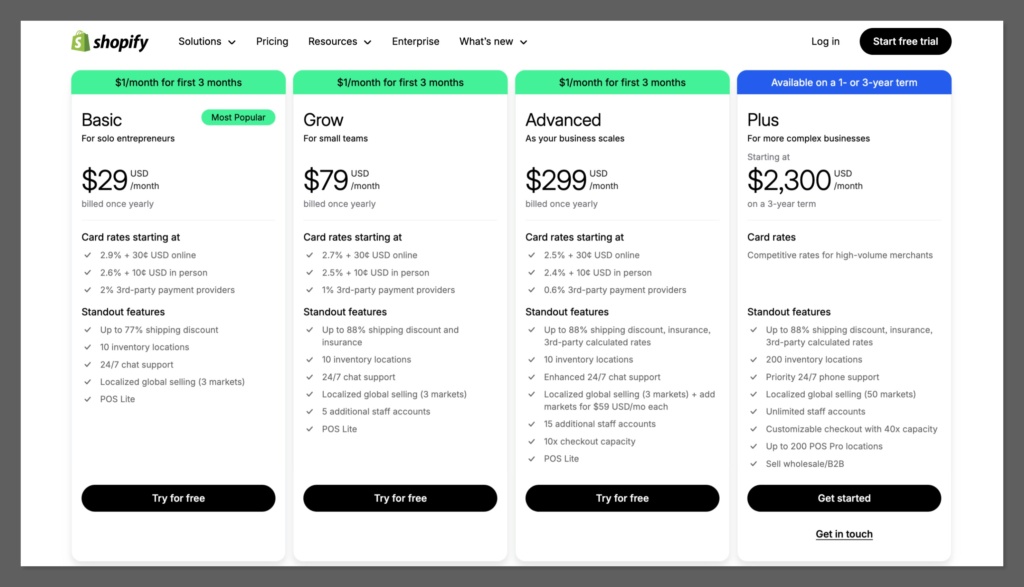
Shopify’s plans (billed annually) run as follows:
- Basic – from around $29/month, aimed at new and small stores
- Grow – from around $79/month
- Advanced – from around $299/month, for scaling and international selling
- Shopify Plus – from $2,300/month for enterprise brands
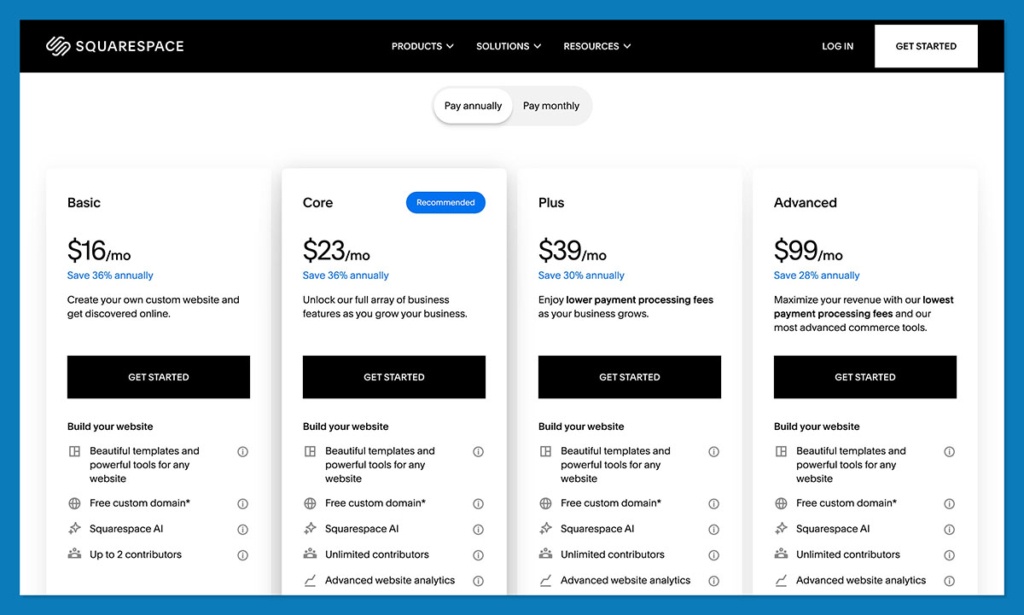
Squarespace’s plans (billed annually) look like this:
- Basic – around $16/month
- Core – around $23/month, the recommended sweet spot for most small businesses
- Plus – around $39/month, with more robust commerce tools
- Advanced – around $49-$99/month for growing stores
On the fees side, Shopify charges card processing rates of around 2.9% + $0.30 per transaction on its Basic plan, dropping to roughly 2.5% + $0.30 on higher tiers.
If you don’t use Shopify Payments, you’ll also pay an additional transaction fee of 0.5-2% depending on your plan. Squarespace has moved to 0% transaction fees on most of its ecommerce-tier plans for physical products, though digital content still carries fees on lower tiers (ranging from 5% down to 0%).
Once you factor in Shopify apps and higher-tier plans, Shopify’s total monthly cost climbs quickly. A realistic small Shopify store typically costs $80-$150/month before advertising, once you add a few apps and a domain. Squarespace tends to stay cheaper upfront for businesses that don’t need deep ecommerce functionality.
That said, Shopify’s lower payment processing fees and better automation can offset the higher subscription cost at larger order volumes.
The Winner
Squarespace wins on entry-level pricing – its plans start lower and include more built-in features. For high-volume stores, Shopify’s fee structure can eventually make it the better value.
Best for Selling Online: Shopify
This is where the gap between the two platforms is most pronounced. Shopify was built from the ground up for ecommerce, and it shows in every layer of the product.
Catalog and Inventory
Shopify supports practically unlimited products across all standard plans, with up to 100 variants per product and up to 2,048 variants on Plus using advanced configurations.
Squarespace caps its catalog at around 10,000 products with roughly 250 variant combinations per item, which is fine for small to medium inventories but can become a constraint for larger operations.
Inventory management also tells a similar story. Shopify includes multi-location stock tracking, stock transfers, and granular inventory controls, while Squarespace is better suited to simpler, single-location setups.
Checkout, Payments, and POS
Shopify’s checkout is one of its clearest differentiators: fast, optimized, and tightly integrated with Shop Pay, fraud prevention tools, and over 100 payment gateway options. You can use Shopify Payments to reduce transaction fees or connect a third-party processor.
Squarespace’s checkout is solid for straightforward stores, but it’s less customizable and not as conversion-optimized as Shopify’s out of the box.
For in-person selling, Shopify has a mature POS ecosystem with dedicated hardware and software for retail stores and pop-ups.
Squarespace supports basic in-person selling through integrations, but it’s not designed to be a unified online and offline retail stack in the same way Shopify is.
Multi-Channel Selling
Shopify includes native integrations with sales channels like Amazon, eBay, Instagram, and TikTok, syncing inventory in real time across platforms. Squarespace can connect to some marketplaces, but typically through third-party apps that add both cost and complexity, and the integrations aren’t as robust.
Product Types
Both platforms support physical products, digital downloads, and services. Squarespace genuinely shines when you need to sell a mix of services, memberships, digital content, and events alongside a content-heavy site.
Shopify can handle the same categories, but often relies on apps for advanced memberships, subscriptions, or courses, which adds to total cost and configuration overhead.
Ecommerce Capability Comparison
| Area | Shopify | Squarespace |
|---|---|---|
| Product limits | Practically unlimited; ~100 variants per product (more on Plus) | Up to ~10,000 products; ~250 variant combinations per item |
| Inventory | Multi-location management, transfers, detailed stock controls | Simpler single-location inventory; fine for small catalogs |
| Checkout | Highly optimized with Shop Pay and anti-fraud tools | Good standard checkout but less customizable |
| POS | Mature hardware and software ecosystem for retail | Basic POS via integrations; not a retail-first stack |
| Multi-channel | Native Amazon, eBay, and social channels with real-time sync | Requires third-party apps for comparable marketplace reach |
The Winner
Shopify wins on sales features – its depth of ecommerce functionality, multi-channel capabilities, and POS support is in a different league for product-focused businesses.
Best for Design and Ease of Use: Squarespace
This is Squarespace’s home turf. The platform has built its reputation on design-forward templates, modern typography, strong image handling, and responsive layouts that work beautifully for portfolios, blogs, restaurants, and studios.
Shopify’s themes have come a long way with Online Store 2.0, but out of the box, they tend toward conversion-oriented storefront patterns rather than the kind of visual polish Squarespace delivers for non-commerce-heavy sites.
Templates
Squarespace’s section-based editor feels intuitive for visually oriented users, with a layout that feels closer to a design canvas than a store builder.

Shopify’s theme editor is more structured around store sections and blocks, which is accessible but clearly prioritizes merchandising over aesthetics.

For non-technical users who want a beautiful site with minimal effort, Squarespace is consistently easier to work with.
Content Management and Blogging
Squarespace offers a genuinely integrated CMS experience: blogging, galleries, landing pages, and static pages all share the same editor, making it easy to build content-heavy sites with light commerce layered on.
Shopify’s CMS has improved, but it still feels secondary to product and collection management. For content-driven sites, it may require extra theme work or apps to reach Squarespace-level editorial polish.
Ease of Use
For pure website building and simple stores, Squarespace is easier for beginners. Shopify’s interface is straightforward but introduces more ecommerce-specific concepts like collections, shipping profiles, tax logic, and discount rules, which steepen the learning curve but pay off if you’re planning to grow a serious store.
The Winner
Squarespace wins on design and ease of use – its templates and editor are consistently rated as more intuitive and aesthetically strong, particularly for non-ecommerce-primary sites.
Best for Marketing and Growth Tools: Shopify
App Ecosystems
Shopify’s App Store has over 8,000 third-party integrations, covering everything from dropshipping and print-on-demand to advanced analytics, loyalty programs, subscriptions, and B2B workflows.
This extensibility is one of Shopify’s biggest advantages for complex or fast-growing stores.
Squarespace has a smaller extension marketplace that covers email marketing, scheduling, booking, and basic analytics, which is sufficient for many small businesses but not remotely on the same scale.
One trade-off worth noting: Shopify relies heavily on its app ecosystem to deliver functionality that Squarespace often includes natively, which means more research time and additional subscription costs for Shopify users.
SEO
Both platforms offer solid SEO fundamentals, including sitemaps, image alt text, and meta tag control. Shopify edges ahead with advanced controls, custom redirects, and proven performance for SEO-heavy stores.
It also partnered with Semrush to create the Ecommerce Booster app, which generates a detailed SEO action plan for merchants.
Squarespace recently introduced AI-assisted SEO tools that scan titles, descriptions, and image alt text to suggest optimizations, making it a practical choice for smaller businesses without dedicated marketing teams.
Built-in Marketing Features
Shopify includes built-in discounting, Shopify Email for campaign creation, and basic automation, though you’ll typically rely on apps for advanced funnels and omnichannel marketing.
Squarespace integrates email campaigns, basic automation, scheduling, and membership features more tightly out of the box, which reduces app dependence for simpler content-driven funnels.
Internationalization
For cross-border commerce, Shopify is the clear winner. Shopify Markets handles multi-currency, multi-language, and duty and tax management at scale. Squarespace now supports automatic VAT calculation at checkout and basic international tax handling, but it lacks Shopify’s full international stack and market-level configuration depth.
Feature and Ecosystem Comparison
| Area | Shopify | Squarespace |
|---|---|---|
| App ecosystem | 8,000+ apps for nearly every ecommerce use case | Smaller set of extensions; enough for simple sites and stores |
| SEO tools | Advanced control, redirects, rich app and theme support | Strong basics plus new AI SEO helper for non-experts |
| AI features | AI-assisted content and store optimization at scale | AI-driven SEO, layout, and copy suggestions for small businesses |
| International selling | Shopify Markets: multi-currency, multi-language, duties and taxes | VAT auto-calculation and basic international support |
| Built-in marketing | Shopify Email, discounts, automation; apps for advanced funnels | Email campaigns, scheduling, and memberships natively included |
The Winner
Shopify wins on marketing and growth tools – its app ecosystem and native multi-channel capabilities are unmatched for businesses planning to scale.
Best for Business Support: Shopify
Both platforms offer 24/7 support, but Shopify’s overall support infrastructure is more comprehensive for most business owners.
Here’s a breakdown of each:
Shopify Support
- 24/7 live chat with the option to escalate to a human Support Advisor for complex queries
- 24/7 phone support for Shopify Plus merchants
- Active social media presence across multiple platforms
- Thorough Help Center with guides, video tutorials, a community forum, and business courses
- Priority support reserved for Plus customers
- Email support has been removed as a contact option
Squarespace Support
- 24/7 live chat available for all customers
- Email support via contact form, though response times aren’t guaranteed
- Help Center with guides, video tutorials, and a community forum
- No equivalent to Shopify’s dedicated merchant success resources at scale
The Winner
Shopify edges ahead on support, its Help Center resources and 24/7 live chat are more robust for businesses dealing with complex ecommerce challenges.
Shopify vs Squarespace: Our Winner
For most businesses building a serious online store, Shopify is the stronger platform. Its ecommerce depth, app ecosystem, payment infrastructure, and multi-channel capabilities are hard to beat, and it scales credibly from a first product to a full retail operation.
That said, Squarespace is genuinely the better choice for a significant portion of online businesses.
If your primary goal is a beautiful, well-designed website where commerce plays a supporting role, if you’re selling services, digital products, or memberships alongside content, or if you’re working with a tighter budget at launch, Squarespace delivers more out of the box at a lower cost.
The honest version of the decision looks like this: if selling is your main activity, go Shopify. If presenting your work, services, or brand is your main activity and selling is a secondary function, go Squarespace.
Both offer free trials, and it’s worth spending time in each admin before committing.


