
 By Bogdan Rancea
Every business owner hates churn, especially when it seems to happen unexpectedly after they’ve spent endless time and resources trying to earn the loyalty of their customers. Once, the only way to figure out what went wrong was to come up with hypotheses about product or customer experience problems and test a few fixes.
Now, churn prediction software can help you get ahead of the issue. That’s an exciting concept, definitely, but the trouble is that there are so many different types of tools that promise to help reduce churn that it can be difficult to know what you actually need.
Some companies might get more from a customer success platform with churn scores built in, while others might want DIY machine learning tools or dedicated churn prediction software.
So here’s a list that compares all of the most compelling options, side by side.
The Best Customer Churn Prediction Software
In general, if you want a convenient AI tool that can help you predict and understand churn, I’d start with Pecan. One of the things that makes it stand out is that it gives you a genuine churn prediction based on historical outcomes, rather than simply calculating a health score based on rules and weights your team defines.
Still, all of these tools have their place in different business setups, as you’ll (hopefully) see in the full reviews below.
| Software | I’d choose it for | How it spots risk |
|---|---|---|
| Pecan AI | Churn prediction based on business insights | Custom models built automatically from your company data |
| Totango Unison | Enterprise churn insights | Custom historical data models or standard models |
| Gainsight | Relationship health and renewal risk | Examines live signals, previous risk data and customer conversations |
| ChurnZero | Using risk to inspire customer service changes | Pre-set scores and machine learning |
| Custify | Churn warnings in conversations | Conversation risk scoring and account health |
| Vitally | Customer health scoring | Configured conditions and simple scores |
| ProfitWell Metrics | Subscription churn analysis | Machine learning model trained on historical data |
| Baremetrics | Cancellation insights | Previous cancellation data plus prediction insights |
| Amazon SageMaker | DIY machine learning churn models | Custom-built models |
How to Choose the Best Churn Prediction Tools
I’d hesitate to tell any company exactly how they should pick churn prediction tools, since they know their priorities much better than I do. Still, I can explain how I ended up with this particular list. I’d look at:
What creates the signal? Does the tool learn from previous churn instances, use AI to read customer behavior, or calculate a score based on rules your business came up with?
How early can it warn you? Some risk scores are based on signals that suggest a customer is already struggling. The better tools should give you enough time to actually do something about the issue.
How detailed are the insights? Can it explain which customers are most at risk, and why they were flagged by the system?
Where does the result go? Will you get alerts in a separate dashboard, or in your CRM, warehouse, or customer support tools?
How complicated is setup? Depending on the tool, do you need historical data, integrations, model training, or ongoing maintenance?
How much does it cost? License price is usually only the beginning. You may have to account for training, custom connections, and configuration too.
It’s also worth keeping an eye out for ongoing updates to all of these tools, as AI and churn prediction capabilities are changing pretty regularly.
1. Pecan AI: Best Overall Churn Prediction Software
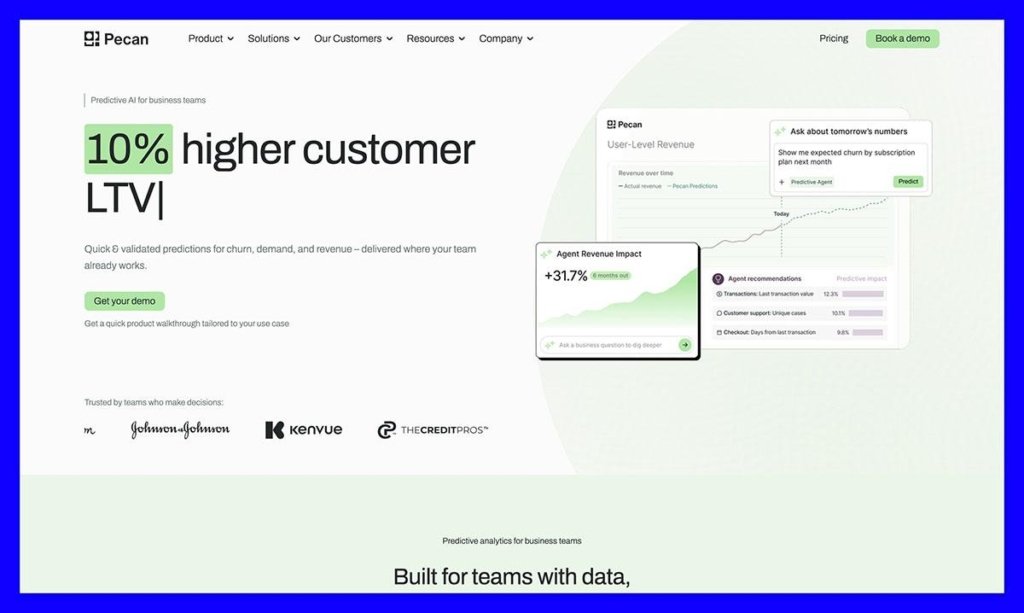
As I said above, Pecan is my first pick because a lot of the tools you’ll see when you search for churn prediction software are actually customer success tools. Pecan is purpose-built for predictive AI, so the focus is on predicting which customers are likely to churn rather than simply giving you health scores or reports about what has already happened.
What’s particularly useful is how much of the setup Pecan handles for you. You give the Predictive AI Agent a specific business question, like “Which currently active customers are most likely to churn in the next 30 days”. The Agent then handles the data preparation, training-set creation, feature engineering, model building, and validation needed to produce predictions.
Pecan can assign a churn likelihood score to individual customers, along with insights into what influenced the prediction, and send those predictions into the tools teams already use, like your CRM. It also complements existing CS platforms like Gainsight or ChurnZero.
On average, Pecan customers already see a 28% reduction in churn. Whistle Express reduced churn by 30% in competitive markets, while Clearwave Fiber cut churn by 20x among customers in its highest-risk segment.
Pros:
Builds custom churn models automatically from your company data
Focuses on predicting future churn, not just customer health
Provides insights into what’s driving churn predictions
Sends scheduled predictions into the tools your teams already use
Automates data preparation, feature engineering, model building, and validation
Cons:
Requires enough historical data to support the prediction
Doesn’t replace a full customer success system
2. Totango Unison: Best for Enterprise Churn Intelligence
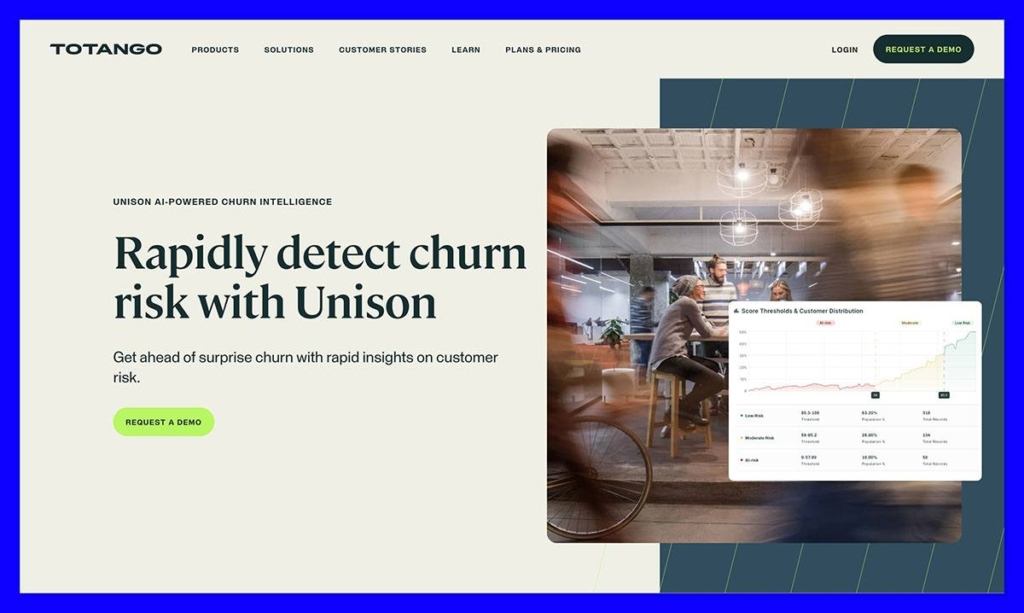
I decided to move Totango higher on this list because Unison goes beyond the standard health scores you often get with customer success platforms. You’ve got two setup options here. You can use the standard AI model, which analyzes engagement data from calls, emails, meetings, and support tickets and scores things like sentiment, engagement, and relationship strength.
Alternatively, you can use the Custom Unison system to build a bespoke churn model based on your available historical data. That takes longer, but it does mean you can end up with more specific insights based on the signals that actually predict churn for your business.
The design of Totango is interesting too, with templates and segmentation solutions that can help you experiment with and scale customer success strategies. The downside is the amount of work involved for teams. Configuration is complicated, and integration maintenance takes a lot of work.
Also, the built-in analytical tools can feel a little restrictive to some, if you have a need for complicated, advanced, or custom reports, you might find yourself exporting data into another tool.
Pros:
You can use a standard model or create your own
Templates and segmentation to help with complex customer success strategies
Suitable for automated workflows and triggers for fast action
Supports bidirectional data syncing with CRMs
Potential for churn prediction and health-scoring in one
Cons:
Custom model creation can take longer
Configuration and maintenance requirements are high
The reports and analytical tools are a little restrictive
3. Gainsight: Best for Relationship Risk and Renewal Intelligence
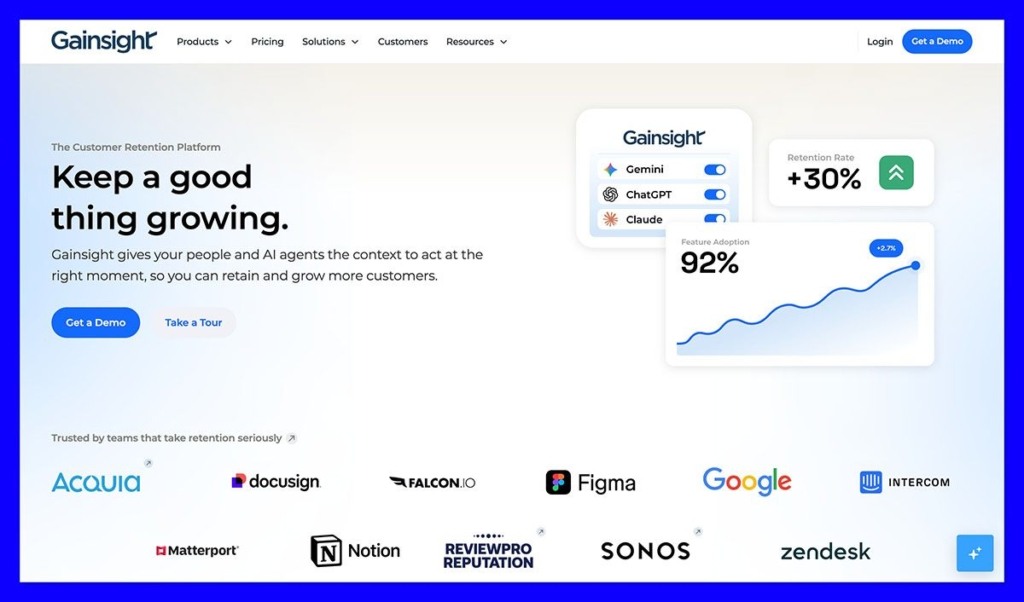
Gainsight is more of a customer success system than a focused churn prediction tool. Still, it deserves serious attention thanks to Risk Analyst, an AI agent inside Staircase AI (which Gainsight acquired in 2024), that can read emails, calls, and tickets for signals. It can also pull up to six months of historical risk data to give you predictions based on what happened in similar accounts.
There are configurable health scorecards you can link to specific segments and accounts, plus a full “Customer 360” solution that helps you spot problems across the business in one place. Companies can also use Gainsight to set up AI agents for retention, or to simply evaluate sentiment or product usage patterns in the background.
Some companies have already earned great outcomes with Gainsight, like Tackle, which says it achieved a 95% renewal forecast accuracy rate. Still, Gainsight is an enterprise-first tool, which means it’s generally more expensive than other software options, has a higher learning curve, and can require a pretty lengthy implementation process.
Pros:
Comprehensive risk analyst agent
AI and automation for agents that support retention
Bi-directional syncing with CRM platforms
Fully configurable health scorecards and customer 360 dashboards
Useful explanations and urgency guidance
Cons:
Time-consuming and expensive to deploy
Somewhat cluttered user interface
May be too much for simple predictions
4. ChurnZero: Best for Turning Churn Risk Into CS Action
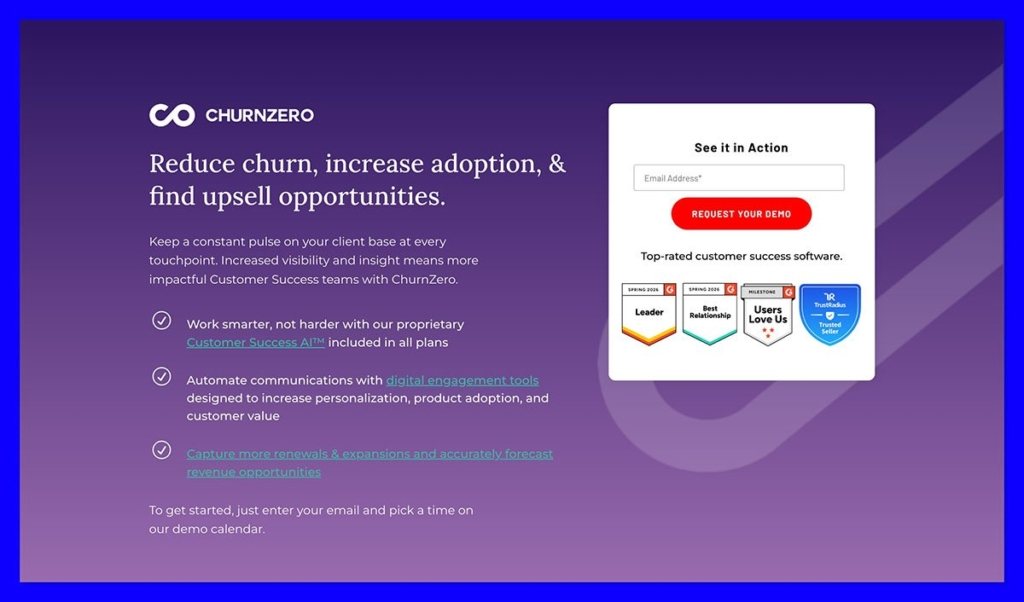
ChurnZero is one of the most highly recommended solutions companies tend to come across when looking for the best churn prediction software. Although it’s technically a customer success platform, it’s designed to help subscription and SaaS businesses generate health scores, predict churn, then create automated workflows to improve retention.
With ChurnZero, teams can use “ChurnScores” to teach the system how healthy a relationship really is based on account attributes, engagement, product usage, or satisfaction data. There’s also “Success Insights”, which adds machine learning to historical data to find factors linked to churn before scanning current accounts for similar patterns.
ChurnZero can categorize risk, flag customers with upcoming renewals, and produce risk reports on a schedule you choose yourself. There’s also the “Plays” tool that lets you build your own processes to reduce the need for manual work. If you don’t want to build everything from scratch, there are fifteen purpose-built AI agents already in the toolkit.
Setup can be a little complicated, taking an average of 4 to 12 weeks, and the huge number of features might mean you need to dedicate extra time to training. Plus, the pricing is typically quite high, starting somewhere around $12,000 per year.
Pros:
Customizable health scoring based on unified data
Excellent automation opportunities through Plays and pre-built agents
Reliable and responsive customer support team
Additional tools to help with things like in-app engagement
Very strong real-time analytics
Cons:
Churn prediction is just one feature in a much larger platform
The pricing is custom (and can be quite expensive)
Takes a significant amount of resources to configure
5. Custify: Best for Conversation-Level AI Churn Signals
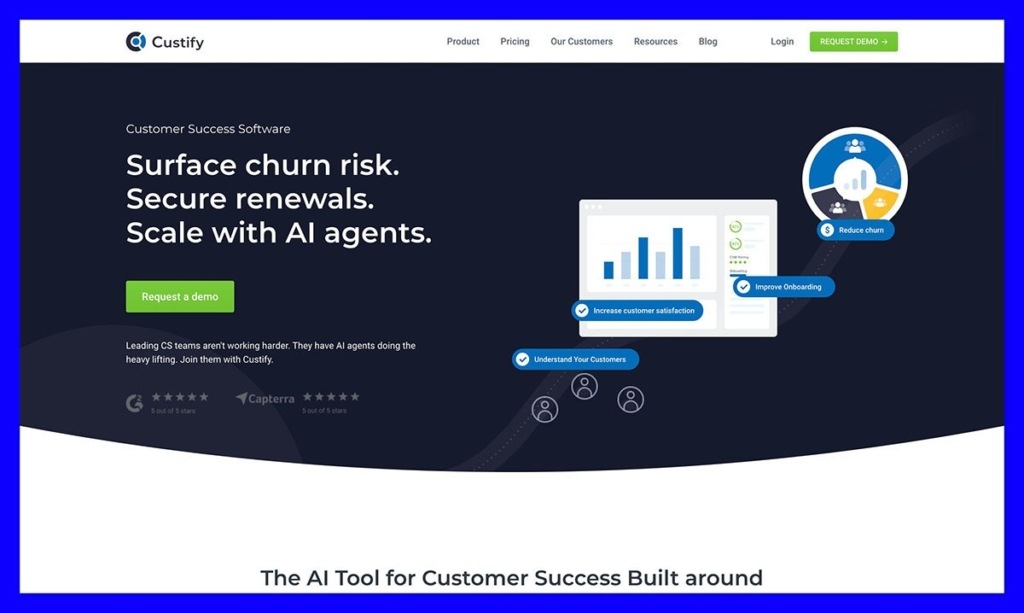
Another customer success platform that can help with churn insights and retention, Custify is designed for B2B SaaS companies that want to bring customer data and conversations together in one place. The platform can connect account data, lifecycle stages, health scores, alerts, and product activity, and also create custom playbooks.
The system can automatically generate a risk score (0-100) for every conversation, considering things like sentiment taken from language or tone. It can also track sentiment over time, and trigger an AI agent to take action when a customer’s sentiment drops or churn risk spikes.
The AI tools are genuinely useful, letting you automate everything from onboarding sequences to renewal reminders. It also helps that this Custify integrates with data warehouses, CRMs, and billing tools, which allows for a much more comprehensive customer profile.
Still, Custify is primarily a customer success platform rather than a dedicated churn prediction tool. Its AI can identify risk in customer conversations and combine those insights with health scores and other customer signals, but that’s different from building a predictive model that calculates the probability of a customer churning within a specific future period.
Pros:
Can score every customer conversation for potential churn risk
Playbooks to automate all kinds of retention tasks
Easy to use for people without a lot of technical knowledge
Great data connections with valuable business tools
Can track customer sentiment over time
Cons:
Reports are limited, and difficult to customize
Initial setup takes time
Conversation risk doesn’t automatically correlate to churn probability
6. Vitally: Best for Flexible Customer Health Scoring
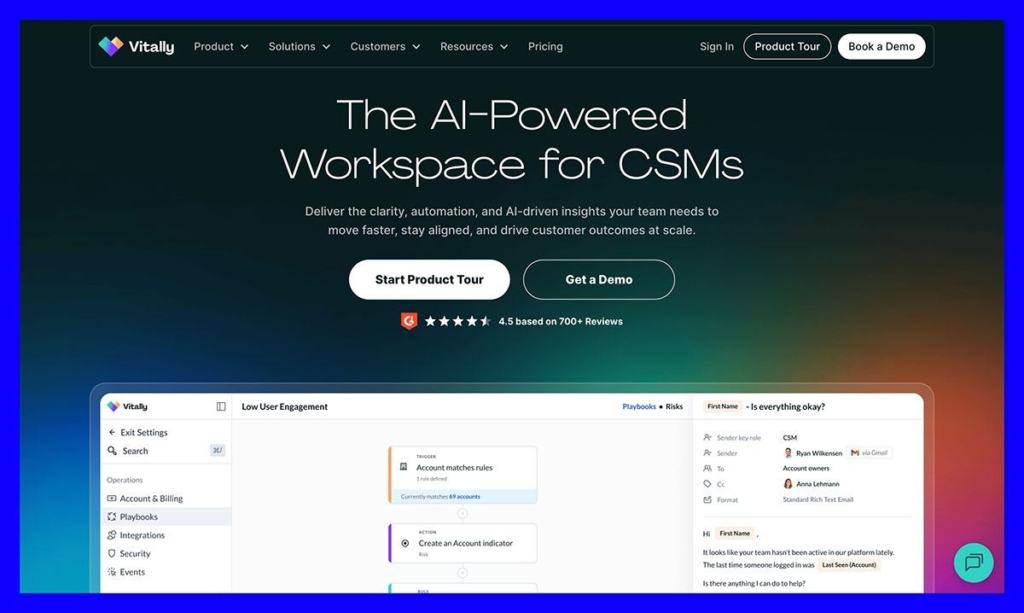
I’d be reluctant to immediately call Vitally one of the “best churn prediction tools”, because it’s more focused on health scores than full churn insights. Like several of the options above, the platform helps to gather risk signals from customer behavior and interactions, so you can decide what kind of retention strategy you’re going to follow.
On the plus side, the real-time health scores are fantastic, with insights pulled from multiple data points from product usage depth to user logins. There’s also a great system in place for teams to collaborate on the same all-in-one customer profile. Plus, the dashboards are fully customizable, so you can decide which metrics need the most focus.
I also like that Vitally can use an external churn forecast as one aspect of your health score, although that does mean you’ll end up using multiple tools together. One possible issue is that your team needs to decide which signals should affect the score and how heavily they should be weighted, rather than relying on a predictive model to determine which factors actually indicate churn.
It can also be a little difficult to set up, especially if you want nuanced and lifecycle-specific scores that differentiate between things like onboarding health or mature account health.
Pros:
Transparent and easy-to-understand real-time health scores
Automated alerts and customizable playbooks
Useful for cross-functional team collaboration
Can use external churn predictions as part of health scores
Different segments can be tracked with different scoring logic
Cons:
Requires a lot of work for initial configuration
Some bias towards product usage metrics
Use-based pricing is difficult to predict
7. ProfitWell Metrics by Paddle: Best for Free Subscription Churn Scoring
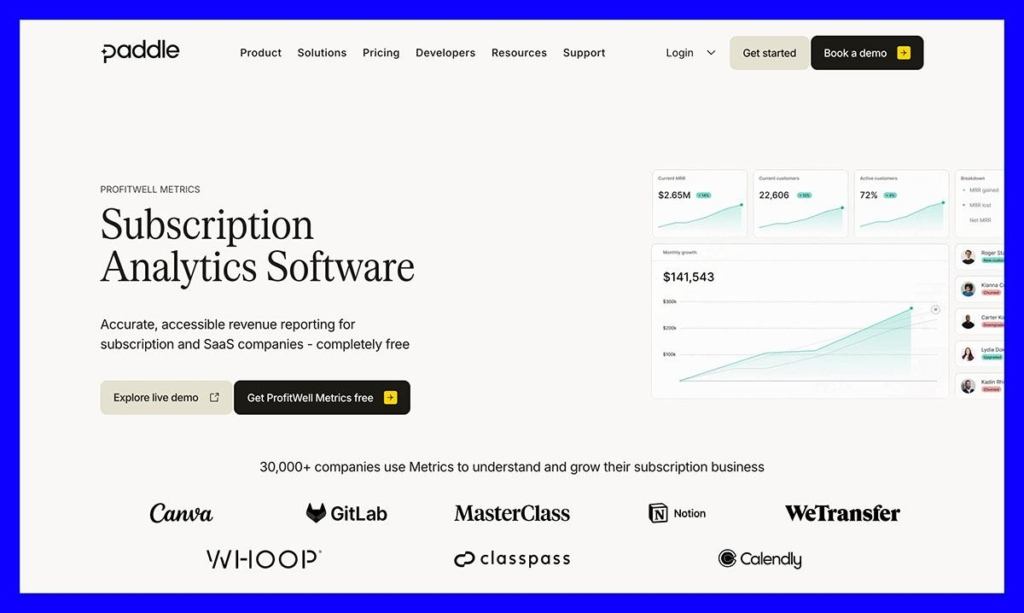
ProfitWell, which is now part of Paddle, gives companies the “Paddle Retain” tool for automatic churn reduction, as well as ProfitWell Metrics for monitoring subscription data. One of the most impressive parts about this tool is that it gives you basic analytics for free, although the churn recovery tool does use performance-based pricing.
ProfitWell’s likelihood-to-churn score is generated by a machine learning model that learns from historical engagement and revenue data. It can assess everything from the age of an account to how often people log in and what they’ve purchased in the past. It can also compare your churn rate against industry benchmarks and help you build automated customer recovery strategies.
As customer churn prediction software goes, ProfitWell is more focused on helping people take action fast. It can even create content in different languages so you can send quick emails out to a global audience. The churn scoring itself is genuinely proactive, flagging at-risk customers before they leave, though the broader toolkit leans more reactive overall, since Retain’s recovery tools only kick in once a payment has already failed or a customer has already started to cancel.
Pros:
Excellent machine-learning-powered health and churn scores
Free analytics tier for basic customer health insights
Daily score updates and monthly model rebuilding
Customer signals to give you more details around risks
Automated recovery options available
Cons:
Focused primarily on subscription businesses
Requires engagement data for the most useful churn scoring
Retain’s recovery tools are reactive rather than predictive
8. Baremetrics: Best for Involuntary Churn and Cancellation Analytics
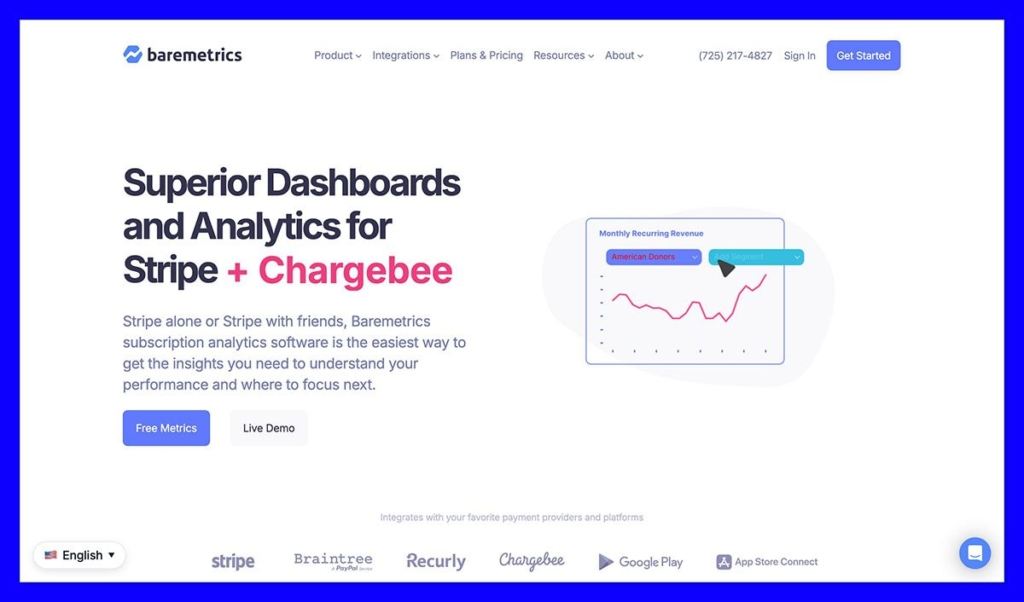
Similar to ProfitWell (Paddle), Baremetrics directs most of its focus towards subscription and software companies. It also concentrates heavily on helping you to understand why someone might have cancelled and taking action when customers are at risk of leaving.
That being said, it does have real-time dashboards that can immediately turn complex subscription metrics into visualizations for a team. There’s also the “Recover” tool, which can automatically dive in to win back a potential customer if someone’s payment failed to go through. According to one report, 119 companies using the tool managed to win back $1,236,764 in total from over 10,000 charges.
Baremetrics can connect with payment gateways and financial tools, and compared to some other options on this list, it can be surprisingly easy to use. The main problem with this tool for me is that it’s still more reactive than proactive. Its tools respond to failed payments and cancellations already in motion, or forecast overall revenue. There’s no individual customer-level churn model that predicts which customers are likely to leave before they act. Plus, the modular pricing means that costs can stack up, since tools like Recover and Cancellation Insights cost extra on top of the core subscription.
Pros:
Excellent for failed payment recovery strategies
Useful insights into cancellation reasons
Easy integrations with existing financial tools and payment gateways
User-friendly interface doesn’t require much technical knowledge
Comprehensive real-time dashboards
Cons:
Reactive approach rather than proactive
Recover and Cancellation Insights cost extra
No individual customer-level churn prediction
9. Amazon SageMaker: Best DIY Churn Prediction Option
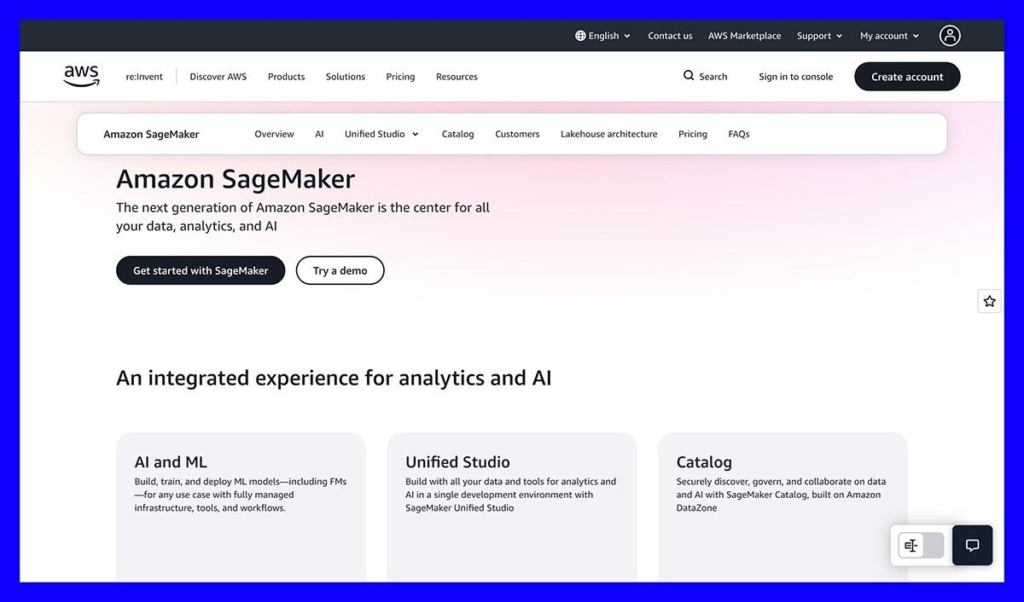
Amazon SageMaker is only last on this list because you have to do a lot more work to get your churn prediction models running. Still, it deserves a fair look, because while most other tools focus on customer success or predefined churn signals, Amazon lets you build a model around exactly what you want to predict.
SageMaker Canvas does make the setup a little easier these days, and you can use customer churn as a two-category prediction use case within it. Canvas can test up to 250 model candidates and choose the strongest performer for you, which can save a lot of time. There’s also the SageMaker Unified Studio if you need to go deeper into customization.
Deployment is incredibly flexible too, letting teams run batch scoring, persistent real-time endpoints, asynchronous jobs, or serverless inference. The big downside is how much work stays with you. Your team has to define what churn means, prepare the right historical data, decide how the model should be used, and determine what happens next.
If you have a well-trained technical team full of engineers and machine learning pros, the level of control AWS gives you is excellent, but that control also makes it a harder purchase for smaller, less experienced teams.
Pros:
You can build entirely custom models based on your own data
Canvas helps with a lower-code route for machine learning
Lots of control over evaluation and deployment
Works well if you’re already invested in AWS products
Lots of built-in algorithms to choose from
Cons:
Your team owns all the setup and maintenance work
Usage-based bills can add up pretty quickly
Can create problems with vendor lock-in
Choosing the Best Churn Prediction Software
It’s hard to give a concrete final verdict here, because as I said before, all of these tools have their own place in improving retention depending on what a business really needs.
Pecan is my top prediction software pick overall because it genuinely focuses on predictions and turning them into action. It’s also one of the simplest and most cost-effective options to get up and running, even if you don’t have a huge engineering team.
Totango is a strong alternative if you want custom modelling inside a bigger customer intelligence tool, while Gainsight is more focused on helping you understand relationship signals. ChurnZero supports teams who need help improving customer success, while ProfitWell is a great free option for initial insights. SageMaker will probably only be your top choice if you want or need to control absolutely everything, and you have the resources to support that.
There isn’t one best retention product overall, in my opinion, Pecan just gives businesses the easiest route from asking who might leave, to acting on the data.
FAQs
What is churn prediction software?
Churn prediction software is a digital tool that helps companies estimate which customers are likely to cancel or stop buying from them. It typically learns from historical customer outcomes and scores current customers against patterns it detects. Some software uses health scores or other risk signals instead, so it’s best to double-check what “prediction” really means.
How does churn prediction work?
Churn prediction really depends on probability. The system looks at customers who have left your business before and what happened before they did, then it compares those patterns to the activity of current customers to estimate how likely they are to leave too. You end up with a label or score that tells you how much risk sits with an account.
What’s the difference between a health score and churn prediction?
A health score typically combines things like product usage, support activity, or engagement into a score based on rules and weights defined by a company. A churn prediction uses historical outcomes to estimate the likelihood of a specific future event. Both can help identify risk, but churn prediction is specifically designed to estimate what’s likely to happen next.
How much customer data do you need to predict churn?
That depends on a lot of things, including how frequently customers churn,your prediction horizon, and how much customer activity you have. There isn’t one minimum amount of historical data that works for every company. What matters is having enough history and enough examples of churn for a model to learn meaningful patterns.
Can churn prediction integrate with customer success platforms?
Usually. Many churn prediction tools can connect with CRM systems, customer success platforms, data warehouses, payment tools, and other systems where customer data lives. Predictions can then be sent into the tools your teams already use, so an AI or human agent can act on them.


