
 By Bogdan Rancea
I’ve been a big fan of Shopify for years now. I know it has its limitations (like any ecommerce platform, really), but you’ll struggle to find anything that can handle scale, customization, and flexibility as well as Shopify. Still, that doesn’t mean I think it’s the best platform for everyone.
If you want to build a serious ecommerce operation, Shopify is probably the right call. But that’s not what most creators are doing these days.
They just want an easy way to monetize, sell merch and subscriptions, and turn their passion into a real business. That’s what Fourthwall offers, and it delivers a lot better than Shopify, if you ask me.
I think, realistically, choosing between Shopify and Fourthwall isn’t about deciding which platform is better. It’s more about asking how much work you actually want to take on.
Fourthwall vs Shopify: Side by Side
Most comparisons of Shopify and Fourthwall are a bit problematic straight away. They’re written as though you’re comparing two different versions of the same thing. Really, you’re not. Both platforms do support ecommerce, that’s true enough, but they’re solving for different problems.
Shopify assumes you want real control, the ability to fine-tune everything from how product pages look, to which apps handle each part of the funnel, and even how taxes are configured. That’s great, if you want managing ecommerce to be your full-time job.

Fourthwall assumes you want as little on your plate as possible. You still get to decide what to sell, how to price it, and how your store looks, but more of the layers are handled for you. You’re not adding apps for subscriptions and memberships, dealing with taxes and customer support manually, or even spending hours trying to track down the best suppliers.

If you look at the platforms side by side, it’s easier to see the big differences.
| Factor | Shopify | Fourthwall |
| What it is | A full ecommerce platform you build on top of | A ready-to-run creator storefront |
| Who it’s for | People running stores full-time | People who don’t want to run a store |
| Monthly cost | Starts at $39/month | $0 |
| What you actually pay | Usually $100–300/month once apps kick in | Nothing until something sells |
| Selling merch | You connect something like Printful or Printify | Already built in, with premium products as standard |
| Digital products / Memberships / Donations | Needs an app | Already there |
| Taxes | You figure it out, or pay someone to | Handled for you (globally) |
| Customer support | Your inbox, your problem | They handle it for you (for their products) |
| Integrations | Pretty much everything | Focused on YouTube, Twitch, TikTok, Discord |
| Setup time | A few hours if you know what you’re doing, longer if you don’t | I had something live in under an hour |
| Learning curve | Steeper than people admit | Hard to mess up |
| Customization | You can change almost anything | You can change enough |
| Scale | Can handle huge brands | Built for creator-level businesses |
Fourthwall vs Shopify: The In-Depth Comparison
I think the easiest way to imagine how you should be looking at Fourthwall and Shopify is to think about who they’re actually intended for. Shopify is the go-to ecommerce platform for people who don’t mind (or actually prefer) running the whole system.
You really do get full control of everything from themes, to product pages, shipping rules, and connected apps. You can even handle omnichannel selling, B2B setups, marketplace connections, custom automated workflows, and point of sale systems.
Fourthwall focuses on a much narrower group: creators who want to make money without taking on another full-time job. It’s an all-in-one platform that already has memberships, digital products, and even POD options built-in. It also gives you more support with taxes and customer service. Basically, you’re building and monetizing a brand, not creating a business to run.
Pricing and Fees: Fourthwall vs Shopify
I know Shopify’s pricing is a big draw for a lot of business owners. Most companies can run for years on the Shopify “Basic” plan for $39 per month. A very small number can make do with the $5 starter plan, but I wouldn’t really recommend that to anyone.
The trouble is that Shopify’s monthly subscription cost isn’t the only fee you need to think about. Look at apps, for instance. Shopify does a lot on its own, but most business owners end up spending more on connectors for email marketing, loyalty programs, membership tools, and even print on demand “premium” subscriptions.
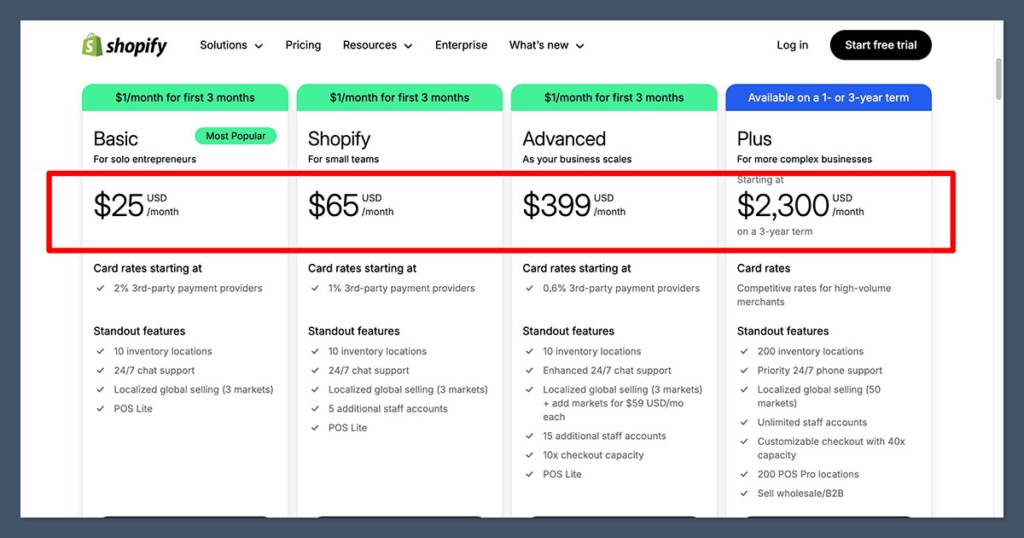
Then there’s the other add-on costs for things like premium theme development, transaction fees (if you’re not using Shopify payments) and expert support for customer service and tax management. Realistically, you can easily end up spending $300+ per month, even on the Basic plan.
Shopify offers a $1/month trial for the first three months, which gives new store owners a low-risk window to test the platform.
Fourthwall skips the teaser pricing entirely: there’s no monthly fee, memberships and POD are built in, and tax compliance is handled for you as your Merchant of Record.
Fourthwall works a bit differently. There’s no monthly fee for the platform, unless you decide to upgrade to the $15 per month Pro plan for extra features and digital product storage. Memberships, digital downloads, and print on demand options are already built-in.
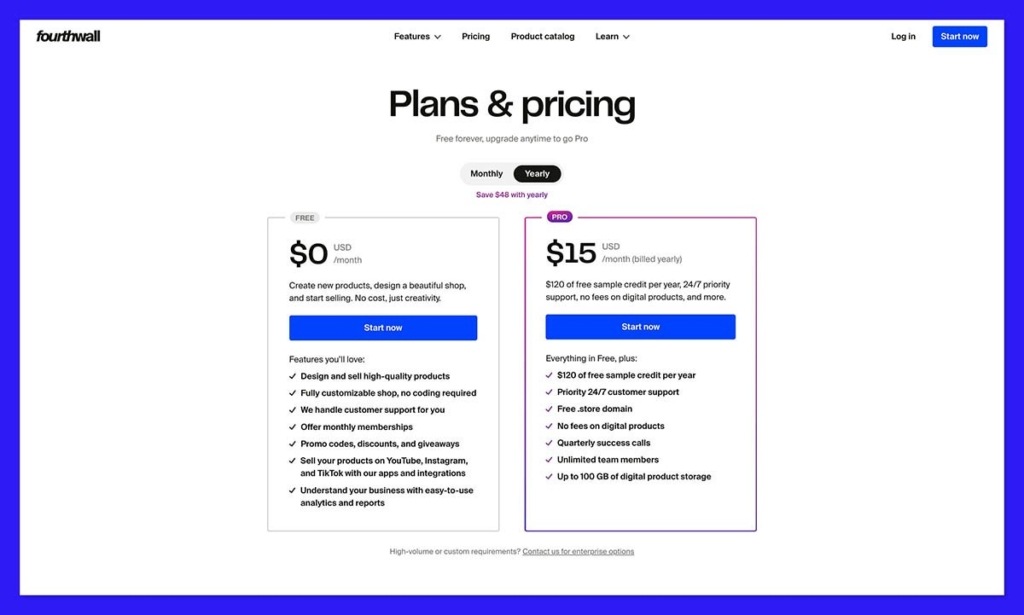
Plus, because Fourthwall acts as your Merchant of Record, you’re not paying another team member to handle tax headaches. Even a portion of customer support is done for you.
Fourthwall still has costs, of course. You still pay for the base cost of POD products, and you still need to handle things like transaction fees, but the number of extra expenses is a lot lower.
Fourthwall vs Shopify: What You’re Actually Managing
I wish more comparisons focused on the work involved with each platform, because I think that really makes the biggest difference to which system you’ll actually stick with.
With Shopify, you’re in charge of everything that sits behind the “buy” button.
That includes:
- Production (through a POD app)
- Order routing
- Returns
- Customer emails
- Tax setup
- App maintenance
That’s all “normal” stuff for someone who goes into this expecting to build and run an ecommerce business; but it’s a lot of work. Fourthwall strips more of that work out of the experience, which I think makes it a lot more valuable for time-pressed creatives.
You still decide what to sell, how your store looks, and what your prices are, but Fourthwall deals with more of the admin work. They’ve already partnered with production teams to source high-quality POD products and custom items you can sell. Fourthwall has already built digital product options, memberships, and subscriptions into the platform too.
Plus, as I said before, they act as your Merchant of Record. You don’t have to handle global taxes, VAT, GST and import rules yourself, or pay extra for Shopify’s Managed Markets to get a bit of help. Fourthwall just does the work for you, collecting sales tax and dealing with compliance in the background.
They also handle aspects of customer service for products they produce. If someone has an issue with an order, they don’t email you. They go through Fourthwall. Shipping delays, damaged items, general questions, it’s handled behind the scenes.
You’re still connected to your audience, obviously. You can still respond to messages, build relationships, all of that. You’re just not acting as a support desk for logistics problems.
Product Quality & Merch Strategy
In theory, you can run the same “types” of business with both Fourthwall and Shopify. Both support you if you want to sell physical products, print on demand items, custom merch, memberships, digital downloads and subscriptions. Although, with Shopify, selling anything other than your own products generally means downloading (and paying for) more apps.

Creators using Shopify usually end up with a huge selection of different systems they need to handle side by side. That’s not impossible to do, it’s just time-consuming, and sometimes expensive.
Fourthwall removes that problem by bringing everything into the same place, from donations, to memberships. It also makes it a lot easier to ensure you’re constantly delivering quality, particularly if you’re investing in print on demand.
Shopify obviously integrates with a lot of the top POD solutions, like Printify, Printful, and Gelato, but it’s up to you to manage quality assurance.
Fourthwall cuts that whole layer down.
You’re not browsing hundreds of supplier options. The catalog’s already narrowed. T-shirts, hoodies, hats, accessories, and a comprehensive “signature” range for real premium quality.
They work directly with production partners, so you’re not playing supplier roulette every time you launch a product. They’ve also built in things like limited drops and pre-orders. That changes how you think about merch. Instead of guessing demand and hoping you got it right, you can test it first. If it sells, great. If it doesn’t, you haven’t committed to anything.

You’re not stuck using just their setup. You can bring in your own products, source things yourself, take it wherever you want. But if you stay within what’s already there, you don’t keep wondering whether the next order is going to come out slightly off compared to the last one.
Storefront, Branding & Control
I said it before, and I’ll say it again, Shopify really does give you more control, and usually more room to scale. You start playing with themes, sections, layouts, and it opens up. If you care about getting every little detail exactly how you want it, Shopify lets you go pretty far down that path.
Still, it’s very easy to get stuck. You start making a few little tweaks and then notice something else stops working. Eventually, you spend a good chunk of your time just making sure everything continues to work together behind the scenes.
Fourthwall might not give you the toolkit you need to build the next Gymshark, but it makes launching a lot easier. You still get to build a site that matches your brand, and you can even dive into headless commerce if you get that far. For most creators though, what matters is that you don’t get stuck in the same feeling of “I could keep tweaking this forever.”
If you’re thinking at a bigger, enterprise level, Shopify does open more doors. But most creator stores don’t need all that. They just need something that looks good, works properly, and loads fast. Especially on mobile, since that’s where most people are coming from anyway.
Fourthwall gives you that without tempting you to get lost in the extra “bells and whistles”.
Integrations & How Sales Actually Happen
This is another place where I think some people automatically assume Shopify is “better”. It has one of the biggest app marketplaces in the world, brimming with options for email marketing, subscriptions, landing pages, upsells and SEO.
That’s all great, but not every company needs all of those extra tools. Creators really just need the basics. You need merch, memberships, and digital product options (Fourthwall already has those built in). If you do want to experiment with integrations, you’re usually looking for opportunities to sell on more of the platforms your customers visit, like YouTube merch shelf, TikTok, or Twitch.
That’s where Fourthwall focuses with its integrations, helping you connect to the extra channels that can increase your revenue, and reduce the friction points in the average buyer journey.
For me, Shopify is great at building a place people go to shop. Fourthwall leans into the places people already are, and lets them buy without leaving that context.
Fourthwall vs Shopify: Setup, Learning Curve & Speed
This part hit me faster than anything else.
With Shopify, you don’t really “launch.” You sort of inch your way there.
You create a store, then you start filling gaps. Add products. Then realize you need a POD app. Install that. Sync it. Test it. Then payments. Then shipping settings. Then taxes, which most people skip at first and circle back to later.
Obviously, a lot of companies manage all of this fine, even if it takes a bit of time (and a lot of effort), and Shopify isn’t really difficult to use once you get used to it. There’s just a lot more to the “set-up” phase than people realize.
Fourthwall seems like it’s actively removing the roadblocks that delay a quick launch. You can sign up, pick a product, add a design, set a price, and have something live and ready to go pretty much immediately.
There’s no moment where you stop and think, “Wait, what am I missing?”
Because most of the things you’d normally have to add later are already there. You’re not connecting anything. You’re just deciding what you want to sell, and diving in.
Fourthwall vs Shopify: The Verdict
I don’t think this is one of those comparisons where you pick a winner and move on. Because really, I’d recommend both of these platforms, just to different people.
If you’re building a complex ecommerce brand, sourcing products, thinking about margins, and hiring people to run your store with you, Shopify is still the top pick.
If you already have an audience, and want to start monetizing the brand you’ve already built with merch, digital products, memberships, and print on demand, Fourthwall is the easier option. It just removes the parts of selling online that most creators don’t want to deal with in the first place.
So that’s my advice. If running an ecommerce business is your goal, Shopify is still great. If you want to have more time to focus on creating, and do less managing behind the scenes, Fourthwall is the better choice.


