
 By Rebekah Carter

The Shopify free trial starts when you create your account, not when your logo and product photos are ready. Prepare those assets before starting the clock.
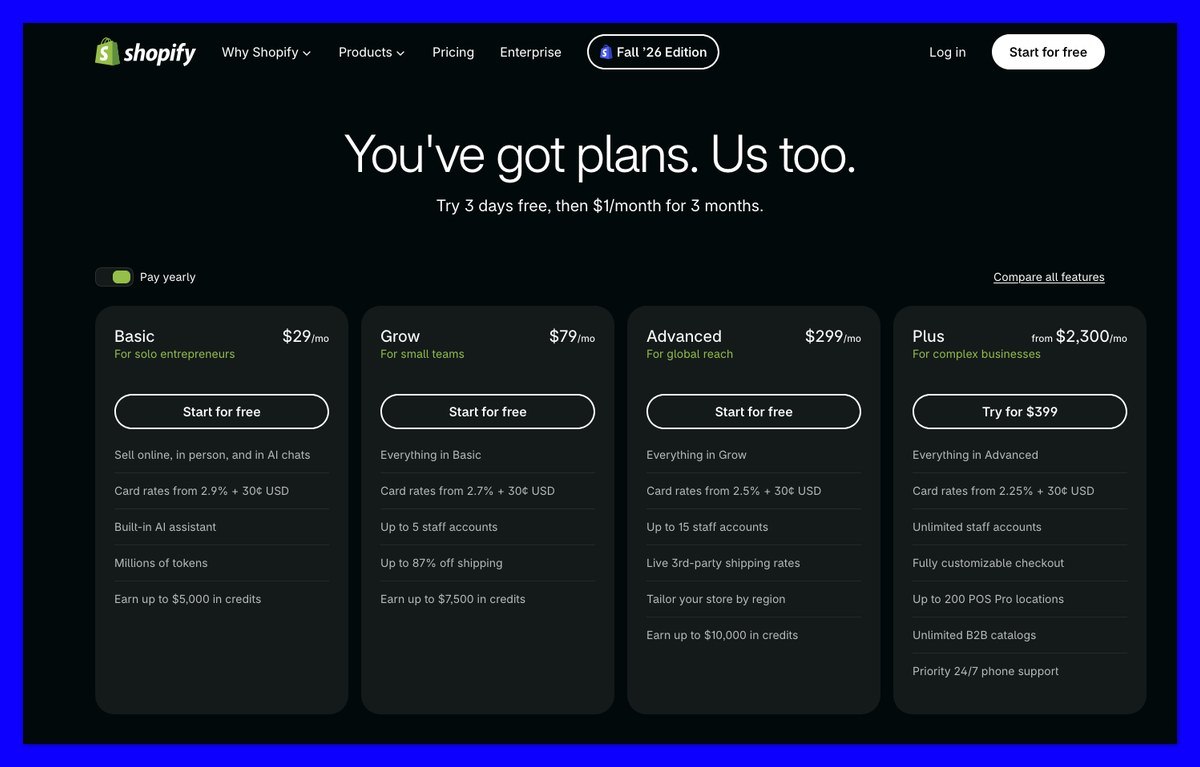
As of November 2026, Shopify’s pricing page offers 3 free days, then $1 a month for 3 months on eligible Basic, Grow or Advanced subscriptions. Use the billing and checkout rules below, followed by a design-led build plan, to finish your storefront before full pricing begins.
Quick answer:
- Length and cost: 3 days free, then $1/month for 3 months. Confirm the promotional period on your plan screen.
- Card: Not required for the free days. Add one when you choose a plan.
- Selling: No customer orders until you select a paid plan and activate checkout. The $1 months support real sales.
- After the promo: Monthly billing automatically becomes $39 for Basic, $105 for Grow or $399 for Advanced.
- If you do nothing: A store without a selected plan freezes after the free days. Your work stays saved, with no subscription charge.
Shopify’s Trial at a Glance: 3 Free Days, $1 Months, Then Full Price
Shopify words the offer two ways. The pricing page says “Try 3 days free, then $1/month for 3 months.” The free-trial headline says “Start for free, keep building for $1/month,” without a month count. The Help Center gives no promotional month count either, so confirm your offer before subscribing.
| Phase | How long | What you pay | Card needed? | Can customers buy? | Test orders? | What ends it |
|---|---|---|---|---|---|---|
| Free trial | 3 days from sign-up | $0 | No | Only after a plan activates checkout | Only after choosing a plan | Day 3: billing starts or store freezes |
| $1 promo | 3 months advertised; confirm your offer | $1/month on Basic, Grow or Advanced | Yes | Yes, with payments configured and password removed | Yes | Your promotional end date |
| Standard pricing | Ongoing | $39 / $105 / $399 monthly | Yes | Yes | Yes | Store deactivation |
Who qualifies and what can change:
- Eligible new merchants: Basic, Grow and Advanced qualify. Plus has a separate trial, not the $1 offer.
- Location: Trial length and promotional pricing can vary by store location. This guide uses USD.
- Sign-up date: In February 2024, Shopify staff explained that offers change; the promotion then lasted one month.
- Extensions: Shopify doesn’t extend or reset the free days or the promotional pricing. “90-day free trial” codes don’t extend the standard offer. A separate route through eligible AI tools or coding partners currently provides a four-month trial.
Before clicking Subscribe, screenshot the promotional price and end date on your plan-selection screen. Check those against your billing settings.
Can You Sell During Shopify’s 3 Free Days? What Works and What Doesn’t
Your admin and theme editor are available immediately, but checkout isn’t. A new trial store starts behind a password page or with checkout inactive: without choosing a paid plan, you can’t accept customer orders or test payments.
Starting the clock
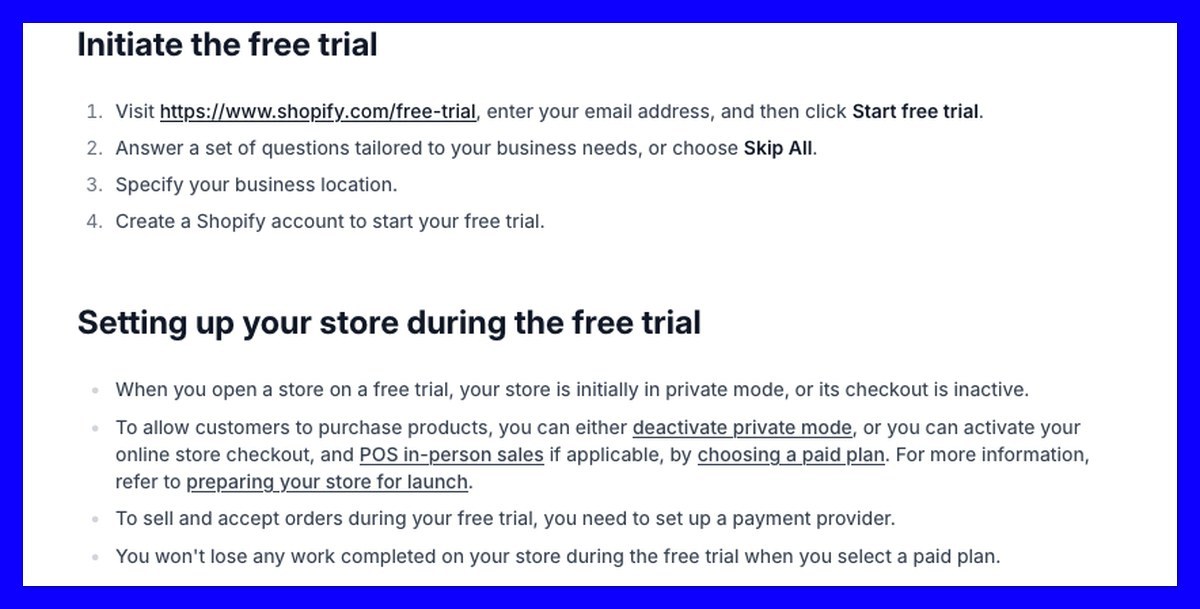
- Open shopify.com/free-trial, enter your email and click Start free trial.
- Answer the setup questions or choose Skip All.
- Set your business location.
- Create your account to start the three-day countdown.
Some sign-up versions show a “Subscribe for $1” card form with a less prominent skip option; consumer-advocacy group TINA.org criticized that layout in 2025. Skip it to start the free days without a credit card, or read the charge timing before subscribing.
What you can and can’t do
You can:
- Build themes: Customize and preview free or paid designs.
- Add content: Create products, collections and pages.
- Set branding: Upload brand assets and style the password page.
- Configure operations: Set up payments, shipping and taxes.
- Install apps: Charges can arrive later, as explained in the costs section.
- Choose a plan: Selecting or changing plans doesn’t remove free days.
You can’t:
- Take orders without a plan: Checkout must first be activated.
- Run test payments without a plan: Shopify requires a paid-plan selection.
- Publish an unpurchased paid theme: Preview access isn’t a license.
- Extend the trial: The standard three-day window cannot be reset.
You can sell during the three-day period if you first choose a paid plan and complete payment setup. Staying on the free trial without a plan doesn’t unlock selling.
When the 3 days run out
- You chose a plan: Billing begins, at the promotional rate if eligible.
- You didn’t: The store freezes with your work preserved. Log in and select a plan to resume.
The Help Center gives no retention deadline for frozen trial stores. One catch: a merchant on the Shopify Community (March 2023) saw the $1 offer during the trial but couldn’t select it once the free days ended.
If you’re continuing, choose your plan on day 2 or 3. If you’re only exploring, let the store freeze.
Shopify $1 for 3 Months: What Unlocks When You Pick a Plan
Choosing a plan during the 3 free days doesn’t shorten them. The plan takes effect immediately, while subscription charges begin when the free days end.
The Shopify $1 for 3 months offer unlocks paid-plan operation, not a fee-free business:
- Checkout: Online-store checkout and POS selling become available.
- Real orders: Configure a payment provider and remove the storefront password before customers buy.
- Test payments: The test gateway becomes available after plan selection.
- Processing fees: US online Shopify Payments rates are 2.9% + $0.30 on Basic, 2.7% + $0.30 on Grow and 2.5% + $0.30 on Advanced, including during the promo.
Switching tiers during the promotion:
- Immediate changes: Your new plan applies immediately.
- Price protection: Covered tiers retain promotional pricing for the remaining period.
- Same deadline: Switching doesn’t restart the promotional clock.
- Proration: Adjustments use the promotional price, not the standard rate.
- Plus exception: Moving to Plus ends promotional eligibility.
The $1 price is billed monthly. If you request annual billing during the promotion, the annual cycle begins afterward, with the full year charged upfront. I’d keep monthly billing initially and confirm the displayed amount before subscribing.
Afterward, standard pricing for your chosen plan and billing cycle applies automatically. Find the exact date in your billing settings.
A merchant on the Shopify Community (February 2024) expected three $1 months but saw a $49 upcoming charge. Staff explained that their offer lasted one month, illustrating why your own billing screen matters.
If you want annual billing, request it in month 3.
What You’ll Pay After the $1 Months (Plans, Credits and Extras in USD)
Basic’s first 12 subscription months cost $354 with the full promotion and monthly billing: $3 + (9 × $39). The equivalent totals are $948 for Grow and $3,594 for Advanced, before extras or processing fees.
These are US prices as of November 2026. Yearly figures are monthly equivalents, paid upfront.
| Plan | First 3 months | Monthly billing after the promo | Yearly billing (per month) | Online card rate (Shopify Payments) | Extra fee with a third-party gateway |
|---|---|---|---|---|---|
| Basic | $1/month | $39 | $29 | 2.9% + $0.30 | 2% |
| Grow | $1/month | $105 | $79 | 2.7% + $0.30 | 1% |
| Advanced | $1/month | $399 | $299 | 2.5% + $0.30 | 0.6% |
Plus starts at $2,300 a month and isn’t included in the $1 promotion. Shopify has shown some US visitors yearly equivalents of $89 for Grow and $359 for Advanced, so check the pricing page on the day you pay.
The full Shopify pricing guide covers the longer-term plan decision.
Credits that can offset subscription costs:
- Shopify Credits: Eligible invited new merchants earn 1% back on Shopify Payments sales, or 0.5% with other gateways, during a six-month promotion beginning with qualifying plan selection. Earnings start after the first $1,000 in sales. Total caps are $5,000 on Basic, $7,500 on Grow and $10,000 on Advanced. Credits cover subscription invoices only and are lost if you cancel.
- Domain credit: Invited merchants can receive the “Add a domain, get $20” offer. Check your invitation’s requirements rather than assuming eligibility.
Extras that land on your first invoice
- Apps: Trial-period charges can appear on your first post-trial invoice. Third-party subscriptions are separate from your plan, and Shopify Support can’t cancel them. Apps can keep billing while a store is frozen, so uninstall unwanted tools. Use our Shopify apps roundup to build a shortlist before you install anything.
- Paid themes: Budget roughly $100 to $500 once per store license. Preview before purchasing: themes are final sale and non-refundable. The guide to one-time Shopify theme purchases explains licensing.
- Domains: A Shopify-purchased .com costs $16 yearly; most domains cost $10 to $20 a year. Renewal is separate from your subscription.
- Email: Shopify Messaging, formerly Shopify Email, includes 10,000 emails monthly on paid plans, then charges $1 per 1,000 at the next usage tier.
- Third-party gateways: The table’s additional fee sits on top of your provider’s processing charges.
Before you sign up, budget for month 4, not just the $3 introductory subscription.
How to Cancel, Pause or Request a Refund on the Shopify Trial
“On the third month I was charged the total $399 price,” reported a merchant on the Shopify Community (July 2023). Staff suggested checking invoice dates: the charge could cover the upcoming billing period.
- Never selected a plan: Let the free days run out. The store freezes without a subscription charge.
- Selected a plan: Deactivate through Settings > Plan before billing begins to avoid subscription charges, or before the first standard-rate invoice to avoid full pricing. Your subscription ends at the current billing cycle’s close after outstanding charges are paid.
- Apps first: Uninstall paid apps before deactivation. Shopify Support can’t cancel third-party app subscriptions.
- Returning later: Shopify retains deactivated store data for two years. Custom domains disconnect and need reconnecting after reactivation.
- Pausing: Pause and Build is closed to new subscriptions. New merchants should use deactivation, as covered in the guide to deleting or pausing a Shopify store.
Subscription fees are generally non-refundable, including promotional charges. Under Shopify’s subscription refund policy, Support reviews eligible requests within these windows from the invoice issue date:
- Monthly subscription: Seven days.
- First invoice after a trial: 30 days.
- Annual subscription: 30 days.
A review doesn’t guarantee a refund. Third-party app refunds must come from the developer, not Shopify.
Set a calendar reminder one week before the promotional end date in your billing settings. Deleting products or abandoning the admin isn’t cancellation.
Shopify’s Free Trial vs Wix, Squarespace, BigCommerce and 4 Other Platforms
The Shopify free trial gives you three days, compared with Squarespace’s 14 and BigCommerce’s 15. Its $3 introductory quarter is inexpensive, but Square Online supports selling without a subscription.
Prices are USD, as of November 2026. Yearly prices are monthly equivalents.
| Platform | Free period | Card to start | Real sales during the free period | Cheapest plan that takes payments |
|---|---|---|---|---|
| Shopify | 3 days, then $1/month for 3 months | No | Only after plan selection | Basic $39/month ($29 yearly) |
| Wix | Free plan; 14-day money-back on first upgrade | No | No | Core $29/month, billed yearly |
| Squarespace | 14 days | No | Check at sign-up | Basic $25/month ($19 yearly), 2% fee; Core $39 ($29 yearly), no store fee |
| BigCommerce | 15 days | No | Yes, with payment provider | Core $39/month ($29 yearly) |
| Ecwid | None listed | n/a | n/a | Starter $5/month, 10 products; confirm at checkout |
| Square Online | Free plan; Plus/Premium trials: 30 days | Check at sign-up | Yes; 3.3% + $0.30 online | $0; Plus $49/month |
| WooCommerce | Free plugin | n/a | Yes, once hosted | Hosting extra; WordPress.com Commerce about $45/month yearly, per price trackers |
| Big Cartel | 7-day Platinum trial; limited free Gold | Check at sign-up | Check at sign-up | Platinum $15/month; limited free Gold |
- Sell during a free trial: BigCommerce allows it. Check BigCommerce’s pricing rules first: open-provider fees are 2%, 1% or 0.6% unless you use an embedded provider, and Core and Growth carry yearly sales caps of $30,000 and $100,000.
- Design before committing: Wix has no free-plan deadline; Squarespace gives 14 days. Compare Shopify and Squarespace.
- Low-cost building: Choose Shopify’s promo for a full store, or Ecwid to add commerce to an existing site.
See the best Shopify alternatives for broader guidance.
The 90-Day Design Plan: What to Prepare Before the Clock Starts
Prepare your assets before you sign up, not while the three-day clock is running.
- Logo files: Prepare a PNG or JPEG at least 512 pixels wide, plus a 512 × 512 version suitable for circular cropping.
- Brand direction: Choose primary, secondary and contrasting colors, plus a one-line slogan.
- Product photos: I’d prepare 10 to 20 shots with consistent backgrounds and proportions.
- Product copy: Collect titles, descriptions, prices and variants in one spreadsheet.
- Business identity: Draft your About text and check domain availability.
| Phase | You pay | Design focus | Done when |
|---|---|---|---|
| Before sign-up | $0 | Assets and copy | Files collected |
| Days 1 to 3 | $0 | Brand, theme, core templates, password page | Core pages previewed; plan decision made |
| Month 1 | $1 | Pages, domain, checkout, tests | Public on your domain |
| Month 2 | $1 | Theme editor, AI blocks, Sidekick, apps | Mobile pages reviewed; unused apps removed |
| Month 3 | $1 | Polish and billing | Plan/cycle selected, or deactivated before full pricing |
These subscription figures assume the complete promotion. For traffic and first-sale tactics, use the guide to making sales during Shopify’s three-month trial.
Days 1 to 3 (Free): Choose a Theme and Lock In Your Brand
Keep the password page enabled while you compare designs. Use the free days to settle choices that affect every page, rather than spending all three days polishing one homepage banner.
Day 1: Brand and theme
- Brand assets first: Open Settings > Brand and add your logos, colors and slogan. Compatible themes pull these assets in automatically. Otherwise, connect them through theme settings.
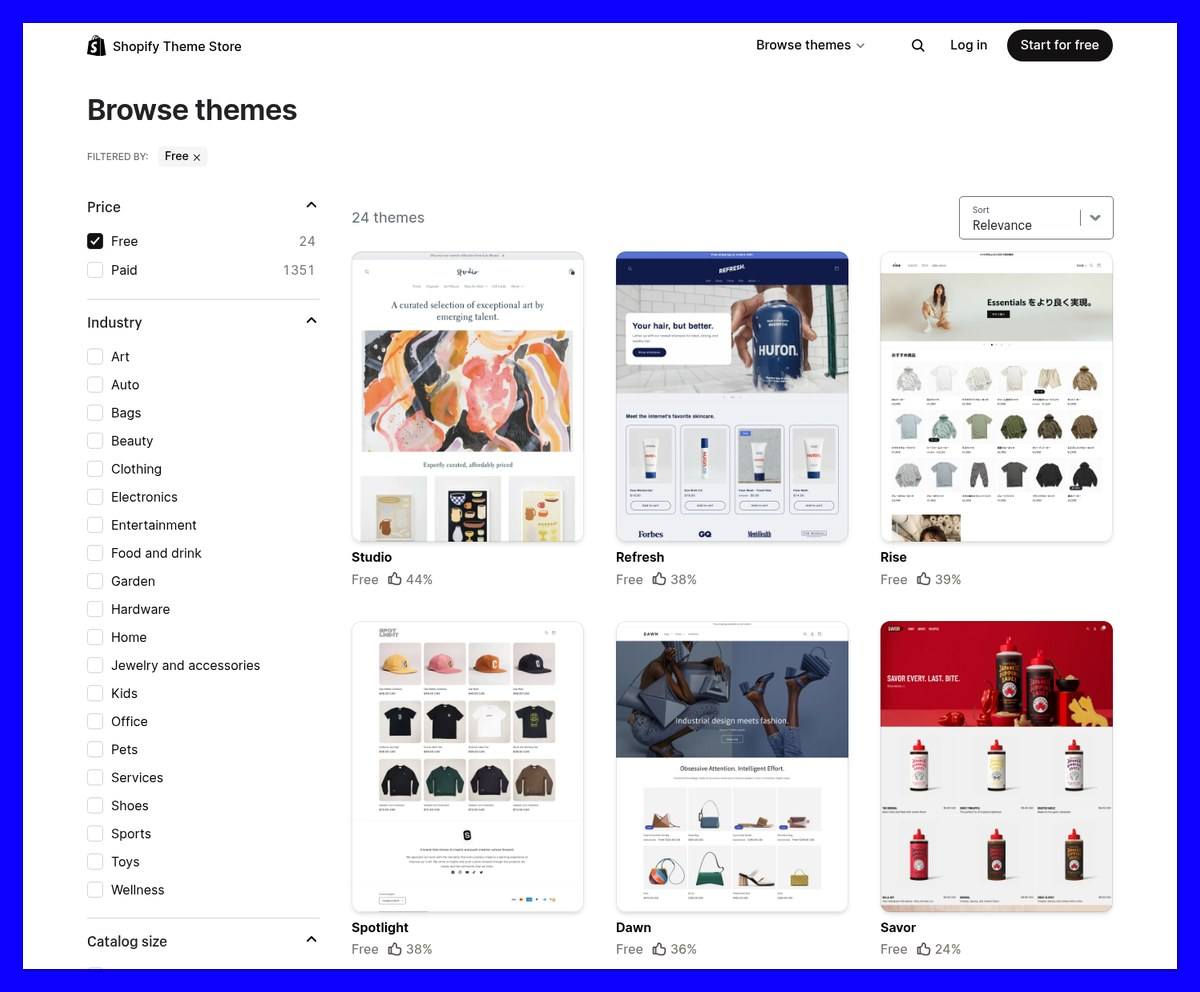
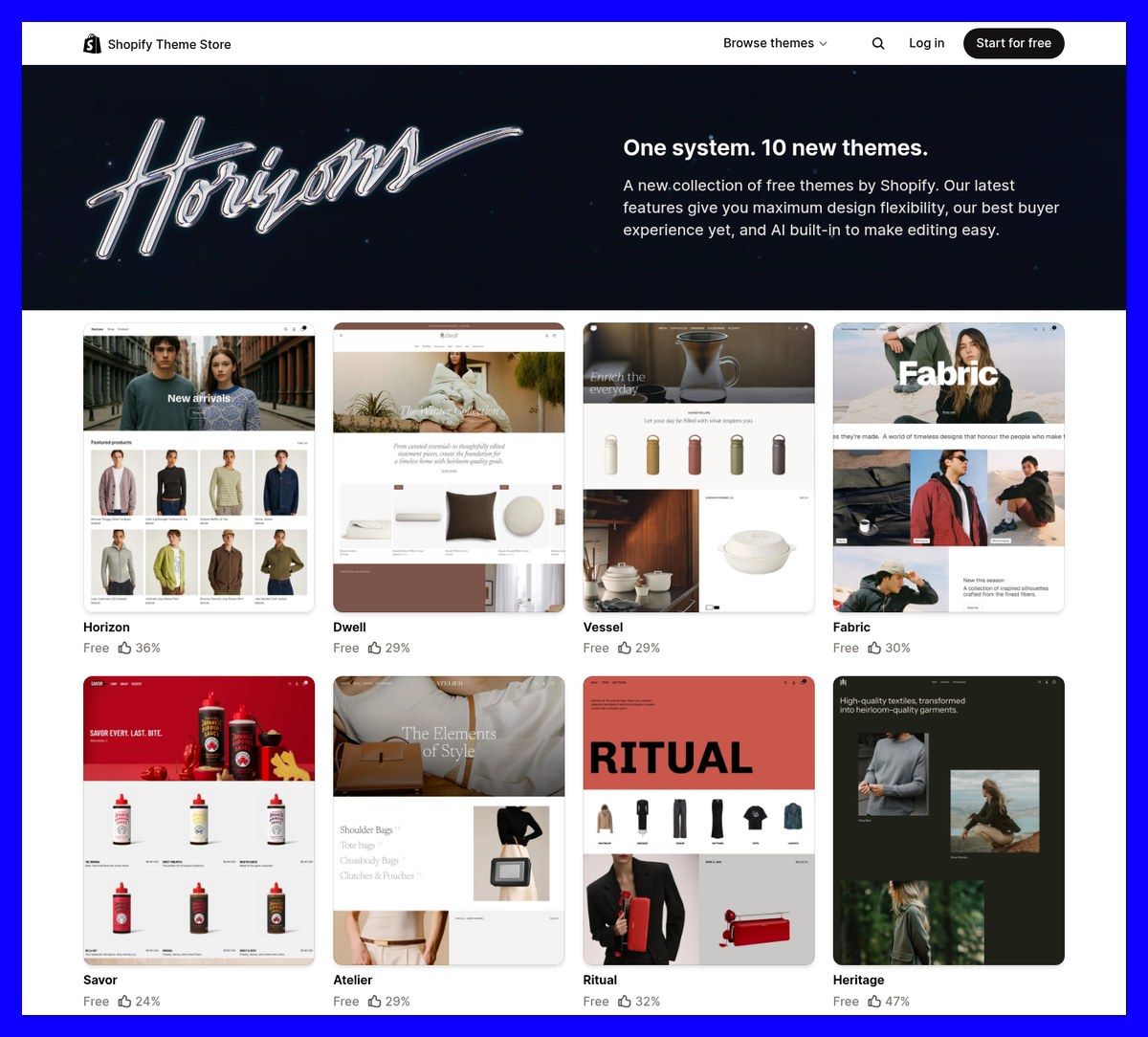
- Free themes: Shopify lists 24 free themes as of November 2026, including 10 in the Horizon family. Compare the best Shopify Horizon themes using your own photography rather than relying on demo imagery.
- Paid theme previews: Customize up to 19 paid themes simultaneously, each marked “Theme trial.” Edits remain if you purchase, but publishing requires payment. Prices are roughly $100 to $500 per store. Use the guide to choosing a Shopify theme to narrow your shortlist.
- AI alternative: Describe your business to generate up to three free personalized themes. Generation works through the Shopify mobile app or admin in a mobile browser, not desktop admin. Results enter your draft themes. Follow the AI store-building guide for the workflow.
Day 2: The three core templates
- Homepage: Establish a clear introduction and route into your collections. Use prepared images so you’re judging the layout with real content.
- Collection page: Check how product cards look together. Consistent image crops matter more than how attractive one isolated photograph looks.
- Product page: Add your prepared catalog, aiming for 10 to 20 products if available. Review longer descriptions and variant choices, not just your simplest item.
- Mobile preview: Inspect all three templates. Shorten headings that dominate the screen and check whether product images remain useful at smaller sizes.
Day 3: Password page and plan decision
- Password page: Customize its header, footer and email signup banner. Its colors and typography follow theme settings, so visitors should see the same visual identity as the upcoming store.
- Plan decision: Choose Basic, Grow or Advanced before the free days expire if you’re continuing. Confirm the promotion on your plan screen; selecting a plan preserves your free days and unlocks test payments. Otherwise, deliberately let the store freeze.
I’d start with a free Horizon theme. Pay for a premium design only when its preview supplies a layout you can’t reasonably create with sections and AI blocks.
Month 1 ($1): Key Pages, Custom Domain, Checkout Look and Launch
A polished homepage doesn’t finish your store if checkout carries a different logo and the confirmation email looks unrelated. Use the first $1 month to align the storefront with the purchasing experience.
- Remaining pages: Finish About, Contact and FAQ pages, plus shipping and returns policies. Add the appropriate main-menu and footer links. I’d check these from the storefront rather than only inside the editor.
- Paid theme: Purchase any previewed theme you intend to publish. Preview access doesn’t permit a live launch.
- Domain: Buy through Shopify or connect an existing domain, then set it as primary. Follow the Shopify domain guide if you’re replacing the initial address.
- Checkout look: Basic and higher plans can use the checkout and accounts editor to add a logo and background color or image, and adjust colors and fonts across checkout, thank-you and order-status pages. Eligible apps can appear on thank-you and order-status pages; apps on information, shipping and payment steps require Plus.
- Separate logos: Set the checkout and notification-email logos separately from Settings > Brand. Don’t assume uploading the main brand asset updates every customer-facing surface.
- Test orders: Use the test payment gateway or Shopify Payments test mode. Simulated orders don’t appear in reports or payouts. Alternatively, place and refund a real order, understanding that processing fees may apply.
Pre-launch checklist:
- Phone review: Open every template on an actual phone.
- Purchase flow: Complete a test order and inspect the confirmation email.
- Brand consistency: Check logos on checkout and notification emails.
- Browser identity: Add your favicon.
- Image descriptions: Write useful alt text for product imagery.
- Policy access: Confirm footer links reach the correct policies.
- Domain security: Check that your primary domain loads with Shopify’s free SSL.
- Public access: Remove the password when checkout and payments are ready.
I’d keep the password enabled until those checks pass, even though your paid plan permits selling earlier. Aim to go public by the end of month 1 with a working purchase flow and complete delivery information, leaving the remaining promotional months for refinement.
Month 2 ($1): Refine the Storefront With the Theme Editor and Sidekick
Could a custom block solve your layout problem without buying another theme? Sidekick’s AI block generation works across every Theme Store theme, not only the Horizon family.
- Theme editor: Rearrange sections and blocks within each template. I’d begin with one consistent template per page type, rather than creating unnecessary variations. The Shopify theme customization guide covers the editing workflow.
- AI blocks: Describe the block you want in plain language, then request revisions if the result misses the brief. Horizon exposes generation through the add-block menu; in most other themes, start from Sidekick. Review the result on mobile before keeping it.
- Sidekick: Rebuilt in Shopify’s Fall ’26 Edition, the assistant handles multi-step tasks and creates product descriptions and images. It presents changes for review before applying them, and Shopify describes it as built into every store.
- Canvas: Whole-store redesign through descriptions is in early access. Treat access as optional, not a requirement for completing your build.
Refinement checklist:
- Product photography: Unify crops across collection cards. I’d fix mismatched image proportions before adding decorative sections.
- Homepage length: Remove sections that repeat the same message. Keep a block only when it adds useful information or a clear route to products.
- Mobile layouts: Revisit collection and product pages after every structural change, not just the homepage.
- App audit: Remove tools you aren’t using before their next invoice. Check whether an existing theme feature already handles the job before paying for another subscription.
Keep the theme you picked in the free days unless a specific limitation prevents your intended layout. I’d use month 2 to improve consistency, not restart around an early-access tool.
Month 3 ($1): Final Polish and the Billing Decision
Your next standard-rate invoice follows the promotional end date, not the day your store feels ready. Use month 3 to decide whether the ongoing subscription fits your budget.
Final polish:
- Homepage hero: Refresh seasonal imagery or dated wording. I’d keep the established layout unless the content needs a different structure.
- Visual consistency: Compare storefront, checkout and confirmation emails together. Align logos and colors, and use matching typography wherever the editor allows.
Make the billing decision:
- Plan: I’d start with Basic for most new stores. Grow costs $66 more monthly, while its online card rate saves 0.2 percentage points. On processing savings alone, that breaks even at about $33,000 in monthly card sales: $66 ÷ 0.002. Other features may justify upgrading earlier.
- Billing cycle: Request annual billing now if you’re committed. It begins after the promo and charges the full year upfront. Basic costs $348 yearly versus $468 across 12 standard monthly payments, saving $120.
- Leaving: Use the cancellation steps above before the promotional end date. Remove unwanted app subscriptions rather than assuming store deactivation handles every bill.
If you’re undecided about the platform rather than the price, review the Shopify pros and cons before committing to a year.
My recommendation: continue on Basic only once you’ve checked the complete recurring budget; choose annual billing only when you’re comfortable paying upfront. The Shopify free trial and $1 months reduce initial subscription costs, not ongoing expenses.
Frequently Asked Questions
Does Shopify still offer a 14-day free trial?
No, Shopify’s standard free trial is three days. Shopify Community staff replies place the previous 14-day offer around late 2022. A separate pandemic-era 90-day trial ran in 2020. The current paid introductory offer is different: three free days followed by promotional $1 months, with eligibility and duration confirmed at sign-up.
Why did Shopify charge me more than $1?
Your promotion may have ended, or your invoice may include app charges. Some sign-up offers lasted less than three months; changing to an ineligible plan can also end the discount. Check the billed period and line items, then contact Support with your store URL, trial dates, expected price and screenshots.
Is the Shopify free trial available outside the US?
Yes, the Shopify free trial is available outside the US, but promotional pricing and trial length can vary by store location. Shopify displays local pricing, while this guide uses USD. Open Shopify’s pricing page from your country, then confirm the promotional duration and subsequent subscription cost before completing plan selection.
Can I open a second store on another free trial?
You can own multiple stores through one Shopify login, but another promotional trial isn’t guaranteed. Each store has its own subscription and bill. Shopify doesn’t document universal second-store eligibility for the free days or $1 offer, so check that store’s plan-selection screen before investing time in its design.
Is there a cheaper Shopify plan than Basic after the trial?
Not for a full online storefront. Basic starts at $39 monthly or $29 per month billed yearly; Starter is closed to new stores. The $0 Agentic plan serves merchants selling through AI channels without Shopify as their ecommerce platform. Its store stays password protected without online-store checkout, and payment processing fees still apply.
Can I use a Shopify development store instead of the trial?
A development store isn’t a substitute for a live merchant subscription. Partner Program development stores support building and testing client stores, but they can’t accept live orders. Transferring one to a client doesn’t include the standard free trial or $1 promotion, so don’t use this route expecting extended discounted selling time.
Can I launch on the free myshopify.com address?
Yes, every Shopify store includes a free myshopify.com address, and you can launch there once your plan and checkout are active. A custom domain can follow later. I’d use one for a more established brand presentation. If you deactivate the store, custom domains disconnect and need reconnecting when you reactivate.


