
 By Bogdan Rancea
When you compare StoreBuild.ai and Atlas across seven ecommerce-focused criteria, the two come out on top for very different reasons. StoreBuild.ai is the stronger pick for a fast, free, finished store, since it hands you a niche shop with products, suppliers, and fulfillment already wired, while Atlas is better suited to one-product stores that you plan to run paid traffic at, because it builds a conversion-focused page around a single item you choose yourself.
Below, I’ve compared both builders for you, using source verification and a close read of every public review, so you get a balanced view rather than the recycled errors that fill most comparisons. Before we start, it’s worth clearing three of those errors out of the way, because they change the whole matchup once you know them.
Atlas does not sell a four-tier ladder of $29, $49, and $99 plans, it sells a single plan at $39 a month, and StoreBuild.ai is not one product but two: a free build funnel at storebuild.ai alongside a separate Shopify app that costs $29.90 a month.
The 1.7/5 rating that keeps appearing next to StoreBuild belongs to an unrelated app with only six reviews, so it tells you nothing about either tool here.
💡 Key Takeaways
- StoreBuild.ai’s core builder is genuinely free because it earns Shopify affiliate commissions rather than charging you, though that free build stops short of the $97 Pro upsell and the $200 AI theme
- Atlas runs on one plan at $39 per month, with a 7-day trial and hard caps of 5 published pages, 5 AI photos, $1,000 in bundle revenue, and 250 cart orders
- Neither tool works without Shopify, so you should budget $1 per month for three months and then $29 to $39 per month on top of everything else
- Atlas carries far more public evidence, at 4.7/5 across 386 Shopify App Store reviews, against StoreBuild’s 4.6/5 across 137 Trustpilot reviews
- You are really choosing between two lock-ins, since StoreBuild ties your sourcing to Zendrop while Atlas ties your design to its Bolt theme
- Both carry documented billing risk, with three Atlas reviewers reporting charges after cancelling and StoreBuild’s $97 upgrade being non-refundable
Why should you trust this comparison?
Rather than repeating figures from other review pages, I checked every price, cap, rating, and feature claim against the companies’ own channels: storebuild.ai and its terms, its Shopify App Store listing, its Trustpilot profile, helloatlas.io, the Atlas listing at apps.shopify.com/dropshipt, Atlas’s own X account, and Shopify’s published pricing.
I put the two head to head across seven criteria, weighting true launch cost most heavily and pricing transparency least, and wherever a claim could not be verified I have labeled it rather than passing it off as fact. Neither company sponsored, reviewed, or approved this comparison.
What changed in this update: I removed the four-tier Atlas price ladder that appears on no official Atlas channel, separated StoreBuild’s free funnel from its paid Shopify app so their ratings no longer blur together, dropped the 1.7/5 rating that belongs to an unrelated app, and relabeled the build-time figures as third-party walkthrough estimates, since no neutral party has run a timed test of either tool.
How Do StoreBuild.ai and Atlas Compare?
For a quick comparison of the two AI store builders, refer to the table below.
| StoreBuild.ai | Atlas: AI Store Builder | |
|---|---|---|
| Public user rating | 4.6/5 (137 Trustpilot) | 4.7/5 (386 App Store) |
| Starting price | $0 for the build funnel | $39/month |
| Free plan or free trial | Free plan, the full build | 7-day trial, no free publishing |
| How products arrive | 10 pre-loaded from Zendrop | You paste a product link |
| Supplier choice | Zendrop only | Any supplier you like |
| Theme | Dawn-based | Atlas Bolt, 35+ sections |
| Customization ceiling | Normal theme editing | Fonts reportedly need CSS |
| AI features | AI store builder AI page and copy generation Up to 10 viral videos Product selection from Zendrop | AI store builder AI product copy 5 AI product photos Automatic market research |
| Shopify plan required | Yes | Yes |
| Advertised build time | 2 to 5 minutes | Under 2 minutes per page |
| Realistic build time | About 50 minutes | 15 to 30 minutes |
| Billing and exit risk | $97 upgrade non-refundable | Charges after cancelling reported |
| Recommended for | Beginners validating a niche on almost no budget | Sellers running paid traffic at one product |
A couple of terms are worth clearing up as we go, since they shape everything below. Dropshipping simply means selling products that a supplier ships directly to your customer for you, and Zendrop is the supplier platform that StoreBuild both runs on and belongs to, which is why your catalog comes from it.
Dawn is Shopify’s free default theme, the base that StoreBuild’s stores are built on, and an in-cart upsell is an extra offer that appears inside the cart to lift your average order value, the kind of thing Atlas’s Bolt theme handles natively.
Is StoreBuild.ai or Atlas Better Value?
StoreBuild.ai is better value on paper, since its core build costs nothing while Atlas asks for a mandatory $39 per month from the start. That said, the sticker price turns out to be the least useful number in this whole comparison, because neither tool is a store on its own, and once you add everything each store genuinely needs, the gap narrows in ways the homepages never mention.
How Much Does StoreBuild.ai Cost?
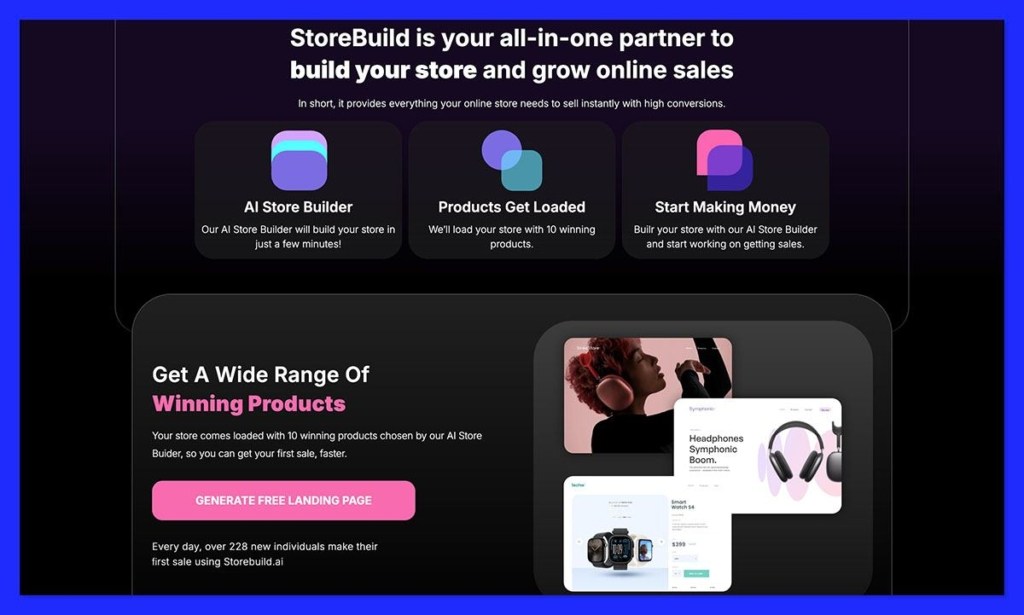
StoreBuild.ai splits into two products at two very different prices, which is the single most confusing thing about it. The free build funnel at storebuild.ai costs nothing and is what most people mean when they say StoreBuild.ai, while the separate Shopify app is a paid tool with its own listing and its own rating.
| Offering | Price | Where it lives | What you get |
|---|---|---|---|
| Free build funnel | $0 | storebuild.ai | 10 Zendrop products, 1 of 5 niches, store pages, up to 10 viral videos, community |
| “Pro” upgrade | $97 once | Upsold inside the funnel | No refunds under any circumstances, binding arbitration under Florida law |
| AI custom theme | $200 | Same page as the “always free” claim | A theme designed by AI |
| App Store Launch plan | $0 | apps.shopify.com/storebuildai | 1 AI product page, AI chat builder, trending products |
| App Store Builder plan | $29.90/mo | Same listing | 3 pages per cycle, dedicated support, 3-day trial |
The one figure to treat with caution is the $97 Pro upgrade, because its terms are unusually strict, stating that no refunds will be issued under any circumstances and that disputes go to binding arbitration under Florida law. That does not make it a bad deal, but it does mean you should decide whether you want it before you pay, since you cannot change your mind afterward.
How Much Does Atlas Cost?
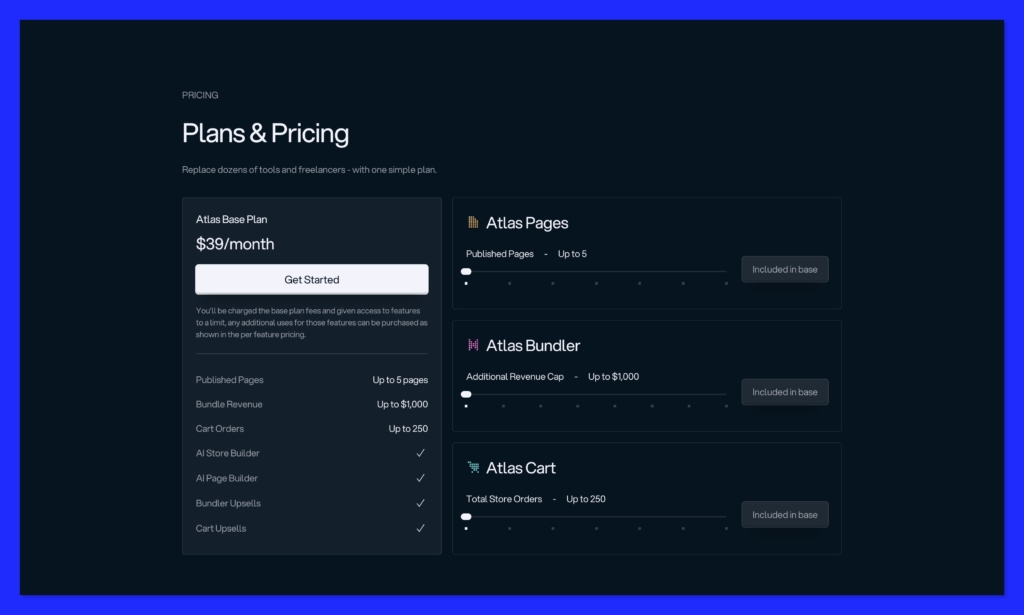
Atlas keeps things simpler, with a single paid plan rather than the ladder you will see quoted elsewhere. The catch is not the price but the caps, because the $39 plan meters your usage and Atlas does not publish what you pay once you cross those limits.
| Plan | Monthly price | Trial | What caps you |
|---|---|---|---|
| Development stores | Free | n/a | Preview only, no live publishing |
| All-in-One | $39 plus overages | 7 days | 5 published pages, 5 AI photos, $1,000 bundle revenue, 250 cart orders |
| Beyond the caps | Usage-based overages | n/a | Atlas publishes no overage rates |
Three official channels show that same single-plan structure, namely helloatlas.io, the Shopify App Store listing, and Atlas’s own X account, so if you find a page quoting Basic, Starter, Pro, and Expert tiers with a one-time theme fee, treat it as unverified. Atlas sells one plan, and the free development-store tier exists only for previewing, since it cannot publish a live store at all.
What Does It Really Cost to Launch?
Over the first 90 days, StoreBuild.ai can come in under $5 and Atlas around $120, but only if you decline every upsell on both sides. The reason the two look so far apart is that StoreBuild’s path leans entirely on free tiers while Atlas charges from month one, so the honest way to see it is to lay both paths side by side with Shopify included, since that subscription is unavoidable either way.
| Your first 90 days | StoreBuild.ai path | Atlas path |
|---|---|---|
| Shopify ($1 x 3 promo months) | $3 | $3 |
| Store builder | $0 | $78 to $117 |
| Fulfillment on the free tier | $0 | $0 |
| Baseline 90-day total | $3 | $81 to $120 |
| Add automated fulfillment (Zendrop Pro, $49/mo) | About $150 | n/a |
| Add the $97 Pro upgrade on top | About $247 | n/a |
| Exceed 250 cart orders or $1,000 bundle revenue | n/a | Real overages, not publicly priced |
Once Shopify’s promo ends in month four, the picture settles into a steadier monthly floor. StoreBuild with Zendrop’s free tier costs $29 to $39 a month, all of it Shopify, and moving to Zendrop Pro for automated fulfillment lifts that to roughly $78 to $88. Atlas with your own supplier lands at about $68 to $78 a month before any overages, which makes the two much closer than the free-versus-$39 framing suggests.
Keep in mind that every figure here excludes product cost, shipping, and ad spend, which are the largest numbers in dropshipping by a wide margin. Shopify’s $1-for-three-months promo is available to new merchants only and follows a 3-day trial, and the roughly $2.50-per-order Zendrop cost that circulates in reviews is a third-party estimate rather than a published line item.
Author’s notes…
The cheapest genuine path I found is to validate a product with StoreBuild’s free build and Shopify’s $1 promo, spend nothing else for the first 30 days, and only then decide whether the idea deserves a paid tool. That turns the $3 you might spend into a real product test rather than a subscription you are talking yourself into.
Who Actually Pays for Each Builder?
The real choice here is not $0 versus $39, it is whether you would rather be locked to one supplier or locked to one theme, and understanding who funds each tool makes that clearer. If StoreBuild charges you nothing and takes no cut of your sales, someone else has to be paying, and that someone is Shopify.
StoreBuild states that its revenue comes from Shopify affiliate commissions rather than from users, which means Shopify pays StoreBuild whenever you sign up through its link, and you keep all of your own profits.
The site brands itself as a Zendrop company, operating through Consumer Products Innovations LLC in West Palm Beach, Florida, and because your 10 products come exclusively from Zendrop’s catalog, both of StoreBuild’s revenue paths run through your store. Atlas takes the plainer route of charging you $39 a month directly, which makes you the paying customer and leaves no third party with a stake in where you source from.
| Question | StoreBuild.ai | Atlas |
|---|---|---|
| Who pays | Shopify, via affiliate commission | You, $39/month |
| What the company earns from you | Your signup, plus Zendrop volume | Subscription plus overages |
| What you are locked into | Your supplier | Your theme |
| What survives if you leave | The store, minus its sourcing | Your products, minus Bolt’s sections |
| Incentive risk | Sourcing steered to one catalog | Pressure to publish more pages |
Weighed against each other, the theme lock-in is the cheaper one to escape, since you can swap a Shopify theme in an afternoon, whereas a supplier relationship is baked into every product page you build. That makes Atlas the safer bet on lock-in alone, even though it costs more up front.
How Long Does Each Build Really Take?
StoreBuild.ai gets you live faster, but neither company’s “minutes” claim survives contact with a store you would actually send paying traffic to.
StoreBuild advertises a two-minute build and a live store in under five, yet the only detailed published walkthrough puts the realistic figure closer to 50 minutes, which is a gap of roughly tenfold once you account for payments, shipping, and copy that does not read as templated.
| What each claim measures | StoreBuild.ai | Atlas |
|---|---|---|
| Vendor claim | “2 minutes,” “under 5 minutes” | “Under 2.0 mins” per page, “40+ hours saved” |
| What that figure covers | AI generation only | Page generation only |
| Third-party walkthrough estimate | About 50 minutes | 15 to 30 minutes |
| What you still do yourself | Payments, shipping, templated copy | Product research, sourcing, copy edits |
| What blocks publishing | Shopify signup and payments | The $39 plan, free tier cannot publish |
Both estimates come with an owner rather than a stopwatch, since no neutral party has timed either tool, so read them as informed claims rather than measured results.
Even so, the shape is believable, because StoreBuild removes the two slowest beginner steps by pre-loading products and wiring fulfillment, whereas Atlas still asks you to research and source the product before it can build anything.
How Do You Build a Store With StoreBuild.ai?
The StoreBuild flow is short by design. You pick one of five niches, being Clothing, Pets, Tech, House, or Sports, and the AI pre-loads 10 products from Zendrop with fulfillment already synced, then generates your homepage, collection, policy, and contact pages and assigns up to 10 viral videos you can use as ad creative. Signing up for Shopify through StoreBuild’s affiliate link is the final step, and at that point your store is live.
How Do You Build a Store With Atlas?
Atlas asks a little more of you, but gives you more control in return. You install the app from its Shopify listing, paste a product link from AliExpress, Amazon, Alibaba, or Shopify, and Atlas analyzes that product, runs market research on it, and generates your homepage, product pages, collections, and sections.
You then configure bundles and in-cart upsells directly in the theme before publishing, which is the point where the paid plan becomes mandatory.
Top Tip 💡 If your budget is the deciding factor, start with StoreBuild’s free build and Shopify’s $1 promo to prove a product works, and only move that product onto Atlas once it shows real traction. Treating the two as a sequence rather than an either-or gets you the cheapest validation and the better-converting page, in that order.
What Does the AI Actually Build?
Atlas builds the better-converting page while StoreBuild builds the more finished store, and the trade-off worth naming up front is that both produce stores that look a great deal like everyone else’s. No vendor page warns you about this, but the AI is not building a store uniquely for you, it is building the same store it has already built for thousands of other merchants, so your differentiation has to come from somewhere the AI never touches.
What Does Atlas Generate?
Atlas centers everything on its Bolt theme, which is built from scratch rather than modified from Dawn and ships with more than 35 customizable sections. Those sections are where its value sits, since the conversion tools that normally cost you separate apps are built in from the start:
- Hero banners, testimonial blocks, FAQ accordions, and feature grids for the storefront
- Urgency timers, upsell blocks, and bundle offers aimed squarely at average order value
- AI-written product copy generated from your pasted link, which reviewers describe as generic rather than persona-targeted
- Up to five AI-generated product images on the base plan
- Automatic market research on the product you imported
The obvious cost of all that polish is uniformity, because every Atlas merchant is running the same theme, so your store shares its skeleton with a great many others.
What Does StoreBuild.ai Generate?
StoreBuild’s output is less about the page and more about the catalog, since it stocks the store as well as designing it:
- 10 AI-selected products from Zendrop, with suppliers, inventory, and fulfillment already synced
- One of five fixed niches, being Clothing, Pets, Tech, House, or Sports
- A homepage plus collection, policy, and contact pages
- Up to 10 customer-made viral videos, which is the one asset neither Atlas nor a manual build gives you
- A milestone-based private community with mentor access and live sessions
- A $200 AI-designed custom theme, sold separately if the default is not enough
The niche list is a genuine constraint rather than a footnote, since a store outside those five categories simply cannot be built here. One merchant made exactly that point after installing the app, spending two minutes in it, and leaving a review that read “didn’t have a health and beauty niche, uninstalling.” In short, Atlas’s sameness is visual while StoreBuild’s sameness is inventory, and either way the parts that make you distinct are your offer, your creative, and your angle.
What Do 526 Real User Reviews Say?
Atlas has more public review evidence than StoreBuild.ai across every channel, and the complaints on both sides are specific, dated, and worth reading before you commit. The first thing to correct is that 1.7/5 rating, because it sits next to StoreBuild.ai in at least one comparison but belongs to an unrelated app named “AI Store Builder,” so it should not weigh on your decision at all.
| Product and channel | Rating | Reviews | Notes |
|---|---|---|---|
| Atlas, Shopify App Store (dropshipt listing) | 4.7/5 | 386 | Counted |
| Atlas, per a third-party comparison page | 4.6/5 | 109 | Undated, the 3.5x gap suggests staleness |
| StoreBuild.ai, Trustpilot | 4.6/5 | 137 | 77% five-star, roughly 9 one-star |
| Storebuild.ai AI StoreBuilder, Shopify App Store | 3.0/5 | 3 | The separate paid app, not the funnel |
| “AI Store Builder” (unrelated app) | 1.7/5 | 6 | Not StoreBuild, excluded |
Three of those rows are the ones that count, which gives 386 plus 137 plus 3, or 526 reviews in total. It is worth noting that StoreBuild’s two ratings measure different products, since the 4.6/5 covers the free build funnel most people mean by StoreBuild.ai while the 3.0/5 covers its separate paid app, which has far less usage behind it.
What Do StoreBuild.ai Users Complain About?
The one-star reviews cluster on three recurring problems. The most common is support going quiet after signup, captured by a reviewer who wrote that the ads lure you in and then nobody responds. The second is the paid upgrade under-delivering, with one buyer reporting that the Pro version gave them nothing it had promised. The third is the build itself failing, described by a reviewer who kept getting errors with no products added to the store.
What Do Atlas Users Complain About?
Atlas’s complaints are more technical than emotional. Several reviewers point to design changes needing code, with one noting it is impossible to change fonts and other basic elements without editing CSS.
Others flag a carousel that only accepted video and was still unfixed when the merchant last replied in a community thread, and a missing “compare at price” field on product pages that can only be restored through manual liquid edits.
Set against those specifics, more than three quarters of StoreBuild’s Trustpilot reviews are five-star and Atlas sits at 4.7/5 across nearly 400 reviews, so the fair way to read the complaints is as risks to price in rather than as a verdict on either tool. On evidence volume alone Atlas is the safer starting point, though volume measures adoption rather than fit, and the tool that suits your particular store may still be the other one.
Can You Cancel or Switch Easily?
Both tools let you leave, but neither exit is as clean as the marketing implies, and the two fail in opposite ways. Atlas is easier to leave on paper and harder to leave in practice, while StoreBuild is the reverse, with a contractual catch rather than a billing one.
Three merchants in three countries reported the same Atlas billing problem within a matter of months, which is that they cancelled and were charged anyway. One in India said they cancelled and uninstalled the app but kept getting charged, one in the UK reported a $39 charge despite cancelling before the trial ended, and one in Peru said they were charged after cancelling and only refunded once they left a negative review.
Atlas’s developer replies publicly that the company takes billing issues very seriously, and that third reviewer’s rating later rose to four stars, so the sensible response is to protect yourself against the pattern rather than to assume bad faith.
Uninstalling Atlas is not always clean either, since one merchant in the Netherlands reported that their page went down because the Atlas elements stayed in place and could not be removed. That is a single report weighed as one, but the mechanism is plausible, because Bolt is a full theme rather than a lightweight widget.
StoreBuild’s risk is different in kind, since its $97 Pro upgrade states in writing that no refunds will be issued under any circumstances, so while your Shopify store itself survives a cancellation, the sourcing and fulfillment wiring does not, and neither company documents what happens to your store afterward.
Top Tip 💡
Before you install either tool, duplicate your Shopify theme so you have a clean version to return to, cancel through the Shopify admin subscriptions area rather than by deleting the app, and screenshot the cancellation so you can check it against your next invoice. Treat the $97 upgrade as unrecoverable before you spend it, because that is exactly how its terms treat it.
How Do I Choose the Right AI Store Builder?
The quickest way to choose is to work out which constraint you can live with, since that matters far more than the monthly price. If your niche fits one of StoreBuild’s five categories, you have almost no budget, and you want products and fulfillment decided for you, StoreBuild is the natural fit. If you already know your product, intend to run paid traffic at it, and can tolerate a shared theme in exchange for built-in conversion tools, Atlas is the better home.
It also helps to answer a few practical questions before you commit, because each one points fairly clearly toward one tool or the other:
- Do you already know what you want to sell, or do you need the tool to decide for you?
- Does your niche fit Clothing, Pets, Tech, House, or Sports?
- Would you rather be locked to one supplier or to one theme?
- Are you running paid traffic at a single product, or building a broader catalog?
- Are you comfortable editing CSS, or do you need font changes to work in the editor?
- Will you cross 250 cart orders or $1,000 in bundle revenue soon?
- Do you already have ad creative, or would the 10 supplied videos genuinely help?
How I Evaluated These AI Store Builders
Because neither company allows a neutral timed test and I did not want to invent one, this comparison rests on source verification rather than on hands-on testing hours. Every price, cap, rating, and feature claim was checked against the companies’ own channels, and anything that could not be confirmed there is flagged in the text as unverified rather than quietly repeated from another review page.
| Category | Weighting | What it covers |
|---|---|---|
| True cost to launch | 30% | Sticker price, required Shopify plan, supplier fees, upsells, and overages across 90 days |
| What the AI actually builds | 20% | Theme quality, conversion features, product sourcing, copy, and images |
| Lock-in and exit | 15% | Supplier and theme lock-in, refund terms, cancellation reports, and what survives if you leave |
| Public user evidence | 15% | Volume, recency, and specificity of reviews across Trustpilot and the Shopify App Store |
| Setup speed | 15% | Vendor claims measured against published walkthroughs, and what you still do yourself |
| Pricing transparency | 5% | Whether plans, caps, and overage rates are published anywhere official |
The sources behind every figure are storebuild.ai and its terms, its Shopify App Store listing, its Trustpilot profile, helloatlas.io, the Atlas listing at apps.shopify.com/dropshipt, Atlas’s own X account, and Shopify’s pricing page. Neither company sponsored, reviewed, or approved this comparison, and where their own numbers contradict each other, I have said so rather than choosing the convenient one.
What the research shows…
The most surprising thing about this matchup is how much of the published comparison landscape is simply wrong, from a price ladder that exists on no official page to a rating borrowed from an unrelated app. Once you clear that out, the decision gets much simpler, because StoreBuild.ai and Atlas are not really competitors at all.
One removes the two hardest decisions a beginner faces, which are what to sell and who ships it, and charges nothing to do it. The other assumes you have already made those decisions and builds the best possible page around them. Deciding which of those describes you answers the question faster than any feature table can.
Final Verdict: Which AI Store Builder Do I Recommend?
After comparing the two across cost, sourcing, setup, and exit terms, StoreBuild.ai is my recommendation for a fast, free first store, because it removes the sourcing and fulfillment decisions that stall most beginners and lets you be live for about a dollar. The one thing to hold in mind is the realistic 50 minutes to a customer-ready store, rather than the five minutes the marketing promises.
Atlas is the stronger choice for one-product stores, since its Bolt theme is purpose-built for exactly that model, with urgency timers, bundle offers, and in-cart upsells sitting inside the theme rather than bolted on through apps. Pasting your own product link means you pick the winner instead of accepting a preset catalog, so long as you budget $39 a month plus Shopify and keep an eye on the 5-page and 250-cart-order caps.
For long-term brand building, honestly, neither tool is the answer, since one deep dive explicitly excludes StoreBuild from brand builders and every Atlas store ships on the same theme. Forced to pick, Atlas edges it because you control your sourcing and have more than 35 sections to work with, but the wiser move is to treat either as a launchpad and budget for a real theme or a designer by around month six. If budget is your single deciding factor, StoreBuild wins outright, provided you skip the $97 Pro upgrade and the $200 AI theme and stay on Zendrop’s free tier until your order volume justifies the $49-a-month upgrade.
FAQ: StoreBuild.ai vs Atlas AI
Does Atlas include AI email and retargeting campaigns?
No, and this is a claim worth checking before you rely on it. One third-party comparison says Atlas includes email and retargeting, yet helloatlas.io, the Shopify App Store listing, and Atlas’s own X account never mention it, so you should treat it as unconfirmed or as a feature conflated with a different tool. In practice, do not choose Atlas expecting built-in email marketing, because nothing official says it exists.
Do I still need a Shopify plan to use either tool?
Yes, you need one for both, since neither is a store platform in its own right and both sit as layers on top of Shopify. New merchants get a 3-day free trial followed by $1 per month for three months, after which the Basic plan costs $29 a month billed annually or $39 a month billed monthly. Atlas adds one extra constraint, which is that its free tier cannot publish a live store at all.
Is Atlas the same app as Dropshipt?
Yes, Atlas previously shipped as Dropshipt on the Shopify App Store, which is why its listing URL still reads apps.shopify.com/dropshipt. If you come across reviews, videos, or tutorials under either name, they describe the same product, and that history also explains why some older tutorials look nothing like the current interface.
Is StoreBuild.ai a scam?
No, though the complaints behind that question are real. StoreBuild holds 4.6/5 across 137 Trustpilot reviews with 77% of them five-star, and its roughly nine one-star reviews cluster on three issues: Instagram-ad onboarding followed by slow or absent support, the $97 Pro upgrade under-delivering, and Zendrop supplier lock-in. Weighed against a mostly positive base, that reads as a tool with genuine weak points rather than a scam.
Are the “23% theme compatibility” and “42% product data corruption” stats about StoreBuild.ai real?
There is no evidence that they are. Both figures appear on a single page with no citation, no methodology, and no sample size, and no other source reproduces them, while nothing in Trustpilot’s review body or the Shopify App Store listings supports either number. You should not use them to make a decision.
Are Atlas’s $250M+ in user sales claims verified?
No, they are self-reported and inconsistent with each other. Atlas’s website states more than $250M in lifetime user sales, while its own X account states a far smaller and oddly precise $22,626,922.25, and both are unaudited marketing figures from the same company. The safest habit is to treat aggregate sales claims from any AI store builder as marketing rather than evidence.
Can I use StoreBuild.ai and Atlas together on the same store?
Structurally, yes, since StoreBuild builds a normal Shopify store and Atlas installs onto a Shopify store as an app, so a StoreBuild-built store could run Atlas pages at $39 a month on top. No source documents anyone actually doing this, so treat it as reasoning from how both products attach to Shopify rather than as a tested workflow.
Do these tools bring me traffic, or do I still have to run ads?
You still have to run the ads. Both tools build and stock a store, but neither drives customers to it, handles customer service, or differentiates your offer, so the traffic is on you. StoreBuild does include up to 10 customer-made videos you can use as ad creative, which is the closest either one comes to helping, but you should budget ad spend on top of every figure in this comparison.
Which AI store builder is better for beginners?
For most beginners, StoreBuild.ai is the gentler starting point, because it removes the two decisions that stall first-time sellers, choosing a product and finding a supplier, and costs nothing to try. Atlas becomes the better beginner choice only if you already have a product in mind and plan to run paid traffic at it, since its free tier cannot publish a live store and its real strength is the conversion-focused page rather than the catalog.


