
 By Bogdan Rancea
Choosing the right product review platform can make or break your store’s ability to build trust and boost conversions.
We spent hours reviewing both Yotpo and PowerReviews, breaking down their features, pricing, integrations, and use cases to help ecommerce brands make the right call.
After testing both, we found that Yotpo is better for DTC brands on Shopify, while PowerReviews is the top choice for enterprise brands with syndication needs.
Yotpo vs PowerReviews: Quick Verdict
- Yotpo – Best for DTC brands on Shopify that want fast setup, conversion-focused widgets, and optional loyalty and referral features.
- PowerReviews – Best for enterprise retailers and manufacturers that need large-scale review syndication and deep analytics.
In this review, I’ll walk you through everything from pricing and features to ease of use and customer support.
Quick Comparison: Yotpo vs PowerReviews
Here’s a clear overview of the key differences between Yotpo and PowerReviews:
| Feature Category | Yotpo | PowerReviews |
|---|---|---|
| Best For | DTC brands, especially on Shopify | Enterprise brands, manufacturers, large retailers |
| Pricing | Starts at $15/month; public pricing available | Quote-based; no public pricing |
| Review Display Tools | AI summaries, on-site widgets, photo & video UGC | Custom enterprise display programs |
| Syndication | Limited; supports some syndication networks | Strong syndication to 2,000+ retailers |
| Analytics | AI-based insights and benchmarking | Deep sentiment analysis using NLP, custom reporting |
| Integrations | Strong Shopify ecosystem support | Built for complex enterprise integrations |
| Ease of Use | Self-serve, user-friendly setup | Requires onboarding, better for large teams |
| Customer Support | Chat and ticket support, some tutorials | Dedicated account management for enterprise customers |
Best for Pricing: Yotpo
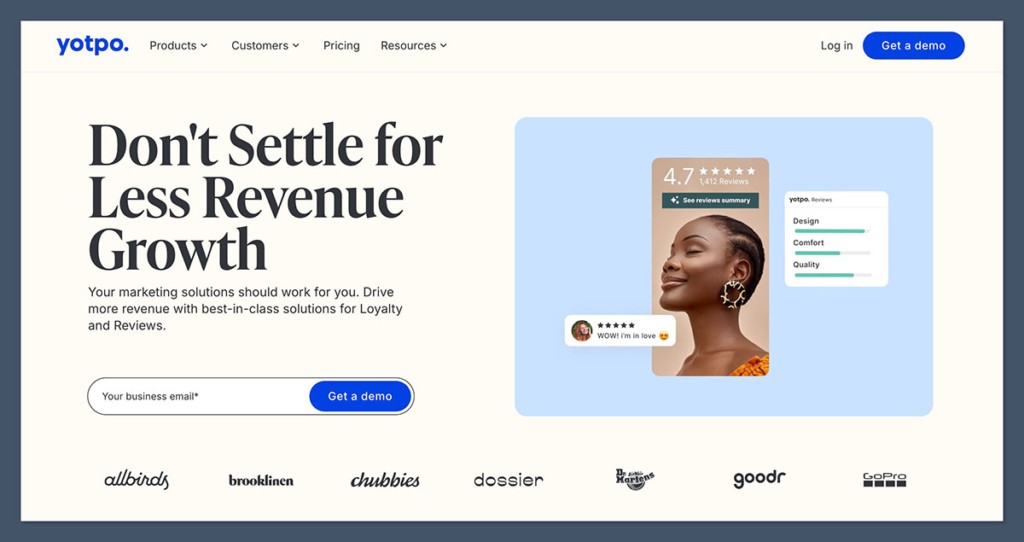
If you’re looking for transparent, entry-level pricing, Yotpo is the better option.
Yotpo Pricing
Yotpo’s pricing is available directly through the Shopify App Store, and it scales based on monthly order volume. This makes it easy to forecast your budget.
Here’s a breakdown of Yotpo’s Shopify pricing tiers:
- Free Plan – Up to 50 monthly orders
- Growth Plan – $15/month
- Prime Plan – $119/month
- Custom Enterprise – Pricing based on order volume and add-ons
The plans increase in features, offering things like coupons for reviews, product grouping, custom widgets, and more as you go up.
PowerReviews Pricing
PowerReviews doesn’t share pricing publicly. Instead, it offers custom quotes based on:
- The number of SKUs
- Syndication needs
- Analytics requirements
- Level of service and integrations
Typical users are enterprise brands with high product counts or distribution needs. That often means a significantly higher monthly investment.
Winner: If you want predictable monthly pricing and self-serve onboarding, Yotpo is the better choice.
Best for Review Display and On-Site Tools: Yotpo
Review platforms need to do more than collect reviews. They need to display them in a way that boosts conversions.
Yotpo’s Display Tools
Yotpo is built with ecommerce conversion in mind. Its display tools are highly customizable and optimized for Shopify.
Some highlights include:
- AI-powered review summaries
- Custom widgets for homepage, PDPs, and category pages
- Review sorting based on relevance, date, or helpfulness
- Visual UGC galleries with photo and video content
- Integration with loyalty and referral programs to incentivize reviews
It’s especially useful for brands with small to mid-size teams that want to move quickly and increase customer trust through on-site content.
PowerReviews’ Display Tools
PowerReviews takes a different approach, focusing more on large-scale customization for enterprise environments.
Key features include:
- Syndicated reviews from external retailers
- Custom review display blocks with moderation controls
- Deep analytics integrated into product display logic
- Review collection across multiple domains and retailers
- Product Q&A integration and content moderation workflows
This is ideal for brands needing consistent UX across dozens of storefronts or SKUs sold via retail partners.
Winner: Yotpo offers more out-of-the-box, conversion-focused display options, making it the winner for ecommerce stores and DTC teams.
Best for Review Syndication: PowerReviews
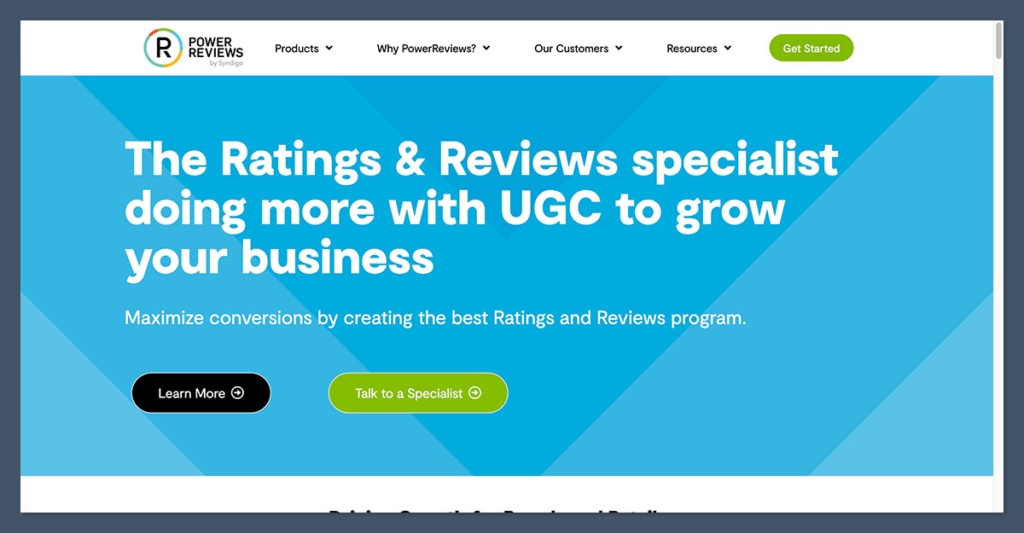
If you sell your products across large marketplaces or retail sites, syndication is essential.
PowerReviews Syndication
PowerReviews is built specifically for syndication. It allows brands to distribute reviews to over 2,000 retailer sites, including:
- Walmart
- Target
- CVS
- Ulta
- Best Buy
This means that reviews collected on your own site or through campaigns can appear directly on product listings across major retailer websites.
PowerReviews also enables you to collect content back from those partners, centralizing your UGC efforts.
Yotpo Syndication
Yotpo offers some syndication features and references access to networks like Bazaarvoice and even PowerReviews itself. But its reach and depth are more limited.
In practice, most brands on Yotpo do not use it as a primary syndication engine.
Winner: If syndication is part of your go-to-market strategy, PowerReviews is the clear winner.
Best for Analytics and Sentiment Insights: PowerReviews
Review data is only valuable if you can act on it. Both Yotpo and PowerReviews have invested in AI-backed analytics, but they serve different user needs.
Yotpo’s Analytics
Yotpo’s “Reviews Atlas” offers:
- Conversion-focused metrics
- Review volume and rating trends
- AI-powered sentiment tags
- Visual dashboards for marketers
It’s designed to give DTC brands fast, clear insights without needing a data analyst on the team.
PowerReviews’ Analytics
PowerReviews goes further with enterprise-grade tools like:
- Natural language processing (NLP) to analyze customer feedback
- Product sentiment tracking over time and across channels
- Custom report exports for BI tools
- Review content performance by SKU or category
- Detailed insights into syndication effectiveness
If you’re making decisions based on thousands of reviews or running multi-brand portfolios, these tools offer more depth.
Winner: PowerReviews provides more powerful analytics for enterprise teams and product managers.
Best for Ease of Use and Setup: Yotpo
Setup time matters, especially if you’re on a lean ecommerce team.
Yotpo Ease of Use
Yotpo is Shopify-friendly and easy to install directly from the app store. You can:
- Get started without a sales call
- Use templates to launch review widgets quickly
- Customize without touching code (though dev options exist)
- Access support via help docs or chat
This makes it perfect for teams that want to move fast.
PowerReviews Ease of Use
PowerReviews is not built for quick deployment. Most brands need to:
- Contact sales
- Go through onboarding and training
- Assign technical resources for integration
- Work with customer success to launch programs
That said, once it’s up and running, the platform is stable and built for scale.
Winner: Yotpo is the better option for fast, self-serve setup.
Best for Integrations and Ecosystem: Tie
Both platforms offer strong integration options, but they cater to different tech stacks.
Yotpo Integrations
Yotpo is built to integrate with common ecommerce tools, including:
- Shopify
- Klaviyo
- Gorgias
- Google Shopping
- Facebook and Instagram Ads
It also integrates with loyalty and referral apps, making it a broader ecommerce marketing suite.
PowerReviews Integrations
PowerReviews supports:
- Custom ecommerce platforms
- ERP systems
- PIM tools
- Custom APIs for syndication and analytics
It is often used by brands selling across multiple retail channels or global markets.
Winner: It depends on your stack. For Shopify users, Yotpo fits better. For complex enterprise systems, PowerReviews is stronger.
G2 User Ratings: Yotpo vs PowerReviews
Here’s a look at recent user ratings from G2:
| Rating Category | Yotpo | PowerReviews |
|---|---|---|
| Ease of Use | 4.5/5 | 4.2/5 |
| Ease of Setup | 4.3/5 | 4.1/5 |
| Support Experience | 4.2/5 | 4.5/5 |
| Feature Satisfaction | 4.4/5 | 4.3/5 |
| Likelihood to Renew | 91% | 89% |
Yotpo scores higher for usability and self-serve setup, while PowerReviews gets better marks for long-term support and enterprise relationships.
Final Recommendation: Yotpo vs PowerReviews
Here’s when to pick each platform based on your business model and goals.
Choose Yotpo If:
- You’re a DTC brand on Shopify
- You want fast, self-serve setup
- You need pricing you can plan for
- You’re focused on on-site conversion
- You might add loyalty or referrals later
Choose PowerReviews If:
- You’re an enterprise brand selling through retail channels
- You need full-scale review syndication
- You want deeper UGC analytics
- You have a dedicated team for onboarding and support
- You’re managing thousands of SKUs
Both platforms are excellent in their own right, but the best choice depends on where your business is today and where you’re aiming to go.
Whether you need agility and speed or scale and control, aligning your review strategy with your growth goals is what matters most.


