
 By Bogdan Rancea
When comparing Pensight and Stan Store across eight creator-store criteria, both platforms came out on top, but for different reasons. Pensight is superior for coaches and service-based creators who want marketing tools at the entry price, while Stan Store is better suited for digital-product sellers converting an Instagram audience.
Below, I’ve compared both platforms for you, using verified current pricing and independent reviews to give you a balanced, informed view.
Quick Verdict
Pensight is the better pick for coaches, service-based creators, and anyone who wants marketing tools cheaply. It bundles native video calls, recordings, email marketing, funnels, affiliates, and a custom domain at $29, and it has a free plan to start on.
Stan Store is the better pick for digital-product sellers who live on Instagram. Its mobile-first checkout, AutoDM, 15-30 minute setup, and 70,000+ creator community are edges Pensight cannot match.
Fees are near-identical on both, so pick on what you sell, not on price.
Pensight vs Stan Store at a Glance
Same category, different creator. Pensight is the coaching-first, feature-dense, free-to-start option. Stan is the beginner-friendly, Instagram-native, community-backed one. The table below shows where the trade-offs sit before I go deep on each.
| Factor | Pensight | Stan Store |
|---|---|---|
| Best for | Coaches and service-based creators | Digital-product sellers on Instagram |
| Plans/pricing | Basic free / Pro $29 / Business $99 | Creator $29 / Creator Pro $99 |
| Transaction fee | Flat 3% all-in (covers Stripe) | 0% platform + Stripe 2.9% + $0.30 |
| Free plan | Yes (Basic, $0/mo) | No (14-day trial only) |
| Built-in video calls | Yes, with auto recordings | No (external Zoom/Meet) |
| Email / funnels / affiliates | Included at $29 (Pro) | Gated to $99 (Creator Pro) |
| Instagram AutoDM | No | Yes (all plans) |
| Custom domain | Yes, at $29 (Pro) | No (redirect only, any plan) |
| Community / scale | Smaller (23 Trustpilot reviews) | 70,000+ creators, $400M+ earnings |
| Setup speed | Steeper, more to configure | 15-30 minutes to live |
What is Pensight?
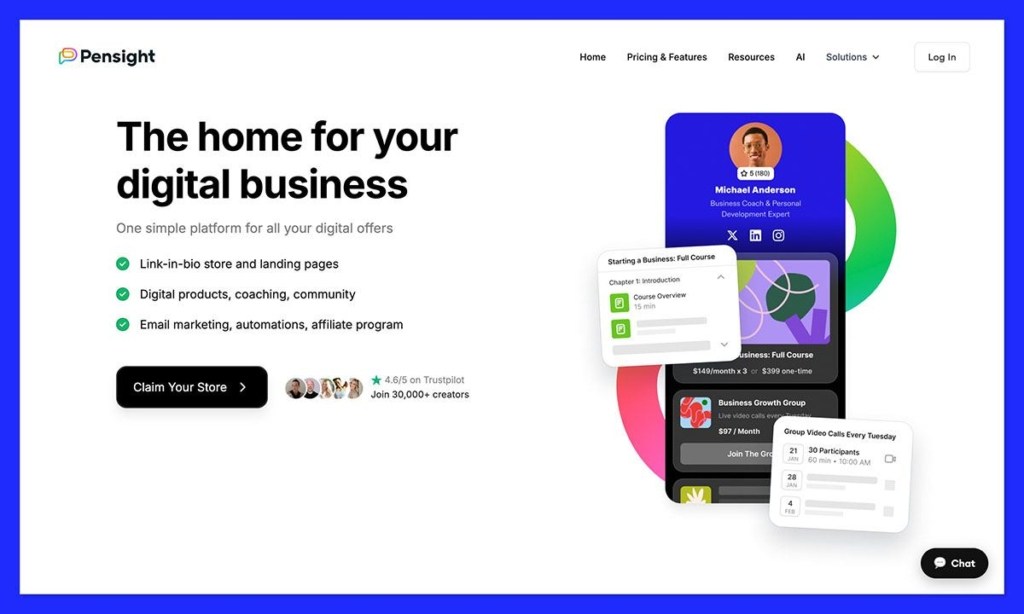
Pensight is a link-in-bio storefront built around coaching and client work. You get native video calls, coaching bundles, courses, memberships, email marketing, and a client portal in one place. Its free Basic plan lets you sell digital products and 1:1 sessions at $0/month with a 3% fee, and paid plans come with a 7-day trial.
What is Stan Store?
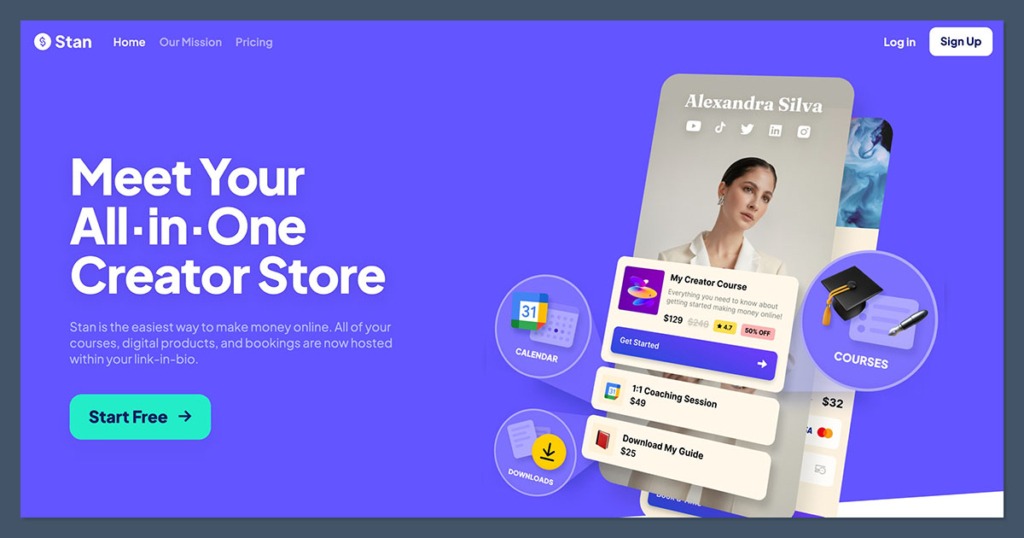
Stan Store is a mobile-first creator store designed for selling digital products to a social audience. It launched to prominence on Instagram, where its AutoDM tool and fast checkout convert followers into buyers. It carries 70,000+ creators, roughly $30M ARR, $300M in GMV, and a co-ownership stake from Steven Bartlett since May 2025.
A note on fees and bias
Both platforms land around 3% all-in, so the “one is free, one isn’t” framing is wrong. Pensight’s flat 3% covers Stripe processing; Stan charges 0% platform but you still pay Stripe’s 2.9% + $0.30 on top. The “10% Pensight commission” figure you may have read is outdated 2023 pricing.
One more thing on neutrality. The loudest “$29 Pensight beats $99 Stan” comparisons come from Pensight’s own blog, so I verified the feature gap against independent reviews. It holds up, but it also ignores Stan’s real strengths, which I will credit as I go.
Key Takeaways
- Pensight is built for coaching, with native video calls, automatic recordings, 1:1 and group bundles, and a client portal Stan cannot match.
- Stan Store is built for fast digital-product selling on Instagram, thanks to a mobile-first checkout and its AutoDM tool that turns comments into buyers.
- Fees are near-identical: Pensight charges a flat 3% all-in, while Stan charges 0% platform plus Stripe’s 2.9% + $0.30 per transaction.
- Pensight includes email marketing, funnels, affiliates, and pixels at $29 that Stan gates behind its $99 Creator Pro tier.
- Pensight has a free plan; Stan does not (Stan starts at $29/month after a 14-day trial).
- Stan has the bigger community: 70,000+ creators, $400M+ in creator earnings, and Steven Bartlett’s co-ownership backing.
I will go criterion by criterion, declare a winner each time, and land a per-use-case verdict at the end.
1. Pricing and Fees: What You Actually Pay
On total cost, Pensight edges it, mostly because of the free plan and the lack of a $0.30 per-sale flat fee. The gap is small, though, and worth understanding before you assume one is dramatically cheaper.
Here is how the two models actually work:
- Pensight charges a flat 3% that is all-inclusive, covering Stripe processing, hosting, and support. That 3% applies on Basic (free), Pro ($29/month, or ~$23.20 annually), and Business ($99/month). You keep 97% of every sale with no separate Stripe fee.
- Stan Store charges 0% platform fee but passes through Stripe or PayPal at roughly 2.9% + $0.30 per transaction. That applies on Creator ($29/month, or $25 annually) and Creator Pro ($99/month).
Two myths to kill quickly. The 10% Pensight figure is dead; it is a flat 3% across all plans today. And “both are 0%” is wrong: Pensight is 3%, Stan is 0% platform plus Stripe on top.
Now the numbers that matter. Here is take-home pay at an average $50 order value.
| Monthly sales (avg $50/order) | Pensight Basic (free) | Pensight Pro ($29) | Stan Creator ($29) |
|---|---|---|---|
| $500 | ~$485 | ~$456 | ~$453.50 |
| $2,000 | ~$1,940 | ~$1,911 | ~$1,901 |
| $5,000 | ~$4,850 | ~$4,821 | ~$4,796 |
Notice the nuance. On small-ticket items, Pensight’s flat 3% beats Stan plus Stripe because you dodge the $0.30 flat fee stacking up across many transactions. On high-ticket sales ($200+), that $0.30 barely registers, so the gap narrows to almost nothing.
The delta is small but consistent. Pensight Pro runs about $2.50 cheaper than Stan Creator at $500 in monthly sales, roughly $10 cheaper at $2,000, and about $25 cheaper at $5,000, entirely because you skip the per-transaction flat fee. The free Basic plan widens that: it costs $31.50 less than Stan Creator at $500, since there is no subscription at all.
There is a hidden-cost angle too. A coach on Stan often adds Zoom (~$13/month) for calls and a separate email tool, which pushes real monthly overhead toward $57-72. One analysis pegs Stan as genuinely cost-effective only around $290/month in revenue once those add-ons are counted, whereas Pensight bundles calls and email into the platform, so its sticker price sits closer to its true cost. One creator who switched put the math bluntly: “I love you stan, but I love my pockets more.”
Pensight’s third tier deserves a mention. Business runs $99/month on the same flat 3% fee, but it is a service upgrade rather than a feature unlock. You get a dedicated growth manager, bi-weekly strategy calls, onboarding with a sales and marketing expert, free course migration, and 1:1 product-building support. The core selling features match Pro.
The Winner: Pensight. Near-parity on paper, but the free tier and flat all-in fee make it the cheaper place to start. Stan’s cost is perfectly fine once you are earning, and many creators happily pay it for the simplicity.
2. Coaching and Client Tools
For coaches and service-based creators, Pensight wins, and it is not close. This is the category where the two platforms diverge most.
Pensight gives coaches a full toolkit at $29:
- Native video calling with automatic call recordings, so no Zoom required.
- 1:1 coaching bundles (multi-session packages) and recurring programs.
- Group programs with group chat and a video Q&A product type unique to Pensight.
- Memberships, client intake forms, and a client portal where customers see all their products, courses, and bookings in one account.
Stan’s reality is different. All video runs through external Zoom or Google Meet, which adds roughly $13/month and fragments the experience. There are no call recordings, no coaching bundles, and no multi-session package selling. Its portal reportedly surfaces only courses, not the full picture of a client’s purchases.
I will flag one caveat honestly. The client-portal detail originates partly from Pensight’s own comparison page, so treat the specifics with mild caution, though independent reviews confirm the core gaps. Stan does offer calendar bookings and one community, which is fine for the occasional 1:1 or a light group.
For repeat clients holding several products, that centralized portal is the quiet differentiator. A returning coaching client on Pensight logs into one account to find every session recording, course, and upcoming booking; on Stan they hit a thinner, course-only view and a Zoom link in their inbox. That friction adds up over a long client relationship.
Independent reviewers land in the same place. One creator-economy analysis concluded that if your business is 60% or more 1:1 sessions, Pensight is sharper in every dimension that matters to coaches, while balanced coaching-plus-product sellers have less to gain from switching.
The Winner: Pensight. Built-in calls, recordings, bundles, and a real client portal at $29. Only skip it if coaching is occasional, in which case Stan’s bookings may be enough.
3. Digital Products, Checkout, and Conversion
For selling digital products to a social audience, Stan wins. Its checkout was engineered for exactly this buyer.
Stan’s edges are real and specific:
- A mobile-first checkout optimized for followers who decide within 30 seconds of tapping a bio link.
- Instagram AutoDM, included on every plan, which auto-sends a DM with your product link to anyone who comments a trigger word. That turns passive post engagement into leads with zero manual effort.
- Order bumps and upsells (on Creator Pro) plus recurring subscriptions.
Pensight sells digital products too, and its free Basic plan is genuinely the cheaper way to start. Its checkout is less conversion-tuned, though, and it has no AutoDM equivalent, which matters a lot if Instagram drives your sales.
Stan is not flawless here. AutoDM works on Instagram only and fires single-step replies, not branching flows, so it is a lead trigger rather than a full automation. There are no dedicated sales pages either, so the checkout doubles as the sales page, which limits long-form copy and testimonials.
The course builder is the other soft spot. It has no quizzes, certificates, progress tracking, or student comments, which reviewers describe as fine for a short video series but thin for a serious course business. If you are teaching a structured, multi-module program, that gap will show.
One reviewer summed Stan up as a buy for social sellers and a skip for anyone building a serious course or community business.
That framing fits the checkout too: it was engineered for the mobile follower who decides to buy within 30 seconds of tapping a bio link, not the buyer who wants to read a long pitch first. Pensight’s product tooling is weaker on that impulse-sale axis, which is exactly why the pick tracks your channel more than your catalog.
The Winner: Stan Store. Mobile-first checkout and AutoDM make it the stronger converter for Instagram-driven impulse sales. Pick Pensight here only if you want to start free and sell products alongside coaching.
4. Email Marketing, Funnels, and Automation
On marketing tools per dollar, Pensight wins outright. This is the single biggest tier-gated difference between the two.
At $29, Pensight Pro includes email broadcasts, automation flows, upsell funnels, and a built-in affiliate program. It also bundles buy-now-pay-later through Klarna and Affirm at that price, letting buyers split payments on higher-ticket offers. That is a working marketing engine at the entry price.
Stan Creator at $29 gives you lead capture and AutoDM, but no email marketing, no funnels, no affiliate management, and no pixels. To unlock any of that, plus its own payment plans through Afterpay and Klarna, you jump to Creator Pro at $99, which is 3.4x the price for the same marketing layer Pensight bundles at $29.
This is the actual basis for the viral “$29 vs $99” claim, and independent reviews confirm the gap is real, even though the loudest version started as Pensight marketing.
It is also the most-cited Stan complaint: the platform markets “all-in-one from $29” while email sits behind $99, which reviewers across Trustpilot, G2, and blogs flag as trust-eroding.
To picture the gap concretely: on Pensight Pro you can capture a lead, drip a broadcast sequence, run an upsell funnel at checkout, and pay affiliates a cut, all inside the $29 plan. On Stan Creator you capture the lead and fire an AutoDM, then hit a wall until you pay $99 for broadcasts, automation flows, contact import, and affiliate management.
Credit where due, though. Stan’s AutoDM is a marketing tool Pensight simply does not have, so this is not a clean sweep across every marketing use case.
The Winner: Pensight. Email, funnels, affiliates, and buy-now-pay-later at $29 versus Stan’s $99 for the same layer. AutoDM is Stan’s one genuine marketing counterpunch.
5. Store, Branding, and Custom Domain
For brand ownership, Pensight wins. One fact drives this.
Stan Store does not support custom domains on any plan, including the $99 Creator Pro. This is confirmed by Stan’s own help center, which offers only domain forwarding (a redirect) and lists custom domains as a “feature request on our radar.” Your store lives at stan.store/yourname permanently, which is the single most-cited limitation for creators who care about owning their brand.
Pensight includes a custom domain at Pro ($29), so you can build SEO and brand equity on a URL you own rather than a platform subdomain.
Domain forwarding is a genuine but partial fix. A redirect points your own URL at the Stan page, yet the address bar still resolves to stan.store/yourname, so you never build SEO authority or brand equity on a domain you control. Over years of content, that is real value left on the table.
The branding picture cuts both ways, though. Stan’s templates are highly uniform: you can change colors, fonts, and a header image, but every store ends up looking similar, and there are no separate sales pages to differentiate your offers.
Pensight offers page themes and more store structure, yet its client-portal branding is fairly restricted, and reviewers note you cannot fully tweak the layout, colors, or navigation to match your brand exactly.
The Winner: Pensight. A custom domain at $29 versus none at any price is decisive for brand equity. Stan is the easier path only if a stan.store link and zero setup friction suit you.
6. Ease of Setup and Design
For getting live fast, Stan wins. Speed is its whole design philosophy.
Multiple reviewers confirm a beginner can have a Stan store accepting payments in 15-30 minutes. The done-for-you layout asks you to make very few decisions, which is a big reason 70,000+ creators adopted it and why it suits absolute first-timers with no tech experience.
Stan’s done-for-you page structure is the mechanism here. It hands you a preset mobile layout and asks you to drop in products and copy rather than design anything, so there is very little to get wrong on day one. That is ideal for a creator making their first sale but limiting once you want a distinctive store.
Pensight is more feature-rich, and that depth comes at a cost. Reviewers consistently note it takes longer to look professional and has a steeper learning curve, especially compared to Stan’s near-automatic setup. You are trading an afternoon of configuration for capability you grow into.
The trade-off is clean to state. Stan optimizes for a zero-friction launch; Pensight optimizes for depth. Stan’s simplicity brings those uniform templates I mentioned, while Pensight’s flexibility brings more setup work up front, so the “right” answer depends on whether you value speed or control today.
The Winner: Stan Store. Live in 15-30 minutes with nothing to get wrong. Pensight rewards you for investing an afternoon, but Stan takes this category on speed alone.
7. Community, Ecosystem, and Momentum
For community and momentum, Stan wins, and the numbers are lopsided.
Stan carries 70,000+ creators, roughly $30M ARR, $300M in GMV, and more than $400M in cumulative creator earnings. Its Trustpilot sits at 4.8/5 across 1,906 reviews. Steven Bartlett took a double-digit co-ownership stake in May 2025 using personal capital and his FlightStory Fund, and he is active in product and AI decisions, which Stan’s CEO likened to “having a board member in your group chat.”
The momentum is not a one-time headline either. Stan roughly doubled ARR from $14.7M in 2023 to $28.3M by the end of 2024 and past $30M in 2025, which signals a platform investing in features rather than coasting. That trajectory is part of what drew Bartlett in.
That scale produces a real ecosystem: abundant YouTube tutorials, Facebook-group help, and documented success stories you can learn from. Bartlett even launched “The Stan Challenge,” a 45-day program with 30 days of his own coaching, to accelerate creator onboarding. For a nervous first-timer, that support net is worth something.
Pensight’s community is small by comparison, with just 23 Trustpilot reviews, so self-starters find fewer peer resources and tutorials. In fairness, that small sample is still positive (Findstack 4.5/5, RatingFacts 5/5), and a smaller platform is not a dealbreaker if the tool fits your work.
Two clarifications keep this honest. Stan’s community feature allows only one community per store with no gamification like points or levels, which constrains creators running multiple cohorts. And Stan’s “Stanley” AI assistant is a separate $149/month tool, not something bundled into your Stan Store plan.
The Winner: Stan Store. 70,000+ creators, a 4.8/5 Trustpilot across 1,906 reviews, and Steven Bartlett’s backing are a support net Pensight cannot offer yet.
8. Analytics, Integrations, and Payments
This one is a split decision, because each platform holds a real advantage the other lacks.
Pensight’s edges:
- Google Analytics, Meta Pixel, and TikTok Pixel all included at Pro ($29). Stan locks Meta, Google, Pinterest, and TikTok pixels to Creator Pro ($99).
- Accelerated payouts on Pro, where transactions are considered complete within an hour of purchase, versus roughly 24 hours to initiate on the free Basic plan.
Stan’s edges:
- Accepts both Stripe and PayPal, while Pensight is Stripe-only (PayPal unconfirmed). That helps buyers without a credit card.
- AutoDM and deep Instagram integration, plus a longer 14-day trial versus Pensight’s 7-day.
Both offer store analytics and Zapier connections, so the baseline tracking is covered on either platform. Both also plug into Google Calendar for scheduling, and each reaches wider tools through Zapier, so neither locks you out of the numbers or integrations you need to run the business day to day.
The payments split is the one to weigh hardest. Stan’s dual Stripe-and-PayPal support captures buyers who default to PayPal or lack a card, which can matter for international or younger audiences, while Pensight’s Stripe-only setup keeps processing simple but narrower. Pair that with Stan’s 14-day trial against Pensight’s 7-day window, and Stan gives you more room to test before committing.
The Winner: Tie. Pensight if pixel tracking at $29 matters to your ads; Stan if you need PayPal or lean heavily on Instagram.
How I Compared Pensight and Stan Store
Each category above was weighted by how much it affects a typical creator’s revenue and running costs. Pricing, coaching tools, product selling, and marketing carry the most weight because they touch every sale; branding, setup, community, and integrations shape the experience around those sales. The table below shows the weighting and each category winner.
| Criterion | Weight | Winner |
|---|---|---|
| Pricing and fees | 15% | Pensight |
| Coaching and client tools | 15% | Pensight |
| Digital products, checkout, and conversion | 15% | Stan Store |
| Email marketing, funnels, and automation | 15% | Pensight |
| Store, branding, and custom domain | 10% | Pensight |
| Ease of setup and design | 10% | Stan Store |
| Community, ecosystem, and momentum | 10% | Stan Store |
| Analytics, integrations, and payments | 10% | Tie |
All pricing figures were verified against the platforms’ current pricing pages and cross-checked with independent reviews. Claims that originate from either platform’s own marketing (such as Pensight’s comparison pages) are flagged as such in the relevant sections.
Final Verdict: Which Should You Choose?
There is no single winner here, only a fork in the road. Pensight is the value and coaching pick (free start, built-in video calls, and marketing tools at $29), while Stan is the beginner, digital-product, and Instagram pick (fastest setup, AutoDM, and the biggest community).
Choose by what you sell. The table below maps the most common situations to a recommendation.
| If you are… | Best pick | Why |
|---|---|---|
| A coach running 1:1 or group sessions | Pensight | Built-in video calls, recordings, bundles, client portal |
| A digital-product seller on Instagram | Stan Store | AutoDM plus mobile-first checkout |
| Just starting, under $1,000/month | Pensight Basic | Free plan, only the 3% fee |
| Wanting email + funnels + affiliates cheaply | Pensight Pro | $29 vs Stan’s $99 for the same layer |
| A total beginner who wants to be live today | Stan Store | 15-30 minute setup |
| Focused on brand ownership / custom domain | Pensight | Custom domain at $29; Stan has none |
| Valuing the biggest community and proven scale | Stan Store | 70,000+ creators, Steven Bartlett backing |
One honest line to dispel the hype: the viral “$29 Pensight beats $99 Stan” is accurate for marketing features, but it ignores Stan’s AutoDM, community, and setup speed. Pick on fit, not on the meme.
Your next move is simple. Match your primary revenue (coaching versus digital products), start on Pensight’s free Basic plan or Stan’s 14-day trial, and judge each on your own numbers within a month. Both are capable tools, not shortcuts, so the offer you build still does the heavy lifting.
Pensight vs Stan Store FAQ
Do both Pensight and Stan Store charge 0% transaction fees?
No. Stan charges 0% platform fee but Stripe or PayPal still takes about 2.9% + $0.30 per transaction. Pensight charges a flat 3% that is all-inclusive and covers Stripe. On a $100 sale that is $3.00 for Pensight versus $3.20 for Stan, so Pensight is slightly better on small-ticket items.
Does Pensight still charge 10% commission?
No, that figure is outdated 2023 pricing. Pensight now charges a flat 3% across all plans, including the free Basic tier, and that 3% covers Stripe processing, hosting, and support. Any source citing 9-10% commission, or older 5%/9%/0% tiers, is describing a pricing model Pensight has since retired. You keep 97% of every sale.
Is there a free plan on either platform?
Pensight has one; Stan does not. Pensight’s Basic plan is $0/month with a 3% fee, and it lets you sell digital products and 1:1 sessions with no fixed cost, which makes it a low-risk way to validate an offer. Stan has no free plan, starting at $29/month after a 14-day trial that requires a card upfront.
Can I use a custom domain on Stan Store?
No, not on any plan, including the $99 Creator Pro. Stan’s own help center confirms it, offering only domain forwarding (a redirect) and listing custom domains as a feature request “on our radar.” Your store stays at stan.store/yourname permanently. Pensight includes a custom domain at its $29 Pro tier, so you can build brand and SEO equity on a URL you own.
Which is better for coaches?
Pensight, by a wide margin. It includes built-in video calls with automatic recordings, 1:1 and group coaching bundles, a client portal, and intake forms, all at $29. Stan routes calls through external Zoom or Meet, has no recordings, and offers no coaching bundles at any price.
Which is better for selling digital products?
Stan has the edge, especially for Instagram creators, thanks to its mobile-first checkout and AutoDM that converts comments into sales. That said, Pensight sells digital products too, and its free Basic plan is the cheaper starting point for creators earning under $1,000/month.
Is the “$29 Pensight = $99 Stan” claim accurate?
Partly. It is true for email marketing, funnels, affiliates, and pixels, which Pensight bundles at $29 and Stan gates to $99. But the claim originated in Pensight’s own marketing, and it ignores Stan’s AutoDM, larger community, and faster setup. Treat it as one data point, not the whole story.


