
 By Bogdan Rancea
After comparing 8 major platforms on the things clothing actually demands, Shopify is the best ecommerce platform for fashion brands, because it pairs the highest variant ceiling on the market with the deepest apparel theme library and the only mature size chart and exchange tooling.
Almost every guide ranking above this one still tells you Shopify caps a product at 100 variants. That number is three years out of date. The real ceiling is 2,048. For a clothing line, that single figure decides whether one product holds your entire size and color run or splits messily across five listings.
That is the sort of thing this guide is for. By the end of it, you will know which of these eight platforms fits the way your line is actually built, what it will really cost you in year one, and which mistakes are expensive enough to be worth avoiding now rather than later.
Key Takeaways 🔍
- Shopify is our top-rated platform for fashion brands, with 2,048 variants per product, 1,225 themes and the only real size chart and returns app ecosystem
- Entry pricing ranges from $0 to $41 per month. Big Cartel and Shift4Shop offer free plans, though both carry conditions that matter for apparel
- Four platforms cost the same $348 in year one, so the plan price is not the decision. The platform fee is
- The 100-variant figure circulating for Shopify, Squarespace and Wix is wrong on all three counts. The real ceilings are 2,048, 250 and 1,000
- Choose Webflow if the lookbook is the product, and Squarespace if the collection is small and the look is the pitch
- Big Cartel’s free tier allows one image per product, which rules it out for clothing before anything else does
The Top Ecommerce Platforms for Fashion Brands
The short version, before we get into the detail:
| Platform | Highlights | Best for |
|---|---|---|
| Shopify (Overall pick) | 2,048 variants per product, 1,225 themes, mature size chart and returns apps, 0% fee on Shopify Payments | Most new clothing brands, and anything with a deep size and color run |
| Squarespace (Design pick) | Templates that ship finished, 0% platform fee from $29, card rates that improve as you climb | Small capsule collections where the look is the pitch |
| BigCommerce (Catalog pick) | 600 variants, native wholesale, multi-storefront from the entry tier, $0 fee on major processors | Real catalogs with a trade channel in the plan |
| Webflow (Editorial pick) | 81 fashion templates from under $6, genuine layout control, 0% fee from Plus | Brands whose art direction is the differentiator |
| Big Cartel (Budget pick) | $0, $15 and $30 plans, limits published plainly, print on demand supported | Merch drops and tiny indie labels |
How we rank ecommerce platforms for fashion brands
Apparel is the category that breaks ecommerce platforms, so this guide ranks on four things that matter more for clothing than for ecommerce in general: variant depth, the true cost of selling, apparel design tools, and channel support for print on demand and social. Pricing comes from each vendor’s own published plans and is verified at time of publishing. The full method is further down.
Recent changes on this page ⬇️
Two figures moved that most comparison tables have not caught up with. Shopify raised its variant ceiling from 100 to 2,048, and BigCommerce renamed every plan on June 1, 2026: Standard became Core, Plus became Growth, Pro became Scale and Enterprise became Performance. If a guide still says “BigCommerce Standard” or “100 variants,” it has not been touched since spring.
More fashion ecommerce guides
This guide covers general needs. For something more specific, we also have:
- The best print on demand platforms for clothing
- The best free ecommerce platforms for small labels
- The best platforms for wholesale and multi-channel apparel
- The best ecommerce platforms for made to order and custom fit
- The best platforms for selling merch and limited drops
Our top 8 at a glance
- Shopify, best overall, 2,048 variants per product
- Squarespace, best for small design led collections, 0% platform fee from $29
- BigCommerce, best for large catalogs and wholesale, 600 variants per product
- Webflow, best for editorial and lookbook driven stores, 81 fashion templates from under $6
- WooCommerce, best for full control, no platform variant cap
- Wix, best for a fast launch, 1,000 variants per product
- Shift4Shop, best if you commit to Shift4 Payments, a free plan with conditions
- Big Cartel, best for tiny indie labels, one image per product on the free tier
What a Fashion Brand Actually Needs From a Platform
Apparel breaks ecommerce platforms in ways other categories never do. Sell a lamp and you need one product, one image and a price. Sell a shirt and you need every size in every color, four photographs of each, a size guide that stops half of them coming back, and a returns flow for the half that come back anyway.
Five things decide it:
- Variant depth: color x size x fit runs out of room faster than any other category
- Image handling: a garment needs the flat lay, the on-model shot, the fabric detail and the back
- Editorial and lookbook layout: fashion sells on the story around the product, not the spec table
- Size guides and exchanges: the two tools that decide your return rate, and almost none are built in
- Print on demand and social selling: how most new labels ship their first hundred orders
Ecommerce Platforms for Fashion Brands: Comparison Table
All eight side by side. Read the variant column first: it eliminates platforms faster than price does.
| Platform | Best for (fashion) | Entry price (US) | Max variants per product | Platform fee on sales | Apparel themes | Printify POD |
|---|---|---|---|---|---|---|
| Shopify | Most new fashion brands | $39/mo, $29 annual | 2,048 | 0% on Shopify Payments, else 2% Basic | 1,225 themes, 24 free, paid $100 to $500 | Yes |
| Squarespace | Small design led collections | $19 Basic, $29 Core | 250 across 6 options | 2% Basic, 0% Core up | Fashion category, no named apparel templates | Yes |
| BigCommerce | Large catalogs and wholesale | $39/mo Core, $29 annual | 600 SKUs | 0% Embedded, else 2.0% Core | Fashion category, counts not published | Yes |
| Webflow | Editorial and lookbook stores | $29/mo Standard, yearly | Not published | 2% Standard, 0% Plus up | 81 fashion templates, $5.79 to $130 plus | Not listed |
| WooCommerce | Founders who want full control | Free, hosting $25 to $350/mo | No platform cap | 0% platform, WooPayments 2.5% to 2.9% plus $0.30 | Unlimited WordPress themes, quality varies | Yes |
| Wix | A fast launch | About $36/mo Core | 1,000 | Not published | Fashion subcategory, generic templates | Yes |
| Shift4Shop | Committing to Shift4 Payments | $0 conditional, else $41/mo | Not published | Not published | 100 plus free themes, no fashion range | Not listed |
| Big Cartel | Tiny indie labels and drops | Free, $15/mo, $30/mo | Not published | None | Small built-in theme range | Yes |
1. Shopify: Best Overall for Fashion Brands
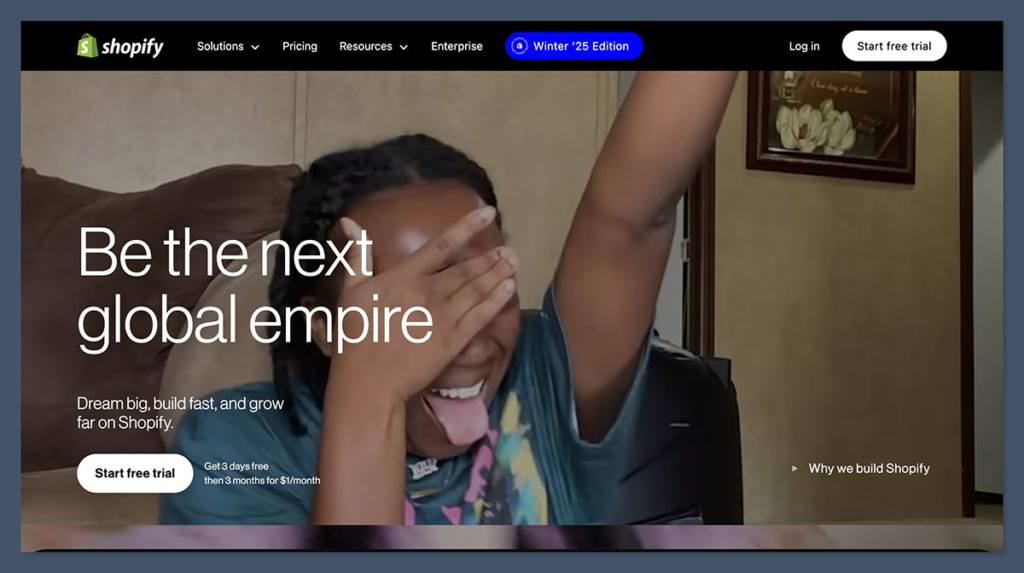
- Shopify pricing: $29 to $2,300 plus per month
- Variant ceiling: 2,048 per product
- Print on demand: Yes, via Printify
Shopify started in 2006 because its founders could not find decent software to sell snowboards online, and two decades later that origin still shows. This is a platform built from the ground up around physical products with variants, which is exactly what a clothing brand is selling.
It is the best ecommerce platform for fashion brands because it holds the highest variant ceiling on the market, the deepest paid apparel theme library, and the only mature size chart and exchange tooling of the eight.
So what’s the catch? The sticker price is not the real price. Almost everything a clothing brand actually needs, size charts, exchange portals, swatch behavior, arrives as a rented app with its own monthly bill.
The variant ceiling everyone gets wrong
The 2,048-variant ceiling replaced a 100-variant limit that had stood for years, and no plan gating applies, so a store on Basic gets the same headroom as one on Plus.
Here is what that means in denim. Eight waist sizes, twelve washes and three inseams is 288 combinations. Under the old ceiling that was three or four separate listings, each one splitting your reviews, your analytics and your customer’s attention. Now it is one product. The structure still runs on three option categories, so you get size, color and one more.
The design lens
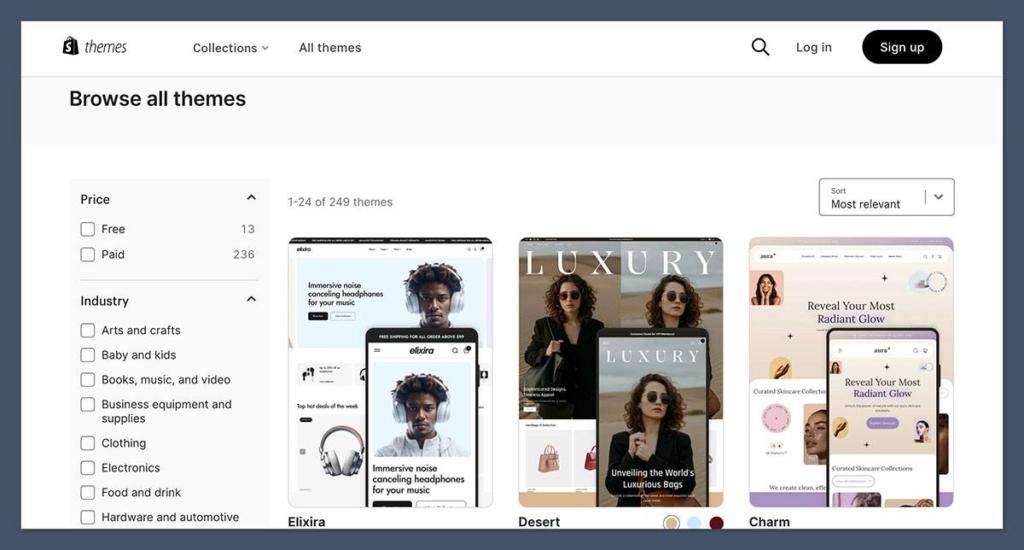
The Theme Store runs 1,225 themes, 24 of them free, with premium apparel-capable options like Impulse at $500, Broadcast at $420, Prestige at $400, Pipeline at $360, Sleek at $350 and Allure at $100.
Is a $500 theme worth it? For most categories, no. For clothing, often yes. A $100 theme buys a competent product grid. The $350 to $500 range buys editorial section blocks, video heroes, swatch behavior and quick view, which is the difference between a store and a catalog.
The fashion app stack
- Kiwi Size Chart and Recommender: free for 2 watermarked charts, then $6.99, $12.49 or $24.49/mo. Rated 4.8/5 across 1,086 reviews
- Loop Returns and Exchanges: free tier, then Essential $155/mo and Advanced $340/mo. Rated 4.7/5 across 406 reviews
That tooling is Shopify’s real fashion advantage, and it costs $7 to $340 a month on top of the plan. Budget for it now, not in month three.
✔️ Pros
- Highest variant ceiling on the market, at 2,048 per product
- Largest paid apparel theme library, with real editorial layouts
- The only mature size chart and exchange tooling of the eight
- 0% platform fee on Shopify Payments
❌ Cons
- Basic still charges 2% if you bring your own gateway
- Size charts and returns are rented apps, not built in
- The three-option structure still shapes how you model a garment
What’s new with Shopify? ⬇️
The variant ceiling moved from 100 to 2,048, and it is the single most out-of-date figure in competing guides. For apparel it is also the one that matters most, because a full size and color run now fits inside one product listing instead of splitting across four. If you built a store under the old limit, you can consolidate.
Why use Shopify for a fashion brand? ⬇️
Because returns are the defining economics of selling clothing online, and this is the only platform here where the size guide, the exchange flow and the variant headroom all exist as mature, well-rated products rather than workarounds. You pay monthly for that, but you are not building it yourself.
How Much Does Shopify Cost?
| Plan | Monthly price (paid annually) | Monthly price (paid monthly) | Platform fee without Shopify Payments |
|---|---|---|---|
| Basic | $29 | $39 | 2% |
| Grow | $79 | $105 | 1% |
| Advanced | $299 | $399 | 0.6% |
| Plus | From $2,300 | Not published | 0.2% |
Who is Shopify for?
Almost any clothing brand that expects to still exist in three years. It is the right default for a first collection and it does not become the wrong answer at 500 styles, which is not true of most of this list. Budget the plan plus the apps before comparing it to anything cheaper, because Basic at $29 with a size chart and a returns portal is a very different number.
Read our full Shopify review for a closer look at the editor, the app ecosystem and checkout, or see how it compares in our Shopify vs BigCommerce guide.
2. Squarespace: Best for Small Design Led Collections
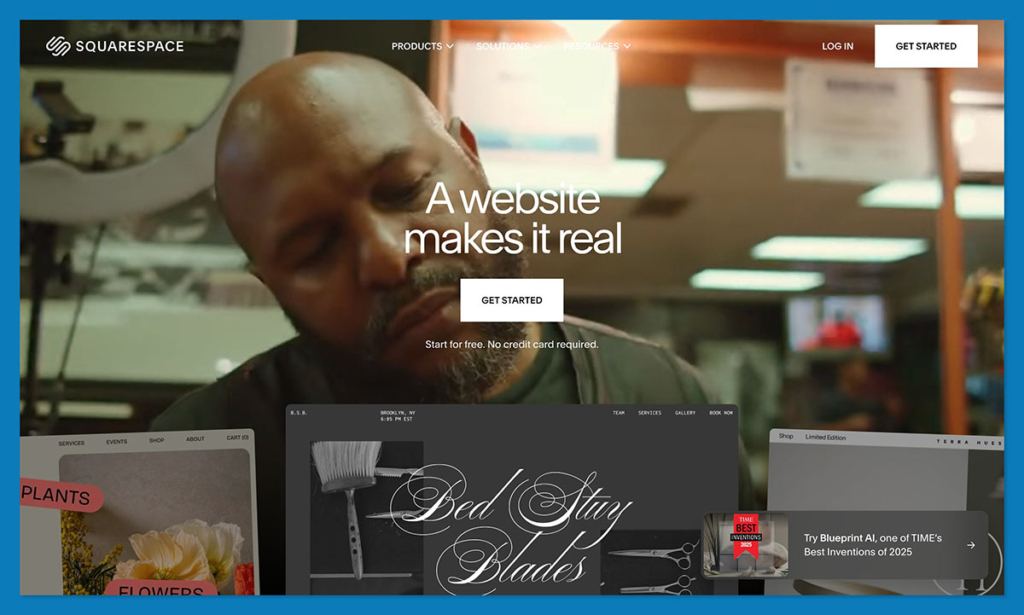
- Squarespace pricing: $19 to $99 per month
- Variant ceiling: 250 combinations across up to 6 options
- Print on demand: Yes, via Printify
Squarespace began in 2003 as a one-person project and grew into the design-first corner of this market. The company sells taste, and it shows: the templates ship finished and nothing here needs a developer.
That makes it the best platform to sell clothes online if your collection is small and the look is the pitch. The friction is structural rather than aesthetic: a multi-attribute line will hit the 250-combination ceiling, and it will hit it sooner than you think.
The cheapest plan is the expensive one
Basic looks like the budget entry at $19 a month. Don’t be fooled. It carries a 2% online store fee on top of the same 2.9% plus $0.30 card rate Core charges, which means the cheap plan quietly becomes the expensive one the moment you start selling properly.
The math: Basic runs $228 a year plus 2% of sales, Core runs $348 plus nothing, and they meet at $6,000 of annual sales. That is $500 a month. Above it, you are paying more to be on the cheaper plan.
The second variant correction
The figure repeated for Squarespace is 100. The real allowance is six options and 250 variant combinations, images, and SKUs per product. Five colors by eight sizes is 40 and fine. Seven by seven by seven is 343 and does not fit.
And here is the part that catches people out: images count inside that same 250. A heavy variant matrix does not just eat your product structure, it eats your photography budget too.
The design lens
Squarespace runs a Fashion and Apparel entry under Creative Services, but it does not publish a named apparel template range the way Shopify and Webflow do. The strongest design reputation in this roster is also the hardest to price before you sign up. What you get instead is a house style that flatters almost any decent product photography, which for a small label is worth more than a menu of options.
✔️ Pros
- 0% platform fee from the $29 Core tier, the cleanest fee story here
- Templates ship finished, the whole reason to be here
- Processing improves as you climb, down to 2.5% plus $0.30
❌ Cons
- The $19 Basic tier is a false economy above $6,000 of annual sales
- 250 combinations is the second lowest ceiling here
- Images and SKUs eat that same 250
- No priced apparel template range to compare before you commit
Why use Squarespace for a fashion brand? ⬇️
Because a 12-piece capsule collection does not need 2,048 variants. It needs to look expensive on day one without a designer. Squarespace is the only platform here where the default output is already art directed, and if your line is tight, the ceiling you would eventually hit is one you may never reach.
How Much Does Squarespace Cost?
| Plan | Monthly price | Online store fee | Card processing |
|---|---|---|---|
| Basic | $19 | 2% | 2.9% plus $0.30 |
| Core | $29 | 0% | 2.9% plus $0.30 |
| Plus | $49 | 0% | 2.7% |
| Advanced | $99 | 0% | 2.5% |
Squarespace advertises up to 36% off for annual billing, so your real cost will land below these monthly figures.
Who is Squarespace for?
Designers, small studios and anyone launching 10 to 40 styles who wants an art directed storefront on day one and has no intention of hiring a developer. Skip it if your line runs three or more attributes per garment, because you will spend your second year fighting a ceiling instead of selling.
Read our full Squarespace review for a closer look at the editor and templates, or compare it directly in our Squarespace vs Shopify guide.
3. BigCommerce: Best for Large Catalogs and Wholesale
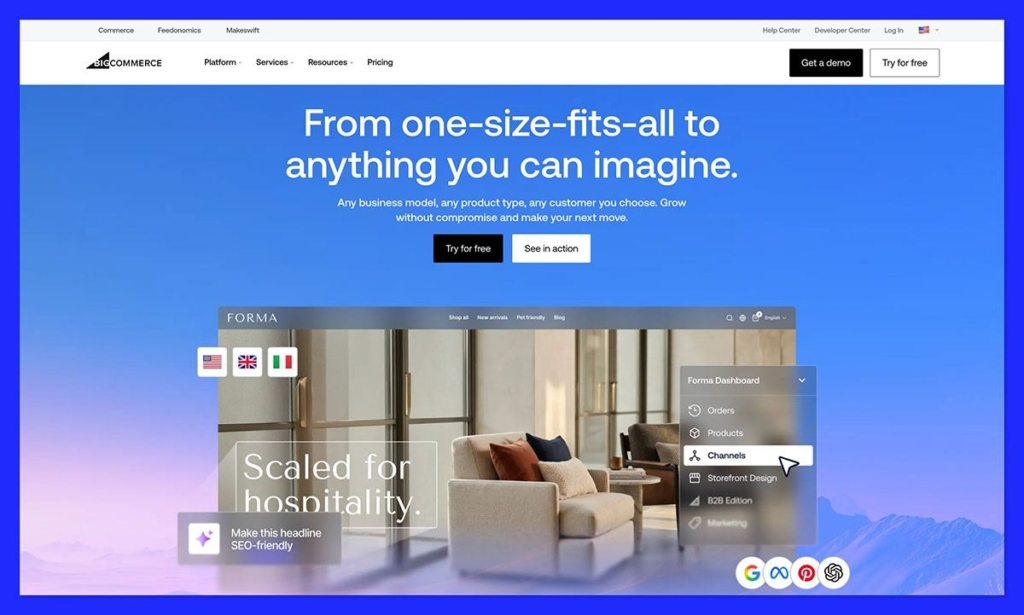
- BigCommerce pricing: $29 to $1,499 plus per month
- Variant ceiling: 600 SKU-bearing variants per product
- Print on demand: Yes, via Printify
BigCommerce launched in Australia in 2009 and now runs out of Austin, Texas, aimed squarely at merchants who outgrow the entry tier of everything else. It is the platform for clothing brands planning a real catalog, because 600 variants plus native wholesale covers a full size run and a trade channel without installing a single app.
The friction? Its fee structure is the most misreported thing in this entire category, and both versions of the error will cost you money.
The fee nuance, stated exactly
BigCommerce charges $0 on orders through an Embedded Payment Provider: Stripe, PayPal Braintree, Adyen, Klarna and Afterpay among others. Any other processor counts as an Open Payment Provider and carries 2.0% on Core, on top of that processor’s own rate.
Two errors circulate, in opposite directions:
- A fee on Stripe or Braintree? No. Both sit on the exempt Embedded list
- Zero fee full stop? Also no. A processor outside that list costs 2% on Core
The zero-fee headline is real, but it is a processor decision disguised as a platform one. Choose your gateway first, then read the pricing page.
600 variants in apparel terms
A 10-color, 8-size, 3-fit line is 240, and fits comfortably. Past 600 you fall back on modifiers, which are customer-choice fields with no SKU or inventory attached. Fine for a monogram, useless for stock you actually count.
The design lens
BigCommerce runs a Fashion and Apparel theme category but does not publish counts or price ranges for it, which makes it the hardest of the three large SaaS platforms to judge on looks before signing up. Design is not the reason to choose it anyway.
Structure is. Core allows 3 storefronts at $30/mo each, Growth 5 and Scale 8, which is the clean way to run wholesale and retail side by side without duplicating your catalog.
✔️ Pros
- 600 variants per product, the highest ceiling here after Shopify
- Genuinely $0 platform fee on the Embedded list
- Wholesale and multi-storefront built in rather than rented
- Core matches Shopify Basic at $29 annual
❌ Cons
- The Open Payment Provider fee is easy to trip over, at 2%
- No published apparel theme range to compare
- Scale adds a $33,333/mo GMV cap and 0.9% overage
What’s new with BigCommerce? ⬇️
Every plan was renamed on June 1, 2026. Standard became Core, Plus became Growth, Pro became Scale and Enterprise became Performance. The prices did not move, but the names did, which means any comparison table written before that date will not match the page you land on.
Why use BigCommerce for a fashion brand? ⬇️
Because wholesale is where clothing brands actually scale, and this is the only platform in the guide where a trade channel and a retail storefront run natively rather than through a paid app. Add 600 variants and multi-storefront support from the entry tier, and it covers a growth path Squarespace and Big Cartel structurally cannot.
How Much Does BigCommerce Cost?
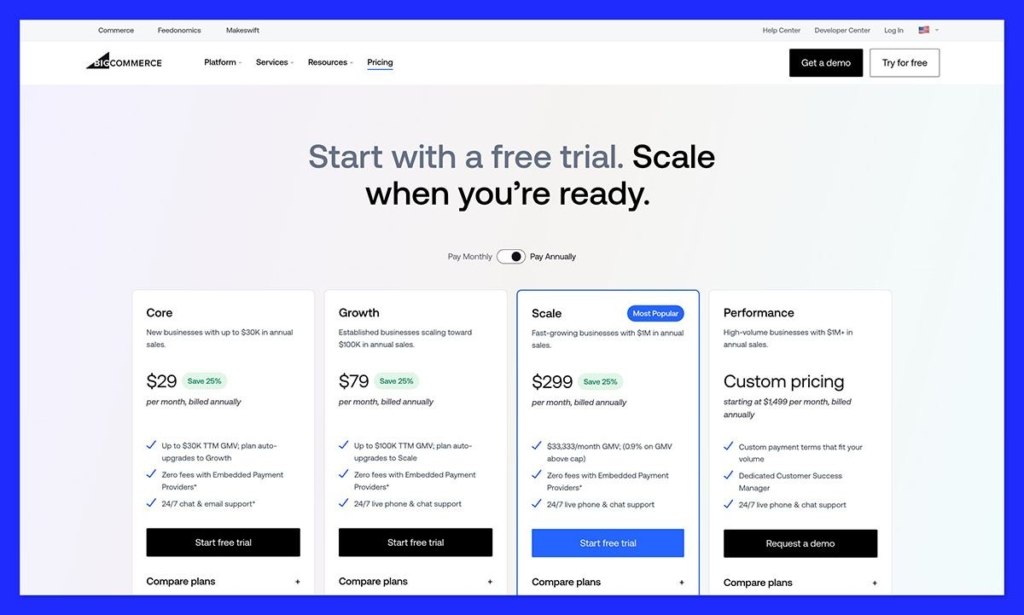
| Plan (new name) | Former name | Monthly price (annual) | Monthly price (monthly) | Open Payment Provider fee |
|---|---|---|---|---|
| Core | Standard | $29 | $39 | 2.0% |
| Growth | Plus | $79 | $105 | 1.0% |
| Scale | Pro | $299 | $399 | 0.6% |
| Performance | Enterprise | From $1,499 | Not published | Not published |
Who is BigCommerce for?
Brands launching a real catalog with wholesale ambition, whose processor will be Stripe, Braintree or PayPal. If you are stocking boutiques as well as selling direct, this is the platform that assumes you will. Skip it for a first collection of a dozen styles, where you will pay for structure you do not need yet.
Read our full BigCommerce review for the detail on wholesale, multi-storefront and the payment provider lists.
4. Webflow: Best for Editorial and Lookbook Driven Stores
- Webflow pricing: $29 to $212 per month, billed yearly per site
- Variant ceiling: not published
- Print on demand: Not listed by Printify
Webflow was built in 2013 for designers who wanted to ship real websites without writing code, and it has never pretended to be anything else. It is the fashion ecommerce platform for brands whose lookbook is the product, with the deepest named fashion template library of the eight.
The friction is simple, and you should take it seriously: you are designing, not choosing.
The design lens
The numbers nobody else prints: 81 fashion templates, with Moderise at $5.79, Veona at $18.48 and Woven Wear at $26.99. Next to Shopify’s $100 to $500 paid tier, that is less than a tenth as much, and you can rebuild any part of it afterwards.
Editorial capability is the real reason to be here: full-bleed campaign imagery, asymmetric lookbook grids, scroll-driven sequences, typography not locked to a theme’s options. If you art directed the brand before you built the store, this is the only platform here that will not flatten it.
The trade is real, though. A bad Webflow store looks considerably worse than a bad Shopify one, because nothing is protecting you from yourself.
The variant question
Webflow does not publish a per-product variant ceiling, and the figures circulating elsewhere range from 50 to 100 without agreement. Both are low for apparel. A 6-color, 8-size shirt is 48 combinations, which sits right on the line. Add a third option and you are over either number, so check with Webflow directly before building a size-heavy collection.
There is a second ceiling that definitely affects you. Variants count against the plan’s total item limit, so 500 items on Standard is not 500 products. One shirt in 48 combinations is 48 items, and suddenly that generous-looking allowance covers about ten styles.
✔️ Pros
- 81 fashion templates from under $6, the best value design start here
- Genuine editorial layout control no template platform matches
- 0% transaction fee from Plus upward
❌ Cons
- No published variant ceiling, and estimates run low for apparel
- Variants consume the site item limit
- Only annual pricing is published
- No print on demand integration
Why use Webflow for a fashion brand? ⬇️
Because on every other platform here, your campaign imagery gets poured into somebody else’s grid. Webflow is the one where the storefront looks like the lookbook rather than a product feed with nice photos. For a brand whose whole differentiation is art direction, that is not a nice-to-have.
How Much Does Webflow Cost?
| Plan | Monthly price (billed yearly) | Store item limit | Transaction fee |
|---|---|---|---|
| Standard | $29 | 500 | 2% |
| Plus | $74 | 5,000 | 0% |
| Advanced | $212 | 15,000 | 0% |
Who is Webflow for?
Brands where the art direction came first and the product list is short enough to work inside an uncertain variant ceiling. Think 15 styles, strong photography, a founder with design instincts or a designer on the team. Skip it if you are running deep size runs or if print on demand is your fulfillment plan.
Read our full Webflow review for the detail on the editor, hosting and template marketplace.
5. WooCommerce: Best for Founders Who Want Full Control
- WooCommerce pricing: plugin free, hosting $25 to $350 per month
- Variant ceiling: no platform cap
- Print on demand: Yes, via Printify
WooCommerce arrived in 2011 as a plugin for WordPress and was acquired by Automattic a few years later. It is less a platform than a shopping cart bolted onto the web’s most widely used publishing system, which explains both its strengths and its headaches.
It is the best ecommerce platform for clothing brands that refuse to be capped, because nothing about your catalog, checkout or storefront is somebody else’s decision. The friction: free is the most expensive word in this entire guide.
No ceiling, but not no limit
With no platform variant limit, the 2,048, 600 and 250 ceilings elsewhere simply do not apply. Performance replaces them. Every variation is a full database row, and admin speed starts to suffer somewhere around 50 variations per product. That is a practical caution rather than a hard cap, and better hosting pushes it further out, but it is real and it arrives quietly.
The design lens
WordPress theme supply is effectively unlimited, and quality is uneven in a way no other platform here has to deal with. On Shopify, $360 buys a designed thing. On WooCommerce the same money buys either an equivalent or something unusable, and telling them apart is entirely your problem.
✔️ Pros
- No platform cap on variants, products or storefront structure
- The only first-party TikTok Shop integration in this guide
- Publishes its own real cost ranges, which few vendors do
❌ Cons
- The total is a range, not a price, starting near $300 a year
- Every fashion feature is a separate extension
- Performance degrades on heavy variant matrices
- Theme quality is unvetted, and choosing badly shows
Why use WooCommerce for a fashion brand? ⬇️
Because it is the only option here where a size chart, an exchange portal or a made-to-measure field is something you build once rather than rent monthly forever. It also carries the only first-party TikTok Shop integration in the guide, which matters if social is your first sales channel rather than your third.
How Much Does WooCommerce Cost?
| Cost line | Price | Notes |
|---|---|---|
| WooCommerce plugin | $0 | Free and open source |
| Hosting | $25 to $350 per month | The real recurring cost |
| Extensions | $29 to $299 per year each | Priced individually |
| WooPayments | About 2.5% to 2.9% plus $0.30 | No platform fee on top |
Who is WooCommerce for?
Founders who already run WordPress, or who have a developer on call and a reason to need one. If you are building something the SaaS platforms cannot model, custom fit, made to order, an unusual bundle structure, this is where you go. Skip it if you are non-technical, which describes most first-time clothing founders and is nothing to be embarrassed about.
Read our full WooCommerce review for the detail on hosting, extensions and what the real total cost looks like.
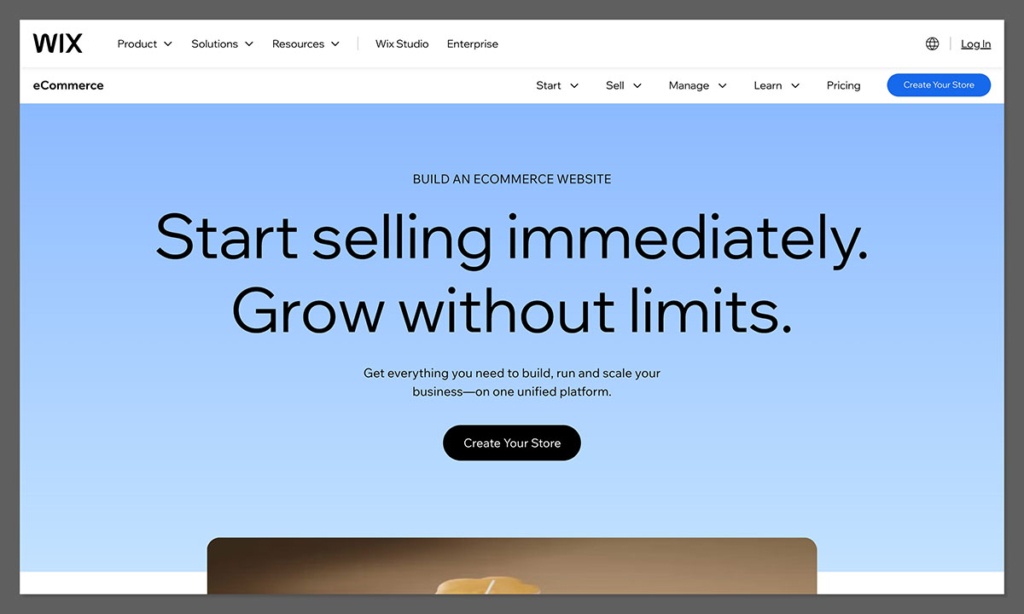
6. Wix: Best for a Fast Launch
- Wix pricing: about $24 to $46 per month
- Variant ceiling: 1,000 per product
- Print on demand: Yes, via Printify
Wix launched in Tel Aviv in 2006 on a simple promise: anyone can build a website in an afternoon. Two decades on, that is still the pitch and still the strongest thing about it. It is the fastest way to get a clothing store online, and its variant ceiling is far higher than the search results give it credit for.
The friction: the templates are functional rather than art directed, and the fee picture is thinner than its rivals’.
The third variant correction
The number circulating for Wix is 100. The real allowance is 1,000, built from six options with up to 100 choices each. That puts Wix ahead of BigCommerce and four times ahead of Squarespace, which almost no comparison table reflects.
For a size and color heavy line on a small budget, that is the best variant-per-dollar ratio in this guide, and almost nobody knows it.
The design lens
Wix runs a Fashion and Clothing subcategory in its store templates, with names like Kids Clothing Store (Colorful) and Clothing Store (Young). That reads generic next to Shopify and Webflow. There is no priced apparel marketplace and no designer theme with real lookbook sections. You will get a store live in an afternoon, and it will look like a store rather than a brand.
Wix is also less forthcoming than its rivals about the cost of selling. Plan pricing shifts with promotions, and the transaction fee that sits on top of card processing is not clearly published, so confirm both before you commit.
✔️ Pros
- 1,000 variants per product, four times Squarespace’s ceiling
- The quickest path from nothing to a live clothing store
- A real fashion template subcategory
❌ Cons
- The transaction fee is not clearly published
- Plan pricing shifts with promotions, so check before you buy
- The apparel templates are generic next to Shopify and Webflow
Why use Wix for a fashion brand? ⬇️
Because 1,000 variants at roughly $36 a month is the best variant-per-dollar ratio here. If your line is size and color heavy but your budget is not, Wix clears Squarespace’s ceiling four times over at a comparable price. What you give up is art direction.
How Much Does Wix Cost?
| Plan | Approximate monthly price | Ecommerce |
|---|---|---|
| Light | About $24 | No |
| Core | About $36 | Yes |
| Business | About $46 | Yes |
Who is Wix for?
Founders who need to be selling this week, with a deep size and color run and no budget for design work. Check current pricing before you buy, and expect a storefront that looks competent rather than art directed. If the look of the store is your main selling point, spend the same money on Squarespace instead.
Read our full Wix review for a closer look at the editor, apps and ecommerce features.
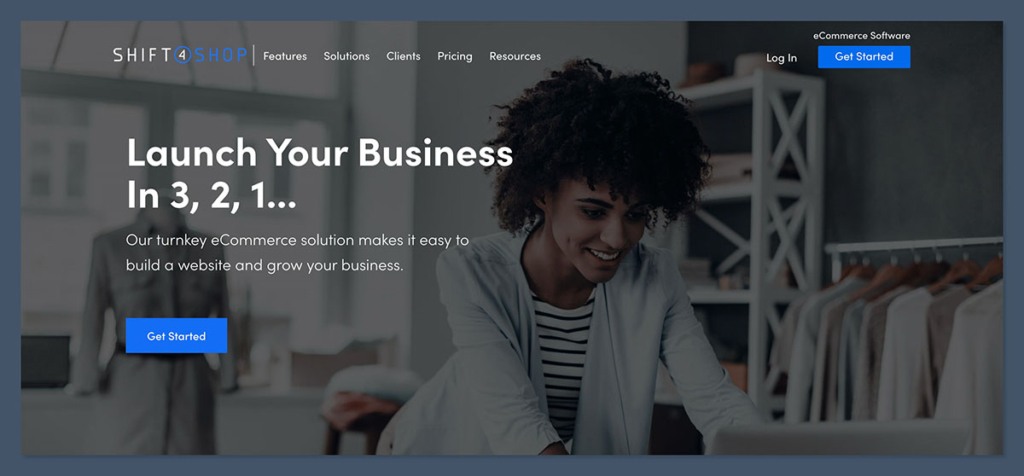
7. Shift4Shop: Best If You Will Commit to Shift4 Payments
- Shift4Shop pricing: $0 conditional, or $41 per month
- Variant ceiling: not published
- Print on demand: Not listed by Printify
Shift4Shop spent most of its life as 3dcart, an ecommerce platform dating back to the late 1990s, until payments company Shift4 acquired it and rebuilt the pricing around its own processing. That history explains everything about how this offer works.
It offers the only free plan in this guide with no product, staff or bandwidth caps, and the price is paid in processing rather than dollars. The friction: the conditions attached to that free plan are not spelled out anywhere obvious.
What the free plan actually costs you
The mechanism is simple enough. US merchants who process exclusively through Shift4 Payments and clear a minimum monthly volume pay nothing for the store. The threshold is reported anywhere between $500 and $1,000 a month in processed sales, Shift4Shop does not publish it, and using another gateway is understood to trigger a platform fee.
So get it in writing before you build. And be clear about what you are signing: this is not a free platform, it is a processor contract with a store attached. Whether that is a good deal depends entirely on what your card rates would have been elsewhere, which is a question only your own volume can answer.
The design lens
Shift4Shop advertises 100 plus free themes but publishes no fashion range, no named apparel theme and no price tiers. For a category that sells on presentation, a theme library you cannot evaluate before signing up is a genuine cost, and it is the main reason this sits at seven rather than higher.
✔️ Pros
- A genuinely uncapped free plan if you meet the payment conditions
- Unlimited products, staff and bandwidth with no revenue caps
❌ Cons
- The free tier locks you to Shift4 Payments
- The qualifying volume is not published, and reported figures vary widely
- Another gateway triggers a platform fee
- No apparel theme range to evaluate
Why use Shift4Shop for a fashion brand? ⬇️
For one specific founder only: a US merchant who has already chosen Shift4 Payments as their processor. For that person, an uncapped store at $0 a month is a real offer nothing else here matches. For everyone else, the processor lock-in costs more than $41 a month ever would.
How Much Does Shift4Shop Cost?
| Plan | Monthly price | Limits | Condition |
|---|---|---|---|
| Free tier | $0 | Uncapped | US merchants using Shift4 Payments exclusively, plus a monthly volume minimum |
| End-to-End eCommerce | $41 | Unlimited products, staff, bandwidth | No revenue caps, 100 plus free themes |
Who is Shift4Shop for?
US merchants already committed to Shift4 Payments, and essentially nobody else. If you have a processor you want to keep, this is no deal at all, and you would be choosing a platform on the basis of a discount you cannot fully see the terms of.
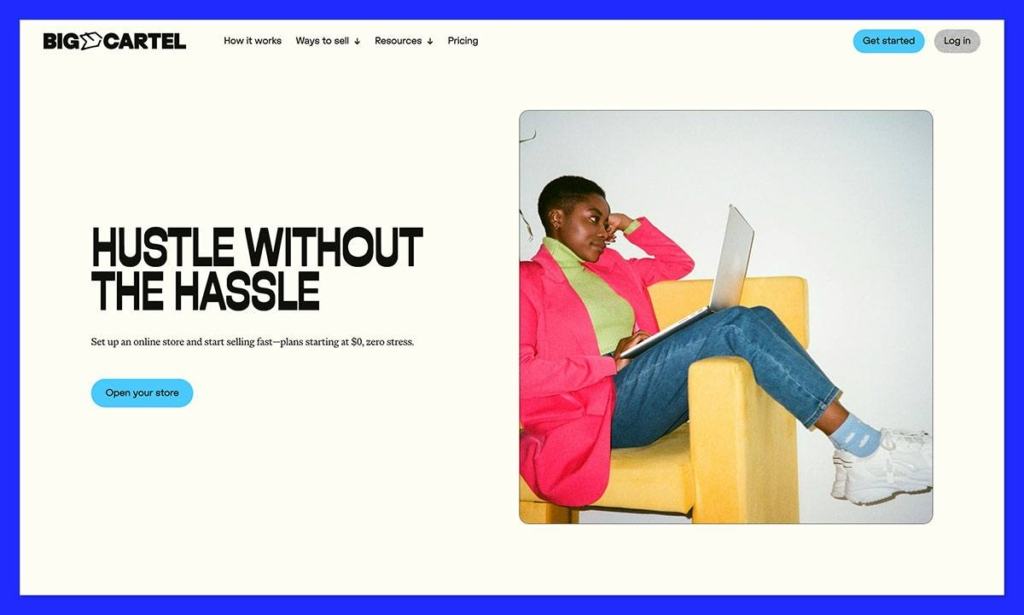
8. Big Cartel: Best for Tiny Indie Labels and Drops
- Big Cartel pricing: $0, $15 or $30 per month
- Variant ceiling: not published
- Print on demand: Yes, via Printify
Big Cartel has been serving independent artists, bands and makers since 2005, and it shows in everything. The whole platform assumes you have twenty products, not two thousand. That is a limitation on paper and a feature in practice, because it makes this the cheapest credible way to sell a small clothing drop, with limits published plainly enough to judge in about a minute.
The friction is one number, and it is a big one: the free tier’s image cap rules it out for apparel entirely.
One image per product is disqualifying for clothing
A garment needs four images before anyone even asks about a second colorway: flat lay, on-model, fabric detail, back. Every other category survives on one hero shot. Apparel does not.
So treat the free Gold plan as a demo rather than a launch option. Platinum’s 5 images works for a drop, and Diamond’s 25 allows a proper lookbook.
The other ceiling
Five hundred products at $30 a month is the top of the platform. Generous for seasonal drops, restrictive for a full size run, since one style across eight sizes and four colors eats a meaningful chunk of it before you have added a second style.
✔️ Pros
- The simplest pricing in this guide, at $0, $15 and $30
- Product and image limits published precisely
- Print on demand confirmed
❌ Cons
- One image per product on the free tier
- 500 products is a hard ceiling even at the top tier
- A small built-in theme range next to any SaaS rival
- No published variant limit
Why use Big Cartel for a fashion brand? ⬇️
Because a merch drop or a 20-piece indie label does not need a catalog system. It needs a checkout that costs $15 a month and states its limits honestly. Big Cartel is the only platform here whose constraints you can fully understand in a minute, which is worth more to a first-time founder than a feature list they will never reach the end of.
How Much Does Big Cartel Cost?
| Plan | Monthly price | Products | Images per product |
|---|---|---|---|
| Gold | $0 | 5 | 1 |
| Platinum | $15 | 50 | 5 |
| Diamond | $30 | 500 | 25 |
Who is Big Cartel for?
Musicians selling merch, illustrators selling printed tees, and indie labels running a handful of styles at a time. Against Shopify it is ceilings you will grow through versus almost none you can hit. Against Squarespace, $15 buys a store and $29 buys a designed one. Against selling through Instagram alone, it buys you a real checkout, which is the whole point.
Read our full Big Cartel review for the detail on themes, limits and print on demand setup.
What Year One Actually Costs for a Small Fashion Store
Modeled on $60,000 of first-year sales, a realistic figure for a small label. Card processing is excluded except where a platform publishes its own rate.
| Platform and plan | 12 month subscription | Theme or template | Platform fee on $60,000 of sales | Year one platform cost |
|---|---|---|---|---|
| Shopify Basic, annual | $348 | $0 free, or $100 to $500 | $0 on Shopify Payments, else $1,200 | $348 to $848, plus $1,200 on another gateway |
| Squarespace Basic, monthly | $228 | Included | $1,200 (2%) | $1,428 |
| Squarespace Core, monthly | $348 | Included | $0 | $348 |
| BigCommerce Core, annual | $348 | Not published | $0 Embedded, else $1,200 | $348, or $1,548 with an Open provider |
| Webflow Standard, yearly | $348 | $5.79 to $130 plus | $1,200 (2%) | About $1,554 to $1,678 |
| Webflow Plus, yearly | $888 | $5.79 to $130 plus | $0 | About $894 to $1,018 |
| WooCommerce, self hosted | $300 to $4,200 hosting | Varies | $0 platform | $300 plus, before extensions |
Notice anything? Four platforms land on the same $348 subscription: Shopify Basic, Squarespace Core, BigCommerce Core and Webflow Standard. So the subscription is not the decision. The fee column is.
Webflow Standard at $348 plus 2% and Plus at $888 with no fee are equal at $27,000 of annual sales, and past that the pricier plan is cheaper. Four rows here are ranges rather than fixed prices, and the widest by far belongs to the free option, which tells you most of what you need to know about free.
The Best Platform for Your Type of Fashion Brand
There is no one-size-fits-all answer here, which is a slightly awkward thing to say in a ranked list. So here is the same information sorted by the shape of your business instead.
Small capsule collections and design led labels
Ten to forty styles, strong photography, the look doing most of the selling. Squarespace is the straightforward pick, and Core at $29 with no platform fee is the tier to start on. If your art direction is genuinely distinctive rather than merely tasteful, Webflow will carry it further.
Deep size and fit runs
Denim, tailoring, footwear, anything where one style spans dozens of combinations. Shopify at 2,048 variants, with BigCommerce at 600 as the alternative if wholesale matters. Wix is the budget option at 1,000, and it is underrated for exactly this. Squarespace and Webflow will fight you.
Print on demand and merch
No inventory, drops rather than seasons. Shopify or Big Cartel are the shortest paths, since both are on Printify’s integration list. Webflow and Shift4Shop are not supported at all, so rule them out early.
Wholesale and multi-channel
Stocking boutiques as well as selling direct. BigCommerce, and it is not close. Native wholesale plus multi-storefront from the entry tier is something the rest of this list charges apps for or does not do.
Made to order and custom fit
Bespoke measurements, configurable garments, anything the SaaS platforms cannot model. WooCommerce, because it is the only place you can build the fields you need rather than approximate them with a workaround.
How Do I Choose the Right Platform for a Fashion Brand?
Work through this checklist before you commit, in roughly this order, because the first two eliminate platforms faster than anything else:
- How many variants does one garment actually need? Multiply colors by sizes by fits, then compare against the ceiling
- How many images does each product need? Four is the working minimum for apparel, and some platforms count images inside the variant limit
- Which processor will you use? On Shopify and BigCommerce this decides whether you pay a platform fee at all
- Is the lookbook the pitch, or is the product? That answer separates Webflow from everything else
- Do you need a wholesale channel within two years? If yes, BigCommerce is built for it and most of this list is not
- Who is handling size guides and exchanges? Almost nothing here includes them, so price the apps in before you compare plans
- Are you selling through print on demand or social? Webflow and Shift4Shop are not on Printify’s list
Choosing a Platform: Don’t Make These Mistakes
Picking the wrong platform is recoverable. Picking it, building on it for eighteen months and then discovering the ceiling is considerably less fun. These are the errors that cost clothing brands the most.
Mistake #1: Underestimating how fast variants multiply
This is the one that catches almost everybody. Colors times sizes times fits compounds far more aggressively than founders expect. Six colors and eight sizes is 48, which sounds harmless. Add three inseams and you are at 144. Add a second fabric and you are at 288. Do this multiplication before you choose, not after your second season.
Mistake #2: Forgetting that images have limits too
Every garment needs four photographs minimum, and on some platforms those images count inside the same allowance as your variants. Squarespace’s 250 covers combinations, images and SKUs together. Big Cartel’s free plan allows exactly one image per product. Count your photography needs as carefully as your product count.
Mistake #3: Confusing the platform fee with card processing
These are two separate charges and guides conflate them constantly. Card processing is what your payment provider takes, usually around 2.9% plus $0.30. The platform fee is what the ecommerce platform takes on top, purely for the privilege. On $60,000 of sales, a 2% platform fee is $1,200 a year, which is more than most of these subscriptions.
Mistake #4: Not planning for returns and exchanges
Apparel has the highest return rate of any ecommerce category, and almost nothing on this list includes exchange tooling or a size guide as standard. On Shopify these are apps costing $7 to $340 a month. On WooCommerce they are extensions you install and maintain. Price this in from day one, because it will not stay optional.
Mistake #5: Choosing on looks before headroom
The storefront design is the easiest thing to change later and the variant structure is the hardest. Migration between platforms means rebuilding your product data, and a catalog built on a high ceiling has nowhere to land on a low one. Choose on capacity first, then make it beautiful.
Mistake #6: Treating the free plan as a launch plan
Free tiers here are demos with real conditions attached. Big Cartel’s costs you three of your four product images. Shift4Shop’s costs you your choice of payment processor. Both are perfectly reasonable trades if you go in knowing about them, and unpleasant surprises if you do not.
Can I Switch Platforms Later?
Yes, and every platform here lets you cancel and leave. But migration is harder for fashion than for almost any other category, because the thing that has to move is your variant structure, not just your product list.
A catalog built inside Squarespace’s 250-combination ceiling maps onto Shopify without trouble. Going the other way, a Shopify line using 800 variants per product has nowhere to land. Plan any move in the direction of more headroom, not less.
Product photography, your custom domain and customer records usually transfer without much pain. Storefront design does not. Assume you rebuild the front end from scratch, which is the strongest possible argument for getting the capacity question right the first time.
Ecommerce Terms Every Fashion Founder Should Know
A quick recap of the vocabulary used throughout this guide, because platforms use these words inconsistently and the differences cost money. Variant A specific purchasable version of a product, such as a shirt in medium and navy. Each one carries its own SKU, stock count and often its own price. This is the number that matters most for apparel. Option or option category The attribute that generates variants, such as size, color or fit. Some platforms cap how many options you can use as well as how many variants they produce. Shopify allows three option categories, Squarespace and Wix six. Modifier A customer-choice field that does not create a SKU or track inventory, such as a monogram or a gift note. Useful for personalization, useless for stock you need to count. SKU Stock keeping unit, the unique code identifying one sellable variant. If a platform says it allows 600 SKU-bearing variants, it means 600 things it will track inventory for. Platform fee A percentage the ecommerce platform charges on your sales, separate from and on top of what your card processor takes. Often waived if you use the platform’s own payment product. Embedded and Open Payment Providers BigCommerce’s terminology. Embedded providers, including Stripe and PayPal Braintree, carry no platform fee. Open providers are everyone else, and cost 2% on the entry plan. Print on demand Fulfillment where garments are printed and shipped only after a customer orders, so you hold no inventory. Requires an integration between your store and a supplier such as Printify.
How We Rank Ecommerce Platforms for Fashion Brands
Clothing asks more of a platform than most categories, so this guide ranks on four criteria weighted for apparel rather than ecommerce in general:
- Variant and image capacity. The most decisive factor for apparel, and the most widely misreported. Color by size by fit is where platforms run out of room
- True cost of selling. Platform fees kept separate from card processing, since the two get conflated constantly and the gap between them decides year one
- Apparel design tools. Named themes with real prices and genuine editorial layout capability, not a category page that exists but publishes nothing
- Channel support. Print on demand and social selling, because that is how most new labels ship their first hundred orders
Plan pricing comes from each vendor’s own published rates and is verified at time of publishing. Where a platform does not publish a figure, this guide says so rather than repeating a number from elsewhere, which is why the variant column has gaps and why platforms that publish less rank lower.
The most useful thing I can tell a founder launching a clothing line is that the plan price is almost never the decision. Four of these platforms cost the same $348 in year one. What separates them is the variant ceiling, the platform fee sitting on top of card processing, and whether size guides and exchanges come included or rented.
Shopify wins because it is the only platform where all three of those questions have a good answer at once. But the right pick genuinely changes with the shape of your line. A 12-piece capsule and a 40-style catalog with a wholesale channel are not the same business, and they should not end up on the same platform.
Final Verdict: Which Platform Do I Recommend?
Shopify is the best ecommerce platform for fashion brands, because 2,048 variants, 1,225 themes and the only mature size chart and returns tooling cover more of what clothing actually demands than anything else here. Budget the plan plus the apps, not the plan alone.
It will not suit everyone, and it should not. Squarespace is the better call for a tight capsule that needs to look expensive on day one. Webflow is the only real choice if the lookbook is the product. BigCommerce is built for the wholesale channel most of this list ignores. And Big Cartel at $15 a month remains a perfectly honest way to sell a drop.
If you are still unsure, do the multiplication first. Colors times sizes times fits. That single number eliminates more of this list than your budget ever will.
Ecommerce Platforms for Fashion Brands: FAQs
Does Shopify still limit products to 100 variants?
No. Shopify raised the ceiling to 2,048 variants per product, after an earlier step took it from 100 to 2,000. The three-option-category structure still applies, so you get size, color and one more.
Is BigCommerce really zero transaction fees?
Only through an Embedded payment provider. Orders through BigCommerce’s Embedded list, which includes Stripe, PayPal Braintree, Adyen, Klarna and Afterpay, carry no platform fee. Any other processor counts as an Open Payment Provider and costs 2.0% on Core, 1.0% on Growth and 0.6% on Scale.
Is Shift4Shop’s free plan actually free?
Conditionally. The plan is free for US merchants who process exclusively through Shift4 Payments and clear a monthly volume minimum. That minimum is reported anywhere between $500 and $1,000 a month and Shift4Shop does not publish it, so confirm the threshold directly before you build.
How many variants do Squarespace and Wix actually allow?
Squarespace allows 250 variant combinations across up to six options per product, with images and SKUs counting inside that 250. Wix allows 1,000 variants per product, from up to six options with up to 100 choices each. Both beat the 100-variant figure still circulating.
Which platform is best for print on demand clothing?
Printify integrates with Shopify, Squarespace, BigCommerce, WooCommerce, Wix, Big Cartel, PrestaShop and Etsy. Webflow and Shift4Shop are not supported. For a first drop, Shopify or Big Cartel are the shortest paths.
Should a fashion brand use a fashion-specific platform like Centra?
Not as a first platform. Centra is a headless, enterprise-oriented option with a fashion PIM built in and pricing available only by demo, which makes it a migration target for a scaled brand rather than a launch decision.


