
 By Bogdan Rancea
One $10 album sale earns you what 2,000 to 3,000 Spotify streams pay out. One $35 merch sale equals roughly 8,750 streams, and 1,000 fans paying $99 a year for a membership matches about 25 million streams. That math is why direct-to-fan selling is the highest-leverage income move an independent artist can make right now, and why picking from the best ecommerce platforms for musicians matters more than chasing playlist placements.
This guide covers nine platforms that actually sell products to fans (music, merch, digital goods, memberships), not gig or freelance marketplaces. For each you get current pricing, exact transaction and revenue-share fees, a clear sell-music vs sell-merch vs all-in-one split, plus a stage-based framework for choosing. Here is the full shortlist.
| Platform | Starting price | Transaction / platform fee | Sells music? | Sells merch? | Best for |
|---|---|---|---|---|---|
| Fourthwall | Free | 0% physical / 5% digital | Yes | Yes | Merch plus memberships |
| Bandcamp | Free | 15% digital / 10% physical + processing | Yes | Yes | Selling music with built-in discovery |
| Bandzoogle | $6.95/mo | 0% commission | Yes | Yes | All-in-one musician site |
| Big Cartel | Free | 0% platform fee | No (physical only) | Yes | Free, simple indie merch store |
| Shopify | $39/mo | 0% extra with Shopify Payments | Via apps | Yes | Scaling bands with real volume |
| Gumroad | Free | 10% per sale (30% via Discover) | Yes | Yes | Low-volume digital goods |
| Sellfy | $29/mo | 0% transaction fee | Yes | Yes | High-volume digital and POD |
| Squarespace | $16/mo | 2% Basic / 0% Core+ | Yes | Yes | Polished brand website with a store |
| Patreon | Free | ~10% + processing (~13-14%) | No (memberships) | No | Recurring fan membership income |
Skip to the decision framework if you just want a straight answer for your stage and budget.
1. Fourthwall: Best for Creators Who Sell Merch and Memberships Together

Launch a branded store with 0% commission on merch and let Fourthwall handle your sales tax in every US state. As Merchant of Record, it deals with that headache automatically, which is a genuine differentiator for creators who would rather make music than file tax paperwork.
Fourthwall puts physical merch, digital products, and memberships in one place, with high-quality POD products built in. It plugs directly into a Spotify artist profile, YouTube Merch Shelf, Twitch gifting, and TikTok Shop, so it suits artists who treat a channel as their main funnel. More than 200,000 sellers use it.
Pricing: Free plan, no monthly fee. 0% commission on physical and POD products; 5% on digital and memberships on the free plan. The $19/mo Pro plan drops digital product fees to 0%. Processing is 2.9% + $0.30.
Pros:
- 0% commission on physical and POD merch.
- Merchant of Record, handling US sales tax for you.
- Native integrations with Spotify, YouTube, Twitch, and TikTok.
- Merch plus memberships in a single store.
- Premium POD quality relative to competitors.
Cons:
- 5% digital fee on the free plan for digital products and memberships.
- Less established in music circles than Bandcamp or Bandzoogle.
- No music player or EPK built in.
- Lighter analytics and AI than Shopify.
If your YouTube or Twitch channel is where your audience actually lives, I would point you here first. Fourthwall meets those fans where they are and removes the sales-tax burden that trips up most creators selling across state lines.
Best for: creator-musicians on YouTube, Twitch, or TikTok who want merch plus memberships and hands-off sales tax.
2. Bandcamp: Best for Selling Music and Reaching New Fans
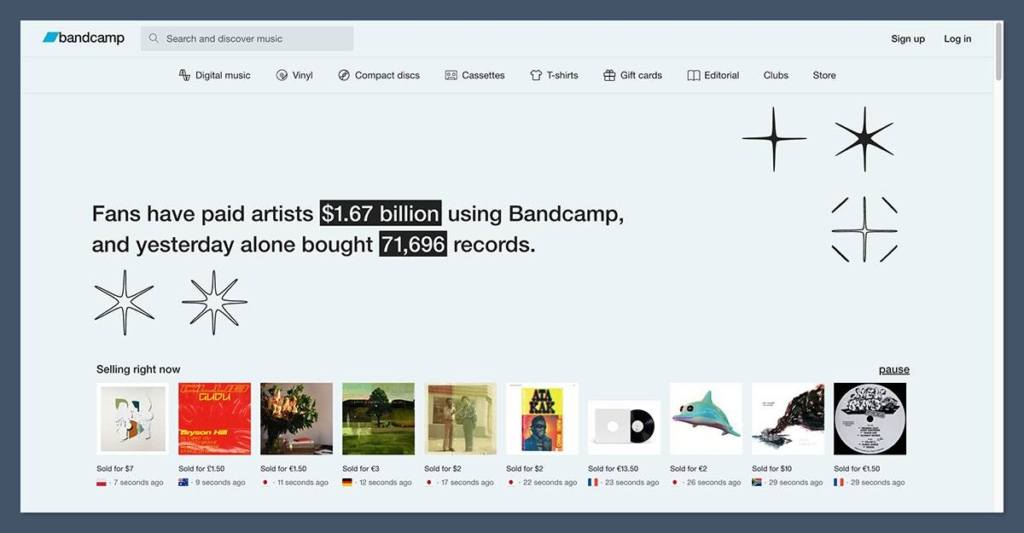
On December 5, 2025, Bandcamp Friday moved $3.8 million to artists and sold 77,031 records in 24 hours. Across 2025, Bandcamp Fridays paid out $19 million, the highest annual total since the program launched, and eight dates are already scheduled for 2026 (Feb 6, Mar 6, May 1, Aug 7, Sep 4, Oct 2, Nov 6, Dec 4). On those days Bandcamp waives its entire cut, so you keep everything above payment processing.
Bandcamp is music-first, and its real value is discovery: a built-in audience of active buyers who find artists they would never have searched for. That justifies the fee early in a career. You can sell digital albums, vinyl, cassettes, and merch bundles, and the “name your price with minimum” option lifts the average sale about 18% above your floor (recommended album floors run $9 to $12). C418, the Minecraft composer, used Bandcamp to run a limited cassette box-set pre-order, the kind of physical drop the platform handles well.
Pricing: Free to join. 15% on digital (drops to 10% after $5,000 in rolling 12-month sales), flat 10% on physical, plus processing (~1.9-2.9% + $0.30). Bandcamp Pro is $10/mo for analytics.
Pros
- ✔️ Built-in discovery puts you in front of fans who are already there to buy music.
- ✔️ No upfront cost, so you only pay when you sell.
- ✔️ Bandcamp Fridays give you eight zero-commission sales days a year.
- ✔️ Physical and digital bundles raise average transaction value.
- ✔️ AI-protective, prohibiting AI training on platform content.
Cons
- ❌ Limited branding, since your store looks like Bandcamp, not you.
- ❌ No website, EPK, or ticketing, it is a music store only.
- ❌ Email list requires opt-in, so non-opted buyers are not yours to contact.
- ❌ AI-ban enforcement in 2026 has caused some wrongful account deletions.
A 2026 Stripe migration is adding Apple Pay, Google Pay, and payouts in 135+ currencies with no withdrawal fees. The trade-off stays the same: you rent discovery in exchange for a healthy cut.
Best for: artists whose main product is recorded music and who want built-in discovery with no upfront cost.
Skip if: you already have an established email list and want full branding plus 100% of digital revenue.
3. Bandzoogle: Best All-in-One Website and Store Built for Musicians
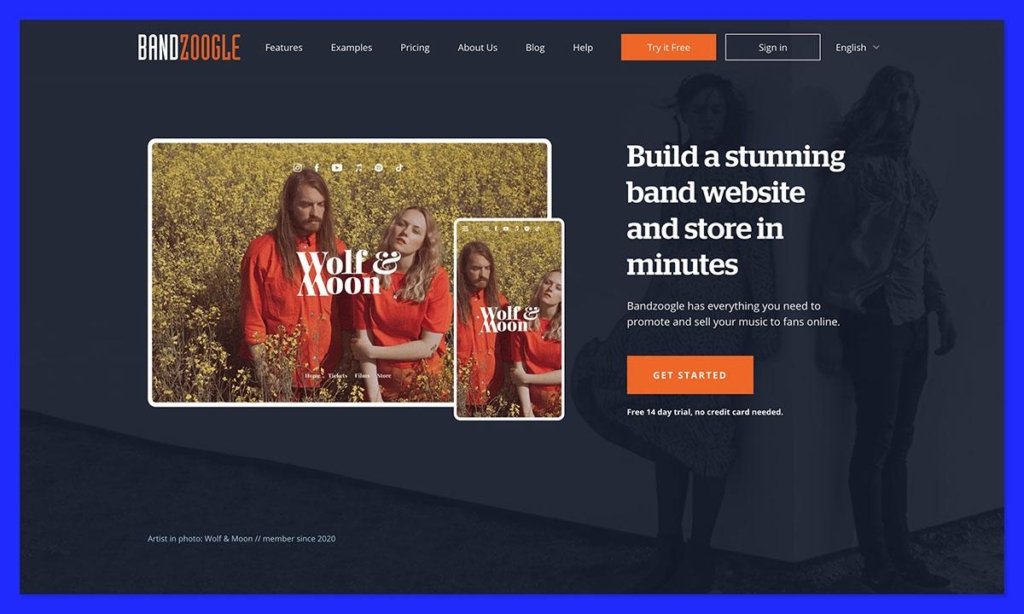
Bandzoogle artists have generated $100 million in cumulative sales, with 75% from merch, 15% from digital music, and 6% from tickets. That number comes from a platform built only for musicians, and it shows in the toolset.
You get an EPK, music player, store, ticketing, fan subscriptions, tips, and an email list in one dashboard, and the platform hands you every buyer’s contact data. Crucially, it charges zero commission on every plan, so you keep 100% above payment processing. During COVID, Toronto band Enter the Haggis averaged $5,000 per livestream listening party run through their Bandzoogle site, with no touring at all. Pair Bandzoogle Pro with Printful and you get commission-free, zero-inventory merch: upload artwork as a 300 DPI PNG, set a 20%+ markup, and orders fulfill automatically.
Pricing: Merch Table Lite $6.95/mo (up to 5 products), Merch Table Pro $24.95/mo (unlimited). Website plans run Lite $11, Standard $17, Pro $22/mo. Pro adds digital file sales, inventory, bundles, tickets, and Printful POD. Zero commission across all tiers.
Pros
- ✔️ Musician-native, with EPK, player, store, tickets, and email under one roof.
- ✔️ Zero commission on every plan and tier.
- ✔️ Owns your fan data, so you control every customer contact.
- ✔️ Printful POD on Pro means no inventory risk.
- ✔️ Free trial on Merch Table Lite, no credit card required.
Cons
- ❌ Fewer integrations than Shopify.
- ❌ Fewer templates and less customization than Squarespace.
- ❌ Not a marketplace, so there is no built-in discovery to lean on.
- ❌ Less flexible for large or complex catalogs.
Bandzoogle is the natural graduation from Bandcamp. As CEO Stacey Bedford puts it, Merch Table Lite “opens the door for more artists to start selling merchandise quickly.” You trade Bandcamp’s discovery for full ownership and 0% commission, which is the right swap once you have fans to drive yourself.
Best for: DIY musicians who want a branded all-in-one site, want to keep 100% of sales, and want to own their fan data.
4. Big Cartel: Best Free Store for Indie Merch
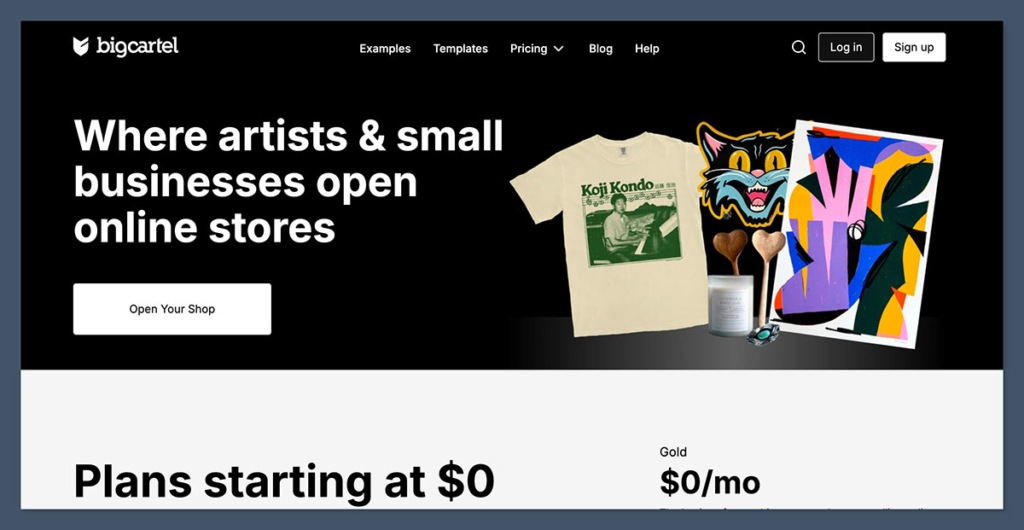
You can have a live merch store today for $0. Big Cartel’s Gold plan is free for up to five products, and the platform charges 0% transaction fees on every tier, so your only real cost is Stripe (2.9% + $0.30) or PayPal (3.49% + $0.49).
That simplicity is the point. The artist-friendly editor needs almost no technical skill, and a small band can list a t-shirt, hoodie, sticker pack, CD, and tote, then link it straight from a social bio. Big Cartel crossed 300,000 shops and processed $280 million+ in 2024, the same year it added Venmo, bulk inventory tools, Google Shopping, and discounted shipping (up to 90% off in the US and Canada).
Pricing: Gold free (5 products), Platinum $12-15/mo (25 products), Diamond $20/mo. 0% platform fee on all plans; you pay only payment processing.
Pros
- ✔️ Genuinely free to start on the Gold plan.
- ✔️ Zero platform fees on every tier.
- ✔️ Dead-simple setup, with minimal technical knowledge needed.
- ✔️ 2024 upgrades include Venmo, bulk tools, and discounted shipping.
Cons
- ❌ No native digital delivery, so you cannot sell music files directly.
- ❌ Product caps of 5 free and 25 on the mid tier.
- ❌ No built-in POD, requiring an external service like Printful.
- ❌ No email marketing tools built in.
Big Cartel is physical-merch only. If you also need to sell music files, look at Bandcamp or Bandzoogle instead, and treat Big Cartel as the zero-cost option for bands that just want a clean store for a handful of items.
Best for: bands with a small number of physical merch items who want a free, simple store and zero platform fees.
5. Shopify: Best for Scaling Bands and Serious Merch Operations
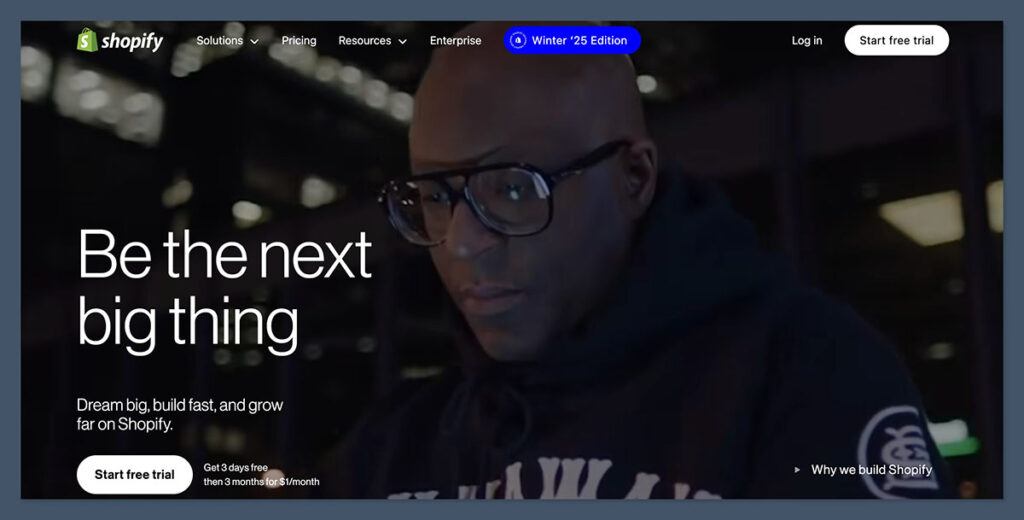
“Most brands that ask how much Shopify costs are asking the wrong question.” The platform fee is only the start. Add payment processing and apps ($350-1,400/mo for a real stack), and a small creator’s monthly bill can climb past $639. Go in with eyes open and Shopify is the most powerful pick here.
Shopify offers best-in-class product, inventory, and order management, full customer data ownership, and room to scale from a small band to a large touring act without switching tools. With Shopify Payments there is no extra transaction fee beyond processing (2.9% + $0.30 on Basic, lower on higher tiers); third-party gateways add 2.0%, 1.0%, or 0.6%. Music features come from apps: the Single app handles music sales, livestreams, and chart reporting, Printful or Printify cover POD, and Bundles ties ticket, album, and merch combos together.
Pricing: Starter $5/mo (buy buttons only, no real storefront), Basic $39/mo ($29 annual), Grow $105/mo ($79 annual), Advanced $399/mo ($299 annual), Plus from $2,300/mo. Annual billing saves about 25%.
Pros
- ✔️ Best-in-class inventory and order management.
- ✔️ Scales from a small band to a large touring operation.
- ✔️ Full data ownership, so you can build a real CRM.
- ✔️ Huge app ecosystem, including the Single app and POD services.
- ✔️ Sidekick AI included on all plans in 2026.
Cons
- ❌ Real monthly cost, with total spend often far above the headline fee.
- ❌ No music features out of the box, apps required.
- ❌ Steeper learning curve than Bandzoogle or Bandcamp.
- ❌ No built-in discovery, you drive 100% of traffic.
The break-even is concrete: Shopify Basic only beats Bandcamp’s 15% above roughly 44 albums a month at $10. On 100 sales, Bandcamp nets about $825 while Shopify nets about $902. Many growing acts run both, keeping Bandcamp for discovery and Shopify for loyalists.
Best for: established artists and bands with real sales volume who want full control and room to scale.
Skip if: you sell fewer than about 40 items a month, since the monthly fee will eat your margin. Start free on Big Cartel or Bandcamp.
6. Gumroad: Best for Selling Digital Goods With No Monthly Fee
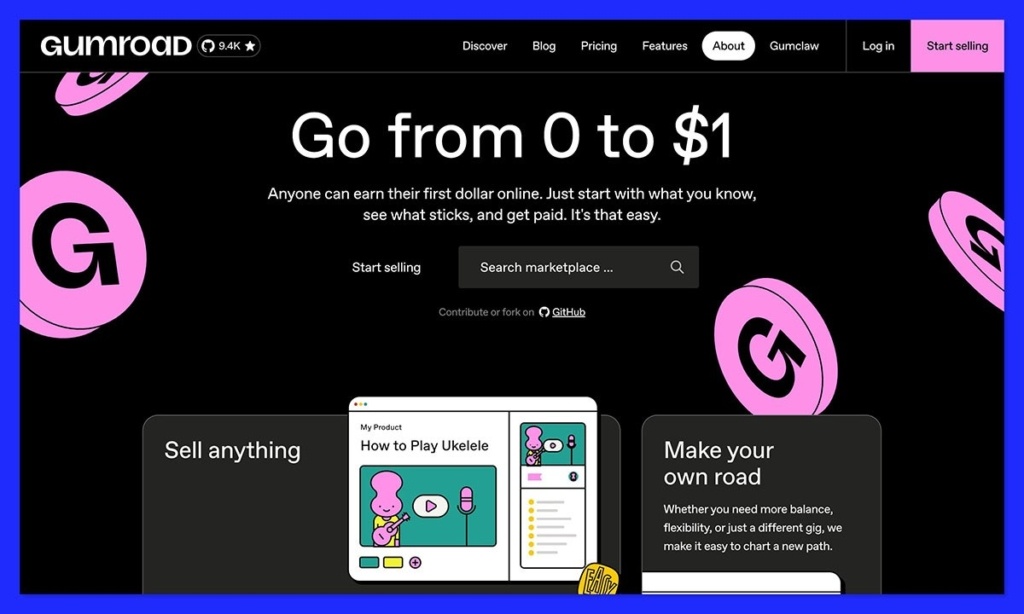
Here is the trap to watch: fans you gain through Gumroad’s own Discover marketplace cost you a flat 30% per sale, three times the 10% rate you pay on traffic you bring yourself. That single fee turns Gumroad’s “discovery” into the most expensive way to grow on the platform.
For everything else, Gumroad is the friction-free pick. There is no monthly subscription, so you pay only when you sell, which makes it ideal for low-volume producers shipping sample packs, beat licenses, sheet music, or the occasional album. Setup is fast: upload an album as MP3/WAV/FLAC, a sample pack as a ZIP, or beats as a PDF plus MP3 bundle, and turn on pay-what-you-want pricing.
Pricing: No monthly fee. 10% flat per sale plus processing (~2.9% + $0.30), so about 13% effective. Sales via the Discover marketplace are charged a flat 30%.
Pros
- ✔️ No monthly fee, you pay only when you sell.
- ✔️ Fast setup for digital downloads of any format.
- ✔️ Pay-what-you-want pricing built in.
- ✔️ Supports subscriptions and memberships.
Cons
- ❌ 10% per sale gets expensive as volume climbs.
- ❌ 30% Discover fee cannibalizes marketplace revenue.
- ❌ Limited branding for your storefront.
- ❌ No music discovery feature.
Gumroad is the right home until your digital sales become consistent. Once you are clearing around $1,000 a month, the percentage model starts costing more than a flat subscription would, which is exactly where the next pick takes over.
Best for: producers and artists selling digital goods at low volume who want zero monthly cost.
7. Sellfy: Best for High-Volume Digital and Print-on-Demand Sellers
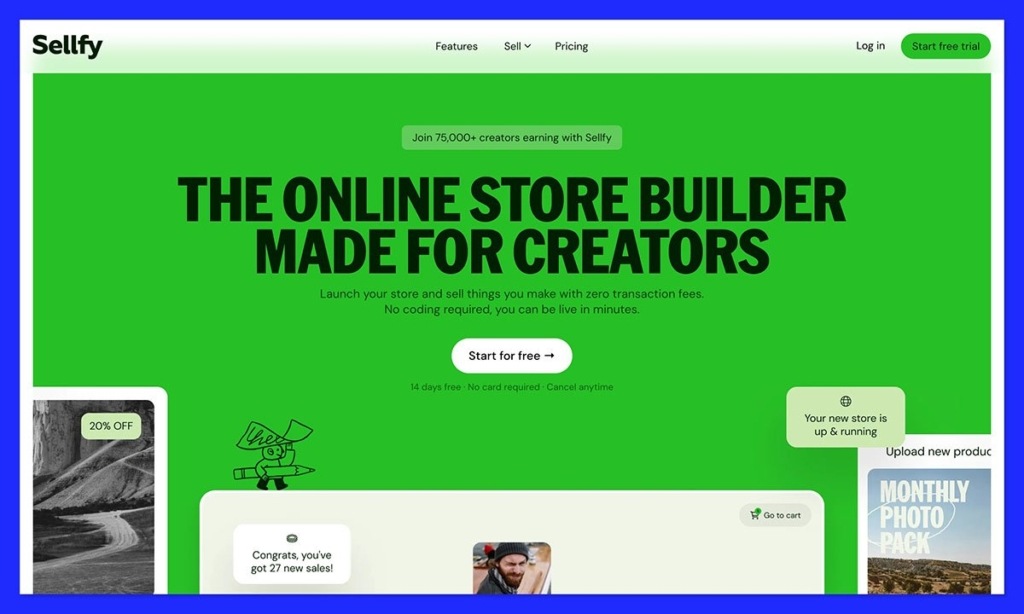
At what point does paying $29 a month actually make you more money than a free plan? For digital sellers, the answer is around $1,000 a month in sales. That is where Sellfy’s flat fee plus 0% transaction cost overtakes Gumroad’s 10% cut.
Sellfy charges 0% transaction fees on every plan, so you keep 100% above Stripe or PayPal processing. It combines digital products, built-in POD merch, and subscriptions in one dashboard, with email marketing, coupons, and upselling tools included. For a producer moving sample packs, beat licenses, and loop kits consistently, that bundle stops the percentage bleed that Gumroad inflicts at volume.
Run the numbers and the case is plain. At $1,000 a month in sales, Gumroad’s 10% cut takes $100, while Sellfy’s $29 Starter plan costs a flat $29 no matter how much you sell. The gap only widens as your volume climbs, which is why higher-volume digital sellers graduate here.
Pricing: Starter $29/mo, Business $79/mo, Premium $159/mo (annual rates). 0% transaction fees on all plans. Cost-effective versus Gumroad at roughly $1,000+/month in sales.
Pros
- ✔️ 0% transaction fees on every plan.
- ✔️ Digital, POD, and subscriptions in one dashboard.
- ✔️ Built-in email marketing, coupons, and upselling.
- ✔️ Better math than Gumroad once you sell consistently.
Cons
- ❌ Monthly cost makes it wrong for low-volume sellers.
- ❌ No marketplace discovery built in.
- ❌ Less name recognition among music fans than Bandcamp.
- ❌ Starter $29/mo rarely pays off for true beginners.
The verdict comes down to one number. Below about $1,000 a month, stay on Gumroad; above it, Sellfy’s 0% fees put more in your pocket every single month.
Best for: producers selling $1,000+/month in digital goods who want 0% fees and built-in POD.
8. Squarespace Commerce: Best for a Polished Brand Website With a Store
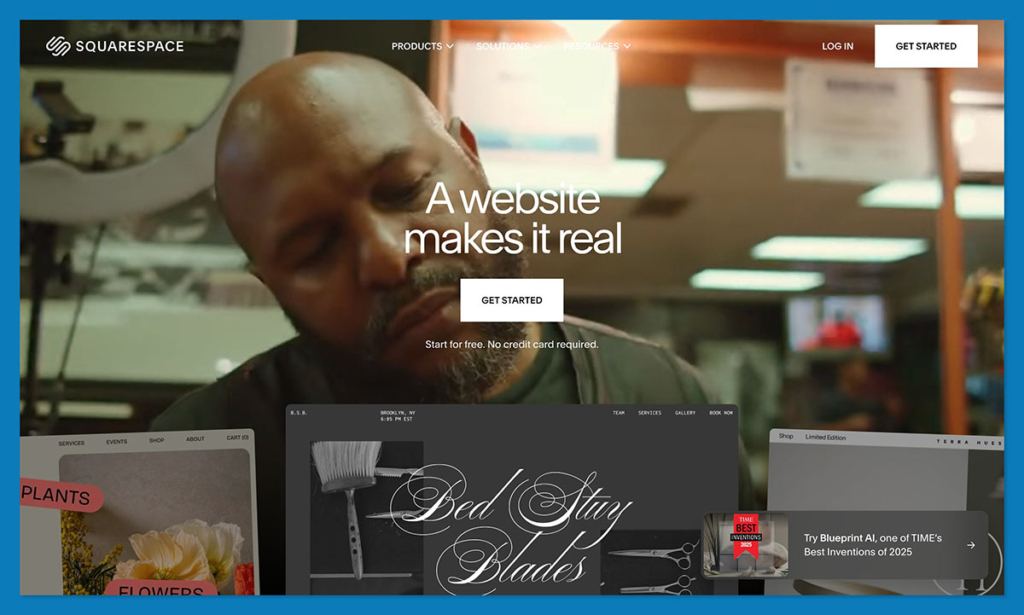
Watch the Basic plan. At $16/mo it quietly charges 2% on product sales and 7% on digital content and memberships, fees that add up fast for anyone selling regularly. The real Squarespace selling plan starts at Core ($23/mo), which drops online-store transaction fees to 0% and digital content to 5%.
Where Squarespace earns its place is design. Its templates are genuinely professional and suit musician branding, and you get website hosting, store, email marketing, and SEO tools in one platform. You can sell digital albums and audio with timed access, though there is no EPK, music player, or ticketing. If you already have a site you love, Ecwid is the lighter alternative: embed a store into any existing site, free for up to 10 products, with 0% fees.
Pricing: Basic $16/mo (2% / 7% fees), Core $23/mo (0% store / 5% digital), Plus $39/mo, Advanced $99/mo. Push past Basic to Core for serious selling.
Pros
- ✔️ Professional templates well-suited to musician branding.
- ✔️ All-in-one hosting, store, email, and SEO.
- ✔️ Sells digital albums with timed access.
- ✔️ 0% store fees on Core and above.
Cons
- ❌ Basic-plan fees of 2% and 7% quietly erode revenue.
- ❌ Not music-specific, with no EPK, player, or ticketing.
- ❌ Fewer integrations than Shopify.
- ❌ Higher entry cost than Big Cartel or Gumroad.
Best for: artists who want a polished branded website first and a capable store second, on the Core plan or higher.
Skip if: your top priority is selling music files or the lowest possible fees, where a musician-native tool like Bandzoogle fits better.
9. Patreon: Best for Recurring Income From Fan Memberships
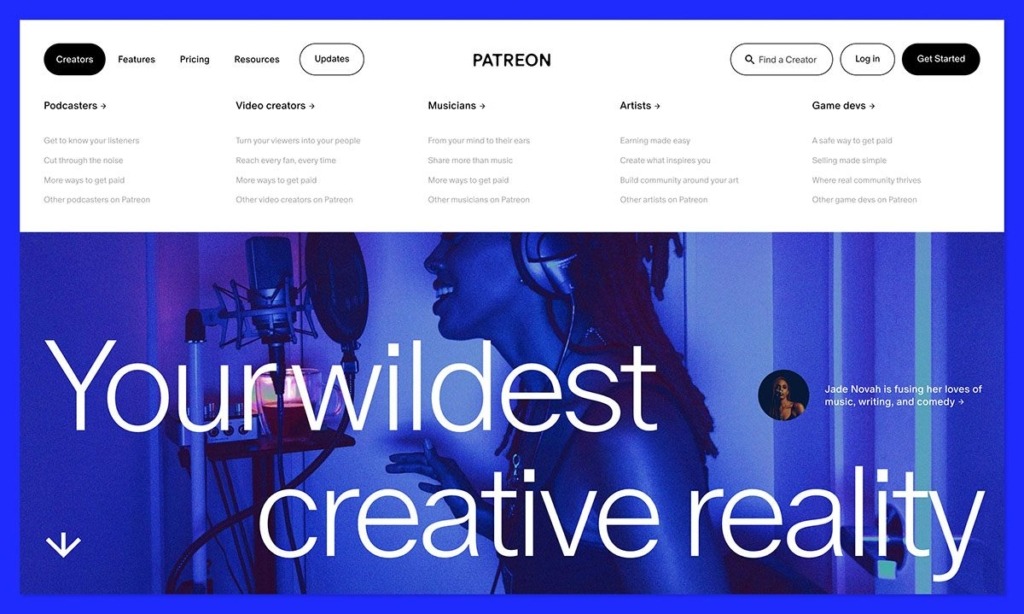
The fees punish small pledges hard. A $1 pledge loses 25% to fees, a $10 membership nets about $8.41, and iOS subscribers signing up through the app can cost you 40%+ of revenue once Apple takes its 30% cut. Know that going in and Patreon still earns a spot, because predictable monthly income is worth a lot.
Patreon is not a storefront; it cannot sell merch or music files directly. It is the recurring-revenue complement to a real store, best run alongside Bandcamp or Bandzoogle. Tiered memberships and community features (posts, polls, Discord, direct messaging) let you build something steady, for example $5/mo for demos, $15/mo for live recording streams, and $30/mo for monthly one-on-one video chats. Set against streaming, 1,000 members at $99/year equals roughly 25 million streams, which is why memberships still matter despite the cut.
Pricing: No monthly fee. ~10% platform fee plus processing (2.9% + $0.30), about 13-14% total. Legacy plans (Lite 5%, Pro 8%, Premium 12%) survive only while the page stays published. iOS in-app purchases add 30%.
Pros
- ✔️ Predictable recurring revenue from memberships.
- ✔️ Tiered content at multiple price points.
- ✔️ Community features built in (Discord, polls, messaging).
- ✔️ Strong complement to a 0%-commission store.
Cons
- ❌ Small pledges crushed, a $1 pledge loses 25%.
- ❌ iOS adds 30%, costing some creators 40%+ of revenue.
- ❌ Not a storefront, so no merch or music-file sales.
- ❌ Constant content demand to retain patrons.
I recommend pairing Patreon with a 0%-commission store and steering fans to pledge on the web rather than through the iOS app. That one habit alone protects a big slice of your membership income.
Best for: artists with an engaged community who want recurring income alongside (not instead of) a store.
How to Choose the Right Platform for Your Stage and Budget
The right platform is not the cheapest or the most powerful. It is the one that matches what you sell and how much you sell right now. Work through three questions.
1. What do you sell?
- Music files: Bandcamp, Bandzoogle, or Sellfy.
- Physical merch only: Big Cartel, Fourthwall, or Shopify.
- Digital goods (samples, beats): Gumroad or Sellfy.
- All-in-one site: Bandzoogle or Squarespace.
- Recurring community income: Patreon.
2. What stage are you at?
- Under $500/mo or fewer than 500 subscribers: start free (Bandcamp, Big Cartel Gold, Fourthwall).
- Over $500/mo or 500+ subscribers: add your own store (Bandzoogle, Shopify). Remember the Shopify-vs-Bandcamp break-even sits near 44 albums a month.
- The long game: run both, using Bandcamp for discovery and your own store for loyalists.
3. POD or bulk inventory?
- POD (Printful for quality and embroidery, Printify for catalog and price) means zero upfront risk and about 48% margin, but online-store only. Fulfillment takes 3-7 days, so it is not for live shows.
- Bulk delivers about 71% margin at 50+ units, ideal for tour inventory.
- Recommended: POD for the online store, bulk for shows, and test designs on POD before committing to a bulk order. Heed Ari Herstand’s warning and never put others’ logos on merch.
One more decision sits underneath all three: own your data. Prioritize platforms that give you buyer emails (Bandzoogle, Shopify, Sellfy, Fourthwall) over marketplace lock-in (Bandcamp opt-in only, Etsy, Amazon). Email drives 40x higher customer acquisition than social, and an algorithm can collapse your reach overnight.
| Your stage / What you sell | Monthly sales | Recommended platform | Why |
|---|---|---|---|
| Just starting, physical merch | $0 | Big Cartel free or Fourthwall | No cost, 0% platform fee |
| Just starting, music | Under $500 | Bandcamp | Free plus built-in discovery |
| Growing, music or merch | $500+/mo | Bandzoogle or Shopify | Own your data, lower per-sale cost |
| Producer, digital goods | Under $1k / $1k+ | Gumroad / Sellfy | Fee model crossover at ~$1,000 |
| Engaged community | Any | Patreon + a store | Recurring income alongside sales |
Frequently Asked Questions About Selling Music and Merch Online
Do I need to pay a monthly fee to start selling music online?
No. Several platforms let you start at $0. Bandcamp is free, taking 15% on digital or 10% on physical only when you sell. Big Cartel’s Gold plan is free for up to five products, Gumroad is free with a 10% per-sale fee, and Fourthwall charges no monthly fee with 0% on physical products. Bandcamp is the fastest free path.
Which platform takes the lowest cut of my sales?
Big Cartel, Bandzoogle, and Shopify (with Shopify Payments) take 0% platform fee, so you pay only processing at roughly 2.9% + $0.30. Fourthwall is 0% on physical and POD products. Bandcamp at 15% and Patreon at about 10% sit at the high end, though both bundle in audience or community value.
Should I use Bandcamp or build my own website?
Use Bandcamp if you earn under $500 a month or have fewer than 500 email subscribers. Add your own store (Bandzoogle or Shopify) once you pass either mark. The break-even versus Shopify Basic is about 44 album sales a month at $10. Long term, run both: Bandcamp captures new fans, your own site converts existing ones at higher margins.
Do I own my fan email list on Bandcamp?
Only partly. Fans who actively opt into your mailing list can be exported from your Bandcamp tools page, and those contacts are yours. Fans who buy without opting in are not, and Bandcamp will not give you their email addresses. For full ownership of every buyer’s contact, use Bandzoogle, Shopify, Sellfy, or Fourthwall instead.
Can I sell both digital downloads and physical merch on one platform?
Yes. Bandcamp, Bandzoogle, Sellfy, Fourthwall, and Shopify all handle digital downloads and physical merch together, often as bundles. Big Cartel is the exception, since it supports physical merch only and has no native digital delivery. If selling music files matters, cross Big Cartel off and pick one of the others.
What is print-on-demand and should my band use it?
Print-on-demand prints and ships each item only after a fan orders, so you hold zero inventory and risk nothing upfront. Margins run about 48%, lower than bulk ordering’s 71%, and fulfillment takes 3-7 days. Use POD for your online store and for testing which designs sell, but order bulk inventory for live shows where fans expect merch in hand.
What is Bandcamp Friday?
Bandcamp Friday is a monthly event where Bandcamp waives its entire revenue share, so artists keep 100% of sales minus payment processing. In 2025 these days paid out $19 million, the highest annual total ever, including $3.8 million on December 5 alone. Eight dates are scheduled for 2026, ideal for timing album launches and exclusive drops.


