
 By Bogdan Rancea


Enterprise ecommerce platforms aren’t just about selling products—they’re about managing huge inventories, scaling across regions, integrating with other systems, and delivering a seamless experience across every touchpoint.
Whether you’re replatforming or launching a high-growth store, I’ve tested and researched the most reliable enterprise ecommerce solutions on the market.
Below are my top recommendations for 2026, based on platform features, pricing, scalability, integrations, and overall value for large businesses.
The 2025-2026 shift to AI agents and the mass migration off SAP Commerce (Hybris) have reshuffled the landscape, pushing Shopify Plus and commercetools to the front at the $50M+ GMV tier.
Quick Comparison: Best Enterprise Ecommerce Platforms
| Platform | Best For | Starting Price (USD) | Headless Support | Free Trial | AI Features |
|---|---|---|---|---|---|
| Shopify Plus | Fast-scaling DTC brands | $2,300/month+ | Partial | Contact sales | Yes |
| BigCommerce Performance (ex-Enterprise) | SEO and catalog-heavy businesses | Custom, from $1,499/month | Yes | Yes | Yes |
| Adobe Commerce (Magento) | Deep customization and B2B | $22,000/year+ (self-hosted) / $40,000/year+ (cloud) | Yes | No | Yes (Adobe Sensei) |
| Salesforce Commerce Cloud | Salesforce-powered ecosystems | $250,000/year+ | Yes | No | Yes (Agentforce) |
| Commercetools | Fully custom, API-first builds | From $3,333/year (Core), enterprise $40,000+/year | Yes | No | Limited (API-first) |
| VTEX | Global brands & marketplaces | $2,000-$10,000/month + 0.5-1% GMV | Yes | Yes | Yes |
| Elastic Path | Composable commerce experiences | ~$50,000/year+ | Yes | Yes | Yes (AI catalog tools) |
Our Top 7 Enterprise Ecommerce Platforms for 2026
1. Shopify Plus – Best for Fast-Scaling Brands
Rating: 4.8/5
Starting price: $2,300/month (3-year term)
Headless support: Limited
Best for: High-growth brands needing ease, speed, and reliability
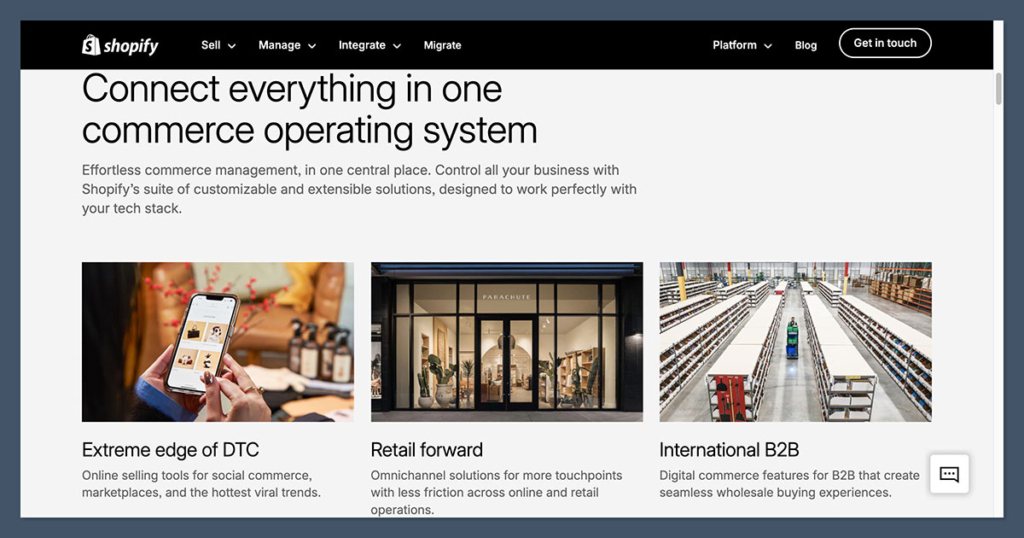
Shopify Plus is built for brands scaling fast. You can run high-traffic stores, manage flash sales, and integrate with major systems without much tech overhead. The real win here is speed: Shopify Plus gets you up and running fast, with built-in tools and robust performance. During testing, setup times were faster than most other platforms, especially when launching multiple storefronts or handling large product catalogs.
The published floor is now $2,300/month on a 3-year term, and once you cross roughly $800,000 in monthly GMV, pricing shifts to a variable rate of 0.25% to 0.40%. Real all-in costs with apps, development, and transaction fees commonly land between $5,000 and $25,000 per month. The upgrade inflection point sits around $1M to $2M in annual GMV, according to practitioner consensus.
Shopify Magic and Sidekick are included free on every plan. Sidekick can now build Shopify Flow automations from natural language, generate basic custom apps, and surface proactive insights through Sidekick Pulse. Shopify Plus carries an exclusive 99.99% uptime SLA, and Gartner named it a Leader for the third consecutive year, ranking it first in the new AI-Enabled Commerce use case.
There’s a real catch. The forced Checkout Extensibility migration broke merchant tracking and custom checkout logic throughout 2025-2026, and Shopify Scripts stopped working on June 30, 2026. Stores that relied on Scripts had to redevelop with Shopify Functions, a non-trivial lift for many teams.
✔️ Pros
- Excellent uptime and speed
- Native POS, payment, and shipping solutions
- Built-in automation (Shopify Flow)
- Huge ecosystem of apps
- Free AI assistant (Sidekick) on every plan
❌ Cons
- Checkout customization remains limited
- Liquid template language has a learning curve
- Higher transaction fees without Shopify Payments
- Forced Checkout Extensibility migration disrupted live stores
Who it’s best for
Direct-to-consumer brands like Gymshark, Kylie Cosmetics, and Allbirds. Perfect for brands needing a low-maintenance platform that scales easily.
2. BigCommerce Performance (formerly Enterprise) – Best for SEO and Flexibility
Rating: 4.6/5
Starting price: Custom, from $1,499/month
Headless support: Yes
Best for: SEO-focused brands with large catalogs
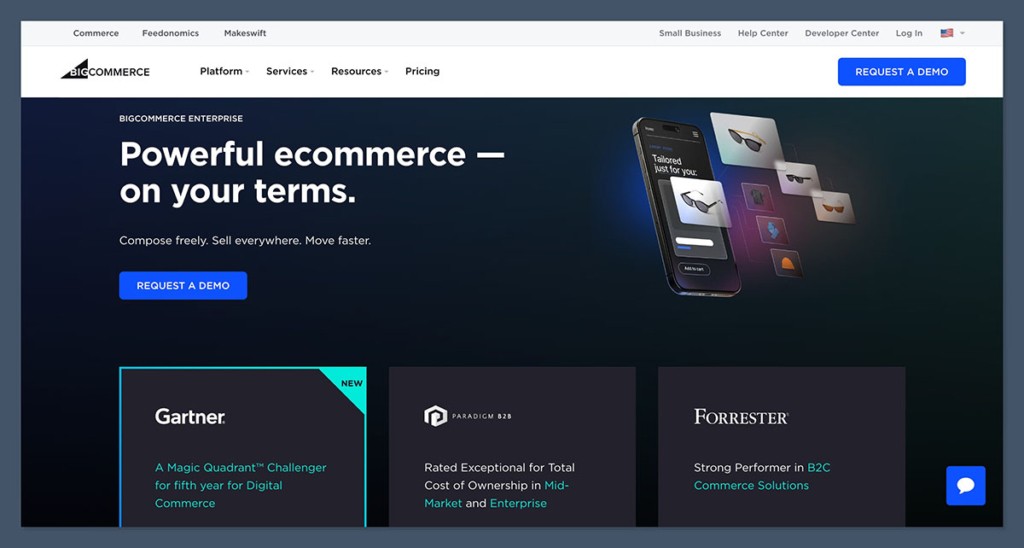
BigCommerce gives you a great blend of native features and design freedom. If SEO matters to you (and it should), this is the better alternative to Shopify. You can build multi-storefront setups, customize URLs, and manage 600+ SKUs without third-party apps. In June 2026, BigCommerce renamed its plans; Enterprise is now called Performance, but all prior enterprise capabilities remain intact at custom-quote pricing starting as low as $1,499/month.
The platform now ships a full B2B Edition natively, including company accounts, custom and tiered pricing, quote management, purchase-order payments with Net 30/60/90 terms, an invoice portal, shared carts, multi-user hierarchies with role-based approvals, and CSV quick ordering. No third-party apps required.
On the AI front, BigCommerce launched an enterprise catalog-export service that formats product data for AI shopping surfaces like ChatGPT, Google AI, Copilot, Perplexity, and Amazon. Launch customer Dell prepared roughly 7,000 products for ChatGPT discovery. An early-access feature built on the Model Context Protocol lets AI agents search a catalog, build a cart, and generate a checkout link.
Gartner named BigCommerce a Challenger for the sixth consecutive year. G2 reviewers rate it higher than Shopify for built-in features like native SEO controls, faceted search, and B2B tooling, while Shopify scores higher for ease of use and apps.
Watch out for the new Open Payment Provider Fee, which adds 0.6% to 2.0% on orders processed through non-embedded payment providers. That’s a genuine new cost to model.
✔️ Pros
- Native faceted search and advanced filtering
- Excellent SEO control
- Multi-storefront from one backend
- No platform transaction fees
- Full B2B suite included (company accounts, quoting, purchase orders)
❌ Cons
- Smaller app ecosystem than Shopify
- Themes can be harder to customize
- Open Payment Provider Fee adds 0.6%-2.0% on non-embedded payments
Who it’s best for
Mid-size to large businesses that need strong SEO, catalog management, and built-in scalability. Also great for businesses that plan to go headless in the future.
3. Adobe Commerce (Magento) – Best for Full Customization
Rating: 4.5/5
Starting price: $22,000/year (self-hosted) / $40,000/year (cloud)
Headless support: Yes
Best for: Custom, complex ecommerce experiences
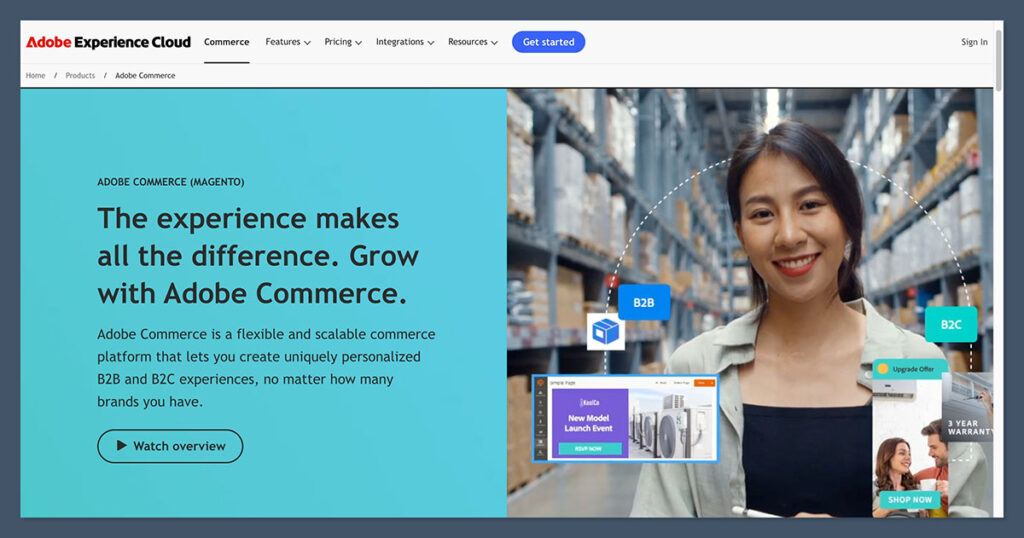
If you have a dev team and a big wishlist, Adobe Commerce is still the powerhouse. You get full control over your storefront, backend, checkout, pricing logic, and integrations. Adobe’s cloud version includes AI features through Adobe Sensei and is bundled into their enterprise ecosystem.
The pricing picture is bigger than the license fee. On-premises licensing starts around $22,000/year, while Adobe Commerce as a Cloud Service starts around $40,000/year. Total cost of ownership, including hosting, implementation, extensions, and maintenance, runs $122,000 to over $450,000 per year. License fees typically represent only 20% to 40% of true annual spend.
Adobe has set Cloud enforcement deadlines: June 1, 2027 for versions 2.4.4/2.4.5, and June 1, 2028 for 2.4.6/2.4.7. After those dates, Adobe will suspend traffic to non-compliant Cloud environments, forcing upgrades that many teams find painful.
AI capabilities are split. Sensei GenAI product recommendations and Live Search are native. The newer agentic AI features, automated pricing updates, content tagging, and AI product bundling, require a separate Adobe Experience Platform license plus the AEP Agent Orchestrator, a real extra cost.
The performance-maintenance burden is well documented. Poor cache management can push page loads from under 2 seconds to 4-6 seconds, and upgrades are notoriously heavy. On the plus side, Adobe offers a 99.95% uptime SLA on the standard tier and 99.99% on Pro. Gartner named it a Leader for the ninth consecutive year.
✔️ Pros
- Fully customizable
- Advanced B2B features (custom pricing, quoting, catalogs)
- Supports multi-brand, multi-language stores
- Rich extension marketplace
❌ Cons
- Expensive to build and maintain (total cost $122k-$450k+/year)
- Long time-to-launch
- Not user-friendly without a development team
- Upgrades and performance tuning require deep expertise
Who it’s best for
Enterprises with complex needs and strong internal tech teams or agency support. Think fashion brands with product personalization, or wholesalers selling across multiple tiers.
4. Salesforce Commerce Cloud – Best for Salesforce Ecosystem Users
Rating: 4.3/5
Starting price: $250,000/year+ (plus mandatory Premier support ~30%)
Headless support: Yes (Composable Storefront)
Best for: Multinational retailers already using Salesforce products
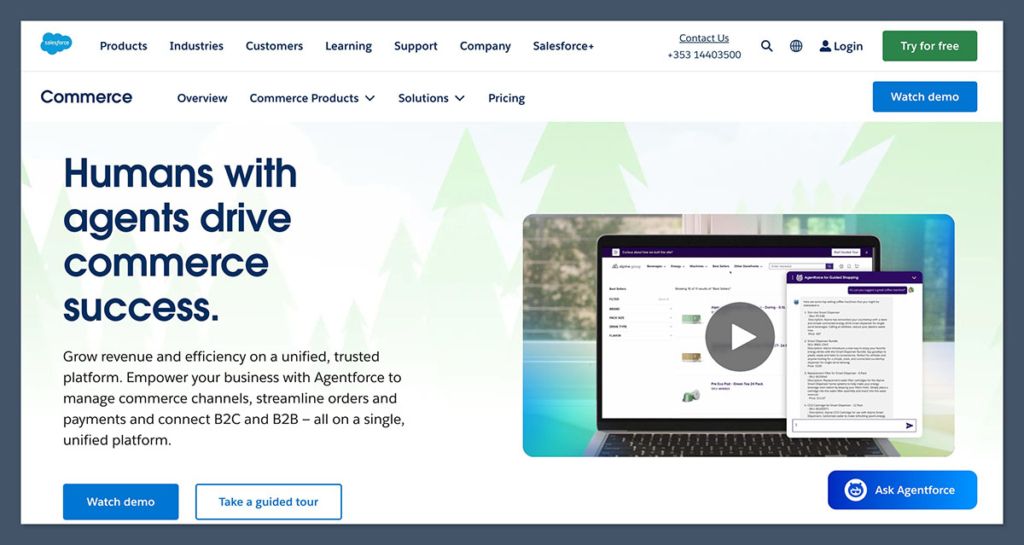
Salesforce Commerce Cloud is built for enterprise retailers managing huge inventories and customer journeys across every channel. It’s tightly integrated with Salesforce CRM, which makes it ideal for personalized shopping, omnichannel marketing, and customer lifecycle tracking.
Pricing is a negotiated percentage of GMV, typically 1% to 3% for B2C, plus a base license. B2B Commerce publishes 1% of GMV/year for Growth and 2% for Advanced. Mandatory Premier support adds roughly 30% on top of net license fees, pushing total cost commonly to $200,000 to over $1,000,000 per year. The old entry benchmark of around $250,000/year still holds as a floor.
Headless support is no longer limited. The React-based Composable Storefront (PWA Kit + Managed Runtime) has been the flagship since 2021, and Salesforce deprecated the older OCAPI in April 2026 in favor of the Commerce API (SCAPI). Older SFRA/OCAPI builds face a real migration lift.
The AI direction is now Agentforce Commerce. Shopper, Buyer, and Merchant Agents hit general availability in June 2026, and a ChatGPT commerce integration went GA in July 2026, with Google Search/Gemini following. Salesforce says AI-assisted retail traffic rose 119% year over year during the 2025 holiday season. A 99.99% platform uptime SLA backs the stack.
The honest drawback: reviewers describe the admin interface as dated, like a legacy system, and implementations remain complex and resource-heavy. Still, Gartner named Salesforce a Leader for the tenth consecutive year, and customers include L’Oréal, Lululemon, Columbia Sportswear, Lacoste, and Puma.
✔️ Pros
- Deep personalization via Agentforce Commerce
- Native omnichannel selling
- Seamless Salesforce CRM integration
- Built-in A/B testing and analytics
❌ Cons
- High cost of entry (total $200k-$1M+/year)
- Long setup time
- Limited design flexibility out of the box
- Dated admin interface and complex implementations
Who it’s best for
Global brands heavily invested in Salesforce tools. Great for those with large digital teams who want a centralized view of customer data and marketing.
5. Commercetools – Best for Headless Commerce
Rating: 4.3/5
Starting price: From $3,333/year (Core), enterprise $40,000+/year
Headless support: Yes (core focus)
Best for: API-first, composable commerce builds
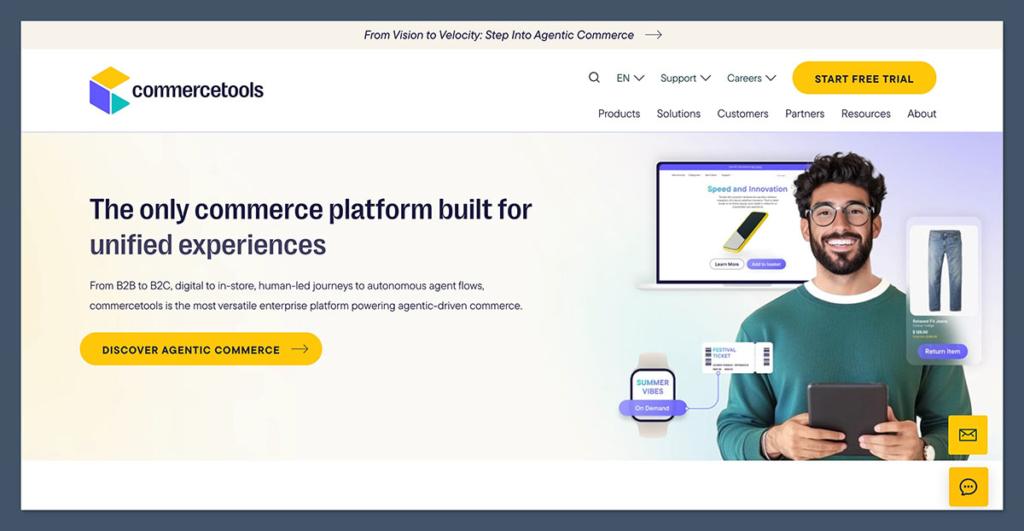
Commercetools is the definition of headless ecommerce. You don’t get a traditional storefront. Instead, you get APIs to build whatever you want: mobile apps, web stores, kiosks, marketplaces. It’s a developer’s playground meant for teams building custom frontends across multiple channels.
Pricing now comes in packaged tiers, Core Commerce at $3,333/year up to Enterprise Custom from $25,000/year, but real enterprise contracts run $40,000 to over $300,000 per year in license fees. License fees are typically only 20% to 35% of first-year spend. No frontend, CMS, or search ships in the box, and systems-integrator engagements run $600,000 to $2 million mid-market, and $2 million to $5 million for large enterprises.
The platform carries a 99.9% standard SLA, with 99.99% available on the Premium add-on. Gartner named commercetools a Leader for the sixth consecutive year, and G2 reviewers praise support quality and API stability. Leadership changed in July 2024 when Andrew Burton became CEO; the company remains independent.
One operational reality: under bursty load, the API can transiently return 502/503 errors, so clients must build retry logic with exponential backoff. The total build cost dwarfs the license fee, a point every team must budget for from day one.
✔️ Pros
- Built entirely on MACH principles
- Scales globally without code refactoring
- Works with any frontend or CMS
- Deep integrations via APIs
❌ Cons
- Requires strong dev team
- No themes or visual editor
- No built-in frontend
- API may return transient errors under load, requiring retry logic
Who it’s best for
Large teams building fully customized, multi-channel commerce experiences from scratch. Ideal for brands using Jamstack or composable architecture.
6. VTEX – Best for Global Brands and Marketplaces
Rating: 4.2/5
Starting price: $2,000-$10,000/month + 0.5%-1% GMV
Headless support: Yes
Best for: Brands selling across multiple channels and countries
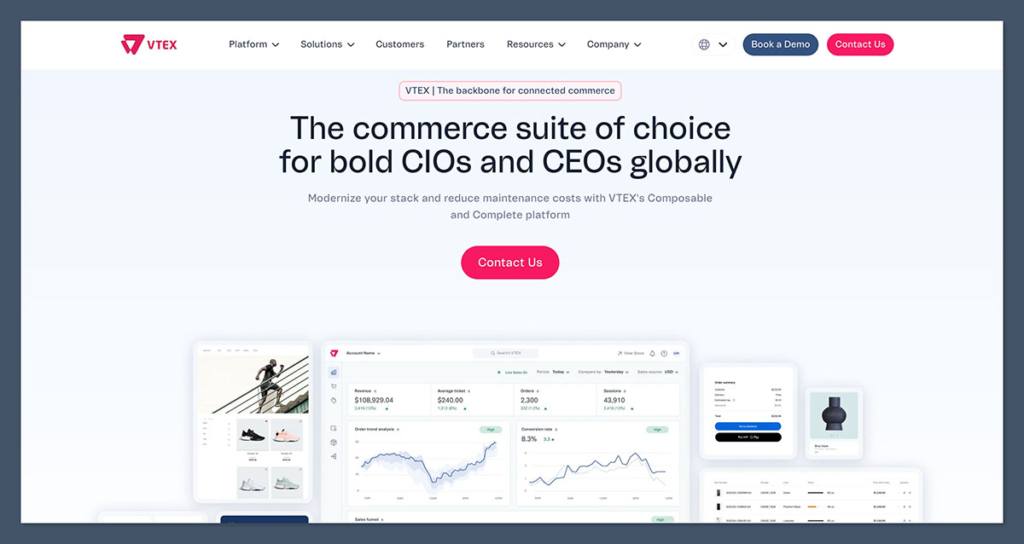
VTEX combines marketplace selling, B2B, and DTC in one platform. It’s growing fast among international retailers because of its unified OMS, strong localization tools, and built-in marketplace functionality. If you’re selling across borders and managing multiple sellers, it deserves a closer look.
Pricing is a fixed subscription of roughly $2,000 to over $10,000 per month plus a take rate of about 0.5% to 1% of GMV. Enterprise implementations run $50,000 to over $500,000. VTEX is publicly traded (NYSE: VTEX) and reported Q2 2026 GMV of $5.7 billion, up 17.8% year over year, with revenue of $64.4 million.
At VTEX Day 2026, the company unified its products into an AI-native suite called AI Workspace and integrated Google’s Universal Commerce Protocol, enabling product discovery and checkout inside Gemini and Google AI Mode. VTEX cites over 91% AI-assisted automation for post-sales tasks like order status, exchanges, and returns.
The platform earned IDC MarketScape Leader recognition and Gartner Peer Insights Customers’ Choice 2025, and Gartner’s 2025 Magic Quadrant named VTEX the top-rated Challenger. G2 reviewers give it 4.5/5 across 37 reviews.
The honest drawback: G2 reviewers report slow page loads during peak traffic, and the GMV take rate adds a variable cost you must budget for.
✔️ Pros
- Built-in marketplace support
- Global-ready (multi-language, multi-currency)
- Strong B2B and B2C features
- Headless support and APIs available
❌ Cons
- Smaller community in North America
- Limited documentation compared to older platforms
- GMV take rate adds variable cost
- Slow page loads during peak traffic (per G2 reviewers)
Who it’s best for
International companies that need flexibility across B2B, DTC, and third-party marketplace selling.
7. Elastic Path – Best for Composable Ecommerce
Rating: 4.1/5
Starting price: ~$50,000/year+ (varies by GMV)
Headless support: Yes
Best for: Teams building modular, composable commerce stacks
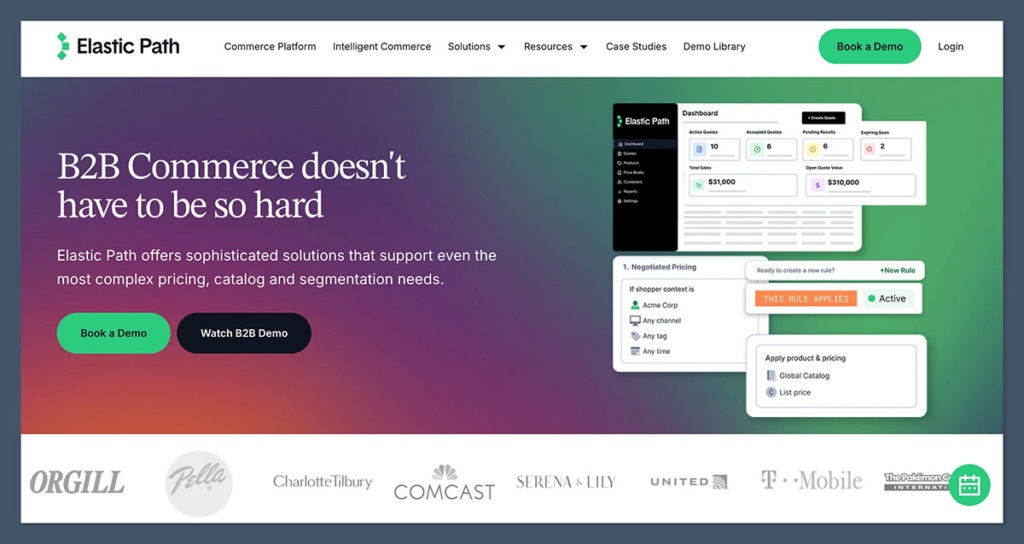
Elastic Path is designed to help brands assemble their ideal tech stack. You can pair it with any CMS, frontend, PIM, or ERP. It’s especially useful for businesses that want to own the frontend experience but don’t want to build ecommerce logic from scratch.
In 2026, the platform added native advanced search, content management, and a hosted frontend to its composable suite. A partnership with ReFiBuy (May 2026) gives merchants tools to optimize product catalogs for AI shopping agents, with early access shipping in the second half of 2026. Elastic Path has raised $149 million in total funding and says its platform has helped customers generate $40 billion in cumulative sales.
Pricing is genuinely variable. Elastic Path’s own guidance cites around $50,000/year as an entry point, while an AWS Marketplace 12-month listing starts at $100,000. Quotes scale by annual GMV band, API call volume, and modules. First-year total cost including implementation commonly reaches $200,000 to over $1,000,000, and implementation alone averages $300,000 to $500,000 for enterprise deployments.
Gartner’s commentary highlights Elastic Path’s strategy of derisking composable commerce through modular packaged business capabilities and its Composer iPaaS. The platform is strongest in telecommunications and manufacturing for complex multi-catalog, multisite builds, though it lacks native unified-retail capabilities like in-store clienteling.
✔️ Pros
- Fully modular, composable architecture
- Works with any CMS, frontend, or PIM
- Native advanced search and content management now included
- Strong in complex multi-catalog, multisite builds
- Early tools for AI shopping agent visibility (ReFiBuy)
❌ Cons
- High implementation cost ($300k-$500k average)
- No native in-store clienteling or unified retail features
- Pricing tied to GMV and API volume, making total cost hard to predict
Who it’s best for
Large teams building modular, composable commerce stacks. Particularly strong in telecommunications and manufacturing with complex multi-catalog, multisite needs.
Key Takeaways
- Shopify Plus is best for fast-scaling DTC brands that want ease, speed, and AI-powered automation
- BigCommerce Performance (formerly Enterprise) offers the best balance between SEO, flexibility, and native B2B capabilities
- Adobe Commerce remains the choice for full custom control but demands a strong development team and budget
- Salesforce Commerce Cloud works well if you’re already in the Salesforce ecosystem and need Agentforce-powered personalization
- Commercetools and Elastic Path are the top picks for headless and composable builds, with Elastic Path now adding native frontend and AI catalog tools
- VTEX is perfect for international brands managing multiple selling models and marketplaces
- The 2025-2026 AI agent shift means every platform now ships agentic commerce features, making AI-assisted selling a baseline expectation for enterprise platforms
Final Thoughts
Choosing the right enterprise ecommerce platform isn’t about chasing the most features. It’s about what fits your infrastructure, team, budget, and growth strategy.
If you want something user-friendly with good built-in tools, go for Shopify Plus or BigCommerce.
If your site needs to run complex workflows and deep customization, look into Adobe Commerce, Commercetools, or Elastic Path.
Before you commit, take advantage of demos, trials, or pilot projects. That’s the best way to test how well a platform actually supports your workflows.


