
 By Bogdan Rancea
The average Shopify store runs 20+ apps, pays over $200/month in subscriptions, and scores a dismal 25-35 on mobile PageSpeed. Third-party scripts eat 62% of total JavaScript on the average store. Most merchants pay a speed tax that costs them more in lost conversions than the apps actually generate in revenue. I tested and tracked revenue data across dozens of apps to find the best Shopify apps that deliver measurable results without destroying your site performance.
Shopify’s 2026 platform updates have shifted the landscape. Sidekick AI, Flow automation, Functions Discounts, and the native TikTok Shop integration have made several paid app categories obsolete. The smartest stores now run 8-12 apps total.
Here is how I evaluated each app on this list:
- Verified revenue impact data (not just star ratings)
- Speed footprint measured in KB of JavaScript added
- Honest downsides and known bugs
- Free tier or trial availability
- Checkout Extensibility compliance for 2026
I ordered apps by measurable impact on revenue. Each entry includes pricing, speed cost, and a clear best-for/skip-if verdict.
I structured the list around a 3-phase app stack approach. Phase 1 covers free tools under $25/month for new stores, Phase 2 covers growth tools for stores doing $10K-$50K/month, and Phase 3 covers scale tools for $50K+ stores. Jump to the apps matching your stage.
1. Klaviyo: Best Email and SMS Marketing App
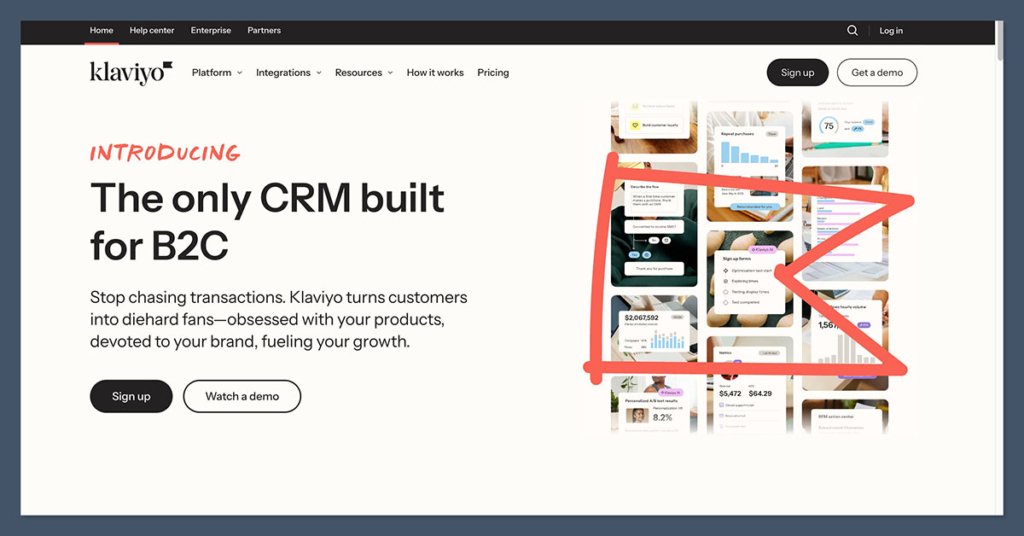
Klaviyo campaigns segmented by five or more criteria generate 760% more revenue than single-segment broadcasts. That number comes from their own platform data, and I’ve seen it hold up. A $600K/month wellness brand grew email revenue share from 18% to 31% in just 90 days using Klaviyo’s deep segmentation.
The app’s native Shopify integration captures over 350 customer data points with millisecond sync. No third-party connector required. Pre-built flows cover abandoned cart recovery, welcome series, browse abandonment, post-purchase follow-ups, and win-back campaigns. The newer K:AI agents handle 60-70% of support volume and recover 10-20 marketing hours monthly through automated campaign generation.
The revenue evidence stacks up across store sizes. An $80K/month home goods brand pushed email revenue share from 12% to 28% within 60 days. Automated flows alone generate 41% of total email revenue from just 5% of sends. That disproportionate return from behavioral triggers is why Klaviyo dominates for growth-stage stores.
Pricing: Free up to 250 contacts. $20/month at 500 contacts. Roughly $100/month at 5,000 contacts. Around $860/month at 60,000 profiles. Contact-based billing means inactive profiles still count toward your bill.
Speed impact: Moderate. Async loading with minimal render-blocking.
Here is what most review sites won’t tell you. Klaviyo has no phone support, and chat support quality complaints are widespread. The platform requires 8-15 hours per week of active management at growth stage.
Billing counts all active profiles, not just engaged ones. One Trustpilot user reported going from $39/month to over $200/month after a billing model change.
If someone signed up two years ago and never bought anything, they still count toward your bill unless you manually suppress or delete them.
Best for: Stores doing $50K+/month with dedicated marketing bandwidth. Skip if: You are under $10K/month or have fewer than 500 contacts. Use Shopify Email (free) or Omnisend instead.
2. Judge.me: Best Free Product Reviews App
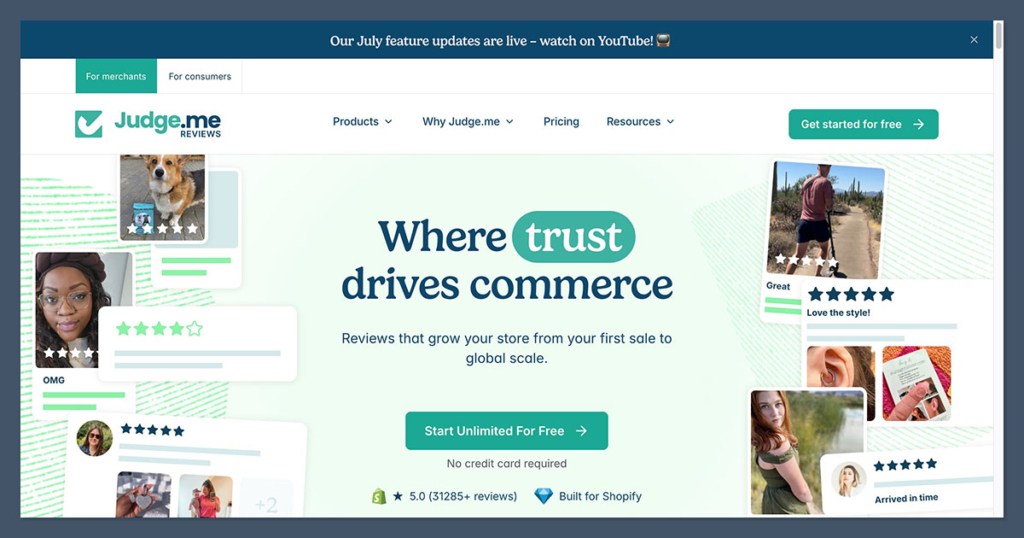
Install Judge.me in 10 minutes and start collecting photo and video reviews with Google rich snippets for free. No catch, no monthly cap, no credit card required.
This is the single highest-ROI free app in the Shopify ecosystem. It holds a perfect 5.0 out of 5 rating from over 41,000 reviews in the Shopify App Store, making it the most-reviewed app on the entire platform. The free plan includes unlimited review requests, photo and video reviews, in-email review forms, review carousels, Q&A, and Google rich snippets. No other review app offers this much at zero cost.
The conversion impact is substantial. Visitors who see reviews are 4x more likely to purchase, and average order value increases roughly 28% when social proof is present during purchase decisions. Pair it with Klaviyo and you can embed dynamic review content directly into abandoned cart recovery flows, adding social proof at the exact moment a customer decides whether to come back.
Pricing: Free forever plan with unlimited reviews. Awesome Plan at $15/month adds coupons, cross-shop syndication, and full customization.
Speed impact: Light, around 100-150KB. Significantly lighter than Loox (180KB) or Yotpo (300-500KB).
The interface can overwhelm beginners with its feature density. Advanced design customization requires some coding knowledge. Default email templates are basic and worth customizing before sending your first review request.
Best for: Every Shopify store, period. The free plan covers 90% of what most stores need. Upgrade to the $15/month Awesome Plan only when you need review syndication across multiple storefronts.
3. ReConvert: Best Post-Purchase Upsell App
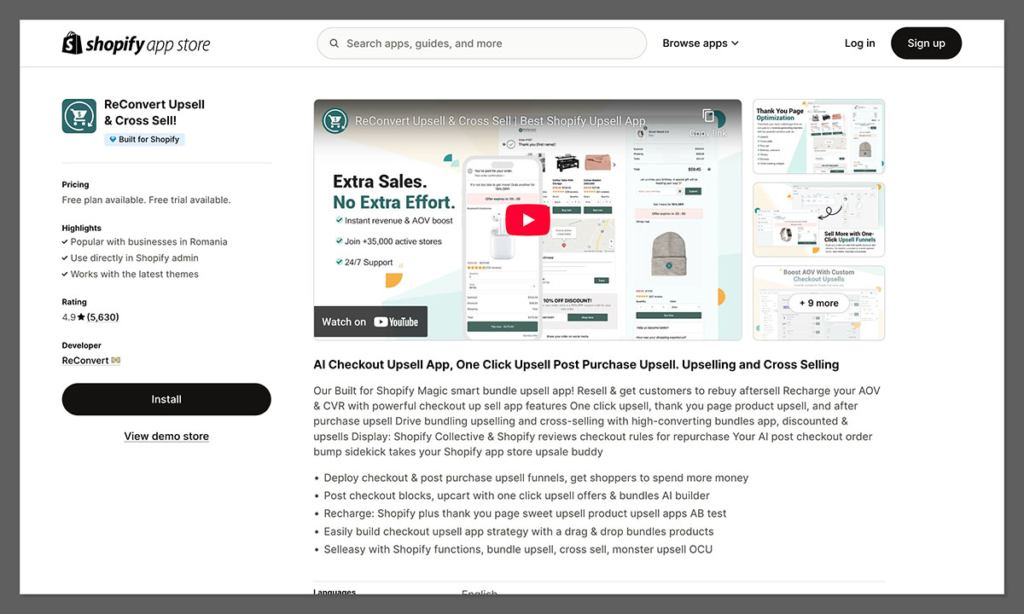
One store added $24,295 in extra sales within 30 days by changing a single page most merchants never touch: the thank-you page.
ReConvert (now rebranded as Upsell.com) turns your post-purchase confirmation into a revenue opportunity instead of a dead end. The drag-and-drop funnel builder lets you add one-click upsells, birthday collection forms, reorder buttons, and cross-sell recommendations. It holds a 4.9 out of 5 rating from over 4,500 reviews and claims a 15% average revenue boost across its user base. One documented user reported a 20% AOV increase without hurting conversion rates.
Pricing: Free plan available. Paid tiers at $4.99/month (49 orders), $7.99/month (99 orders), and $14.99/month (199 orders). Plus a 0.75% commission on extra revenue the app generates.
Speed impact: Minimal on main pages. The app loads only on post-purchase and thank-you pages.
That 0.75% commission adds up fast. At $10K/month in extra revenue, you are paying $75/month on top of the subscription. The UI is challenging to navigate, with non-intuitive settings toggles. Post-purchase pages can load slowly, and the app lacks multi-language support.
Some users report it “rarely resulted in sales and never paid for itself.” Results vary significantly by store type and product catalog, so treat the 15% revenue boost claim as a ceiling, not a floor.
Before installing, verify the app has migrated to Checkout UI Extensions. Non-Plus stores face an August 26, 2026 migration deadline, and apps that have not migrated may break checkout tracking.
The verdict: Worth testing on the free plan. If it generates measurable upsell revenue within 14 days, upgrade. Watch the commission fees as you scale past $5K/month in upsell revenue.
4. Omnisend: Best Budget Email and SMS Alternative
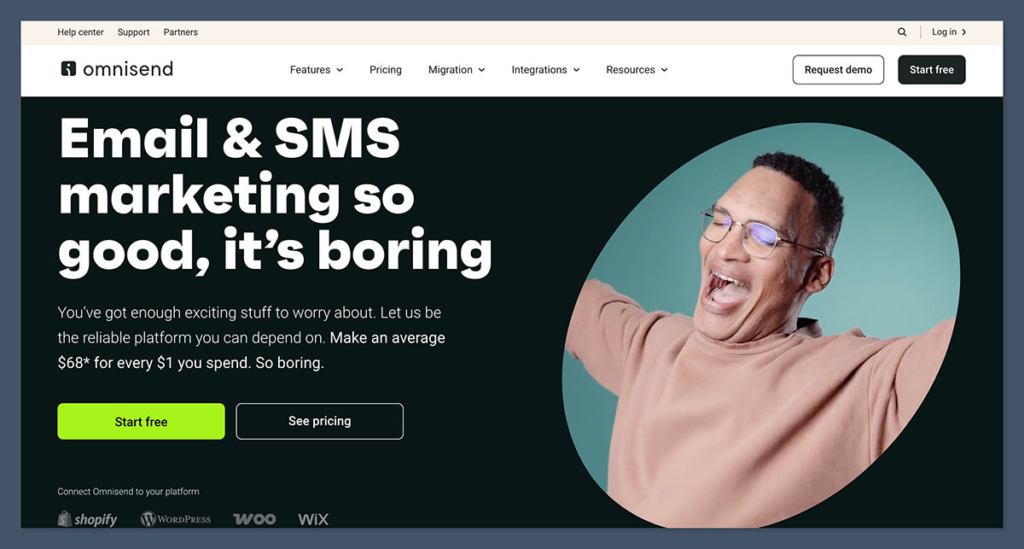
At 25,000 contacts, Klaviyo costs roughly $118/month more than Omnisend. At 5,000 contacts, you are paying around $100/month for Klaviyo email alone versus roughly $65/month for Omnisend email and SMS combined. For most stores under $50K/month, that savings matters.
Omnisend bundles email, SMS, and push notifications on all plans. Pre-built Shopify automation workflows handle the essentials. Segmentation is less advanced than Klaviyo but sufficient for most stores not running hyper-personalized retention campaigns. The app holds 4.7 out of 5 stars from over 6,000 reviews.
The revenue case studies are compelling. Chubby’s achieved a 55% conversion rate on abandoned cart SMS recovery after optimization. Pura Vida generated $1.4 million from push notifications alone, a 106x ROI. Omnisend’s multichannel approach (email plus SMS plus push on every plan) gives you three channels from day one.
Pricing: Free for 250 contacts. Standard plan starts at roughly $16/month at 500 contacts and $65/month at 5,000. Pro plan includes advanced reporting and priority support.
Speed impact: Light. Async script loading with minimal storefront overhead.
Omnisend’s segmentation and predictive analytics lag behind Klaviyo’s. Revenue attribution caps at 18-month history. AI capabilities trail Klaviyo’s K:AI agents. For stores over $100K/month that need deep customer intelligence, Omnisend will feel limiting.
Best for: Stores doing $10K-$50K/month that want 80% of Klaviyo’s value at 60% of the cost. Skip if: You are over $100K/month and need deep customer intelligence. Graduate to Klaviyo only when you have the team bandwidth and data volume to justify its complexity.
5. Shopify Flow: Best Free Automation App
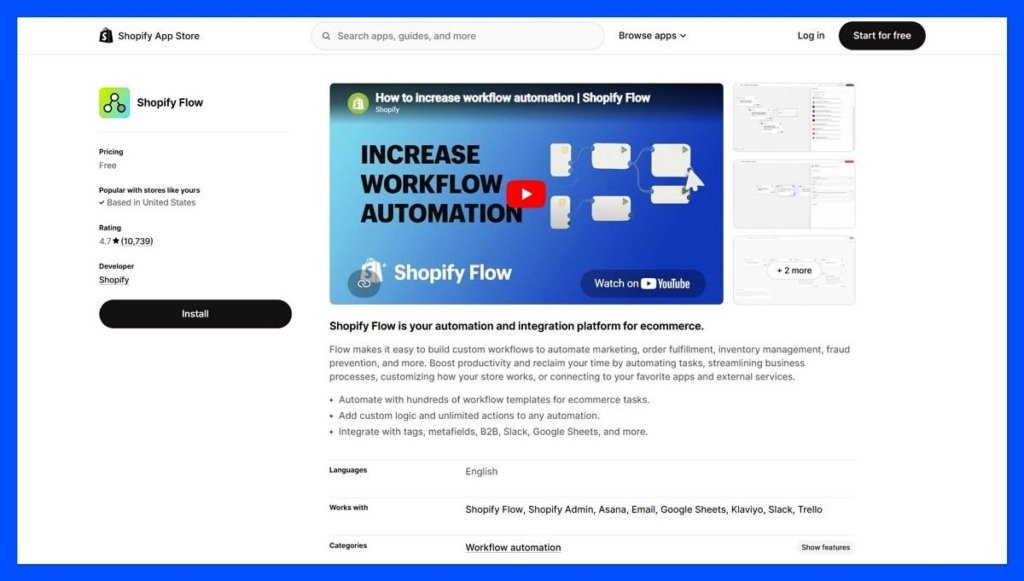
Shopify Flow is free, built into every Shopify plan, and according to app analysts at Oxify, it “replaces half the paid apps” most merchants install. If you are paying for a separate automation tool, you are probably overpaying.
The visual workflow builder automates store tasks you would otherwise handle manually. Sidekick AI generates complete workflows from plain-language prompts in roughly 3 minutes, down from 30 minutes of manual setup. Type something like “Tag customers as VIP when they place an order over $200” and Sidekick builds the entire automation.
Its Test Run Preview feature shows each condition marked as true or false, with the execution path lit up step-by-step using sample data. No risk to live orders, customers, or inventory. Flow handles customer tagging, inventory alerts, fraud flagging, abandoned cart recovery, and scheduled reports. Workflow Run Cancellation prevents cascading errors by letting you cancel failing runs individually or in bulk.
Pricing: Free. Built into all Shopify plans. The Plus plan unlocks 40+ additional triggers.
Speed impact: Zero. Runs entirely server-side with no JavaScript added to your storefront.
The most powerful triggers (40+) require Shopify Plus. Complex multi-step workflows still demand some technical understanding. There is no visual analytics dashboard for workflow performance. Third-party automation tools like Alloy offer deeper cross-app integrations for advanced use cases.
Best for: Every Shopify store. Install and activate before paying for any automation tool. Even if you only use it for customer tagging and inventory alerts, it saves money immediately. Audit your paid automation tools for overlap with what Flow already does.
6. Loox: Best Visual Reviews and UGC App
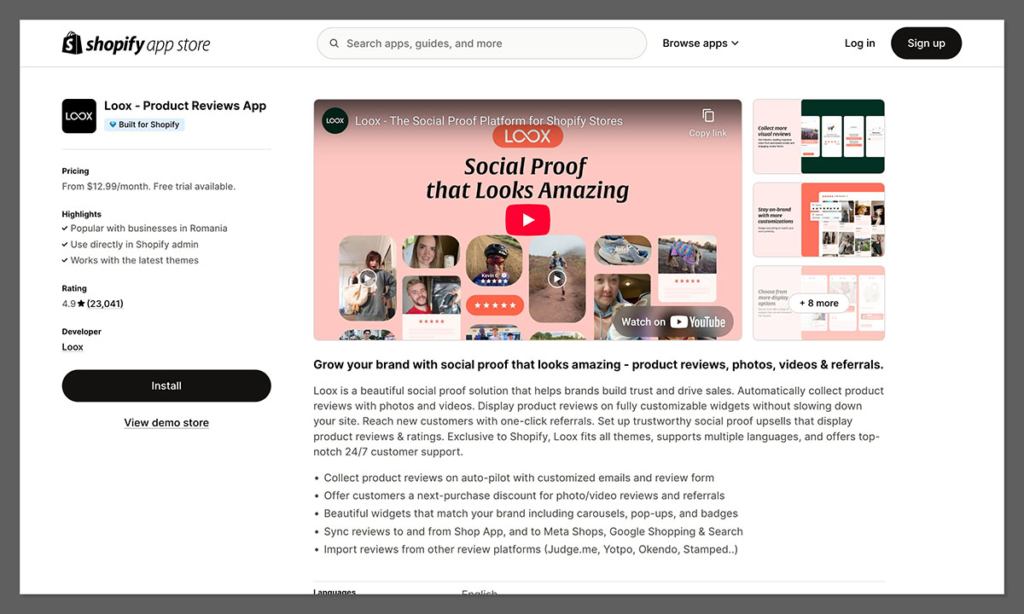
Loox appears on every “best Shopify apps” list, but none of them mention the referral code bug that adds duplicate items to carts or the review caps that force unnecessary upgrades. I will.
The app collects photo and video reviews with discount incentives, displays them in beautiful gallery widgets, and includes a built-in referral program. It holds a 4.9 out of 5 rating from over 18,000 reviews. For visual-heavy brands in fashion, beauty, and home decor, photo reviews convert significantly higher than text-only reviews. AOV increases roughly 28% when visual social proof is present at the point of purchase.
Pricing: No free plan. Beginner plan at $9.99/month. Growth plan at $34.99/month. Unlimited plan at $299.99/month.
Speed impact: 180KB of JavaScript. Lighter than Yotpo (300-500KB) but heavier than Judge.me (100-150KB).
Monthly review volume caps across all plans create upgrade pressure even when your basic needs have not changed. Users report a known bug where referral codes add duplicate items to carts that customers cannot remove. This issue was reported months ago and remains unresolved.
Email service charges continue even after disabling the feature. And $299.99/month for unlimited reviews is steep when Judge.me offers unlimited for free.
Best for: Fashion, beauty, and home decor brands where visual UGC directly drives purchase decisions and you can budget $35+/month. Skip if: You are starting out, budget-conscious, or selling products where text reviews work fine. Start with Judge.me (free) and migrate to Loox only when visual reviews become a measurable conversion driver.
7. Gorgias: Best AI Customer Support App
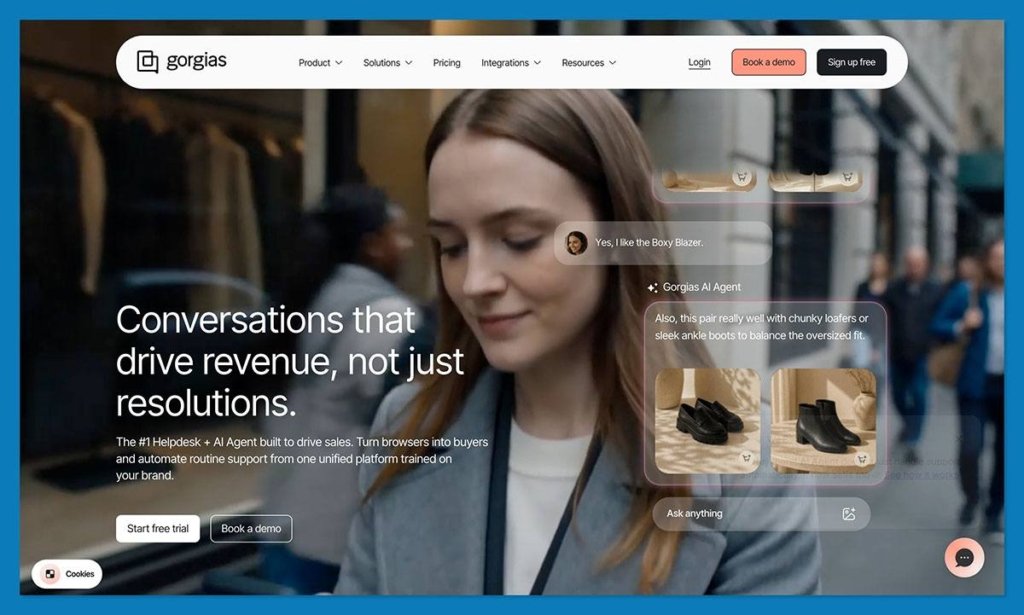
Support tickets convert at 20-30%. Gorgias’s AI agent handles 60% of them autonomously. That is not a cost center. That is a revenue channel most stores ignore.
Gorgias is an AI-powered customer support platform with a unified inbox spanning email, chat, SMS, and social media. Its deep Shopify integration pulls order history instantly, so agents (human or AI) see the full context of every conversation. The AI agent resolves routine tickets for shipping, returns, and order status without human intervention. Alpinestars called it “like a third member of our team.”
The revenue angle separates Gorgias from basic helpdesks. When a customer contacts you with a pre-purchase question, that is a buying signal. Gorgias makes it easy for support agents to pivot from answering a question to closing a sale.
Across their platform data, support interactions convert at 20-30%. Freeing human agents from routine tickets lets them focus on these high-value conversations.
Pricing: From $10/month for 50 tickets. Scales with ticket volume. Full AI capabilities on higher tiers.
Speed impact: Moderate, around 200-300KB for the chat widget. Consider lazy-loading it.
The app carries a 4.3 out of 5 rating, lower than most top apps on this list. It delivers the best value only when you handle 300+ monthly tickets. Full AI agent capability requires pricier tiers. For stores with fewer than 50 support tickets per month, Gorgias is overkill.
Best for: Stores handling 300+ monthly support tickets, especially if you sell products with frequent questions around sizing, compatibility, or shipping. Skip if: You get fewer than 50 tickets/month. Use Shopify Inbox (free) or Tidio (free plan) until volume justifies the investment.
8. Tidio: Best Free Live Chat and Chatbot App
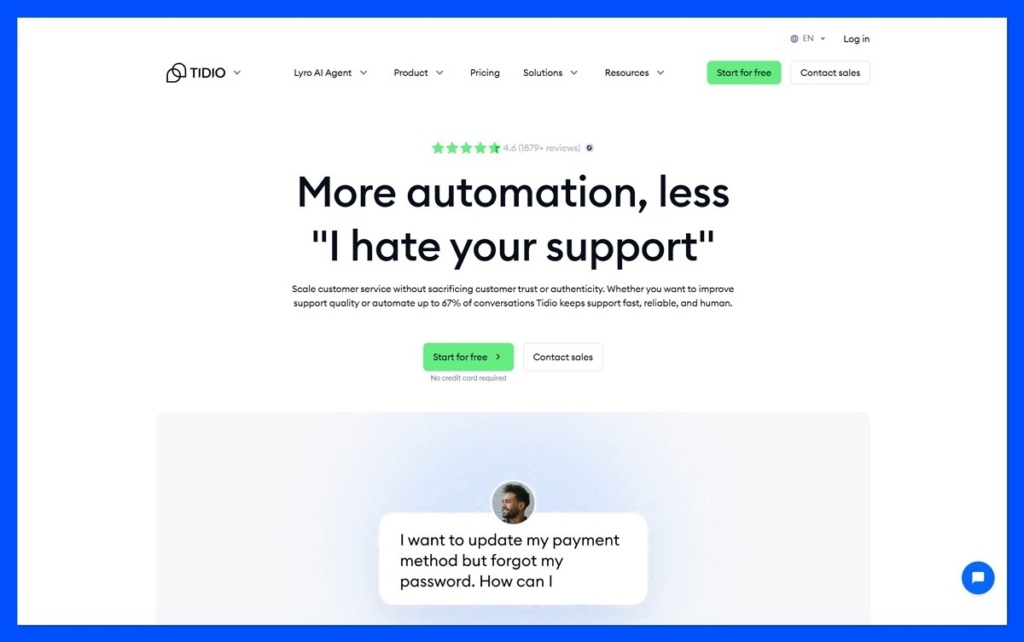
Tidio’s free plan gives you live chat and a basic chatbot today. Its Lyro AI agent resolves up to 67% of customer queries without a human touching them.
The app combines a live chat widget, AI chatbot, automated responses, and visitor tracking in one package. It holds 4.7 out of 5 stars from over 1,900 reviews and integrates quickly with Shopify. Veto Pro Pac implemented Tidio’s chatbot and achieved a 50% sales increase paired with a 48% drop in customer service tickets. Real-time visitor tracking lets you proactively engage high-intent browsers before they bounce.
Pricing: Free plan available. Paid plans from $29/month.
Speed impact: Heavy. The chat widget adds roughly 350KB of JavaScript per page. This is one of the heavier app categories with a significant impact on mobile-first stores.
The Shopify integration is less advanced than what Gorgias offers. The free plan limits chatbot conversations. And 350KB of JavaScript loading on every page is a real cost, especially for stores where mobile accounts for most traffic.
A 1-second delay in page load drops conversions by 7%, so the speed hit is not abstract. Load the widget only on specific pages (contact, product detail) rather than site-wide to manage the performance cost.
The verdict: Best live chat option for stores under $20K/month that want AI-powered customer support without paying for Gorgias. Load it selectively on high-value pages. Graduate to Gorgias when ticket volume exceeds 300 per month.
9. PageFly: Best Landing Page Builder
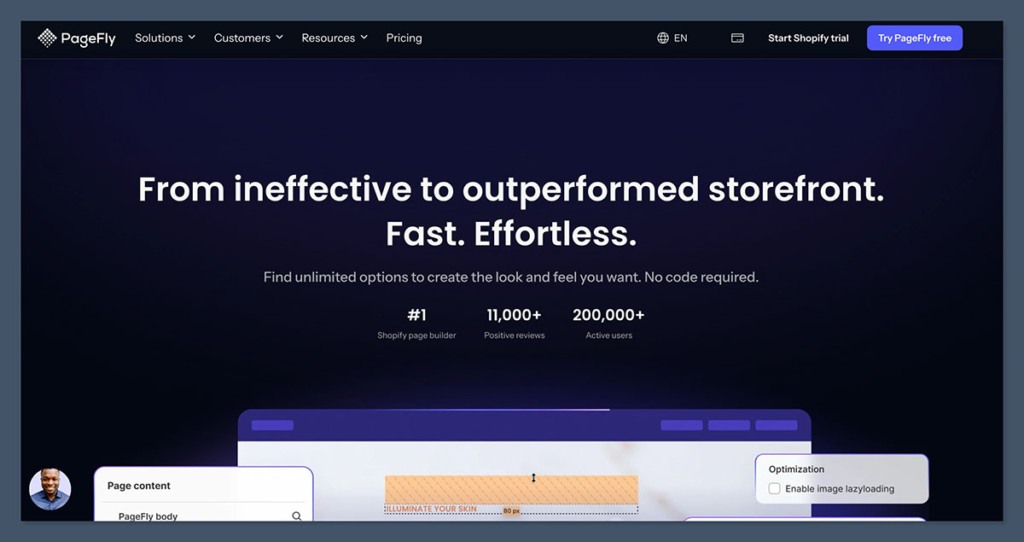
Page builders are one of the top three app categories killing Shopify store speed. PageFly adds 300-400KB of render-blocking JavaScript per page. Before you install it, ask whether Shopify’s Dawn 12.0 theme (18% faster LCP, free) already does what you need.
PageFly is a drag-and-drop page builder for product pages, landing pages, homepages, and blog layouts. Full design control without coding. It holds a 4.9 out of 5 rating from over 10,000 reviews. The flexibility is real, and for stores running paid ads to custom landing pages, the conversion gains can justify the speed cost.
The results, when used strategically, are strong. Nuun used a page builder to increase conversions 34%, reduce checkout time 25%, and decrease bounce rates 33%. The key phrase is “used strategically.” Highest ROI comes from building custom landing pages for high-traffic ad campaigns, not rebuilding your entire site with a page builder.
Pricing: Limited free plan. Paid plans from $24/month.
Speed impact: Heavy. 300-400KB of render-blocking JavaScript on every page it touches. GemPages adds roughly 350KB. Zipify Pages adds roughly 250KB.
Dawn theme 12.0 (Shopify’s 2026 update) reduces JavaScript, implements lazy loading, and delivers 18% LCP improvement with halved CLS. It is free. Pages built with PageFly become dependent on the app, so uninstalling breaks those pages. That vendor lock-in is worth considering before you commit.
Best for: Stores running paid ads to custom landing pages where conversion optimization directly impacts ROAS. Skip if: You are using Dawn or a modern Shopify 2.0 theme and your product pages already convert well. Test Dawn 12.0 first.
10. Smile.io: Best Loyalty and Rewards Program App
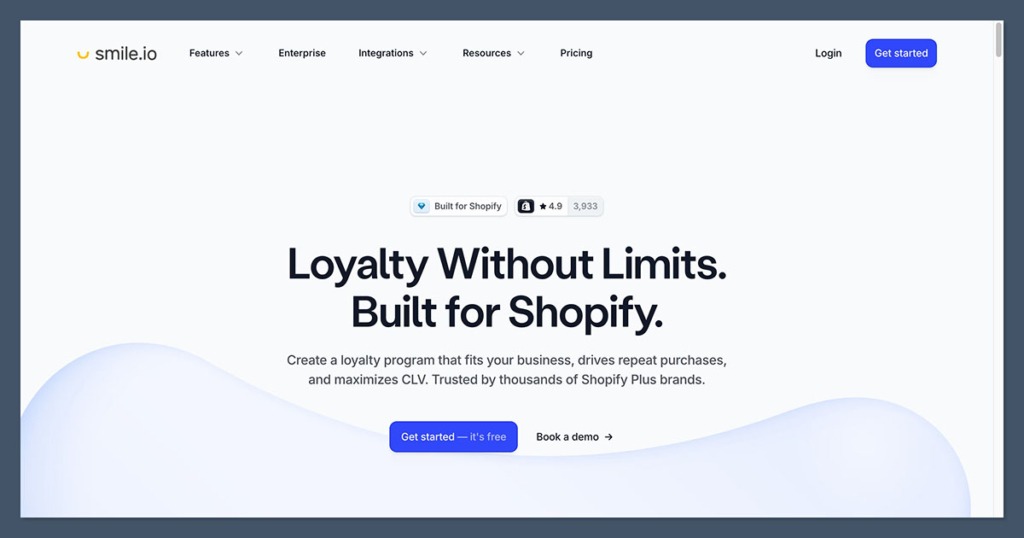
You are spending $50-$100 to acquire each new customer through ads. Meanwhile, your existing customers, who spend 67% more per order on average, have zero incentive to come back. That is the problem a loyalty program solves.
Smile.io offers points-based rewards, VIP tiers, and referral programs. Over 100,000 merchants trust it. The app holds a 4.8 out of 5 rating from over 6,500 reviews and integrates with Klaviyo, Judge.me, and most major Shopify apps.
Farm Hounds generated over $600K in referral sales through their Smile.io word-of-mouth program. VIP tier programs increase customer lifetime value through escalating rewards that give your best customers a reason to keep buying. Repeat customers have higher AOV and lower acquisition costs, so every percentage point you add to your retention rate compounds over time.
Pricing: Free plan for 200 orders/month. Starter at $49/month. Growth at $199/month. Plus at $999/month.
Speed impact: Moderate, around 200KB of JavaScript.
The free plan caps at 200 orders/month, which growing stores outgrow quickly. Jumping from free to $49/month is steep for small stores. Smile.io locks API access behind the Enterprise plan.
ROI is a slow burn: expect 3-6 months before you see measurable retention impact. Loyalty programs are a long game, not a quick win.
Best for: Stores with repeat-purchase products (consumables, beauty, pet supplies, fashion) doing $20K+/month. Skip if: Your products are one-time purchases or you are still in the acquisition phase with under 200 orders per month.
11. Triple Whale: Best Analytics and Attribution App
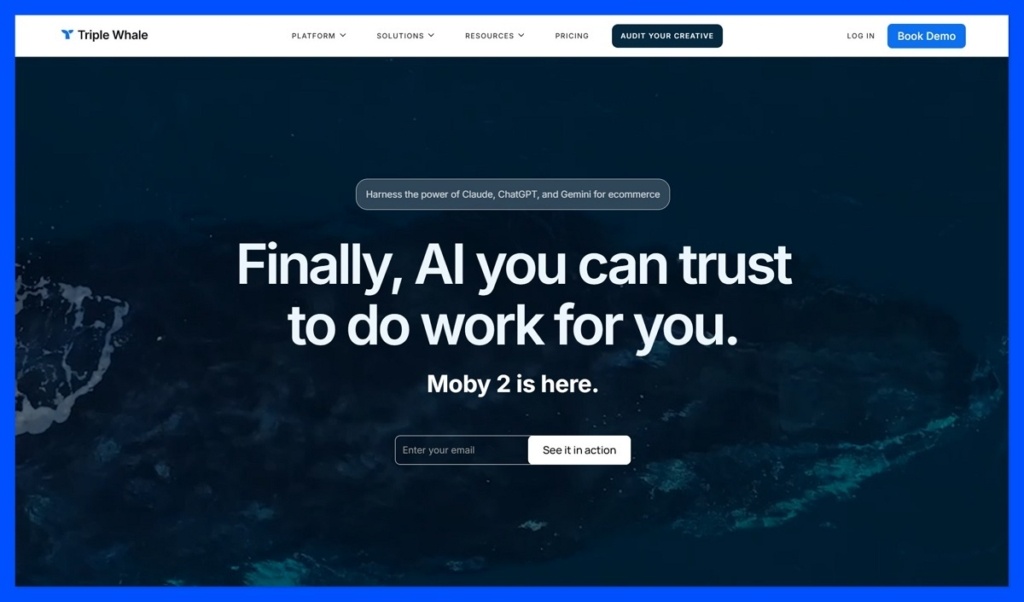
You cannot optimize what you cannot measure. Most Shopify stores rely on platform-reported ROAS from Meta and Google, which double-count conversions and inflate results by 20-40%. Triple Whale shows you what is actually working.
The app provides a real-time analytics dashboard consolidating ad spend, revenue, and attribution across all channels. Its AI analytics agent (Moby) lets you ask conversational data queries instead of digging through dashboards. The first-party pixel delivers accurate attribution in a post-iOS privacy landscape where platform-reported numbers are increasingly unreliable.
As the team at Uncommon Logic puts it, proving ROI per marketing dollar is “non-negotiable in 2026.” Triple Whale identifies underperforming campaigns that platform dashboards mask. It makes quarterly ROI audits per app possible with accurate attribution data. Without a tool like this, you are making budget decisions based on inflated numbers.
Pricing: Free plan available. Paid plans from $129/month.
Speed impact: Light. Runs primarily server-side and via pixel with minimal storefront JavaScript.
The app carries a 4.3 out of 5 rating with relatively few reviews (around 40+). Setup is complex, especially for smaller teams without analytics experience. The $129/month entry price is high for stores under $50K/month in ad spend.
This is not a set-and-forget tool. It requires consistent use to deliver value.
Best for: Stores spending $5K+/month on paid ads across multiple channels. Skip if: You are bootstrapping or spending under $2K/month on ads where platform-native analytics suffice. The free plan lets you test the dashboard before committing.
12. SMSBump (by Yotpo): Best Dedicated SMS Marketing App
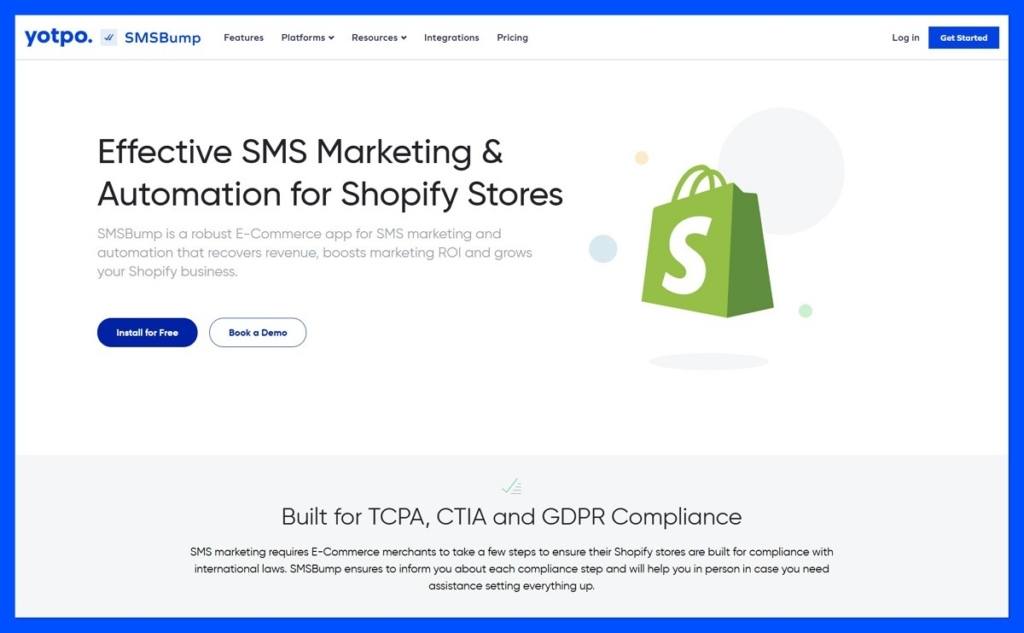
SMS messages have 90%+ open rates compared to email’s 20-25%. Chubby’s achieved a 55% conversion rate on abandoned cart SMS recovery after optimization. That is not a typo.
SMSBump handles SMS and MMS marketing campaigns with automated abandoned cart recovery, welcome flows, and post-purchase follow-ups. A/B testing for SMS lets you optimize message timing and content. Built-in compliance tools manage TCPA and GDPR requirements, and the deep Shopify integration keeps everything synced.
SMS excels for time-sensitive messages. Flash sales, restock alerts, and limited drops perform dramatically better over text than email. The 90%+ open rate means your message is almost guaranteed to be seen. For urgent offers, SMS conversion rates consistently outperform every other channel.
Pricing: Pay-as-you-go SMS pricing. Plans from $19/month plus per-message fees.
Speed impact: Minimal. Backend automation with negligible storefront JavaScript.
Per-message costs add up quickly at scale because SMS is more expensive per-send than email. Yotpo’s broader platform is enterprise-priced and can push upsells to their other products. Both Omnisend and Klaviyo include SMS on their plans, which potentially makes a standalone SMS app redundant for many stores. Compliance is also complex, with opt-in requirements, quiet hours, and consent management adding operational overhead.
Best for: Stores with time-sensitive products (fashion drops, perishables, flash sales) that want SMS as a dedicated channel with deep optimization. Skip if: You are already using Klaviyo or Omnisend for SMS. Never run two SMS tools on the same list.
13. Plug In SEO: Best SEO Optimization App for Beginners
Your Shopify store probably has SEO problems you do not know about. Missing alt tags, duplicate meta descriptions, broken links, and no structured data. These invisible issues silently kill your organic traffic.
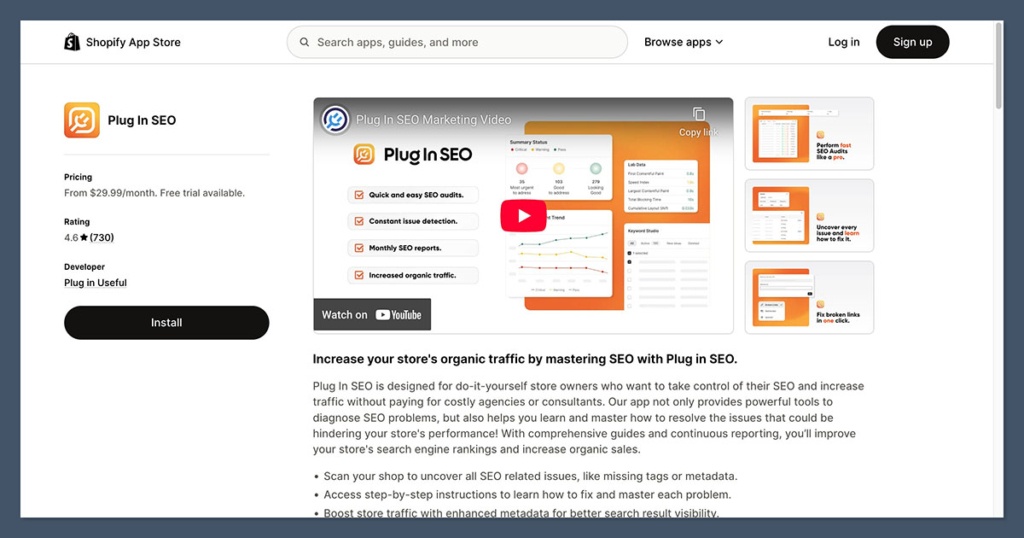
Plug In SEO runs automated audits covering meta titles, descriptions, alt tags, broken links, page speed, and structured data. Bulk editing tools let you fix dozens of issues at once. Ongoing monitoring sends alerts when new problems appear. The interface explains issues in plain language, making it accessible for store owners without SEO expertise.
Organic traffic is free recurring revenue. Fixing structured data enables Google rich snippets, which improve click-through rates by 20-30%. Stores recovering from SEO neglect typically see 15-40% organic traffic improvement within 90 days of fixing fundamental issues.
Pricing: Free plan for basic checks. Paid plans from $29.99/month.
Speed impact: Negligible. Runs audits in the background with no storefront JavaScript.
Shopify has platform-level SEO limitations (URL structure, canonical tag handling) that no app can fix. Advanced SEO work still requires manual effort and expertise beyond what any automated tool provides. Some features overlap with free tools like Google Search Console and Shopify’s built-in SEO fields.
The verdict: Worth the free plan for any store owner who does not regularly audit their SEO. Upgrade to paid only if you have 100+ products and need bulk editing. For stores with dedicated SEO knowledge, Google Search Console may be sufficient.
14. Recharge: Best Subscription and Recurring Revenue App
The most profitable Shopify stores do not just sell products. They sell subscriptions. A customer who subscribes at $40/month is worth $480/year without a single retargeting ad.
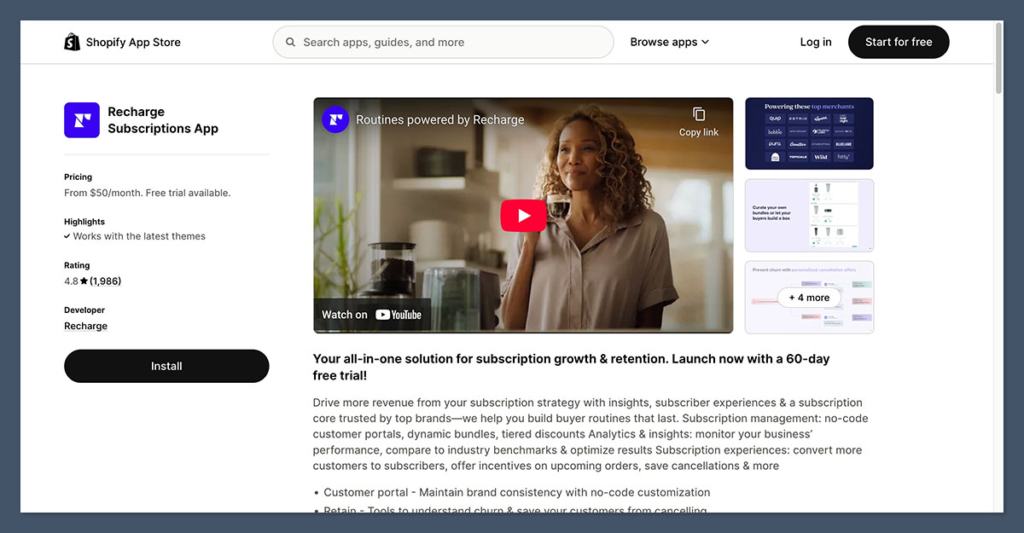
Recharge handles subscription management with flexible billing models including subscribe-and-save, curated boxes, and memberships. The customer portal supports pause, swap, and skip actions so subscribers manage their own accounts without creating support tickets. Deep Shopify checkout integration keeps the experience seamless. It supports both prepaid and pay-as-you-go models.
Subscription customers have 2-3x higher lifetime value than one-time buyers. Predictable monthly recurring revenue stabilizes cash flow and makes growth planning significantly easier. Subscribe-and-save discounts of 10-15% reduce churn while increasing order frequency.
For stores selling consumable products, subscriptions transform your revenue model from transactional to recurring. That predictability changes how you plan inventory, forecast revenue, and allocate ad spend.
Pricing: Free Standard plan for Shopify merchants. Pro plan from $99/month for advanced features. Transaction fees apply.
Speed impact: Minimal. Checkout integration with minimal storefront overhead.
The Pro plan at $99/month is expensive for stores just testing subscriptions. Lower tiers limit customer portal customization. Migration from another subscription app is complex and time-consuming. Appstle is a viable cheaper alternative for stores with simpler subscription needs.
Best for: Stores selling consumables, supplements, coffee, beauty products, or anything customers reorder regularly. Skip if: Your products are one-time purchases (furniture, electronics, gifts). Test with the free Standard plan before committing to Pro.
15. Shopify Email: Best Free Email Marketing Starter
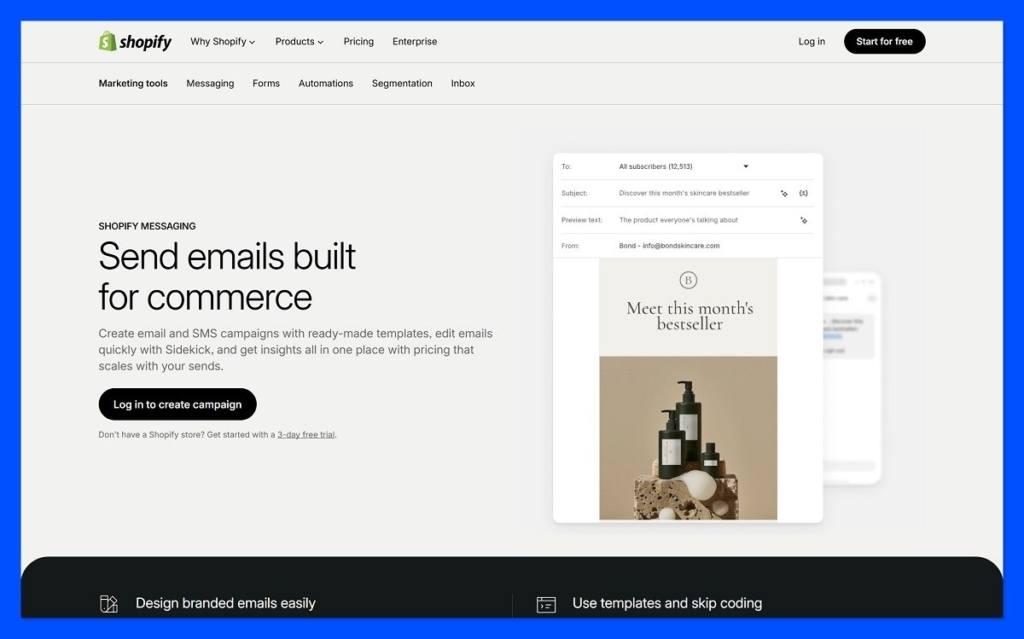
Shopify Email is free for the first 10,000 emails per month, built directly into your admin, and pre-loaded with your products, logo, and brand colors. Zero setup. Zero cost. Start sending today.
The app creates email campaigns using your store data, provides pre-built templates, and handles basic automation including welcome sequences and abandoned cart recovery. Segmentation by purchase history and location covers the fundamentals. Shopify Magic AI generates subject lines and email content. Everything runs from inside your Shopify admin with no external login required.
Automated flows generate 41% of email revenue from just 5% of sends, and that principle applies regardless of which email tool you use. Shopify Email gives you access to those automated flows for free. For Phase 1 stores building their foundation, this eliminates email tool costs entirely.
Pricing: Free for 10,000 emails/month. $1 per additional 1,000 emails after that.
Speed impact: Zero. Runs entirely within the Shopify admin.
Segmentation is basic compared to Klaviyo or Omnisend, and no SMS capability exists. Automation triggers and flow complexity fall short of paid alternatives. You will not find predictive analytics, LTV scoring, or advanced templates here.
Best for: Every new Shopify store. Use it until your list exceeds 2,000 subscribers and email generates meaningful revenue. Then graduate to Omnisend (budget) or Klaviyo (advanced). There is no reason to pay for email marketing on day one.
Shopify Apps FAQ
How many apps should a Shopify store have?
High-performing retailers run 8-12 apps total. As the Oxify team puts it, “Every unnecessary app is a tax on your site speed, your wallet, and operational complexity.” The difference between a 7-figure and 8-figure brand is not app count but strategic deployment. Run quarterly ROI audits. If an app cannot prove it generates more revenue than it costs, remove it.
Do Shopify apps slow down my store?
Yes. Each app adds 200-500ms of load time and 50-500KB of JavaScript. Third-party scripts account for 62% of total JavaScript on the average store.
Worst offenders: live chat (200-400KB), review apps with galleries (150-500KB), and page builders (200-600KB). Even uninstalled apps leave residual code. One store found remnants from 23 apps adding 3.2 seconds to load time. Run PageSpeed Insights after every install.
What free Shopify apps are actually worth installing?
Judge.me (unlimited reviews with rich snippets), Shopify Flow (automation), Shopify Email (10,000 sends/month), Shopify Inbox (live chat), Translate and Adapt (2 languages), Search and Discovery (filters), and Google and YouTube (Shopping feed). A Phase 1 stack built on these free tools costs under $25/month total.
Do I need Klaviyo or will Shopify Email work?
Shopify Email is the right call for stores under $10K/month with small lists and basic needs. Omnisend fits stores doing $10K-$50K/month that want multichannel (email, SMS, push) at a lower cost. Klaviyo makes sense for stores over $50K/month with dedicated marketing bandwidth. The upgrade trigger: your list exceeds 2,000 subscribers and email is not yet generating 25% or more of your revenue.
Which Shopify apps are being replaced by built-in features in 2026?
Several categories are shrinking. Shopify Email covers basic campaigns. Shopify Flow with Sidekick AI handles automation. Functions Discounts (January 2026) enables complex discount rules natively.
Shopify Magic generates product descriptions and emails. The native TikTok Shop integration (February 2026) replaces third-party connectors. Shopify’s personalization engine handles product recommendations across five touchpoints. Check whether native tools cover your needs before paying for an app.
What is checkout extensibility and does it affect my apps?
Non-Plus stores face an August 26, 2026 migration deadline. Shopify Scripts sunset June 30, 2026. Apps still using the old ScriptTag API may break checkout tracking after these dates.
Shopify already stopped passing customer PII to legacy tracking scripts for Plus stores, degrading Meta and Google Ads conversion tracking. Audit your installed apps for compliance before these deadlines.
What is the best app stack for a new Shopify store?
Build in phases. Phase 1 ($0-$10K/month): Shopify Email plus Shopify Flow (both free), Judge.me (free), TinyIMG ($9.99/month). Under $25/month total. Phase 2 ($10K-$50K/month): Add Omnisend or Klaviyo, ReConvert, and Parcel Panel. Phase 3 ($50K+/month): Add Gorgias, Smile.io, Triple Whale, and Recharge. At every phase, run quarterly ROI audits, check PageSpeed after each install, and remove residual code from uninstalled apps.


