
 By Bogdan Rancea
There was a time when comparing print on demand partners was pretty simple.
You’d look for the company with the biggest collection of (good quality) products for the lowest price, and if the pricing was low enough, you’d sign up. Now though, creators want a lot more from their POD solution. They might need a simple store setup, marketing tools, or even someone to help them handle the trickier parts of online selling, like tax.
Popular names like Printify are still grabbing attention in this market, particularly if you want AI mockups, a convenient pop-up store, and lots of supplier variety. But Fourthwall is starting to feel like the better option for scalability and true brand control.
I still think Printify is a great choice if you’re running a POD operation, but Fourthwall is edging ahead for creators who want to launch a brand without the extra work.
Fourthwall vs Printify: Quick Verdict
I’m a big fan of both Printify and Fourthwall, really, but I’d recommend them to different sellers. If you need to be able to mix and match suppliers, access hundreds of unique product types, and play with helpful design tools like an AI mockup generator, Printify is great.
If what you’re really looking for is consistent quality, a fully branded store, exceptional backend support with taxes and customer service, and lots of ways to branch out into different kinds of sales (memberships, digital downloads, etc.), Fourthwall is the better choice.
| Category | Printify | Fourthwall |
|---|---|---|
| Best fit | POD testers, Etsy sellers, and creators with a limited budget | All kinds of creators, nonprofits, schools, streamers, and small brands |
| Main job | Connects sellers with print providers | Gives you a complete branded store and multiple selling options |
| Catalog | 1,300+ products | Complete curated product collection, custom-sourced products, digital downloads and memberships |
| Quality | Varies depending on supplier | More consistent and premium |
| Storefront | Pop-Up Store or integrations with ecommerce platforms | Full branded storefront and integrations with social channels |
| Pricing | Free plan, Premium starts at $39 per month | Free to start, paid Pro option for $19 per month |
| Support | General support for all print on demand sellers | Customer support for POD items, Merchant of Record support, and end-to-end assistance |
What Are Fourthwall and Printify Really Built For?
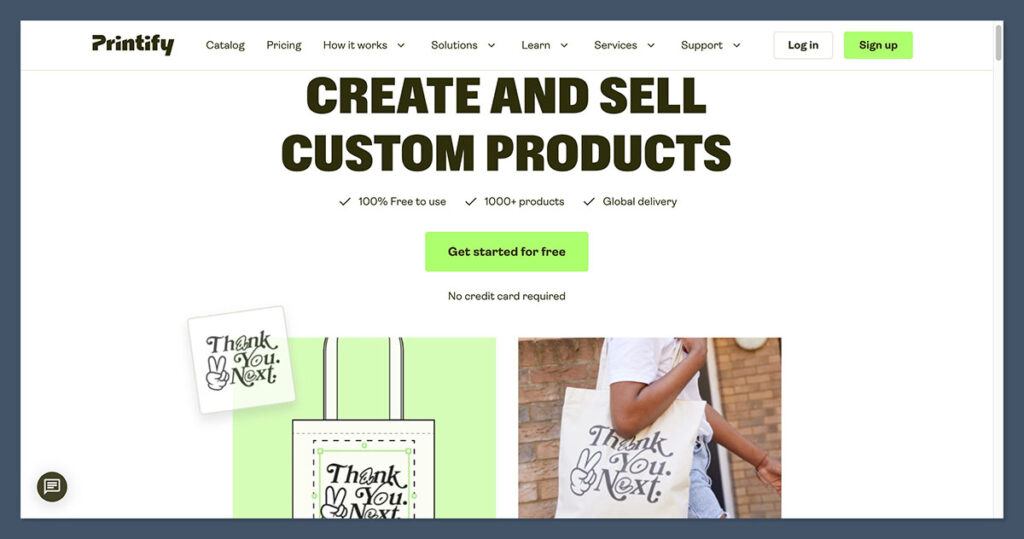
First of all, it’s worth saying that Fourthwall and Printify are pretty different tools, even if they both let you sell print-on-demand goods. Printify is one of the world’s top print on demand suppliers, with excellent design tools, and global product networks.
Although you can create a simple pop-up store with Printify, you need to integrate with something like Shopify, WooCommerce, or even Etsy for more comprehensive features.
Fourthwall, on the other hand, gives you the full storefront straight away, even on its free plan. You can create a branded store, customize and sell a great range of retail-grade print on demand products, and even expand into selling digital downloads or memberships at the same time. You can also source and sell your own products, and accept donations.

It’s the more “extensive” solution for launching a business online, but even though it gives you more features, it’s still one of the easier choices out there for beginners, particularly since Fourthwall handles customer support for catalog products, and acts as your Merchant of Record for tax.
Fourthwall vs Printify: Product Range and Quality
I can’t argue with Printify’s range, it gives you more than 1,000 products to choose from, ranging from popular apparel options from companies like Bella+Canvas, to pet accessories, home décor, tech gadgets, and even more interesting options like deluxe blankets.
The quality of those products is usually quite good too, but you are taking a bit of a risk every time you choose a new supplier to work with. Even if ten suppliers are offering the same product, the print quality can vary. So you might save a bit of money choosing a “cheaper” supplier, but you could also put your reputation on the line if you don’t get the results you expected.
Fourthwall gives you a smaller range, although there’s still hundreds of great options to choose from. The collection is smaller because it’s more curated. Fourthwall prioritizes premium, retail-grade quality over catalog volume, which means you can trust you’re going to get a consistent outcome with every order.
It’s also worth remembering that Fourthwall doesn’t just limit you to custom merch. You can use the sourcing tools to track down unique items like enamel pins or plushies. You can sell digital products and memberships without paying for another app, and you can accept donations too.
I will say that Fourthwall’s products can be more expensive than the ones on Printify, especially if you’re using Printify Premium to get discounts, but at least with Fourthwall, you can stack together more product types beyond print on demand, and avoid playing supplier lottery.
Fourthwall vs Printify: Storefront and Setup
Printify does deserve some credit here, because its Pop-Up Store has gotten a lot better lately. It used to feel more like a link-in-bio selling page, but now you get a store builder with ready-to-use templates, logo toggles, cover banners, personalization options, even a custom domain.
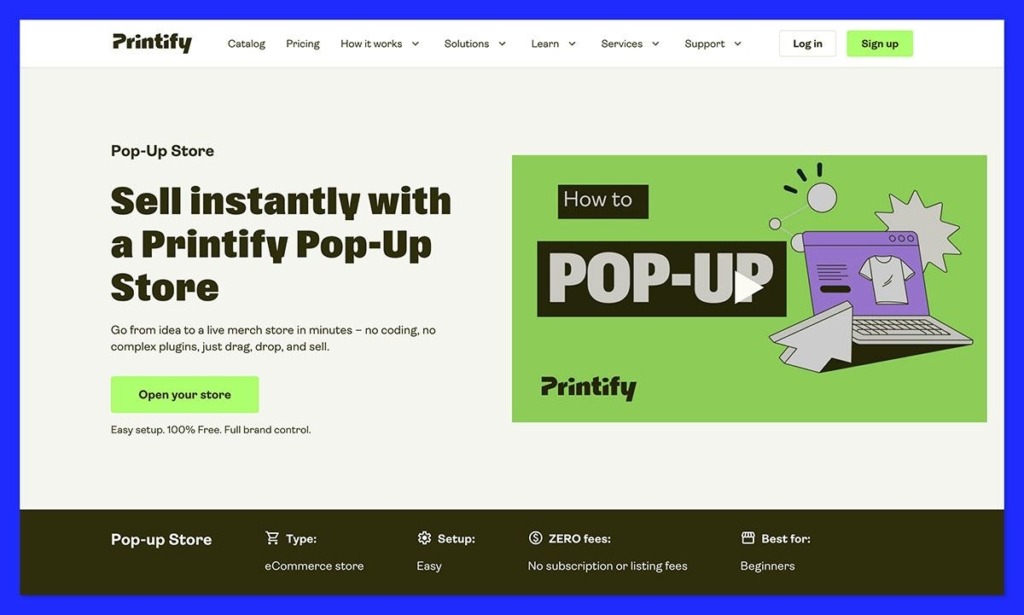
You can also add QR code checkout options, and Printify is working on an AI store builder with an analytics dashboard to make things even simpler for beginners. Plus, as I already mentioned, the AI mockup generator and design tools are fantastic. There’s even a “Trends” tool now that lets you search through social media to find niche product ideas.
Still, even with those improvements, Fourthwall still takes the win for overall store functionality. Every user gets a no-code website builder, with custom domain support, a built-in checkout, sales analytics, and complete ownership over fan data. You get something closer to a Shopify ecommerce experience than a single selling page, without having to pay an extra monthly ecommerce platform subscription (like you’d have to with Printify).
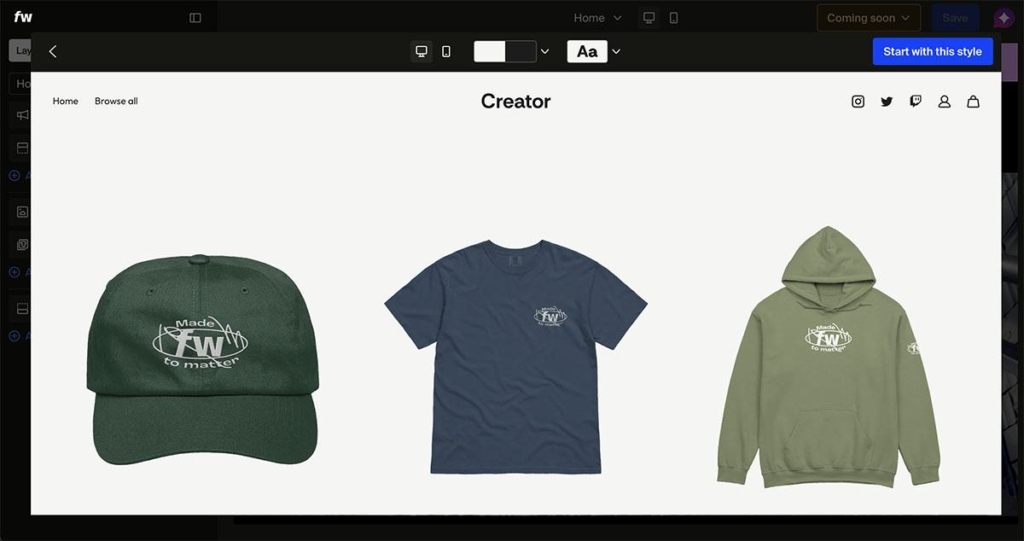
Like Printify, Fourthwall has been making some great updates lately too. It lets you build personalized apps without having to deal with app store fees, you can send direct messages to customers, and build email marketing strategies with a platform like Klaviyo.
The Integration Options
Quick note on integrations here, because arguably, Printify does seem to give you a lot more options. Mainly, it plugs into most of the ecommerce platforms and selling channels creators need, from Shopify and WooCommerce, to Wix, Squarespace, TikTok Shop, Etsy, plus Amazon. It also has an API for custom connections.
Fourthwall doesn’t connect with as many ecommerce platforms because it doesn’t need to. You already get the storefront and checkout, plus the digital product selling and membership options you’d usually rely on a separate ecommerce platform for.
That doesn’t mean it doesn’t have any integrations though. There are Klaviyo and Mailchimp connections for email marketing. Plus, you can seamlessly link to social media channels like TikTok Shop, Twitch, YouTube Product Shelf, and Instagram or Facebook shop. There are also StreamLabs and StreamElements connections for creator alerts.
Fourthwall vs Printify: Pricing and True Cost
A lot of people still assume that Printify is the cheaper option, usually because you have the option to scroll through suppliers and find better deals on the products you want to sell. Still, as I said above, sometimes cutting costs with a supplier also means compromising on quality.
You can still save money if you subscribe to the Printify Premium plan, now $39 per month (or around $24.99 per month if you pay $299 annually), which gives you up to 20% off product costs. That can be helpful if you’re deliberately picking higher-quality suppliers who might charge a little more.
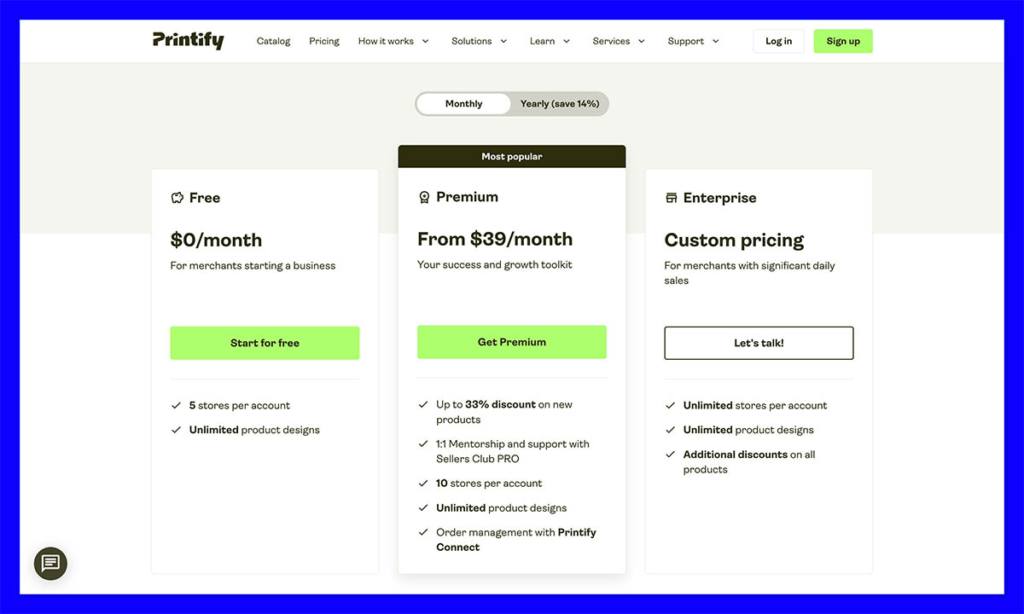
However, Fourthwall’s Pro plan is still cheaper at $19 per month, particularly when you consider that if you wanted to combine print on demand selling with digital product and membership sales with Printify, you’d probably need an ecommerce platform like Shopify starting at $39 per month, plus some extra apps.
It’s also worth noting that Fourthwall saves you money in other ways too. With Printify, if you’re using the Pop-Up Store, or an integration with something like Shopify, you’re still the Merchant of Record for your products, so you have to handle tax yourself. You’ll also be responsible for dealing with customer service.
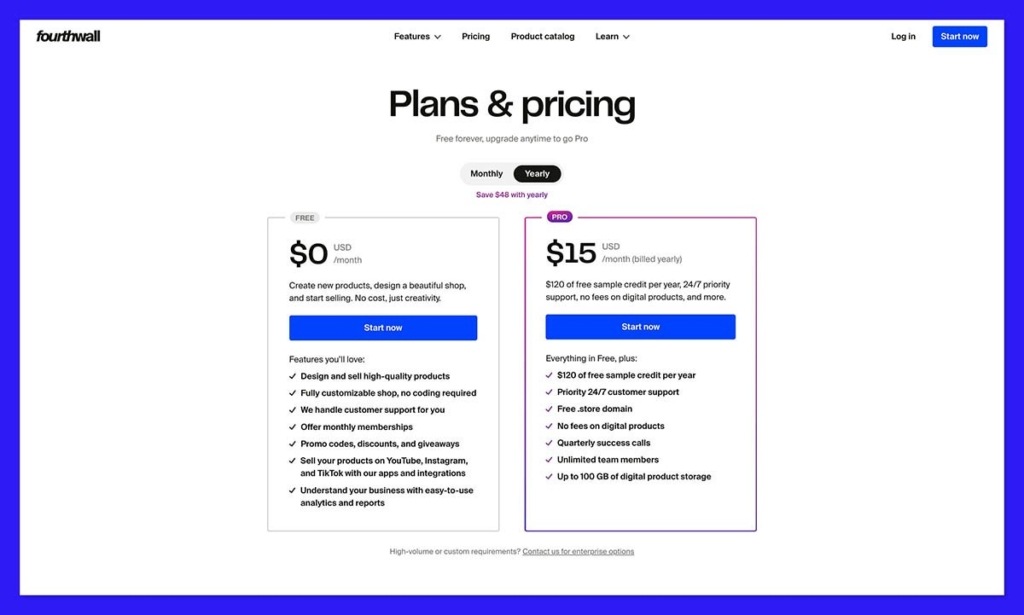
Fourthwall manages both of those things for you. It’s the Merchant of Record for every company using the platform, and it handles print on demand customer support, although you have to deal with customer service for self-sourced products yourself.
Even so, that still saves you a lot of time and money on extra admin work, you might even be able to skip the cost of hiring an extra team member with Fourthwall in your corner.
Fourthwall vs Printify: Shipping and Fulfillment
When you’re using them for print on demand, both Fourthwall and Printify handle end-to-end fulfillment for you, letting you send products to customers worldwide without having to deal with shipping headaches yourself.
Still, Printify relies on a network of third-party providers, which means delivery times and cost will depend on the partner you choose, and your preferred shipping tier. You also have to manually configure shipping profiles on any connected storefront.
On the plus side, Printify’s variety means you can choose the ideal provider based on your situation. For instance, you could pick a US provider for US buyers, and an EU provider for EU customers.
Fourthwall is still the more simple and reliable option, though. It delivers branded packages straight to your customers, and you don’t have to manage your own carrier rates, as Fourthwall sets its own dynamic or flat-rate shipping costs.
Sometimes, deliveries can take a little longer to arrive with Fourthwall, but the overall shipping times are pretty good, usually 3 to 10 business days for the majority of products, and 3 to 5 business days for the Signature products.
Fourthwall vs Printify: The Latest Updates
I touched briefly on some of the more recent updates both of these companies have made to their platforms already, but when you dig a little deeper, it becomes a bit more obvious what the two solutions are aiming for.
Printify’s newer tools all seem to be focused on sellers who want to set up and scale fast. You’ve got the Trends tool to scan marketplaces and social platforms for ideas, AI tools for creating your Pop-Up store or mockups, and an ever-evolving range of product options.
Printify and Printful are also officially merged now, which means Printify sits in a bigger POD machine which could open the door to better tools and broader supply options going forward.
Fourthwall, on the other hand, seems to be concentrating more on helping creators build and scale customer relationships. The mobile membership app keeps people connected to your brand without forcing you to pay Apple or Google fees. There are DMs for direct conversations, plus custom inserts that are great for earning more brand loyalty.
If you’re trying to launch a print on demand company quickly, Printify is still a great pick, but Fourthwall is definitely the one to choose if you’re trying to turn a dedicated community into a consistent source of income.
Final Verdict: Fourthwall for Creator Brands, Printify for POD Sellers
Both platforms are still great, just for different types of sellers with different priorities.
I’d probably choose Printify if I was building a product-testing strategy, with an Etsy store, or a Shopify POD setup. It’s great for product variety, supplier scale, and convenient design tools.
Fourthwall, however, is the better option if you’re looking for more than just a print on demand supplier network. It’s the all-in-one option for building a branded store, sourcing high-quality print on demand products, and earning extra revenue through memberships, downloads, and donations.
It’s also the choice that gives you a lot less work to do on the back end, if the last thing you want to worry about is hundreds of customer emails, and tax headaches.
Still consider Printify if you want to run a POD business, but use Fourthwall if you want to launch a creator brand people keep coming back to.


