
 By Bogdan Rancea
At this point, I’ve experimented with enough ecommerce platforms to know there’s a limit to how “simple” most of the easy options out there are. Most of the more popular options like Shopify or Wix do make certain things straightforward, like giving you a drag-and-drop builder to design your site.
But ultimately, all of the work of connecting apps, and running your business, still falls on you. Fourthwall is one of the first solutions I’ve tried that actually reduces that work.
I used to think of it as a brand platform for creators, but really, it’s a simplified toolkit for anyone who wants a storefront, a way to sell products (physical or digital), and a little helping hand along the way, from an AI assistant (Eli), to a team that acts as your Merchant of Record for tax, and your outsourced customer support team for print on demand orders.
Really, it’s one of the best options out there if you want to monetize something, without making ecommerce your full-time job.
Fourthwall Review: Quick Verdict
Fourthwall isn’t going to be right for every seller. It doesn’t have the same depth as some other platforms if you’re an enterprise-level store owner looking for a system that can handle confusing shipping rules or custom checkout logic.
It’s better for creators, startups, nonprofits, musicians, and even schools that want a branded presence online, and an easy way to sell memberships, digital downloads, print-on-demand merch, and custom products, without hiring a full team (or burning yourself out).
Pros
- Free to start with no monthly platform fees
- Merch, memberships, donations, and digital downloads in one
- Tax support (Fourthwall is your Merchant of Record)
- Customer support for POD products
- Useful AI assistant
- Genuinely useful integrations with social platforms (Twitch, TikTok, Discord) and others
Cons
- Less control than you’d get from something like Shopify
- Print on Demand products are premium quality (so not the cheapest)
- There are limits to the free plan (50 product listings)
What Is Fourthwall, Really?

Fourthwall is a brand platform built for people who want to sell something, without having to build and run a complicated ecommerce operation. You customize a site, add products, set prices, connect channels, and Fourthwall handles most of the extra stuff behind the scenes.
The merch side is one of its biggest benefits. Premium print-on-demand is already built-in, so you’re not connecting Shopify with something like Printful manually. You can also source custom products like enamel pins and plushies (hard to find elsewhere). But merch is just one part.
Fourthwall lets you sell anything, including digital products and memberships, and it lets you accept donations too, making it ideal for nonprofits and creators with avid supporters.
The system just keeps getting better too, with things like the AI assistant (Eli), to help you out with managing your store, analyzing sales, adjusting pricing, or turning a single design into a lineup. Fourthwall is even collaborating with a few other brands to tackle more of the problems its customers tend to have. For instance, the Throne collaboration lets your community support you with wishlists and fundraising. The Karat collaboration also gives you premium financial management features.
That’s the whole thing, really: Fourthwall’s whole goal is to make sure anyone who has the potential to build and monetize a brand can get it done, without the extra stress.
Fourthwall Pricing: What Does Fourthwall Cost?
Most people will start with Fourthwall’s free plan, which is very generous, by the way. You get pretty much everything you need there, including your storefront, access to the POD catalog, support for digital products and memberships, and all the basic day-to-day tools you need.
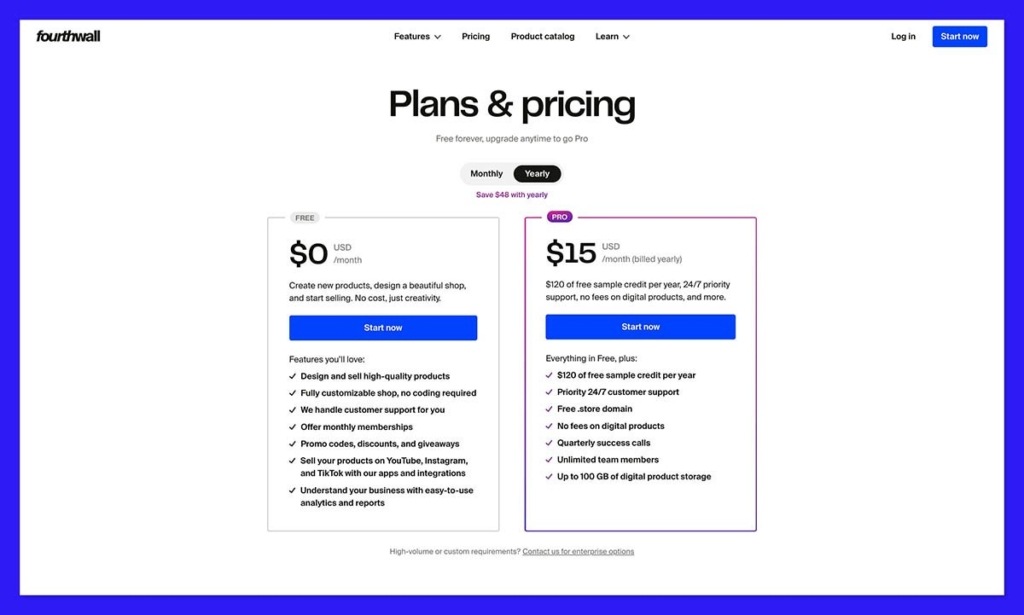
The limits are quite small: you can only list 50 products in total, and have a single other user. The free plan also comes with a 5% fee on digital product sales.
The Pro plan, for $19 per month or $180 per year, removes the fee on digital products, gives you 500 product listings, unlimited team members, and $10 in monthly sample credit. You also get priority support and 3PL access for self-sourced products.
If you’re worried about the cost of “premium” print-on-demand products, I will say that the base costs of some of Fourthwall’s products are a little higher than those on some other platforms. You can’t compare suppliers like you would on Printify to get a cheaper rate. However, you’re paying for the kind of quality that really protects your brand’s reputation and ability to grow.
Plus, since you can set your own prices, you can choose margins that make sense, based on the kind of luxury you’re offering. There’s definitely still room to make a profit here.
Fourthwall Review: The Complete Breakdown
There’s actually a lot more to Fourthwall than most people think, so here’s a quick rundown of what you can expect before we get into the details:
| Feature | What’s included |
|---|---|
| Pricing | Free plan, or $19 per month for Pro |
| Physical products | Retail-grade print on demand or custom product sourcing |
| Digital products / subscriptions / etc | Digital products (ebooks, videos, music, etc), memberships or subscriptions, donations and tips |
| Payment gateways | Support for most major options including credit cards, Apple Pay, PayPal, etc |
| Website creation | Drag-and-drop editor with custom themes, and code options |
| App integrations | Integrations with all major social selling channels, email channels, and Zapier |
| Custom mobile app | Available on the Pro plan |
| Customer support and assistant | AI assistant (Eli), Merchant of Record support, and customer support assistance for POD products |
| Security | SSL, GDPR compliance, and access controls |
Fourthwall Review: Website and Store Builder
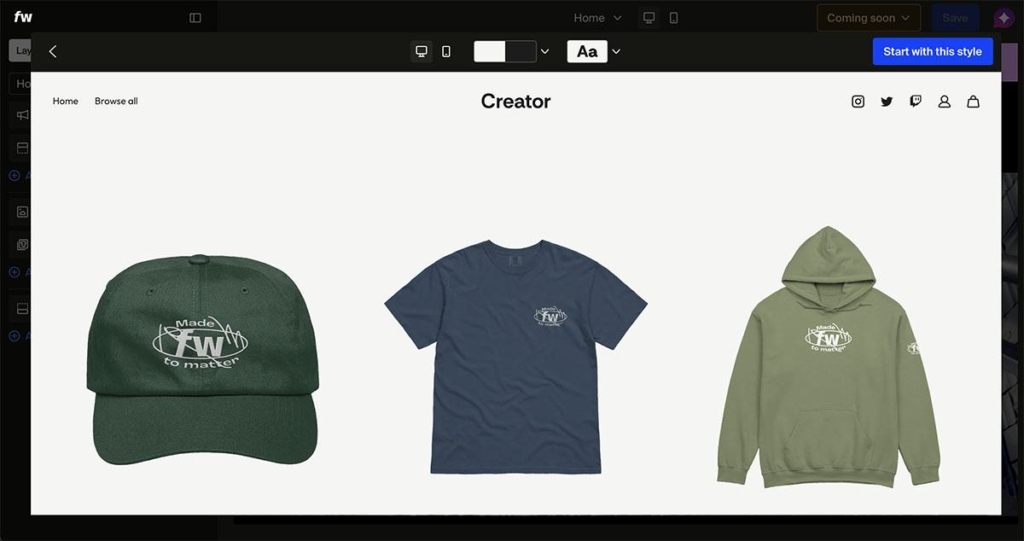
Fourthwall is all about making a brand launch as simple as possible, and that starts with its website building tools. You get a range of themes you can customize with a drag-and-drop builder. There’s also dropdown navigation menus and personalized favicons.
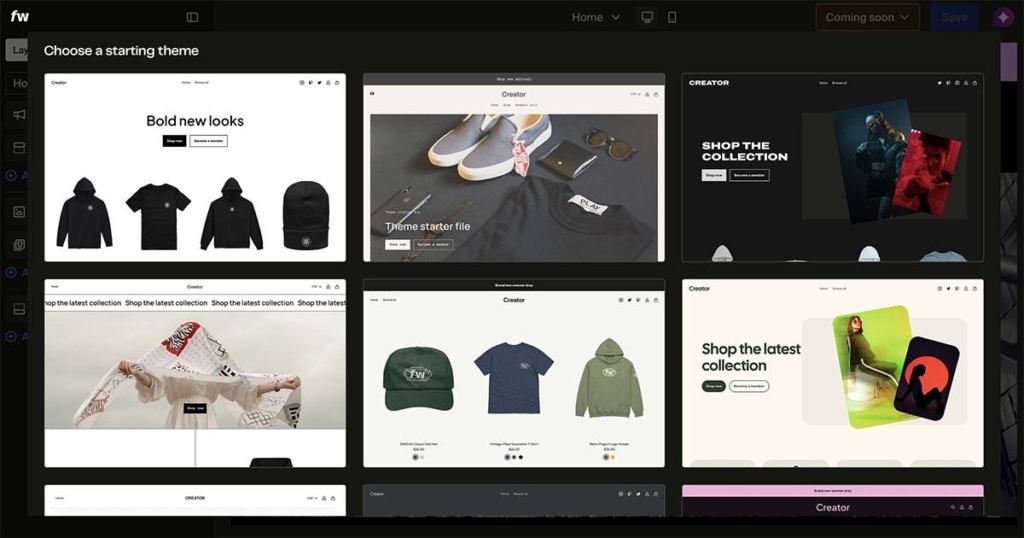
You can add your logo, preferred colors and fonts, and create custom pages. Plus, you can connect your own custom domain or subdomain. There are also a lot of little extras you can add to make your store more appealing, like promo codes or limited time offers.
Product pages are highly customizable too, with plenty of space for FAQs, sizing notes, images, videos, QR codes, and anything else you want to add. You can even build entire collections, and Eli, the AI assistant, can help you turn a single product into a series.
You don’t get as many “advanced” features as some other platforms like Shopify might give you, although there is support for custom HTML and CSS. But the whole system is designed to give the kind of early starter all the tools they need to get their brand home live, without having to invest in experts, or spend months building.
Print-on-Demand, Premium Products, and Custom Products
If your plan is to sell physical products, Fourthwall gives you options. The easiest one is to use the built-in print on demand catalog. It’s a curated collection of retail-grade top-selling products, with best-sellers like the Comfort Colors 1717 garment-dyed heavyweight tee from $15.45 and the Bella+Canvas 3001 supersoft tee from $11.75.
Fourthwall even works with manufacturers to make sure they use the highest quality print settings consistently, so you’re not worried about quality differences from one batch to the next. There are no minimum order requirements for anything in the catalog, and Fourthwall actually deals with customer service for those products, which is something most POD leaders don’t do.
If you want to expand a little further, there are custom product sourcing options too, so you can sell things like plushies, keyboards, or enamel pins. You can even set up a crowdfunding strategy to help you source money for your collection.
You don’t get the extra customer support help with those products, but there are 3PL fulfillment tools you can use to send custom inventory to Fourthwall’s partners, if you want assistance with storage, shipping, and packaging.
Digital Products, Memberships, Videos, and Donations
The non-physical-product side has plenty of variety too. First, you can sell all the different types of digital downloads you can think of. That includes eBooks, PDFs, templates, stock photos, video courses, audio, art, guides, and more.
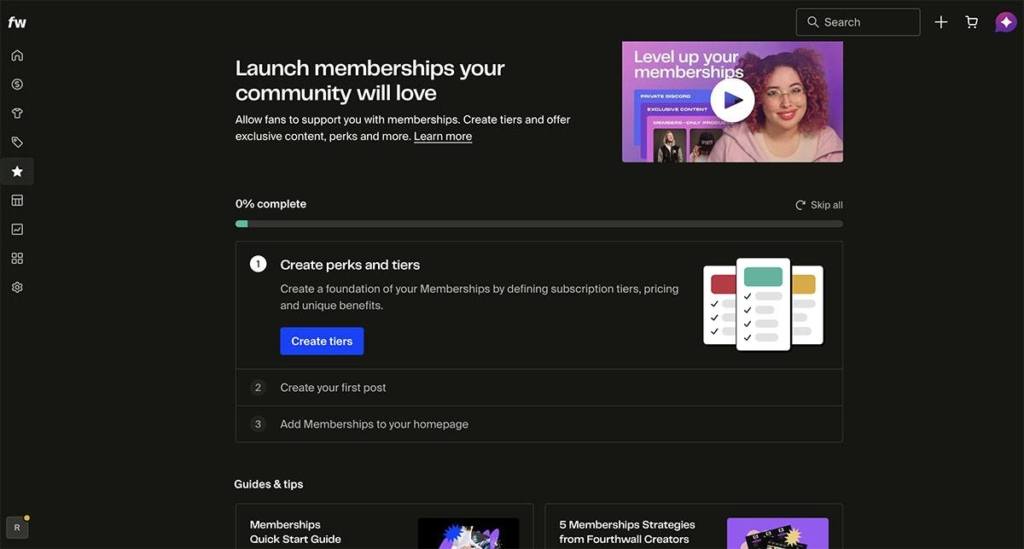
You also get a comprehensive system for designing tiered subscriptions and membership options. That’s ideal if you already have an audience, and your plan is to sell access to something exclusive.
What really makes the whole thing more impressive though, is how easy it is to create bundles across categories. For instance, a musician could sell a custom t-shirt bundled with a track download, or an exclusive video recording. A fitness coach could sell a hoodie bundled with a paid workout plan.
The option to accept donations rounds things out wonderfully too, particularly if you’re running a school, nonprofit, or a kind of creator club where people are keen to give you their support without actually getting anything specific in return.
Everything exists in the same ecosystem, so you’re not stitching things together with integrations, and trying to keep track of endless tabs.
Extra Features, AI Tools, and Integrations
Beyond the basics, the list of “extra” tools available from Fourthwall keeps growing. I already mentioned the AI assistant Eli, which helps with shop work. It can assist with pricing, promotions, analytics, product creation, catalog expansion, and general store management. Importantly, it also waits for approval before making any changes.
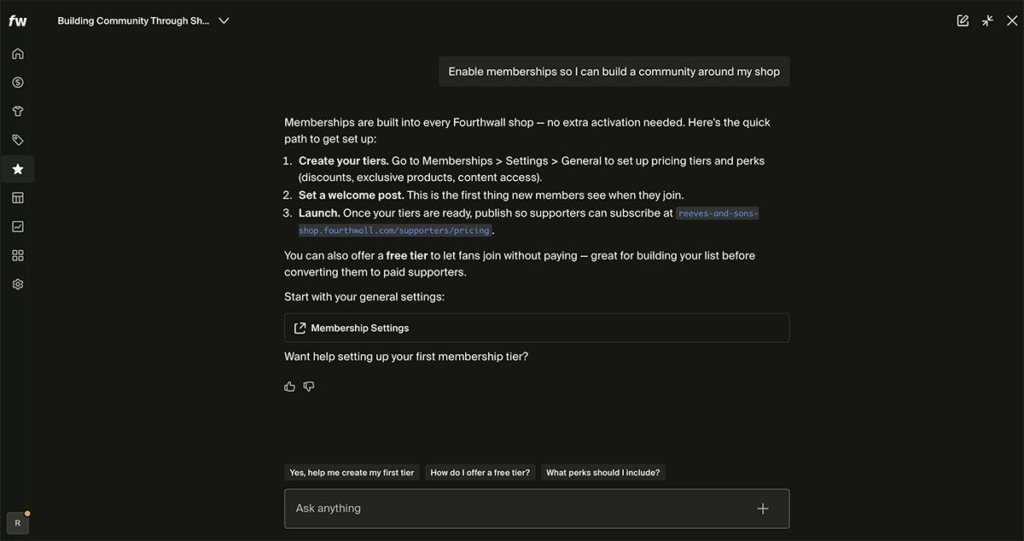
There’s also a custom MCP server you can use to let other AI assistants access shop data and help you out with growth plans. Beyond that, you’ve got:
- A designer marketplace, if you need help with product designs
- Promo codes, gift cards, and extra promotional features
- Direct messages and chat for customer support
- An automatic “thank you” tool
- Custom mobile app creation (on the Pro plan) that works with iOS and Android
- Multiple payment gateway options and multi-currency settings
The list of integrations is impressive too. You don’t need connectors to most things like ecommerce platforms (Shopify), print on demand platforms (Printify, Printful, Gelato), or digital download apps (Easy Download), because all of those tools are already included.
What you get instead is direct links to social media shopping channels such as Instagram Shopping, YouTube Product Shelf, TikTok Shop, Twitch Product Gifting, and StreamLabs. There are also integrations for email marketing tools like Klaviyo and Mailchimp. Plus, a Zapier connection is available for custom integrations.
Customer Support, Ease of Use, and Merchant of Record
If you ask me, the support part is where Fourthwall earns most of its extra points. The general customer support is excellent, even on the free plan, and there are plenty of resources to help you out with simple problems. Beyond that, though, Fourthwall does two very important things.
First, it acts as your Merchant of Record, so it handles sales tax work, including nexus registration, collecting sales tax, and remitting it to US states and other countries. That takes a lot of extra stress off your plate straight away.
Secondly, it deals with customer support for print on demand products, so you don’t need as many people answering shipping questions or dealing with refund requests in the background.
Overall, those two things, combined with Fourthwall’s straightforward setup and AI assistant, make this one of the most straightforward platforms I’ve used in a long time. It’s not just easy to get started, it’s surprisingly easy to manage your store as it scales, too.
Who Fourthwall Is, and Isn’t, Right For
Fourthwall is best when you already have an audience, and an idea for how you want to monetize your brand, and you just want to launch without extra headaches. It’s ideal for:
- Podcasters, influencers or creators
- Schools and course creators
- Musicians and bands
- Nonprofits
- Small startups
It’s really ideal for any kind of brand testing demand and exploring ways to grow. Still, that doesn’t make it perfect for everyone. I’d avoid it if you want:
- To run a complex ecommerce operation with specific rules
- Wholesale or B2B selling features
- Cheap POD products with lots of suppliers
- Mostly self-sourced products
- A simple “link-in-bio” selling option
Final Verdict: Is Fourthwall Worth It?
Right now, Fourthwall is one of my favorite platforms. Not because it’s the best, most advanced solution out there. Just because it’s one of the only systems I’ve used that seems to address the things that stop creative people or businesses from launching a brand in the first place.
What Fourthwall does best is reduce the stress associated with defining your brand, finding a home online, and experimenting with ways to sell.
I wouldn’t use it for a store that needs deep ecommerce control. If you’re building a big catalogue, running wholesale, building custom checkout flows, or treating SEO content as the main growth engine, there are better solutions out there.
What I love about Fourthwall is that it doesn’t ask you to become a store operator or hire an entire team to make your business work. It’s the ultimate low-admin brand platform.


