
 By Bogdan Rancea
Quick disclaimer, I’ve actually been a Semrush customer for several years now, so I remember well what using the platform used to feel like. You’d check rankings, dig through keywords, panic about backlinks, and build a visibility strategy somewhere along the way.
Semrush, the new flagship visibility platform from the brand, still gives you everything you might have come to expect from one of the world’s biggest SEO systems, but now it has a new angle.
Semrush One connects the classic SEO toolkit with AI visibility features, so you can build a plan that not only helps you show up on Google search, but also helps you grab the attention of the AI tools (like ChatGPT, Gemini, and Perplexity), people are starting to use for search.
If you’re wondering if that upgrade is really worthwhile, then you’re in the right place. I’ll walk you through the features of the Semrush One plan, and (hopefully) give you an idea of whether it’s right for your workflow in the process.
Semrush One: Quick Verdict
Semrush One is a brilliant upgrade from the previous “classic” Semrush platform. You get all the serious SEO tools you really need, plus a comprehensive suite of AI visibility features, so you can better understand your brand’s visibility in every area that counts.
The biggest downside, for me, is that it’s definitely a premium product, with prices starting at $299 per month, without accounting for extra “add-ons”.
Pros:
- SEO and AI visibility in one place
- Strong prompt and citation tracking
- Useful sentiment reports
- Competitor comparisons
- AI Search Health checks
- 261 million-prompt database
Cons:
- Expensive for smaller teams
- Interface still feels busy
- Extra costs for users, domains, and prompts
- Platform coverage varies by report
- Some newer AI features sit outside standard plans
What Is Semrush One?
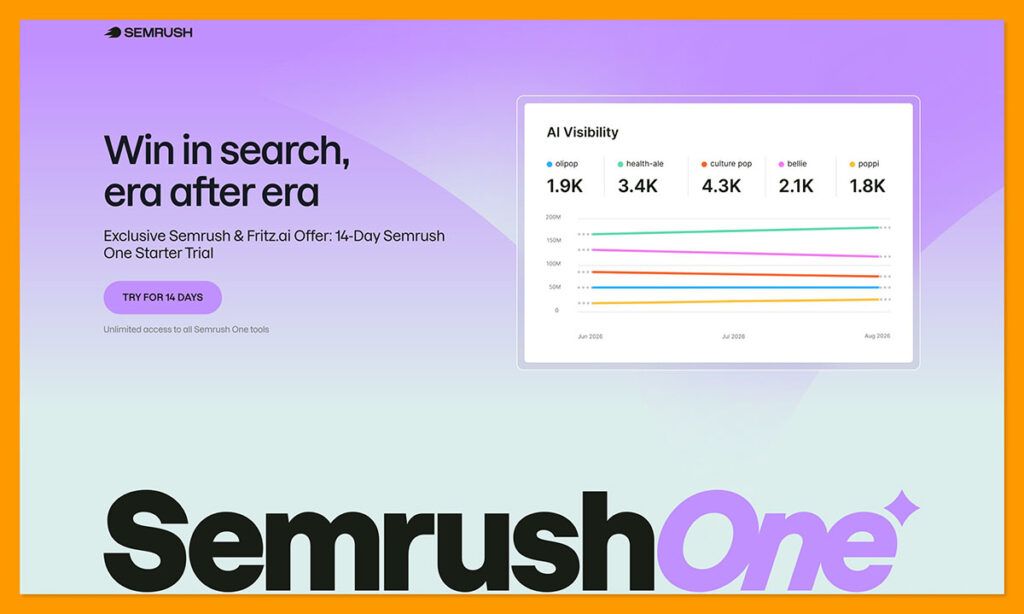
Semrush One is the primary SEO and AI search package from Semrush, bundling the regular SEO toolkit with a full AI visibility toolkit. That means you get to look at Google rankings and AI answer coverage in the same account.
The SEO side should feel familiar for most users. You get keyword research, rank tracking, competitor analysis, backlinks, and site audits, plus outreach tools and content optimization features. The AI side is the newer part, combining prompt research, prompt tracking, brand performance, sentiment, citations, competitor visibility, and AI search health.
Really, this new offering just gives you a clear insight into where Semrush, and a lot of other rank-boosting marketing tools are heading. They haven’t decided to ignore Google and SERPs, but they are aware of how much traffic actually moves through AI systems these days. About 37% of consumers start their journey with AI tools today, for instance.
If you’re comparing Semrush One with classic Semrush, here are the main differences at a glance:
My Experience Using Semrush One
The first thing I’ll say is that either version of Semrush can be tricky to get your head around at first. There are a lot of tools bundled into one plan, so it’s fair to expect a bit of a learning curve. That being said, I didn’t have much trouble with the initial setup.
I was already used to Semrush “classic”, so I knew what I was getting into. I will also say, however, that Semrush has made some major design improvements lately, too. In Spring 2026, it released a comprehensive “brand refresh” to shift its positioning from the SEO toolkit everyone’s familiar with, to a full, unified intelligence engine.
That sounds a bit like obscure marketing speak, but what it really means is that the overall system is cleaner, and the enterprise features are a lot stronger. The new UI, for instance, gives you expanded visibility metrics, and there are dedicated dashboards and workflows intended for things like Agentic Search Optimization.
What really stands out is how unified this workspace feels. You’re not constantly toggling between rank tracking and AI mentions, you can see everything in one view. For instance, I could see, at a glance, that one website currently ranking in the top five on Google search for our main search term was barely being mentioned by ChatGPT.
Key Features and Benefits of Semrush One
The feature list for Semrush is pretty long, so I’m going to focus on the stuff that really matters to most companies interested in a “visibility toolkit” these days.
AI Visibility Overview
This is where I’d start. It shows whether your brand appears in AI answers, how often it’s mentioned, which competitors show up beside, or before you, and which pages AI tools cite.
I’m a big fan of the “AI share of voice” metric in particular. I could see, at a glance, how my test brand compared with some of its biggest competitors, with insights broken down by query type and platform (such as ChatGPT, Gemini, and Google AI overviews).
Prompt Research and Tracking
The prompt research tool is more helpful than I expected. It’s much easier to guess at the kind of keywords someone might search for when they’re looking for a product or service your brand offers. It’s harder to figure out what they’d ask an LLM.
The research tool lets you enter a topic to analyze, and shows you the prompts most commonly used related to that topic. That’s very useful if you’re looking for tips on what questions should inform your FAQs, comparison pages, or buying guides.
The prompt tracking tool, on the other hand, lets you monitor prompt performance over time, seeing how your brand appears in answers to questions across LLM platforms. It’s handy if you want a quick insight into whether your share of voice is improving.
Brand Performance and Sentiment Analysis
Like most AEO-focused tools these days, Semrush One isn’t content with just telling you if AI tools are mentioning your brand. It wants you to know how exactly they’re describing you. Brand Performance and Sentiment analysis tools show you whether AI bots are talking about your company in positive, negative, or neutral ways.
You also get an idea of the kind of terms being used to describe your company. That’s helpful if you realize that you’re constantly being referenced as “budget-friendly” when you’re actually building a premium brand, for instance.
AI Citations and Site Audits
Cited pages are another incredibly helpful feature. They show you what kinds of pages most AI tools trust enough to reference.
If your best buying guide is ignored, that tells you something. If a competitor’s weaker article keeps getting cited, that tells you something too. I’d use this to decide which pages need clearer answers, better structure, stronger comparison detail, fresher proof, or cleaner internal links.
The better part is that the AI-enhanced audit recommendations can give you extra direction if you don’t know where to start. They might recommend updating your content structure, or refreshing a specific page, for example.
Competitor AI Visibility
If an AI answer keeps listing your competitors and leaving you out, you need to know why. Semrush gives you a deeper insight into what’s really happening. More importantly, those insights come with other competitor research capabilities too.
You can see at a glance if the problem might be with your backlinking structure, the specific keywords you’re targeting, or the way you’re presenting your brand to AI tools. Then you can actually turn those insights into action.
As I said before, you still get all the content workflow tools you had from Semrush before, like topic selection, and brief creation tools. This time, though, they’re pulling data from SEO and AI performance data at the same time.
Classic SEO Tools
Finally, there’s also all the classic SEO tools that prompted people to fall in love with this platform in the first place. You’ve still got all the essentials:
- Keyword research with search volume and difficulty scores
- Competitor traffic and domain analysis
- Position tracking by device, location, and keyword
- Technical site audits covering on-page issues and core web vitals
- Backlink analytics and outreach opportunities
- Content development tools for templates and writing assistance
- In-depth, shareable reports
Pricing: How Much Does Semrush One Cost?
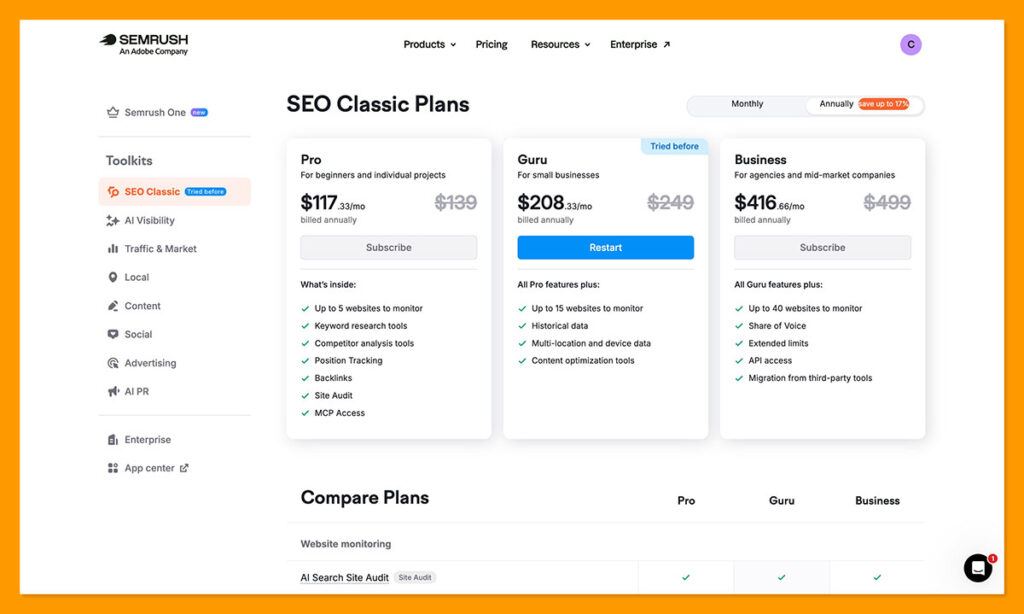
Semrush One isn’t cheap. The classic platform wasn’t either, if we’re fair.
The classic, entry-level Semrush plan focuses exclusively on SEO and costs $139.95 per month when billed monthly.
For businesses that want both SEO and AI visibility tools, Semrush One includes three primary tiers:
- Starter ($199/mo) — The entry-level Semrush One package.
- Pro+ ($299/mo) — Includes support for 15 websites, 1,500 tracked keywords, keyword cannibalization analysis, historical SEO data, MCP access, and expanded AI visibility capabilities.
- Advanced ($549/mo) — Supports 40 websites, 5,000 tracked keywords, SEO Share of Voice reporting, and 200 tracked AI prompts per day.
There’s also the option to request a custom enterprise quote if you need additional capacity or features.
The Advanced plan ($549/mo) includes everything in the Pro+ plan, plus:
- Monitoring for up to 40 websites (up from 15)
- Tracking for up to 5,000 keywords (up from 1,500)
- SEO Share of Voice reporting
- Tracking for up to 200 AI prompts per day (up from 100)
It’s primarily designed for larger teams and agencies that need broader tracking limits and deeper visibility reporting.
There’s also the option to request a custom quote from Semrush directly if you think you need something specific.
Again, all of that might seem expensive, but really, it’s good value for money. If you wanted to add the standalone AI Visibility Toolkit to a classic plan, for instance, you’d be paying $99 per month, alongside your $139.95 Starter plan, and you’d get fewer prompts to monitor (starting at 25).
There are some extra costs to think about, such as fees for extra domains, or extra AI visibility tool access for additional users ($45 each). It’s worth keeping that in mind when you’re budgeting.
Who Should Use Semrush One, and Who Shouldn’t?
Really, Semrush makes a lot of sense for a specific kind of team. If you already have a lot of search activity, content, and brand visibility stats to monitor, and you want a complete view of your search engine and AI results, this system makes sense. I’d recommend Semrush One to:
- AEO and AI-focused search teams who still care about SEO
- Mid-sized to large agencies managing multiple clients
- Ecommerce brands relying on AI and SEO for traffic
- Teams already using Semrush for SEO insights
- In-house teams at companies that produce a lot of content
You might want to look elsewhere if you:
- Run a new site with very little content
- Have a very tight budget and only want basic keyword research
- Don’t have much time to act on the data you get
- Only care about Google SEO rankings right now
Semrush One Review: Final Verdict
Semrush One is a strong upgrade, and certainly one of the most comprehensive visibility platforms I’ve tried. It’s probably a bit much for very small teams with limited budgets, but for growing companies, enterprises, and agencies, it has a lot of value.
You get all of the strong SEO features you probably already love using with Semrush, plus the extra AI visibility tracking, prompt discovery, sentiment analysis, and AI-enhanced audits that can help you strengthen your share of voice in the current digital space.
Yes, it’s a little expensive, and it can come with a bit of a learning curve, particularly if you haven’t used Semrush before, and you’re new to AEO. Still, if AI visibility and search engine growth are priorities for your business, Semrush One gives you the perfect combo.
It’s not a casual tool for SEO and AI search growth. It’s a real toolkit, intended for companies that understand how the worlds of search and traffic are changing now, and want to get ahead of their competition before they fade into obscurity.


