
 By Bogdan Rancea
Shift4Shop’s zero-fee deal looks great on paper, but it only really works for US merchants who can run their store on Shift4 Payments.
Step outside that lane and the catch shows up fast: dated templates, mixed support reviews since the 2020 acquisition, and an app ecosystem far smaller than Shopify’s or WooCommerce’s. International sellers, anyone tied to Stripe or PayPal, or merchants who want a modern admin will quickly feel boxed in.
Plenty of platforms promise to fix this, but many trade one set of compromises for another.
Some pile on transaction fees, others force expensive upgrades the moment your revenue grows, and a few aren’t really comparable products at all. To cut through it, I tested the most credible Shift4Shop replacements on free trials and entry-level plans, building real stores instead of skimming feature lists.
Each platform was scored on what actually matters: pricing transparency, fee structure, ease of setup, design flexibility, multichannel selling, and how it handles growth.
You’ll see clearly which alternative beats Shift4Shop on which dimension – and which ones cost less without forcing you back into another corner.
My top overall pick is Shopify.
Its ecosystem, checkout, and reliability are simply unmatched at this price point, and Shopify Payments wipes out the platform transaction fees that scare merchants away. The other platforms on this list each win in their own lane, so you can pick the one that fits your specific reason for leaving Shift4Shop.
Short on time? These are the best Shift4Shop alternatives in 2026
- Shopify – Largest app ecosystem and most polished admin, with Shop Pay checkout and zero platform fees on Shopify Payments.
- BigCommerce – Strongest no-extra-fee SaaS option for B2B, multi-storefront, and headless setups.
- WooCommerce – Free open-source plugin for WordPress that gives full control of stack and SEO with no platform cut.
- Ecwid by Lightspeed – Cheapest way to add a store to an existing site or social profile, with a real free plan.
- Wix Commerce – Easiest entry-level ecommerce for design-first small sites and service brands.
- Squarespace Commerce – Best looking templates and clean editor for portfolios and brand-led stores.
- PrestaShop – Open-source cart with strong EU multi-language and tax handling.
- Medusa.js – Modern headless engine for dev-led teams, with an AI builder for natural-language store setup.
By the numbers
- Shopify Basic costs $39/month, with Shopify Payments waiving all platform transaction fees.
- BigCommerce introduced a new Open Payment Provider Fee on June 1, 2026 – up to 2% for non-approved gateways.
- Ecwid raised pricing on its Venture, Business, and Unlimited plans on March 2, 2026; the Starter plan stays at $5/mo.
- WooCommerce powers a large share of WordPress stores with $0 platform fees, but typically costs $1,200–$3,000/year in hosting and extensions.
- Squarespace Plus removes its 2% commerce transaction fee, charging only standard processor rates.
Shift4Shop alternatives compared
| Platform | Starting price | Platform transaction fees | Best for vs Shift4Shop |
|---|---|---|---|
| Shopify | $39/mo (Basic) | 0% with Shopify Payments | Brands wanting the largest app and theme ecosystem |
| BigCommerce | $39/mo (Standard, pre-rename) | 0% on approved gateways; up to 2% Open Payment Provider Fee | Growing stores, B2B, multi-storefront |
| WooCommerce | Free (plus hosting) | 0% platform fee; gateway fees only | Owners wanting full stack control and SEO depth |
| Ecwid by Lightspeed | $5/mo (Starter) | 0% platform fee | Adding a store to an existing site or social channel |
| Wix Commerce | From Core plan | 0% platform fee | Small, design-led sites and service businesses |
| Squarespace Commerce | $23/mo (Core) | 0% on Core, Plus, Advanced | Brand-first stores and portfolios |
| PrestaShop | Free (open source) | 0% platform fee | EU stores needing multi-language and VAT depth |
| Medusa.js | Free (self-hosted) | 0% platform fee | Dev teams building custom headless storefronts |
1. Shopify: Best overall Shift4Shop alternative

Shopify is the most popular ecommerce platform in the world, and after testing it against Shift4Shop, the gap in day-to-day experience is hard to overstate.
The admin is faster, the theme store is wider, and Shop Pay – Shopify’s one-tap checkout – converts better than almost any other checkout flow I’ve used. Where Shift4Shop’s interface still looks like the 3dcart product it grew out of, Shopify feels like a platform that ships updates every month.
The big sticking point for fee-conscious merchants is Shopify’s platform transaction fees, but that concern dissolves the moment you use Shopify Payments.
On Shopify Payments, the platform fee drops to 0% on every plan – matching Shift4Shop’s headline “no platform fee” pitch. You still pay standard card processing rates (2.9% + 30¢ on Basic, dropping to 2.5% + 30¢ on Advanced), which are comparable to what Shift4 Payments charges.
Where Shopify pulls ahead is the ecosystem around it. The app store covers subscriptions, B2B, headless front ends, dropshipping, POS, and pretty much any niche workflow you can think of. The downside is that some of those apps add real monthly costs, and a typical growing store ends up spending $50–$200/month on apps on top of the plan fee.
Pros
- Largest app and theme ecosystem of any ecommerce platform.
- Shop Pay checkout consistently outperforms competitor checkouts on conversion.
- Shopify Payments eliminates platform transaction fees on every plan.
- Mature POS hardware and software covering 12+ countries.
- Shopify Plus offers a clear upgrade path for high-volume brands.
Cons
- Third-party payment gateways trigger platform fees on every plan.
- App costs add up quickly and aren’t obvious until you’ve built the store.
- Premium themes are a one-time $180–$350 expense if you outgrow free themes.
Pricing
Shopify’s main plans for 2026 are Basic at $39/mo, Grow (formerly “Shopify”) at $105/mo, and Advanced at $399/mo, with annual billing saving roughly 25%. There’s a Starter plan at $5/mo for social and link-in-bio selling, and Shopify Plus starts at $2,300/mo for enterprise merchants. All plans waive platform transaction fees on Shopify Payments.
Why use Shopify in 2026?
Shopify is the safest long-term bet on this list. The platform ships features constantly, the ecosystem keeps growing, and the merchant infrastructure (POS, payments, capital, balance) reaches further than anything Shift4Shop offers. If you’re leaving Shift4Shop because the platform feels stuck in time, Shopify is the most direct upgrade.
Suitable for
- DTC brands looking for a modern admin and large app ecosystem.
- Stores that want a checkout proven at scale (Shop Pay).
- Merchants planning omnichannel, including POS and social commerce.
- US and international merchants who want native payments support.
Not suitable for
- Merchants tied to a specific third-party gateway who refuse to switch to Shopify Payments.
- Anyone wanting fully free hosting like Shift4Shop’s end-to-end plan.
2. BigCommerce: Best for B2B and multi-storefront
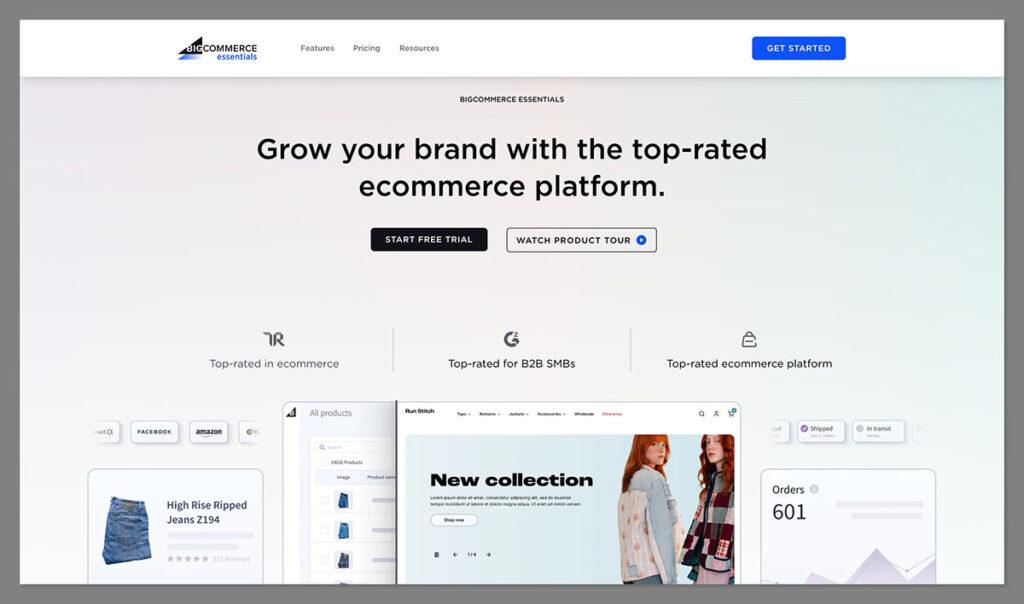
BigCommerce has historically been the closest direct competitor to Shift4Shop on fee structure – its long-standing pitch was “no platform transaction fees on any plan.”
That made it a natural switch for merchants leaving Shift4Shop who weren’t willing to give up that benefit. In 2026, the comparison gets more complicated, but BigCommerce is still the strongest SaaS pick for B2B, headless, and multi-storefront use cases.
The B2B tooling out of the box is what really separates BigCommerce from Shift4Shop. Native price lists, customer groups, quote management, and multi-storefront support all come baked in on appropriate plans – no third-party apps needed.
For wholesale brands and merchants running multiple regional storefronts off one catalog, that’s a meaningful operational advantage.
The catch in 2026 is real, though. Starting June 1, 2026, BigCommerce introduced a new Open Payment Provider Fee: 2% on the rebranded Core plan, 1% on Growth, and 0.6% on Scale for any order processed through a gateway not on its approved list.
GMV thresholds also dropped, meaning more merchants get pushed into higher tiers. The “no transaction fees” banner that used to be BigCommerce’s loudest argument against Shopify is now a more nuanced story.
Pros
- Strong native B2B tools (price lists, customer groups, quotes) without third-party apps.
- Multi-storefront support from a single admin dashboard.
- API-first architecture that handles headless front-end builds cleanly.
- No platform transaction fees on approved Embedded Payment Providers.
Cons
- New Open Payment Provider Fee (up to 2%) on non-approved gateways from June 2026.
- GMV thresholds force plan upgrades regardless of your feature needs.
- Editor and theme system are less beginner-friendly than Shopify or Wix.
Pricing
Standard starts at $39/mo ($29/mo annually), Plus at $105/mo ($79/mo annually), Pro at $399/mo ($299/mo annually), and Enterprise pricing is custom. Pro stays at its base rate up to $400,000 in trailing 12-month GMV, then adds $150/mo per additional $200,000 in GMV. Plans rename to Core, Growth, Scale, and Performance from June 1, 2026.
Why use BigCommerce in 2026?
BigCommerce still makes financial sense for merchants who can use one of its approved Embedded Payment Providers (Stripe, PayPal/Braintree, Adyen, Checkout.com, and others). For B2B, multi-region brands, and headless setups, it remains one of the most capable SaaS platforms at this price point – just run the math on your gateway choice before signing up.
Suitable for
- B2B brands needing wholesale, quoting, and customer-specific pricing.
- Multi-storefront operators managing several brands or regions.
- Stores planning to go headless with React, Next.js, or Vue front ends.
Not suitable for
- Merchants who insist on a third-party gateway outside the approved list.
- Very small stores that would feel the GMV-based forced upgrades early.
3. WooCommerce: Best free open-source Shift4Shop alternative
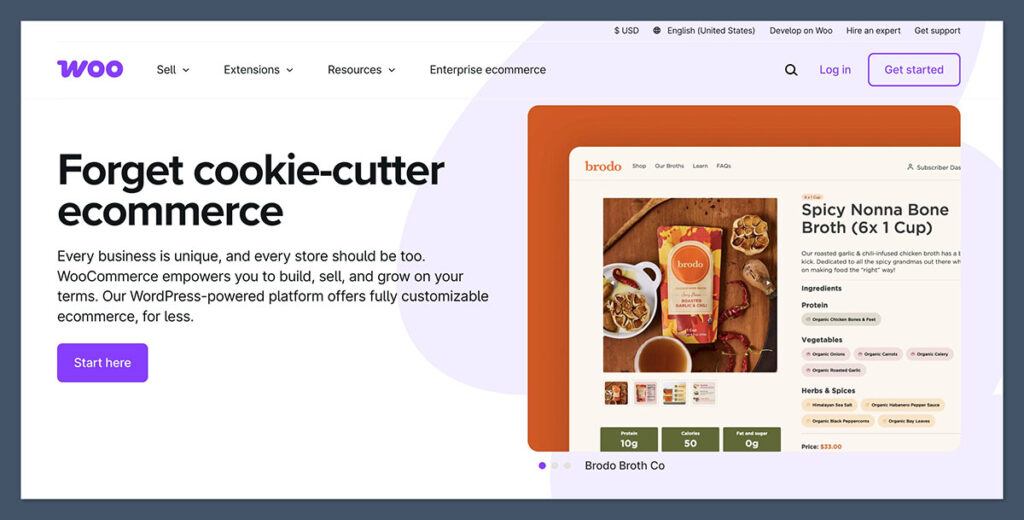
WooCommerce is the open-source counterpoint to Shift4Shop. Instead of a hosted platform with built-in payments, you get a free WordPress plugin that turns any WordPress site into a fully functional online store.
The plugin itself costs nothing, you keep your stack, and the only fees on sales are whatever your payment processor charges.
For merchants leaving Shift4Shop because they want more SEO control, more design freedom, or to escape platform lock-in entirely, WooCommerce is the obvious destination. WordPress is the strongest content platform on the web, and stores that depend on organic search, content marketing, or complex product taxonomy benefit hugely from running on it.
The “free” part is misleading, though. You pay for hosting ($10–$200/month depending on traffic), premium extensions ($100–$1,000/year for things like subscriptions, advanced shipping, or B2B), and often a developer to set things up correctly.
Annual total cost typically lands somewhere between $300 and $5,000 depending on how lean you keep the stack. Maintenance, security patches, and PCI compliance also become your responsibility.
Pros
- $0 platform fees on every sale, ever – only processor rates apply.
- Complete control over hosting, code, themes, and plugins.
- Industry-leading SEO with Yoast, Rank Math, and WordPress’s content architecture.
- Massive plugin ecosystem covering almost any feature need.
Cons
- You handle hosting, security, updates, and PCI compliance yourself.
- Plugin conflicts and bloat can degrade site speed over time.
- True total cost of ownership often surprises non-technical owners.
Pricing
The WooCommerce plugin is free. Expect $10–$30/month for solid managed WordPress hosting, $0–$200 one-time for a theme, and $100–$1,000/year for the extensions a typical store ends up needing. Payment processing fees (Stripe, PayPal) sit at standard rates of around 2.9% + 30¢ per transaction.
Why use WooCommerce in 2026?
If you’re leaving Shift4Shop because you want stack ownership and zero platform cut, WooCommerce is the cleanest move. The trade-off is technical responsibility – but for content-heavy brands, niche stores, and merchants with dev resources, the flexibility wins.
Suitable for
- Content-led brands that publish heavily and rely on organic search.
- Merchants who already run a WordPress site and want to add commerce.
- Stores willing to invest in hosting and developer support for full control.
Not suitable for
- Non-technical owners who want a fully managed solution like Shift4Shop.
- Anyone who needs PCI compliance handled at the platform level.
4. Ecwid by Lightspeed: Best for adding a store to an existing site
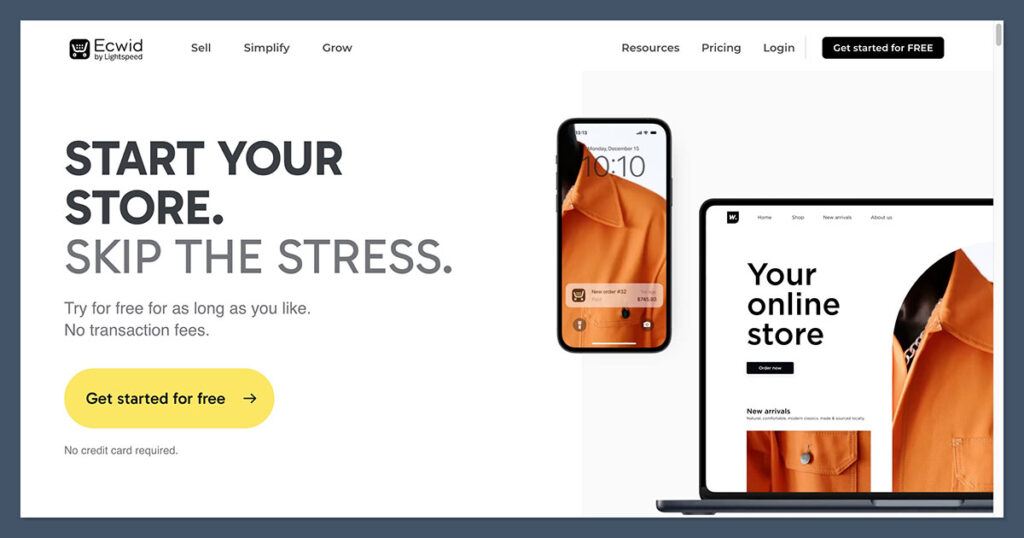
Ecwid (now part of Lightspeed) takes a fundamentally different approach to ecommerce than Shift4Shop. Instead of replacing your website, it gives you an embeddable store you can drop into any existing WordPress, Wix, Squarespace, or custom-built site. The widget inherits your site’s header, footer, and navigation, so customers never feel like they’ve left your domain.
For merchants who like their current website but want commerce added without rebuilding, Ecwid is uniquely useful. It’s also one of the few platforms with a real free tier, plus genuinely low entry pricing for paid plans.
Zero platform transaction fees apply on every tier, and the multi-channel selling (sync your catalog to Facebook, Instagram, Amazon, eBay, and TikTok) compares well to Shift4Shop’s native marketplace integrations.
The trade-off is design control. Because Ecwid lives inside your existing site, you don’t get the deep theme customization of a dedicated platform.
The Lightspeed acquisition has expanded POS integration for omnichannel businesses, but the brand recognition is lower – customers may not recognize “Ecwid” the way they recognize Shopify or PayPal at checkout. Pricing also stepped up on March 2, 2026, with increases on Venture, Business, and Unlimited plans (Starter stays at $5/mo).
Pros
- Embeds into any existing website, blog, or social profile without a rebuild.
- Genuinely useful free plan for small catalogs and testing.
- Zero platform transaction fees on every plan.
- Strong multi-channel selling across social, marketplaces, and POS.
Cons
- Design flexibility is limited compared to standalone platforms.
- Starter plan caps inventory at 10 products – most stores upgrade quickly.
- Brand recognition is lower than Shopify or BigCommerce.
Pricing
Ecwid by Lightspeed has four tiers starting at Starter ($5/mo, unchanged). Venture, Business, and Unlimited plans were repriced in March 2026, with annual billing saving roughly 16–25%. A 14-day free trial is available, and there’s a free tier through the embeddable widget for very small catalogs.
Why use Ecwid in 2026?
Ecwid is the move when you don’t actually want to leave your current website – you just want to add a store to it. For content creators, service businesses adding merch, or anyone with an established blog or portfolio, it’s the lowest-friction way to start selling.
Suitable for
- Content creators and bloggers adding commerce to existing sites.
- Service businesses wanting to sell a small product line alongside services.
- Multi-channel sellers managing social, marketplace, and web sales together.
Not suitable for
- Brands that need deep design customization and unique theme architecture.
- Catalogs growing past several hundred products.
5. Wix Commerce: Best easiest entry-level alternative
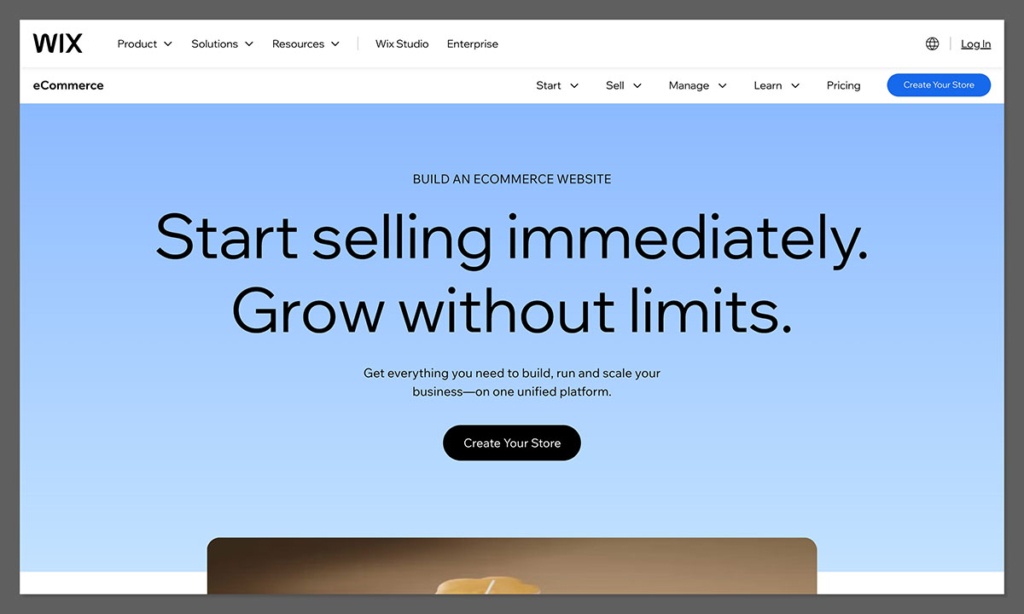
Wix is the easiest builder on this list to get a basic store up on, full stop. The drag-and-drop editor gives you direct visual control, the templates look modern, and Wix’s built-in AI builder can scaffold a working store in minutes. For merchants picking Shift4Shop mainly because of the free pricing rather than its deep ecommerce features, Wix is usually the gentler landing pad.
The commerce side has matured significantly. Wix supports roughly the same range of payment gateways as Shift4Shop, charges no platform transaction fees, and includes blogs, bookings, marketing tools, and SEO basics out of the box.
Wix Studio (the Pro-tier version) adds team workspaces, responsive AI layout tools, and Figma import for agencies and designers.
Wix’s limits show up at scale. The template lock-in is real – once published, you can’t switch templates without rebuilding. Product limits, advanced shipping, and serious multichannel selling start to feel cramped past a few hundred SKUs, and Wix POS hardware is limited to the US, Canada, and UK. For high-volume DTC, Shopify or BigCommerce will scale further; for small and design-led stores, Wix is plenty.
Pros
- Easiest editor to learn for non-technical store owners.
- Hundreds of modern templates and strong design freedom inside each one.
- Zero platform transaction fees.
- Built-in bookings, blog, and marketing tools without extra apps.
Cons
- You can’t switch templates after publishing without rebuilding.
- Mobile editor requires separate manual adjustments.
- Less scalable than Shopify or BigCommerce for high-volume stores.
Pricing
Wix Commerce requires the Core plan or higher. There’s no free ecommerce plan, but Wix offers a 14-day money-back guarantee on annual plans. Wix Studio (Pro) starts low but stacks features through Enterprise tiers for agencies.
Why use Wix in 2026?
Wix wins when ease and design are the priorities, not deep ecommerce features. For service businesses, designers, and small stores under a few hundred products, the time-to-launch advantage over Shift4Shop is significant.
Suitable for
- Small stores prioritizing design and quick launch over feature depth.
- Service businesses adding bookings and product sales together.
- Non-technical owners who want full visual control of the editor.
Not suitable for
- High-volume merchants with large catalogs and complex shipping rules.
- Stores planning to scale into headless, B2B, or multi-storefront setups.
6. Squarespace Commerce: Best for design-led brands

Squarespace’s biggest argument against Shift4Shop is the look. Templates are well above industry average – polished, editorial, and noticeably different from the boilerplate aesthetic of older platforms. Unlike Wix, Squarespace lets you switch templates inside the same version generation without losing content, so you’re not locked into your first design choice.
Commerce on Squarespace has matured into a serious offering. The 2026 plan structure (Basic, Core, Plus, Advanced) lets you sell on every plan, with subscriptions, digital products, abandoned cart recovery, and advanced shipping unlocking as you move up. Core ($23/mo annually) removes the 2% commerce transaction fee that catches a lot of Basic-plan merchants off guard – on Core, Plus, and Advanced, you pay only standard processor rates.
Squarespace works best for brand-first businesses, creative professionals, and stores where design carries more weight than feature depth.
For high-ticket dropshipping, complex catalogs, or anything needing a large app marketplace, Shopify or BigCommerce will give you more tools. Squarespace also doesn’t offer live phone support – just email and chat – which is a step down from Shift4Shop’s 24/7 phone line.
Pros
- Best-looking templates of any platform on this list.
- Mid-build template switching without rebuilding the site.
- Core, Plus, and Advanced plans charge 0% commerce transaction fees.
- Built-in email campaigns, native analytics, and Acuity scheduling.
Cons
- No free plan – the 14-day trial is the only way to test before paying.
- No live phone support; only email and chat.
- Smaller ecommerce ecosystem than Shopify or BigCommerce.
Pricing
Squarespace 2026 pricing runs from Basic ($16/mo annually) to Advanced ($99/mo annually), with Core ($23/mo) being the sweet spot for most ecommerce stores. Annual billing saves 28–36% versus monthly, and every annual plan includes a free custom domain for the first year.
Why use Squarespace in 2026?
Squarespace makes sense when brand presentation is a top three priority. Creative professionals, designer-led stores, and content-led brands consistently get more polished results out of Squarespace than out of Shift4Shop with the same effort.
Suitable for
- Design-led brands, creative professionals, and portfolio-style stores.
- Service businesses needing both a website and integrated booking.
- Small-to-mid stores that prioritize aesthetics over deep ecommerce features.
Not suitable for
- High-volume stores needing a large app ecosystem.
- Merchants who require live phone support.
7. PrestaShop: Best open-source alternative for EU sellers
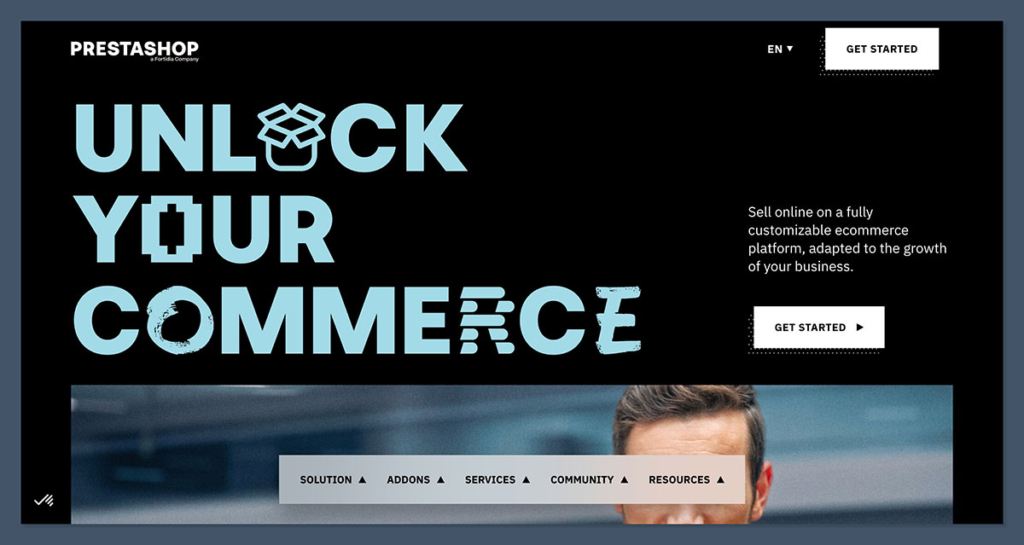
PrestaShop is the open-source cart most popular with European stores, and for good reason. Native multi-language and multi-currency support, deep VAT and tax handling, and a strong agency ecosystem across the EU make it a credible alternative for merchants outside the US who don’t fit Shift4Shop’s mostly-American footprint.
Like WooCommerce, PrestaShop runs as software you host yourself, with no platform fee on sales. Unlike WooCommerce, it’s a standalone application rather than a plugin – meaning the architecture is more ecommerce-first out of the gate, but you give up WordPress’s content advantages.
The module marketplace is large but uneven: some modules are excellent, others are abandoned, and quality varies.
The trade-off is the same as any open-source path: you take on hosting, security, upgrades, and developer costs. For merchants who already have technical resources – or an agency relationship – PrestaShop can deliver a sophisticated international store at a fraction of an enterprise SaaS bill.
Pros
- Excellent native multi-language and multi-currency support.
- Strong VAT handling and EU tax compliance.
- No platform transaction fees – host and pay processor only.
- Large module marketplace and strong agency network in Europe.
Cons
- Requires technical or agency support to run well.
- Module quality is inconsistent.
- Smaller global community than WooCommerce or Shopify.
Pricing
The PrestaShop software is free. Real costs come from hosting (typically €10–€50/month), modules (€50–€300 each for premium options), themes (€80–€300 one-time), and developer time. PrestaShop also offers a hosted “PrestaShop Hosted” edition with monthly subscription pricing for merchants who want a managed option.
Why use PrestaShop in 2026?
For EU-based merchants who want stack ownership and strong international tax handling, PrestaShop hits a sweet spot that Shift4Shop doesn’t really address. It’s especially useful when local payment methods, multi-language SEO, and EU compliance are central to the business.
Suitable for
- European merchants selling across multiple languages and currencies.
- Stores with agency or in-house dev support.
- Merchants prioritizing open-source flexibility over SaaS convenience.
Not suitable for
- US-only merchants who would benefit more from Shift4Shop’s free plan.
- Non-technical owners without agency support.
8. Medusa.js: Best for headless and developer-led teams
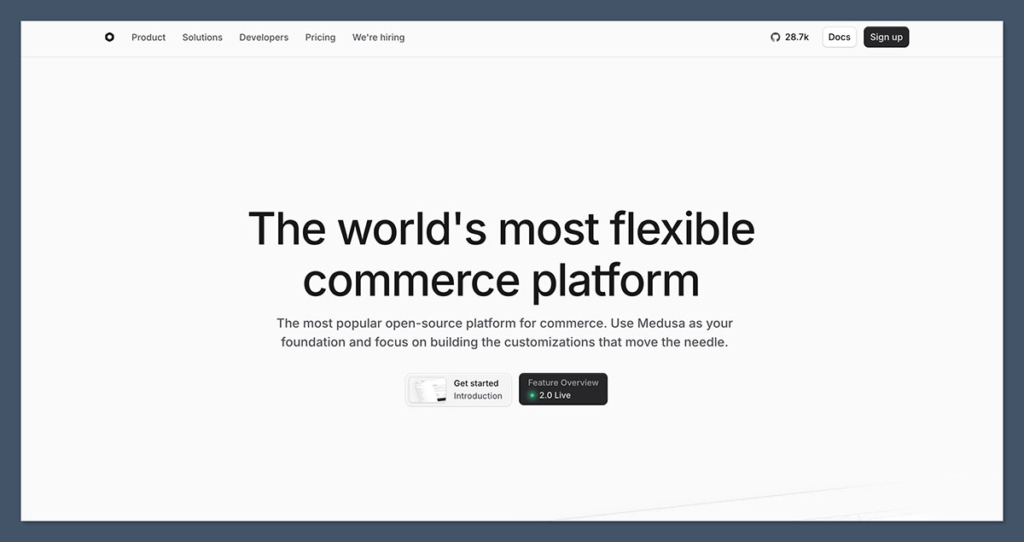
Medusa is the most modern entry on this list, and the one furthest from Shift4Shop’s model. It’s an open-source, Node-based ecommerce engine with REST and GraphQL APIs, built for teams who want to design their own storefront experience from scratch. There’s no built-in visual store builder – you bring your own front end, typically Next.js or another modern framework.
What makes Medusa worth a mention in a Shift4Shop alternatives article is its 2026 trajectory.
The platform now ships an AI builder called Bloom that lets you scaffold and manage an ecommerce store using natural-language prompts, which is the kind of differentiator that didn’t exist when most Shift4Shop alternatives lists were written. Combined with its API-first architecture, Medusa is one of the few platforms credible as a long-term bet for teams investing in custom commerce experiences.
The cost model is simple: $0 platform fees, you pay only infrastructure (hosting, database, CDN) and your own development time.
For dev-heavy teams, the long-term economics beat any SaaS option once you scale past a certain volume. For everyone else, the upfront engineering investment is real.
Pros
- API-first architecture suits modern headless front ends out of the box.
- No platform transaction fees – pure infrastructure cost.
- AI builder (Bloom) for natural-language store scaffolding.
- Fully open source with active development community.
Cons
- Requires real engineering investment – not for non-technical owners.
- Smaller community and module marketplace than WooCommerce.
- You handle hosting, scaling, and security yourself.
Pricing
Medusa core is free and open source. Real costs are infrastructure ($20–$200+/month depending on traffic), developer time, and any third-party services you wire in for payments, search, and analytics. There’s also a managed cloud offering for teams that want the platform without the infrastructure overhead.
Why use Medusa in 2026?
Medusa is the right pick when “custom” genuinely matters – brands building unique customer experiences, marketplaces, or commerce flows that don’t fit a SaaS template. For dev-led teams leaving Shift4Shop because they want full control and don’t mind owning the stack, it’s a credible 2026 bet.
Suitable for
- Dev-heavy teams building custom storefronts on modern frameworks.
- Brands needing bespoke commerce flows beyond standard ecommerce.
- Marketplaces and multi-vendor commerce projects.
Not suitable for
- Non-technical merchants who need a visual store builder.
- Anyone wanting to launch without engineering investment.
How to choose the right Shift4Shop alternative
The right replacement for Shift4Shop depends entirely on why you’re leaving and what trade-offs you’re willing to accept. A few practical filters will narrow the list fast.
If you’re leaving for a more modern admin and bigger ecosystem, Shopify is the most direct upgrade. The ecosystem, checkout, and reliability make it the safest long-term bet.
If your priority is wholesale or multi-storefront, BigCommerce still beats Shopify on native B2B – just check whether your gateway falls under the new Open Payment Provider Fee.
If you’re leaving because you want stack ownership and zero platform cut, WooCommerce is the cleanest move for content-led brands, and PrestaShop is the stronger pick for EU-focused stores with serious tax requirements.
If your team has real engineering resources and wants a long-term custom build, Medusa.js represents the most modern direction.
If you’re leaving because you actually like your existing site and just want to add commerce, Ecwid by Lightspeed is the only embeddable option here.
And if Shift4Shop was already overkill for what you needed, Wix Commerce or Squarespace Commerce will get you a polished store faster, with Wix winning on ease and Squarespace winning on design.
How we tested these Shift4Shop alternatives
Each platform was tested on its free trial or entry-level paid plan, with a real store built – not a theoretical feature comparison.
Scoring focused on five areas that matter most to merchants leaving Shift4Shop: pricing transparency and total cost of ownership, ease of setup and admin experience, design flexibility and template quality, native ecommerce feature depth (multichannel, B2B, shipping, SEO), and scalability path as the business grows.
Pricing was verified directly against current 2026 plan pages and recent platform announcements, including BigCommerce’s June 2026 pricing update and the March 2026 Ecwid repricing.
Key takeaways
- Shift4Shop’s “free if you use Shift4 Payments” deal is unbeatable for US merchants who fit that lane – but the moment you need flexibility, the alternatives deliver more.
- SaaS alternatives (Shopify, BigCommerce, Squarespace, Wix) replace Shift4Shop with more polished admins and bigger app ecosystems.
- Open-source options (WooCommerce, PrestaShop, Medusa) replace Shift4Shop with stack ownership – but you take on hosting and maintenance.
- Ecwid offers something Shift4Shop doesn’t: a tiny embeddable store that lives inside your existing site.
- Watch fee structures carefully in 2026 – BigCommerce now charges a 2% Open Payment Provider Fee for non-approved gateways on Core plans.
Final verdict
Shift4Shop has a real value proposition for one specific merchant: a US-based seller willing to run their store on Shift4 Payments and accept a dated admin in exchange for $0/month. Outside that lane, the alternatives win on almost every dimension that matters in 2026.
Shopify is the best overall replacement – it gives you the largest ecosystem, the most polished checkout, and the clearest scaling path. BigCommerce wins for B2B and multi-storefront merchants who can use approved gateways.
WooCommerce is the best free-software route for content-led brands and merchants who want stack ownership.
Ecwid is the only sensible pick if you don’t actually want to leave your existing site.
And for design-led brands, Squarespace consistently produces the most polished output for the least effort.
Run the math on your gateway, your expected volume, and your tolerance for technical responsibility before you switch. Most merchants leaving Shift4Shop will find a better fit on this list within minutes once those three filters are applied.
FAQ
Is Shift4Shop really free?
Shift4Shop’s End-to-End ecommerce plan is genuinely free for US merchants who use Shift4 Payments as their payment processor. Outside that setup – international merchants or anyone using a third-party gateway like Stripe or PayPal as their primary processor – Shift4Shop falls back to standard monthly plan pricing, which makes it considerably less distinctive.
Which Shift4Shop alternative has the lowest fees long term?
WooCommerce on a self-hosted setup typically has the lowest long-term fee structure – no platform fee, only your payment processor takes a cut. The trade-off is hosting, security, and maintenance costs that average $1,200–$3,000/year for a healthy store. For SaaS, Shopify with Shopify Payments and BigCommerce on an approved Embedded Payment Provider both eliminate platform transaction fees and end up similar on total cost.
Can I migrate from Shift4Shop to another platform easily?
Most major platforms (Shopify, BigCommerce, WooCommerce) have migration tools or partner agencies that handle the move from Shift4Shop. Product data, customer records, and order history typically transfer cleanly. URL structure and SEO setup require more careful work – plan 301 redirects from old Shift4Shop URLs to the new structure, and migrate page-level meta data manually if you want to protect organic rankings.
Does Shopify charge transaction fees like Shift4Shop?
Shopify charges platform transaction fees only when you use a third-party payment gateway. On Shopify Payments, the platform fee drops to 0% on every plan – matching Shift4Shop’s “no platform fee” pitch. You still pay standard card processing rates (2.4%–2.9% + 30¢ depending on plan), which are comparable to what Shift4 Payments charges.
What changed with BigCommerce pricing in 2026?
BigCommerce introduced a new Open Payment Provider Fee on June 1, 2026: 2% on the rebranded Core plan, 1% on Growth, and 0.6% on Scale for any order processed through a gateway not on its approved Embedded Payment Provider list (Stripe, PayPal/Braintree, Adyen, Checkout.com, and others). GMV thresholds also dropped, meaning more merchants get pushed into higher tiers. If you’re evaluating BigCommerce as a Shift4Shop alternative, check your gateway before signing up.
Is WooCommerce actually cheaper than Shift4Shop?
It depends on volume. For US merchants who qualify for Shift4Shop’s free plan with Shift4 Payments, Shift4Shop is cheaper than WooCommerce in pure platform costs. WooCommerce wins on long-term flexibility and SEO control, but you’re paying $1,200–$3,000/year in hosting and extensions to run it well. For international merchants who don’t qualify for Shift4Shop’s free tier, WooCommerce is often more cost-effective overall.
Which Shift4Shop alternative is best for B2B?
BigCommerce has the strongest native B2B tooling at SaaS prices – customer groups, price lists, quote management, and multi-storefront all come built in on appropriate plans. Shopify’s B2B features are growing fast but generally require Shopify Plus for the full toolset. WooCommerce can handle B2B with the right extensions but adds setup work.


