Autonomous 
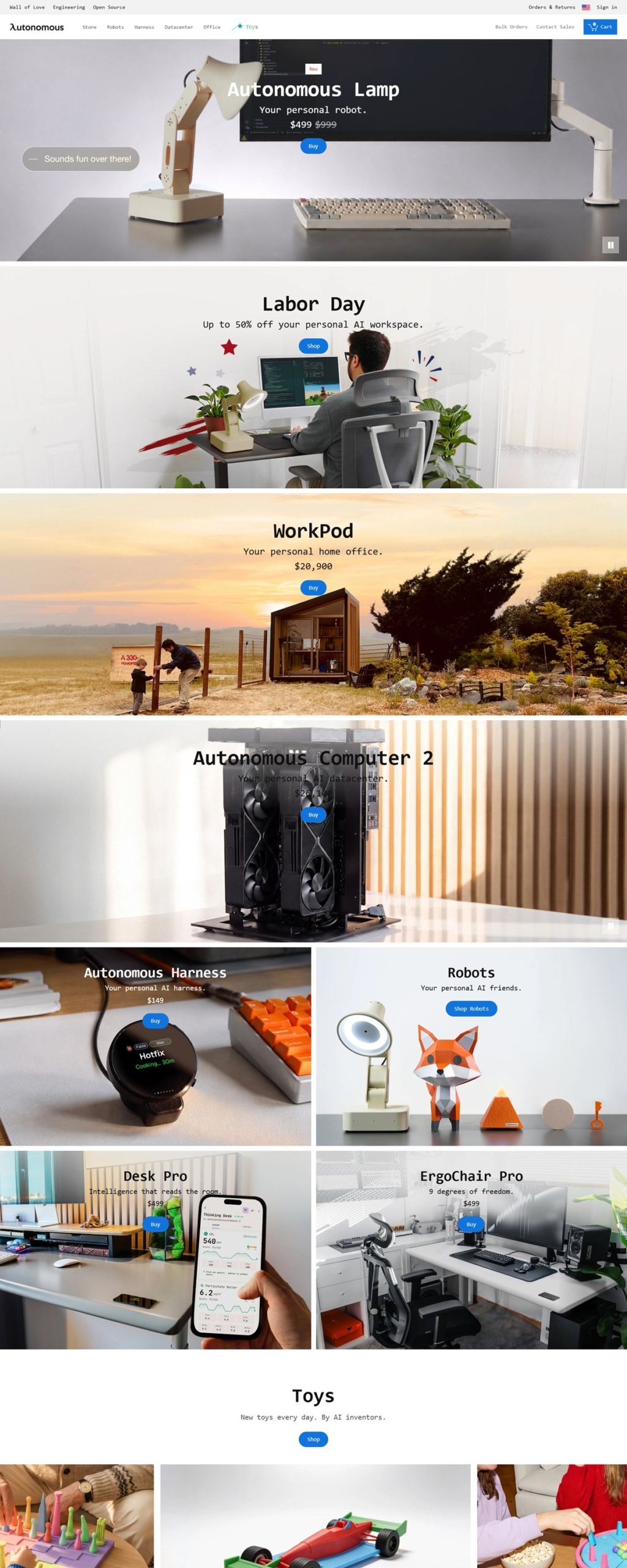
Autonomous now describes itself as an “AI hardware workshop,” having expanded from its original standing desk and ergonomic chair line into robots, an AI workstation called Computer 2, a desk lamp, a wearable Harness and AI-designed toys. Office furniture remains a category, but the homepage leads with robotics and AI compute. Navigation runs Store, Robots, Harness, Datacenter, Office and Toys, on a Next.js build.
Website Design
Fraunces over a system sans. Headline type loads Fraunces, a Google Fonts serif with an optical-size axis, pulled in specifically for display text, while interface and body copy fall back to the operating system’s own sans-serif stack.
A dual light and dark token set. The design system defines paired values for every color, for example background #111 in dark mode against #fff in light, so pages can render either scheme from the same variable names rather than a single fixed palette.
Deep blue reserved for buying. Across both modes, the add-to-cart color stays a consistent dark blue, #003e7f, with a lighter accent blue, #5fa8f5, used for informational states, keeping the purchase action visually distinct from general UI accents.
Status colors follow a standard traffic system. Error and danger states use red tones (#e7000b in dark mode, #c10015 for a stronger variant), paired with matching light backgrounds, a conventional design-token approach rather than a custom brand palette for alerts.
Shopping Experience
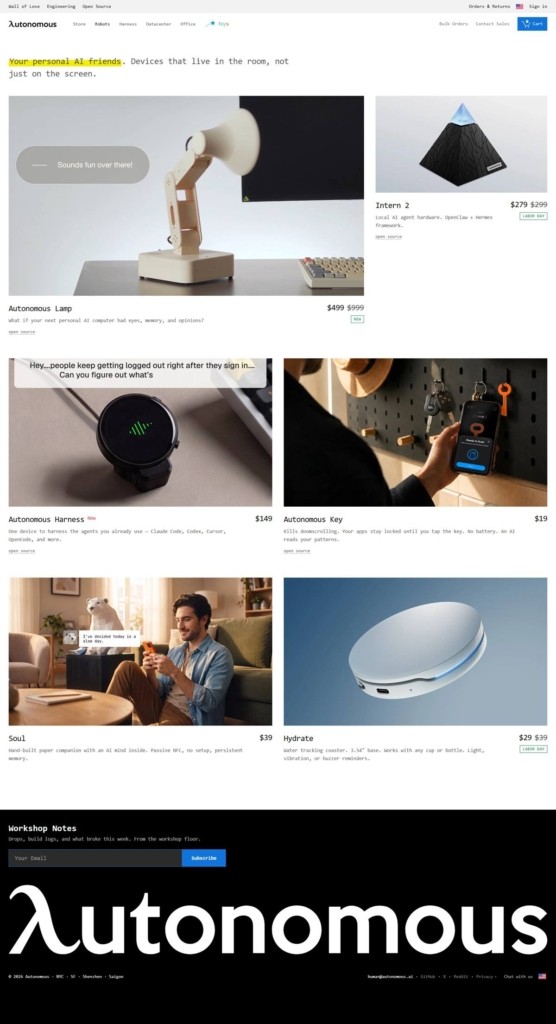
Category-first entry points. Rather than one storefront grid, the homepage routes shoppers directly into Robots, Harness, Datacenter, Office and Toys as separate destinations, each functioning as its own mini-store.
A wide price spread in one catalogue. Pricing spans from roughly $149 for the Harness up to $26,100 for the Computer 2 workstation, putting an accessible wearable and an enterprise-grade AI machine under the same brand.
Bulk and business ordering surfaced separately. An “office furniture bulk orders” page sits outside the main navigation, aimed at business buyers rather than individual shoppers.
Toys framed as a designed category. The Toys section is described as designed by “AI inventors,” giving it its own creative framing rather than treating it as a minor accessory line.
Brand Storytelling
A one-line thesis on the homepage. The hero states plainly, “Software got AI. Hardware didn’t. So we build devices that do,” using that gap as the entire premise for the product range.
Personal framing repeated across categories. Taglines like “Your personal robot,” “Your personal home office” and “Your personal AI datacenter” apply the same personal-ownership language to products as different as a chatbot companion and a data center rack.
Community and open-source pages sit in the main nav. Community and Open Source links appear alongside shopping categories, positioning some hardware as developer-facing rather than purely consumer.
Notable Features
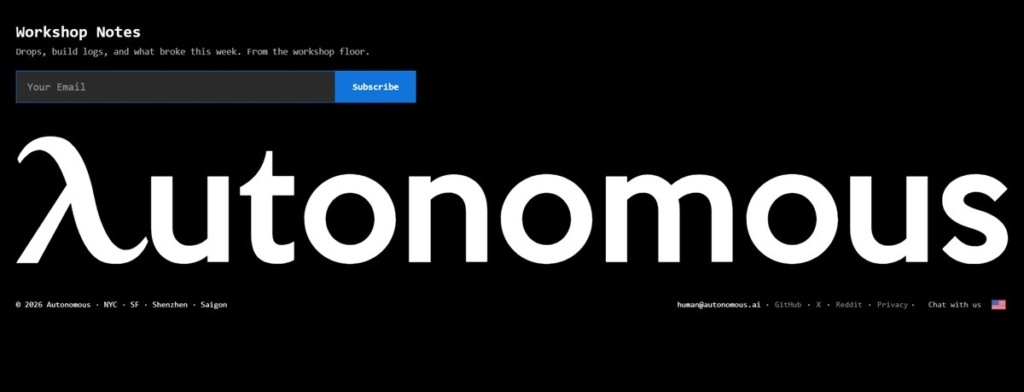
A named newsletter with editorial framing. The signup is branded “Workshop Notes” rather than a generic newsletter, extending the workshop metaphor from the hero tagline into ongoing communication.
Physical offices listed by city. The footer names specific locations, including New York, San Francisco, Shenzhen and Saigon, a stated physical footprint beyond the storefront.
Developer-adjacent social channels. Alongside typical social links, the footer includes GitHub and Reddit, channels more common to a hardware or software company than a furniture retailer.
Autonomous Shop Category page example
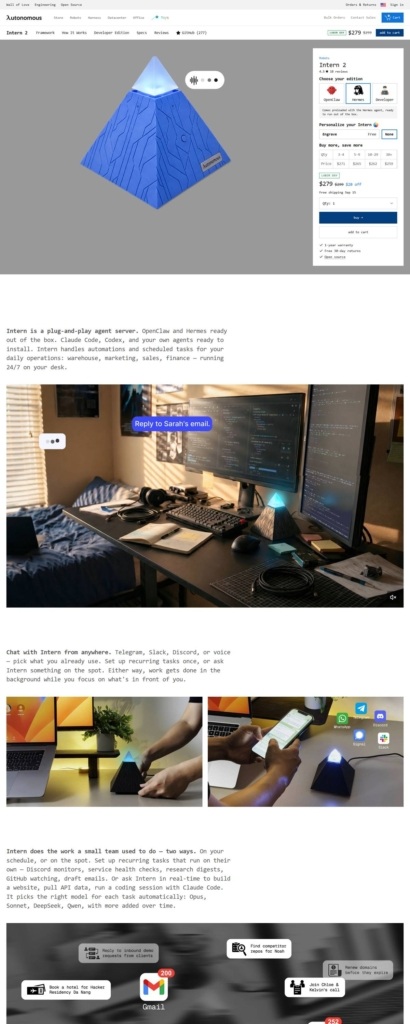
Autonomous Product page example
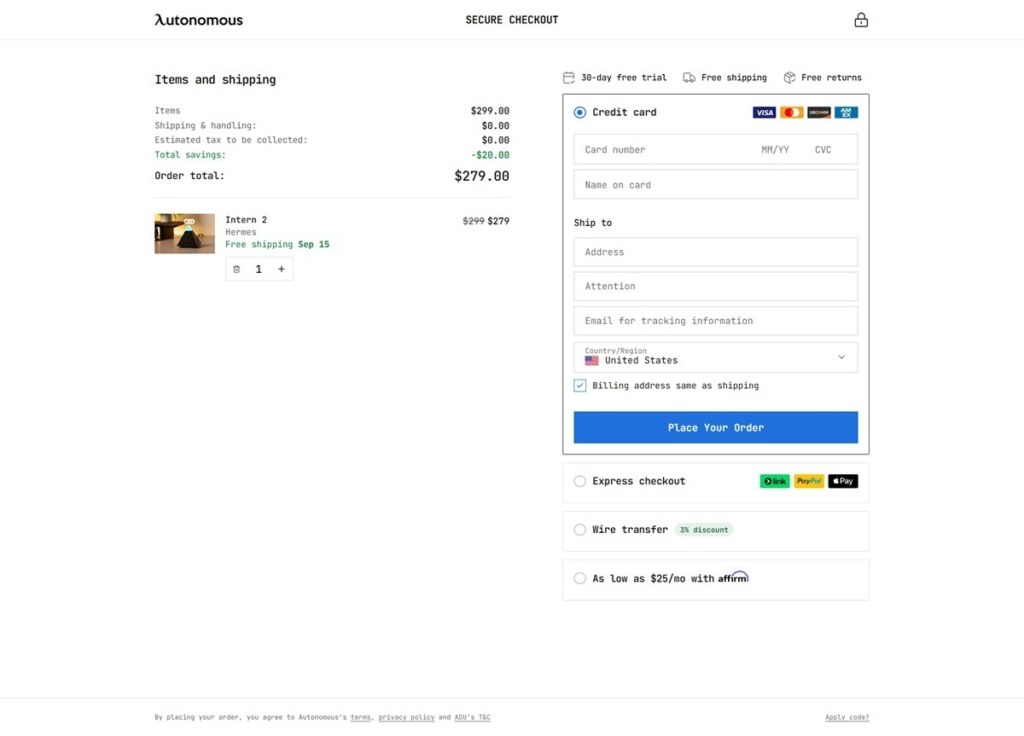
Autonomous Checkout page example
Autonomous footer example
eCommerce Platform:
Tech Stack: