
 By Bogdan Rancea
You don’t need a warehouse or a huge catalog to start selling T-shirts. You need a specific customer, an original design, a shirt you’ve sampled, and a selling price that leaves room after fulfillment and fees.
We may earn a commission if you buy through links on this page.
The practical answer to how to start a t-shirt business is to test those pieces before committing heavily. Start with a small collection, choose a production method you can afford, and give buyers a clear reason to choose your shirt.
Use the steps below to move from a customer idea to a sampled product, a working store, and your first launch.
Step 1: Pick a niche and define your ideal customer
Choose a customer you can reach, not just a subject you enjoy. “Nature lovers” is broad; weekend birdwatchers who want understated shirts for club outings give you a clearer design brief and somewhere to find buyers.
Write a customer sentence before creating artwork:
My customer is a weekend birdwatcher who wants a comfortable, subtly funny shirt for group walks and gifts for fellow birders.
Then investigate what that person already buys:
- Look at buying occasions: Gifts, club gatherings, and everyday wear can require different designs.
- Read product complaints: Note recurring issues with sizing, fabric weight, print placement, and delivery.
- Identify reachable communities: Find relevant clubs, newsletters, events, or social accounts where participation is welcome.
Use this research to understand expectations, not to copy popular artwork or slogans. A crowded niche can still work if your shirt offers a distinct style, fit, or buying occasion.
Finish with a short brief covering the buyer, occasion, visual style, and preferred fit. That becomes your filter for later decisions.
Step 2: Validate your idea before spending heavily
Test whether people want the shirt at your intended price, not whether they like the picture. Compliments cost nothing; purchasing requires a tradeoff.
Prepare 2 or 3 concepts and show each with the proposed shirt price, shipping charge, and estimated delivery window. Ask people who fit your customer profile, including people outside your friendship circle.
Useful questions include:
- Which design would you actually wear, and where?
- What would stop you buying it at this total price?
- What shirt have you bought recently instead?
- Which fit or size information would you need before ordering?
Record objections alongside preferences. If people like the artwork but reject the delivered price, you haven’t validated the offer yet.
A waitlist can help you collect permission to contact interested buyers. Treat it as a weaker signal than paid demand, rather than counting subscribers as future customers.
A small preorder can provide stronger evidence, but only when you have a credible production and delivery plan. Explain that it is a preorder, state cancellation and refund terms, and follow applicable consumer rules. Don’t collect money against a delivery date your supplier cannot reasonably support.
Step 3: Choose how you’ll produce and fulfill your T-shirts
For an unproven design, print on demand limits inventory risk. Bulk printing becomes more attractive when you have evidence about which designs and sizes will sell.
| Production model | Upfront spending | Per-shirt economics | Control and inventory | Best use |
|---|---|---|---|---|
| Print on demand (POD) | Samples and setup; no bulk stock purchase | Often higher production cost per shirt | Provider produces and ships; limited hands-on inspection | Testing designs without holding stock |
| Bulk or local printing | Pay for a batch before selling | Potentially lower unit cost at sufficient quantities | Inspect stock yourself; store and ship it | Proven demand, events, group orders |
| Home printing | Equipment, blanks, supplies, workspace | Depends on materials, labor, and mistakes | Strong process control; you handle production and fulfillment | Small custom runs and hands-on operators |
The business model and printing technique are separate decisions. POD describes when a shirt is produced, not how ink reaches the fabric.
- Direct-to-garment (DTG) prints onto the garment and can suit detailed, multicolor artwork. Results depend on the fabric and production process.
- Screen printing uses screens for ink application. Setup makes batch size and color count important to the quote.
- Heat transfers apply a prepared design using heat and pressure. You can buy outsourced transfers rather than print them yourself.
Home printing is not automatically cheaper. Include pressing time, misprints, packaging, equipment maintenance, and safe workspace requirements. Follow the equipment and transfer manufacturers’ instructions.
Before choosing a supplier, confirm available sizes, stock continuity, delivery destinations, and how defective orders are handled. A low production quote is less useful if the required blank is frequently unavailable.
Step 4: Set a startup budget and calculate your margins
Budget for both launching and funding orders. A store without a monthly subscription still needs samples, customer acquisition work, and cash for problems.
The following is an illustrative US/USD lean POD budget, not a vendor quote:
| Allocation | Illustrative amount |
|---|---|
| Samples, including shipping | $90 |
| Domain allowance | $20 |
| Design or merchandise-license allowance | $40 |
| Launch marketing test | $50 |
| Working capital and refund reserve | $150 |
| Total cash allocation | $350 |
This assumes no paid store subscription. Equipment, business registration, and location-specific legal or tax costs are additional. Your needs may differ substantially.
The $150 reserve is cash you keep available, not an expense simply because you set it aside.
Work out what each order contributes
This separate hypothetical US/USD order assumes a $28 shirt and $5 shipping charged to the buyer. It excludes collected sales tax.
| Order item | Illustrative amount |
|---|---|
| Shirt revenue | $28.00 |
| Shipping revenue | $5.00 |
| Total revenue | $33.00 |
| Production cost | $13.00 |
| Shipping paid to provider | $5.00 |
| Assumed processing: 2.9% of $33 + $0.30 | $1.26 |
| Expected replacement-cost allowance | $1.00 |
| Total modeled variable costs | $20.26 |
| Contribution before advertising and fixed costs | $12.74 |
Contribution is revenue minus the modeled variable costs. Here, $12.74 divided by $33 gives a 38.6% contribution margin.
An illustrative $6 customer acquisition cost would leave $6.74. That is still not final profit: fixed costs, your labor if excluded, and applicable taxes remain to be accounted for.
Replace these assumptions with actual supplier quotes and your sales channel’s fees. Add marketplace charges, packaging, or per-order labor wherever your setup requires them.
Keep shipping on both sides of the calculation when you charge for it. Don’t subtract it twice. Collected sales tax is not your revenue, although a payment processor may include tax in the amount used to calculate its fee.
Also map the timing of payments:
- When does the fulfillment provider charge you?
- When does your storefront release payouts?
- Can you fund replacements or refunds before the next payout?
With connected POD providers, production charges can arrive before customer funds reach your bank. Size your reserve around that gap, not just your expected launch spending.
Step 5: Create your first designs and order samples
Launch with 1 to 3 original designs and a limited color selection. Every additional variant creates another combination of contrast, placement, and product availability to manage.
You can create the artwork yourself or commission a designer. Either way, keep records of ownership and permissions. Font, stock image, and illustration licenses must permit printed merchandise; access to a design tool does not automatically grant those rights.
Check trademark risk before using names or slogans. In the US, qualifying original artwork can receive copyright protection, while short phrases may raise trademark issues instead. Requirements differ by jurisdiction.
Prepare files for the exact product and print area:
- Follow its required dimensions, file format, transparency, and color guidance.
- Check resolution at the intended physical print size.
- Review readability and contrast on each garment color.
There is no universal DPI instruction that replaces product-specific requirements.
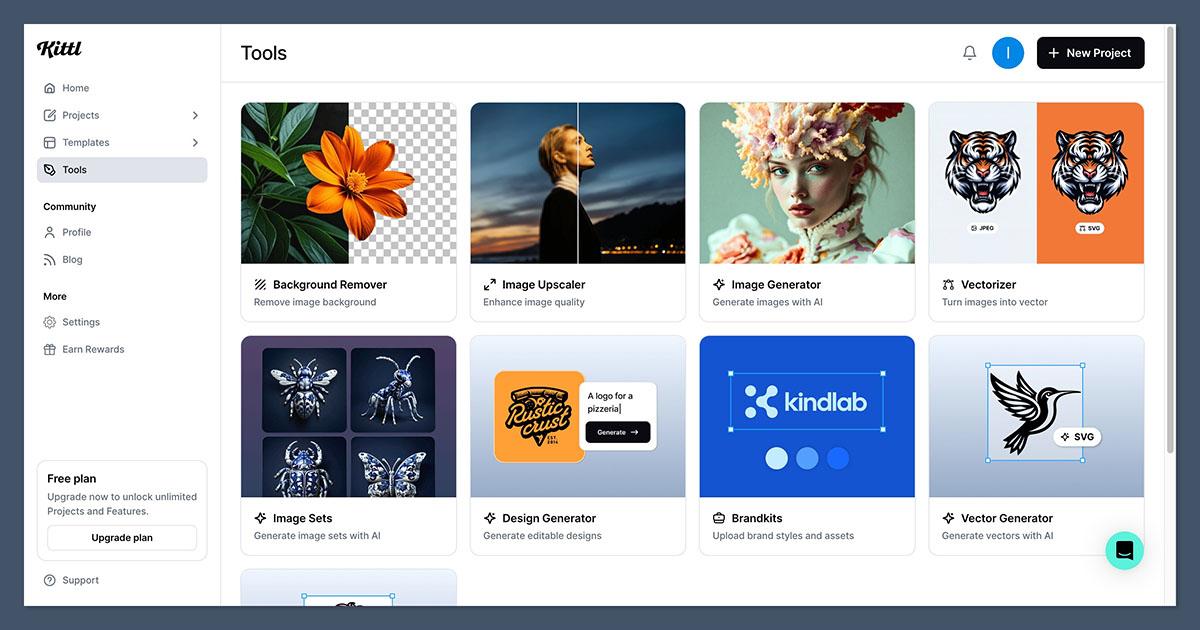
Order the exact blank, color, and printing technique you intend to sell. Then inspect it systematically:
- Fit and movement: Measure the shirt and compare it with the size chart. Wear it while sitting, reaching, and walking.
- Placement: Check the artwork on a body, not just a flat mockup.
- Print quality: Inspect opacity, color, fine edges, and unwanted marks.
- Wash performance: Follow the care label through several washes. Compare measurements and look for cracking, peeling, twisting, or seam problems.
Photograph the actual garment, including close-ups and a useful fit view. If the sample fails, revise the artwork or change the product before accepting orders. A mockup cannot resolve a physical quality problem.
Step 6: Choose where to sell your T-shirts
For beginners and creators who want a branded merchandise shop, Fourthwall is a good starting point because it combines the storefront with catalog production and fulfillment. Shopify offers more scope for a broader store, while Etsy offers marketplace discovery rather than relying entirely on your own traffic.
Understand the roles first: a storefront is your shop, a marketplace puts listings among other sellers, and a fulfillment provider produces and ships orders. Some services combine these functions.
Prices current as of October 2026. Platform prices below are in USD for US sellers; payment rates and taxes can vary.
| Selling route | Starting costs and fees | Choose it when | Main limitation |
|---|---|---|---|
| Fourthwall | Free plan: $0/month; optional Pro available. Catalog production, shipping, and processing costs apply | You want a branded merchandise shop with integrated fulfillment | Catalog choice and destination shipping must suit your buyers; you bring traffic |
| Shopify + Printful or Printify | Shopify Basic: $39/month, or $29/month equivalent billed annually ($348/year). Provider free options exclude production and shipping | You need broader store control and an app ecosystem | Subscription, optional apps, integration management, and separate fulfillment charges |
| Etsy + POD provider | $0.20 listing fee; 6.5% transaction fee; payment processing separate | Your designs match specific marketplace searches | Competition, cumulative fees, and marketplace rules |
| Local printer + chosen sales channel | Printer quote plus storefront, event, or payment costs | You have batch demand or want to inspect stock | Inventory, storage, packing, and shipping responsibility |
Fourthwall: fewer separate systems to manage
Fourthwall’s Free plan includes a brandable store and custom domain connection. Catalog production costs are deducted from sales, and customer service is included for catalog orders. You handle support for self-sourced products.
For US domestic card payments, processing is 2.9% + $0.30, including shipping and tax in the fee calculation. International card rates are higher; other payment methods vary. Physical products have no additional platform percentage fee, but production and shipping still cost money.
Its appeal is simplicity, not guaranteed low costs. Compare the exact shirt and delivered cost against alternatives before committing. An integrated shop also does not supply an audience.
For a closer look at the store builder and fulfillment options, read our Fourthwall review.
Shopify: more control, more responsibility
Shopify suits a store that may expand beyond merchandise. US Basic card rates start at 2.9% + $0.30, separate from the subscription.
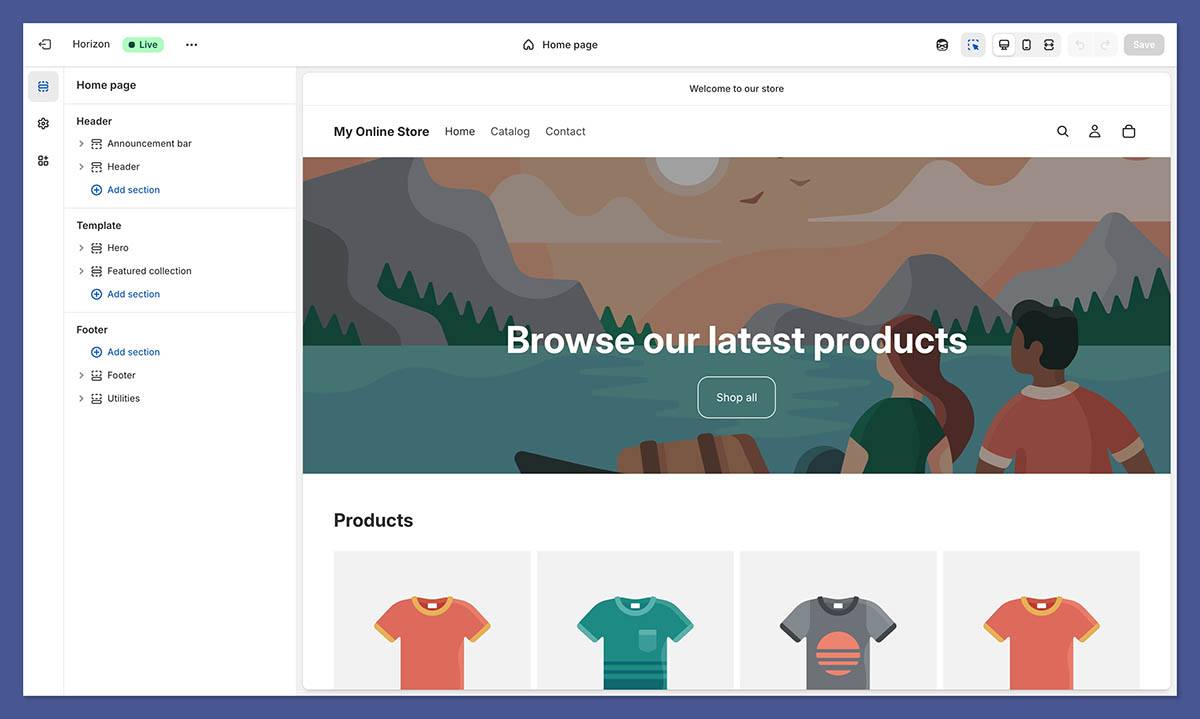
Printful and Printify offer free options, but you still pay production, shipping, and applicable taxes. In connected-store arrangements, customers pay through your storefront while the provider charges you separately. Budget for that timing gap and your own customer service.
Etsy or local selling: different routes to demand
Etsy can expose your listings to shoppers searching for particular gifts or interests. Our Fourthwall vs Etsy comparison explains the tradeoff between your own branded shop and marketplace discovery. Its 6.5% fee includes charged shipping, and is not an all-in selling fee.
Listing renewals, processing, and applicable setup or advertising charges add costs. Offsite Ads can add 12% or 15% to attributed orders, depending on eligibility. Sell qualifying original designs, disclose production partners, and use accurate dispatch locations.
A local printer is a supplier, not a sales channel. Pair one with events, preorders, or your own store when you can justify the batch purchase and handle fulfillment yourself.
Step 7: Build your brand and prepare your store for launch
Build a small, complete shop rather than a large, unfinished catalog. Consistent branding helps, but accurate product information does more immediate work than an elaborate logo.
For a practical Fourthwall setup, start with your approved sample and follow this sequence:
- Select the catalog shirt that matches your sample. Upload artwork and restrict variants to combinations you have reviewed.
- Set the price using that product’s actual cost and delivery economics.
- Apply your branding with a readable store name, simple colors, and a short explanation of who the shirts are for.
- Connect a domain if wanted, then check that it resolves correctly.
- Complete the product page with real photos, fit guidance, fabric details, care instructions, and a size chart.
- Review shipping, returns, and support information, then check the customer journey on mobile.
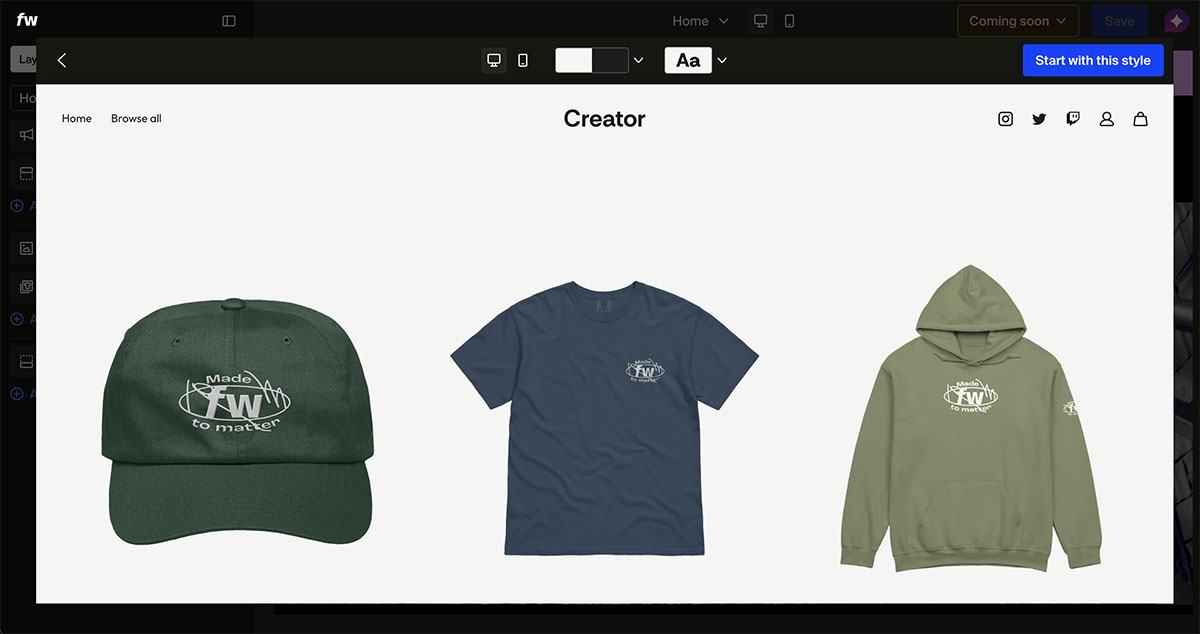
The same sequence applies elsewhere. Keep mockups clearly representative and avoid unsupported delivery promises.
For layout and product-page ideas, use our guide to designing a print-on-demand store.
Before launch, complete this checklist:
- ☐ The sample passes fit, print, placement, and wash checks.
- ☐ Photos and size guidance match the actual garment.
- ☐ Buyers can see shipping costs and realistic delivery estimates.
- ☐ Refund, return, and defect procedures are understandable.
- ☐ A test order confirms checkout and order information work.
- ☐ Payout details and any required account verification are complete.
Check business registration, tax, privacy, and consumer obligations for your location and customer markets. Platform tax handling does not eliminate every obligation you may have.
POD is not a blanket “no returns” exemption. Supplier coverage, your store policy, marketplace requirements, and statutory rights can differ. Decide who pays when your customer obligations extend beyond the supplier’s coverage, and get qualified advice where needed.
Step 8: Launch and get your first customers
Choose a focused launch channel instead of trying to post everywhere. Your first task is to connect the shirt with people who already care about its subject.
If you already have an audience
Use your audience’s interests to shape the launch, but don’t assume followers automatically want merchandise.
- Run a relevant poll: Ask about design direction or fit without implying every vote is a purchase.
- Show the actual sample: Share the garment being worn, print details, and the reason behind the design.
- Announce the launch clearly: Give permission-based email subscribers or followers the total price and buying instructions.
- Follow up with useful answers: Address sizing, shipping, or care questions rather than repeating the same announcement.
Only claim limited stock or a deadline when it is real. Made-to-order availability is not inherently scarce.
If you’re starting without an audience
Pick 1 reachable niche channel and contribute before promoting. A birdwatching club or local event may be more relevant than a broad fashion account.
Create useful niche content, participate in communities with permission, and approach small creators whose followers match your customer. Product gifts or collaborations cost money and do not guarantee sales.
For Etsy, describe the design, recipient, and occasion using wording buyers would reasonably search for. Avoid irrelevant keywords and protected brand names.
Test paid advertising only after the product page and checkout work. Set a maximum test budget and compare acquisition cost with contribution, not revenue.
Track visits, cart additions, purchases, and traffic source. These numbers help distinguish a discovery problem from a product-page or checkout problem.
Step 9: Improve your bestsellers and grow carefully
Improve the weak point in the buying journey before adding more designs. More products won’t fix unclear sizing or expensive shipping.
Use the available evidence to choose a change:
- Impressions without clicks: Rework the main image, message, or audience targeting.
- Product visits without cart additions: Investigate design appeal, price, photos, and fit information.
- Carts without purchases: Inspect delivery costs, checkout friction, and payment issues.
- Sales followed by complaints: Fix the garment, artwork, or fulfillment problem before sending more traffic.
Change 1 meaningful variable at a time so you can interpret the result. Small traffic volumes provide clues, not certainty.
Consider bulk production only after sustained paid demand reveals the actual design, color, and size mix. Compare the lower unit quote with storage, packing labor, and the risk of unsold stock.
Start with your customer sentence and a small concept set. Get feedback at the intended delivered price, then sample the strongest idea before opening sales.
Frequently asked questions
How much does it cost to start a T-shirt business?
The illustrative lean POD allocation above totals $350, including a $150 working capital and refund reserve. It is not a quote or guaranteed minimum. Paid subscriptions, equipment, registration, and local compliance costs would increase the amount you need.
Can I start a T-shirt business without inventory?
Yes. With print on demand, a provider produces and ships shirts after orders are placed. You still need samples and cash available for fulfillment charges, refunds, or replacements. Depending on your setup, provider charges may precede storefront payouts.
Do I need advanced design skills to sell T-shirts?
No, but your designs must be readable, suitable for printing, and legally usable. You can commission a designer or create simple original artwork. Keep written rights agreements and merchandise licenses; hiring someone does not automatically settle every ownership question.
How should I price my T-shirts?
Add production, shipping, processing, marketplace fees, and expected replacement costs, then assess the contribution remaining at a price your customer will accept. Include likely acquisition costs and allow for fixed overhead and labor. Matching a competitor’s price does not establish your margin.
Can I sell T-shirts without an existing audience?
Yes, but you need a discovery plan. Marketplace searches, relevant communities, local events, and targeted creator collaborations can introduce buyers to your designs. None guarantees demand. Start with a reachable niche and measure which activities bring interested visitors and purchases.


