
 By Bogdan Rancea
Best overall

Shopify
See pricing Visit Shopify →$29 per month billed yearly ($39 monthly)
3 days free, then $1/month for 3 months
- Most sales tools on this list
- Sells online and in person
- AI channels can be switched off
Best own website

Squarespace
See pricing Visit Squarespace →$19-$99 per month billed yearly
14 days free
- Portfolio and shop in one site
- Unlimited products on every plan
- Setting to block known AI crawlers
Best with a following

Ko-fi
See pricing Visit Ko-fi →$0 per month + 5% service fee
Gold: $12 per month, 0% fee
- Shop, commissions and memberships
- Paid straight to PayPal or Stripe
- Blocks major AI training bots
Shopify is my top pick among Etsy alternatives for sellers who want a store of their own: it has the strongest sales tools on this list, and its AI shopping channels can be switched off in four steps.
I read the content licences of 13 Etsy alternatives, and only two put a no-AI-training promise in their terms: Fybe and Carrd, both with qualifications. Ko-fi opposes training too, but in a help article rather than its contract.
If you’re comparing sites like Etsy because of its AI terms, check the replacement’s licence before moving your work. I compare what each platform can do with your uploads, what selling costs, and which shops it suits.
Key Takeaways
- Shopify is the #1 Etsy alternative: the most sales tools, from $29/month billed yearly, with AI channels you can turn off.
- Etsy’s clause 5.C expressly permits AI training from December 16, 2026.
- Of the 353 sellers we tracked, 118 named their own website, 48 Ko-fi and 26 craft markets or conventions.
- Only 2 alternatives have contractual no-training commitments: Fybe and Carrd. Ko-fi’s stance is a separate policy.
- Shopify’s AI channels are on by default: switch them off on day one; section 9 of its supplemental terms preserves the channel licence after departure.
Etsy’s Terms of Use, clause 5.C, last updated October 26, 2026 and effective December 16, 2026, includes:
“the right for us and our third party partners and vendors to use Your Content to develop, train, test and improve artificial intelligence and machine learning technologies”
Etsy’s VP of Customer Operations told The New York Times, in a report published November 20, 2026, that revised terms would follow. As of November 22, 2026, the clause still stood. Re-read it when that revision arrives.
Of the 353 sellers we tracked, the destinations below come from their public departure announcements. Shopify leads the list as my top pick; the rest follow where those sellers went. For more ideas on where to sell art online, see our 15 best websites for selling art online.
Etsy AI Policy: What Clause 5.C Says and How to Object
Etsy’s AI policy adds training rights to an already broad licence. Clause 5.C, last updated October 26, 2026 and effective December 16, 2026, grants a “non-exclusive, worldwide, royalty-free, irrevocable, sub-licensable, perpetual license” and allows Etsy to “prepare derivative works from Your Content”. It also requires you not to assert moral rights against Etsy.
Its Privacy Policy, section 2, updated October 26, 2026, identifies “listing information, product reviews, and community posts” as material it may use for training.
- No AI switch: The Privacy Policy names no dedicated training opt-out setting or form.
- Regional objection rights: Sections 2 and 7 describe a right to object in the EEA, UK and other countries. Etsy can continue where it has compelling legitimate grounds. The policy doesn’t name the United States.
- Contact route: Section 12 directs you to the Help Center, chat support or [email protected].
In a November 16 community post, Etsy’s VP of Customer Operations wrote: “We do not use your content to train AI models designed to copy your original work or replace your creativity.”
That reassurance doesn’t amend clause 5.C, which contains no equivalent restriction. Check the promised revision for third-party training permissions and a practical opt-out.
Comparing Etsy Alternatives
Every cost example assumes $500 a month from 20 orders of $25, standard US card payments, no shipping charges and no ads. Etsy totals $56.50: 20 listings at $0.20, a 6.5% transaction fee and processing at 3% + $0.25 per order.
For Ko-fi and Big Cartel, I assume Stripe’s standard 2.9% + $0.30, or $20.50, because neither publishes its own processor rate. Yearly-billed prices are monthly equivalents; Squarespace figures exclude memberships and gated content.
| Platform | Of the 353 sellers we tracked | AI terms | Example cost | Best for | Training opt-out |
|---|---|---|---|---|---|
| Shopify | 5 | Default AI channels; surviving licence | Basic $59.50 monthly; $49.50 yearly-billed | Sales tools | Channel controls |
| Squarespace | 118 across own websites | Perpetual; training unspecified | Basic $55.50 monthly; Basic/Core $49.50 yearly-billed | Portfolio/shop | Crawler request only |
| Carrd | Included in 118 | No-training clause, with exceptions | $19/year plus provider fees; no fixed total | One-page sites | Contractual commitment |
| Ko-fi | 48 | Limited licence; anti-training help policy | Free: $25 + $20.50 = $45.50; Gold: $12 + $20.50 = $32.50 | Existing followers | Platform-wide bot blocking |
| Craft markets and cons | 26 | No online platform licence | Event fee plus processing; varies | Face-to-face sales | Not applicable |
| Mayhem | 14 | No content-licence clause | Standard: $10 a month plus card processing | US handmade sellers | None |
| Big Cartel | 9 | Purpose-limited; termination exceptions | Platinum: $15 + $20.50 = $35.50 | Small catalogs | None |
| ACGGoods | 8 | Making/marketing merchandise | Free store; unpublished service rate prevents total | Character merchandise | None |
| Fybe | 5 | No intentional training | Free: $25 + $20.50 = $45.50 | Handmade goods | Contractual commitment |
| Folksy | 3 to 6 | Perpetual; training unspecified | 15p + VAT per item listed and 6% + VAT commission, charged in GBP | UK makers | None |
| INPRNT | 3 to 6 | Sublicensable; broad purposes | Artist earns $75 to $250, depending on product/account; frames excluded | Art prints | None |
| Redbubble | 3 to 6 | Ends after deletion | Depends on base costs, margin and tier | Merch/stickers | None |
| Threadless | 3 to 6 | Ends with exceptions | Free shop; you keep the margin above Threadless’s base fee | Print on demand | None |
| VGen | 3 to 6 | Perpetual; training unspecified | $25 service + $20.50 processing = $45.50 | Commissions | None |
An AI-upload ban isn’t a no-training promise. Crawler requests don’t cancel licences. Seller counts are approximate.
Which Etsy Alternative Is Best for My Shop?
- A shop you plan to grow: Shopify, with the AI channels switched off.
- Prints and stickers: Big Cartel for your shop; INPRNT for fulfilment.
- One-off originals: Squarespace plus craft markets.
- Crochet and sewing: Fybe for human checks; Mayhem for flat fees.
- Digital patterns: Ko-fi combines downloads, commissions and memberships.
- Merch: ACGGoods bans AI art; Threadless and Redbubble handle production.
1. Shopify: For the Most Sales Tools (and the Most AI)
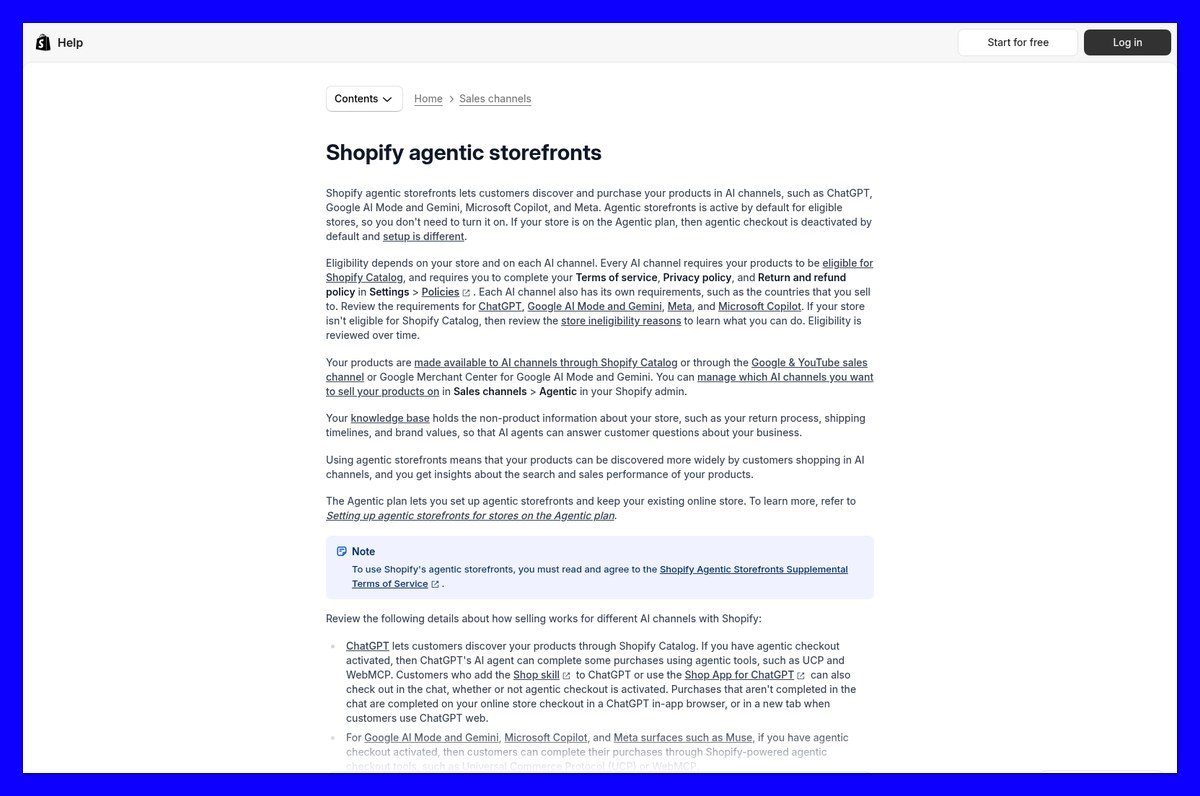
Shopify is my #1 Etsy alternative because no other platform here matches its selling tools, online and in person. Only 5 of the 353 sellers we tracked named it, and the reason is worth knowing before you sign up. Does Shopify use AI? Yes: eligible stores have agentic storefronts active by default, connecting products with AI shopping channels.
What I Like
- Online and in-person selling: Basic’s in-person rate is 2.6% + $0.10.
- Developer restrictions: API terms 2.3.24, updated October 7, 2026, restrict training without Shopify’s or the relevant merchant’s consent. They bind developers, not Shopify itself.
What I Dislike
- Default participation: Doing nothing leaves eligible stores opted in.
- Surviving rights: The channel licence and sublicences outlive departure.
What Do Shopify’s Terms Say About AI?
- Main terms, 8.1: Updated October 20, 2026, these permit Shopify to “create derivative works of your Materials”. They include a moral-rights waiver but don’t mention training.
- Channel terms, section 5: The Agentic Storefronts Supplemental Terms, updated October 6, 2026, make the licence “sublicensable to Shopify partners and their affiliates operating Participating Channels”. Section 9 preserves it after termination.
- Training remains unclear: The terms don’t establish whether channel operators train on your products. OpenAI’s direct-feed terms shouldn’t be assumed to govern Shopify Catalog feeds.
To stop Shopify Catalog sharing:
- In your Shopify admin, open Sales channels > Agentic.
- Turn off Allow Shopify to manage for me.
- Click a channel, such as ChatGPT, and turn off Shopify Catalog access.
- Click Save, then repeat step 3 for each remaining channel.
These controls have limits:
- Timing: Sharing can take up to seven days to stop.
- Crawling: Public products can still be discovered independently.
- Separate channels: Shop cannot be disabled here; Google AI Mode and Gemini receive products through Google & YouTube or Merchant Center.
- Reactivation: Turning automatic management back on re-enables the settings.
Opting out stops future sharing; it doesn’t cancel the licence.
How Much Does Shopify Cost?
- Basic: $39/month, or $29/month billed yearly.
- Shopify Payments: 2.9% + $0.30 for standard online cards.
- Other providers: 2% extra on Basic, plus their processing fees.
Etsy vs Shopify: How Do They Compare?
- Fees: Annual Basic is cheaper in the example; monthly Basic isn’t.
- AI: Shopify doesn’t expressly name training, but default channel sharing creates additional exposure.
- Traffic: Your own store doesn’t inherit Etsy search buyers.
Shopify is the most AI-connected option on this list; pick it for the tools, and switch the AI channels off on day one.
For the listing transfer, follow our guide on how to migrate from Etsy to Shopify.
2. Your Own Website (Squarespace): For a Shop and Portfolio You Control
118 of the 353 sellers we tracked named their own website, across multiple builders, the most popular route of all. I’d shortlist Squarespace for a portfolio and shop together, but owning your storefront doesn’t eliminate a platform licence.
What I Like
- Unlimited products: Sell physical goods, digital products and services.
- Time to decide: A 14-day free trial before you pay for a plan.
What I Dislike
- Surviving licence: Its content rights are perpetual and irrevocable.
- Traffic is yours to generate: No marketplace audience or free plan.
What Do Squarespace’s Terms Say About AI?
The Terms of Service, section 2.2, effective March 27, 2025, permit content use for “the limited purposes of allowing us to provide, improve, promote and protect the Services”.
Training is neither expressly permitted nor ruled out. Separate AI Terms, effective June 25, 2026, section 6, allow inputs to Squarespace AI features to reach its AI providers under their terms.
Under Settings > Crawlers > Block known artificial intelligence crawlers, you can request that outside bots stay away. It’s off by default, isn’t guaranteed and doesn’t change Squarespace’s rights or remove previously scraped content.
How Much Does Squarespace Cost?
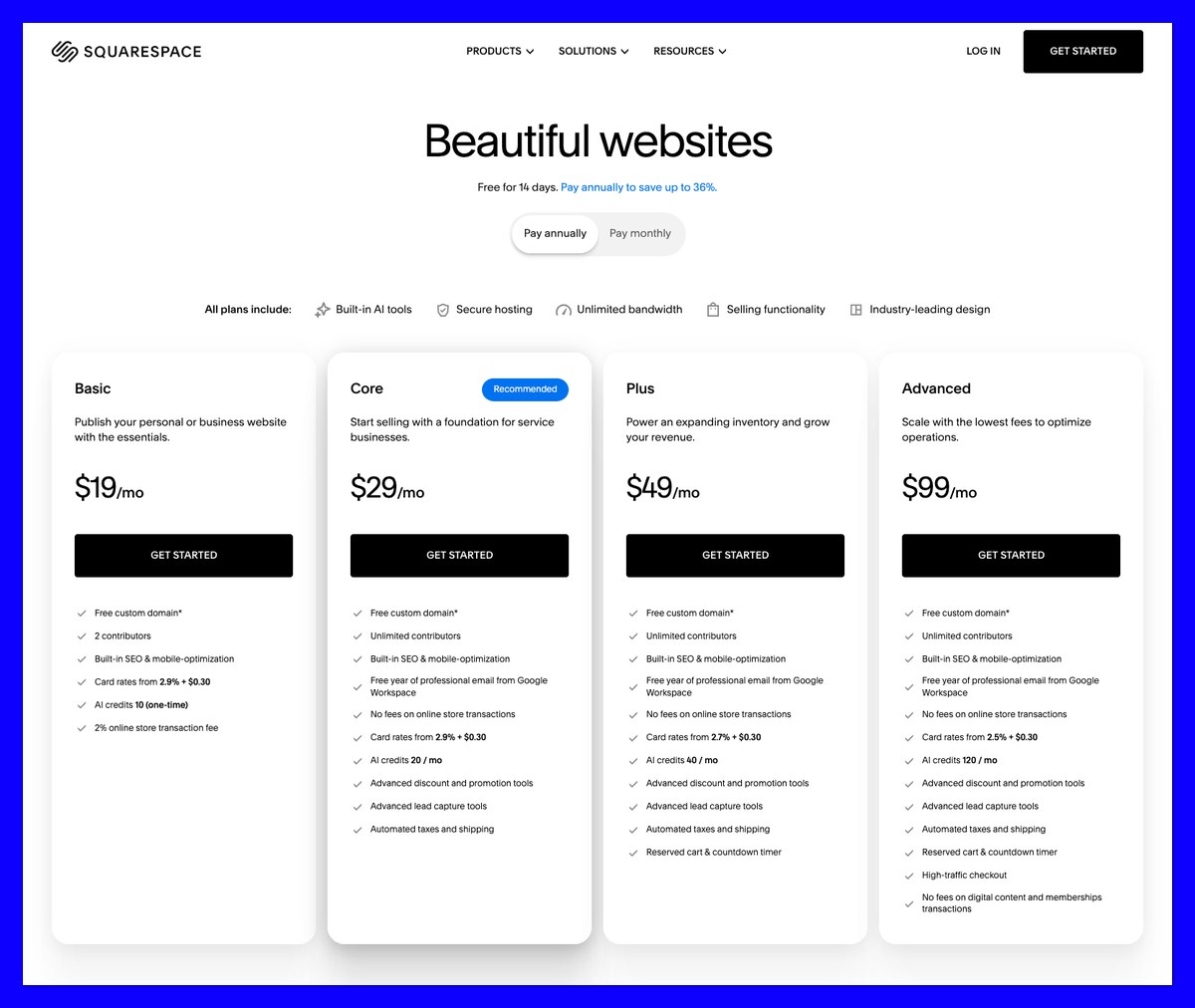
- Basic: $25/month, or $19/month billed yearly, plus 2% on store sales.
- Core: $39/month, or $29/month billed yearly, with no store transaction fee.
- Standard-card processing: 2.9% + $0.30 on both.
Core beats Basic above $500 monthly sales on annual billing, or $700 on monthly billing.
What About Carrd?
Carrd Pro Standard costs $19/year, with payment forms, embeds and custom domains, but no full store management.
Its Terms of Use, 5(H), updated November 13, 2026, say “we will not use, or permit any other third party to use, User Content or any Persona to train, fine-tune, or otherwise develop artificial intelligence or machine learning models”. Exceptions cover your permission and safety/security uses. Section 5(D) remains perpetual and irrevocable.
How Does Squarespace Compare to Etsy?
- Cost: Annual billing lowers the example’s total.
- AI: Silence isn’t a contractual training ban.
- My recommendation: Pick it for existing followers; don’t expect it to replace Etsy discovery immediately.
3. Ko-fi Shop: For Artists Who Already Have a Following
48 of the 353 sellers we tracked named Ko-fi, the most for any single platform. A Ko-fi shop combines products and commissions, but its anti-training stance isn’t contractual.
What I Like
- Direct payments: Earnings reach your PayPal or Stripe account without Ko-fi holding them. Ko-fi adds no buyer, payout or marketing fees.
- Bot blocking: Ko-fi says it blocks major AI training crawlers.
- Downloads: Sell patterns alongside commissions and memberships. Compare our guide to where to sell digital products.
What I Dislike
- Bring your audience: Your links, rather than marketplace search, drive buyers.
- AI-made work is allowed: It cannot be misleadingly presented as human-made.
What Do Ko-fi’s Terms Say About AI?
The Terms, Creator Specific Terms > Rules about Creator Content, last updated and effective July 13, 2026, grant a “limited licence to use, store and copy that content and to distribute and make it available to third parties”.
They also say: “We may use your content to improve Ko-fi and our business without liability to you.” They don’t specify when that licence ends, but omit Etsy’s perpetual, irrevocable and derivative-works wording.
The June 26, 2024 help article, Ko-fi’s stance on AI, says: “That’s why we do not support AI models being trained on creators’ work.” Bot blocking is platform-wide, not a seller toggle.
How Much Does Ko-fi Cost?
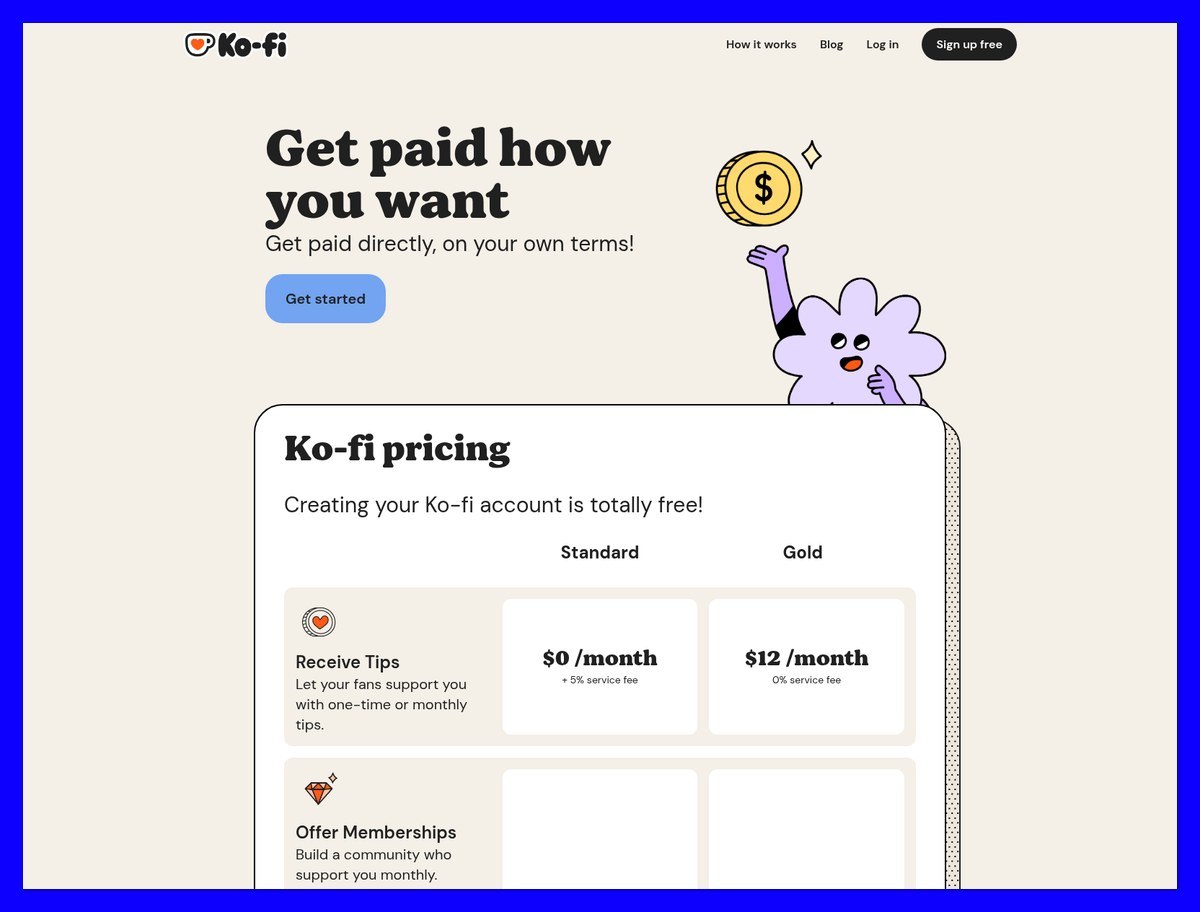
- Free: 5% on shop sales, commissions and memberships.
- Gold: $12/month, with no service fee; new creators can only subscribe monthly.
- Processing: PayPal or Stripe charges separately.
Gold becomes cheaper above $240 monthly sales.
How Does Ko-fi Compare to Etsy?
- Fees: Lower in the comparison example.
- AI: A limited licence plus policy, rather than Etsy’s express training right.
- My recommendation: Start here if buyers already follow you; build that audience before relying on Ko-fi alone.
4. Craft Markets and Cons: For Selling Face to Face
26 of the 353 sellers we tracked chose markets or conventions. This route doesn’t require uploading your work under an online platform’s content licence.
- AI terms: The online question returns when you post promotional photos.
- Costs: Check each organizer’s booth fee. Shopify Basic’s in-person card rate is 2.6% + $0.10; Big Cartel Platinum includes in-person sales.
- Best fit: Originals and handmade goods buyers want to inspect, plus prints and stickers at conventions.
- My recommendation: Pair events with an online shop. Offer an optional email signup at your table so interested visitors can hear from you afterward.
Before booking, compare the booth charge with your expected profit, not sales alone. Include card processing in that calculation, and decide how buyers will find your online shop after the event.
5. Mayhem Marketplace: For Flat Fees and No AI Listings
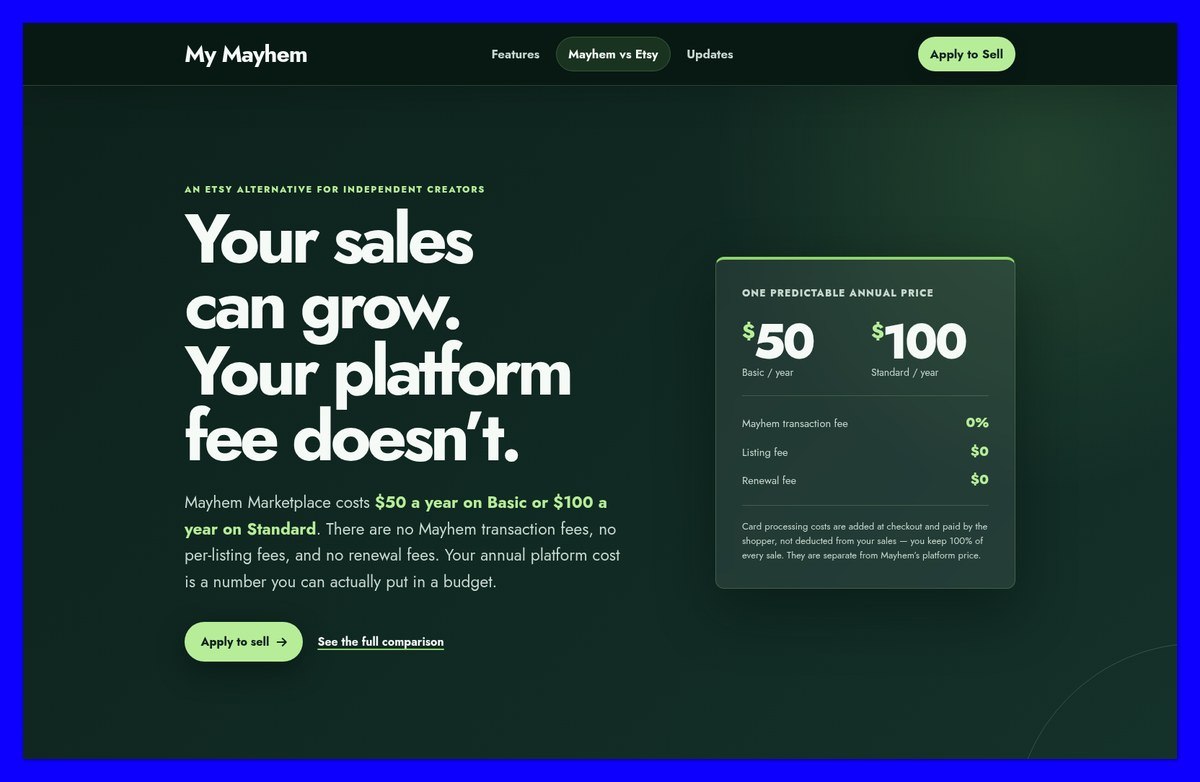
14 of the 353 sellers we tracked named Mayhem. Its flat subscription avoids Etsy’s listing and transaction fees, but Basic lacks integrated checkout.
What I Like
- No per-sale platform fees: A storefront and combined marketplace.
- Strict listing rules: AI-generated products and AI-assisted listing content are banned.
What I Dislike
- Application required: Products must be legal in the US.
- Basic checkout: Buyers pay through external payment accounts; you mark orders paid manually.
What Do Mayhem’s Terms Say About AI?
The Seller Terms, updated November 20, 2026, contain no content-licence clause. Section 6 says: “All products, listings, and images must be entirely human-created to ensure authenticity and support human creators.”
That regulates sellers, not Mayhem’s training practices. Its October 18, 2026 Privacy Notice identifies AI support and moderation providers. Neither document promises no training, and there’s no opt-out setting.
How Much Does Mayhem Cost?
- Basic: $5/month or $50/year.
- Standard: $10/month or $100/year, with automated checkout.
Card processing remains additional, payable by the buyer or absorbed by you. Compare that allocation before deciding that a flat subscription produces the lowest total.
How Does Mayhem Compare to Etsy?
- Fees: Flat platform charges, not per-sale charges.
- AI: No licence clause isn’t a no-training guarantee.
- My recommendation: Consider Standard for handmade selling, and skip Basic unless you’re happy to mark orders paid by hand.
6. Big Cartel: For Small Catalogs on a Budget
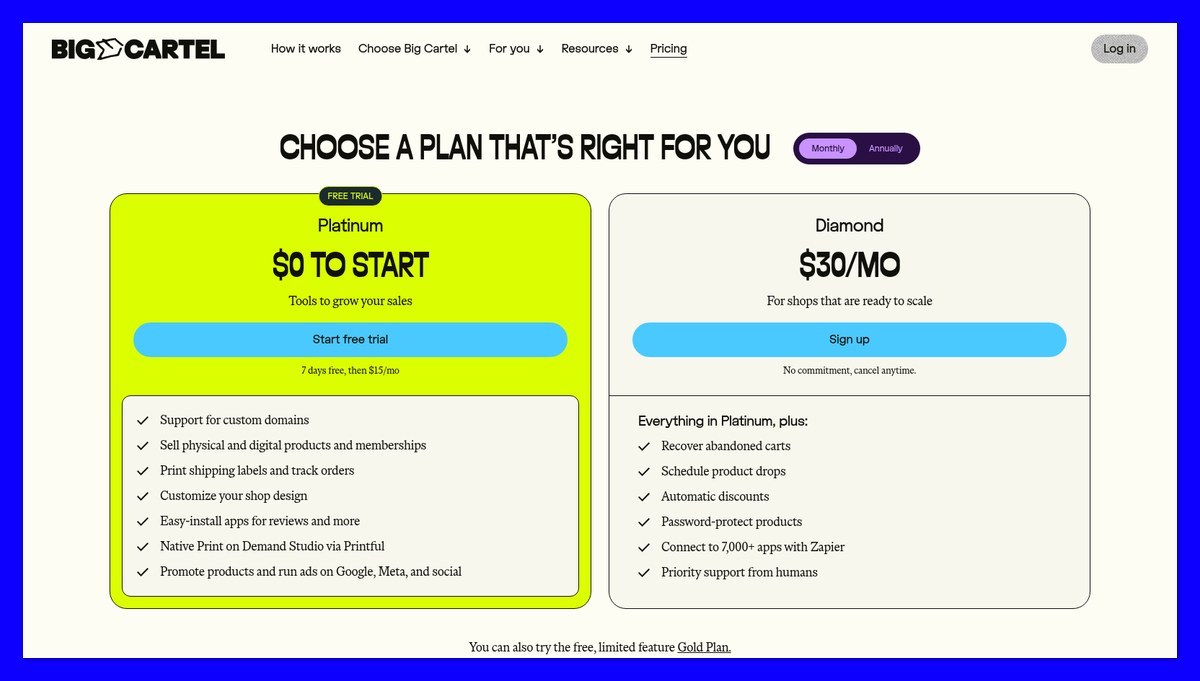
9 of the 353 sellers we tracked named Big Cartel. I prefer its commitment to stop using your content after closure, subject to legal and recordkeeping exceptions.
What I Like
- Free small shop: Gold supports 5 products.
- Platinum tools: Etsy imports, Printful integration and in-person payments.
What I Dislike
- No marketplace traffic: Buyers must find your store.
- No AI promise: Its legal documents don’t address training.
What Do Big Cartel’s Terms Say About AI?
The Merchant User Agreement, 4.4, effective June 29, 2020, limits use “solely to host Your Store, run the Tools, provide the Services and to otherwise promote and manage the Big Cartel Site and Services”.
Use stops after termination with exceptions, although copies may remain. Section 4.4 also permits beta testing. No AI-training opt-out is offered.
How Much Does Big Cartel Cost?
- Gold: Free, 5 products.
- Platinum: $15/month or $144/year, following a seven-day trial.
- Diamond: $30/month or $288/year.
- Transaction fees: 0%, with separate Stripe or PayPal processing.
Big Cartel vs Etsy: How Do They Compare?
- Cost: Platinum is cheaper in the example.
- AI: Big Cartel limits post-closure use; Etsy’s licence is perpetual.
- My recommendation: Shortlist it for a small catalog. Our Shopify vs Big Cartel comparison covers the larger-store trade-offs.
7. ACGGoods: For Character-Art Merch Without Inventory
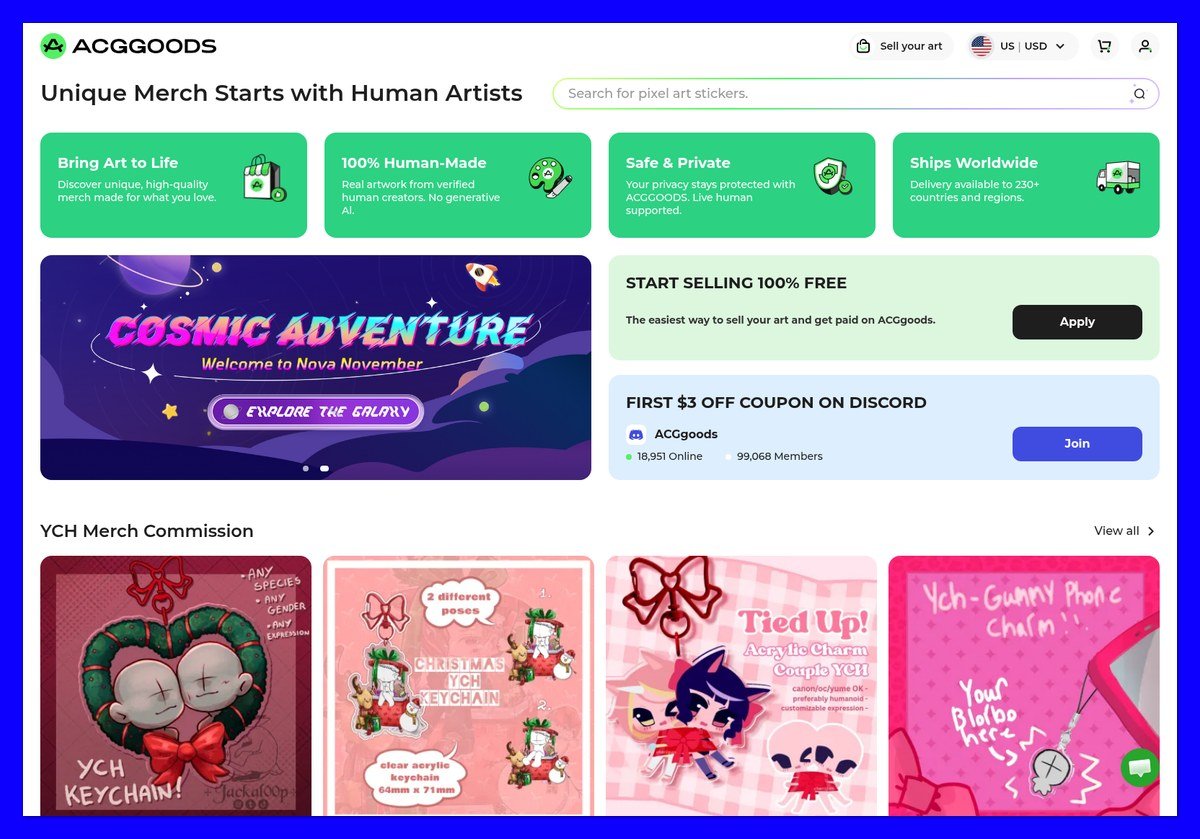
8 of the 353 sellers we tracked chose ACGGoods. It bans AI artwork and requires artists to retain source files, producible within 48 hours of a copyright inquiry.
What I Like
- No subscription: Free storefront with print-on-demand fulfilment.
- Human-art requirement: New sellers undergo staff review.
What I Dislike
- Unpublished service rate: You can’t calculate a universal fee total.
- Print-on-demand merchandise only: Products ship from China, and payouts are monthly by PayPal.
What Do ACGGoods’ Terms Say About AI?
Its Terms of Service, section 4, Ownership & Licensing, updated August 4, 2026, permit use “solely for the purpose of fulfilling, and marketing your merchandise”.
That purpose limit is narrower than Etsy’s, but isn’t an express no-training promise. The terms don’t specify licence termination, and there’s no opt-out.
How Much Does ACGGoods Cost?
Your payout is the selling price minus base costs, including production, payment and service fees. Use its profit calculator before setting prices.
How Does ACGGoods Compare to Etsy?
- Fees: No listing fee, but an unpublished service charge.
- AI: A merchandise-specific licence.
- My recommendation: Suitable for character merchandise without stock, not selling products you manufacture by hand.
8. Fybe: For Handmade Sellers Who Want Human Checks
5 of the 353 sellers we tracked named Fybe. It’s the only marketplace here with a contractual no-training commitment, alongside human seller approval.
What I Like
- Human moderation: Applications include checks of socials and listings.
- No generative-AI listings: The ban covers products, files, images and text.
What I Dislike
- Shipping restrictions: No physical orders to the EEA or Northern Ireland at launch.
- Payment limits: Stripe-only payouts, on a two-week schedule.
What Do Fybe’s Terms Say About AI?
Its Terms of Service, section 9, updated November 16, 2026, state: “We promise to never intentionally feed your information, text, artworks, or image representations of your artwork into any Generative AI model for training.”
“Intentionally” qualifies that promise. The licence is service-limited, and marketing use of your images requires written consent. There’s no training toggle because the commitment applies platform-wide.
How Much Does Fybe Cost?
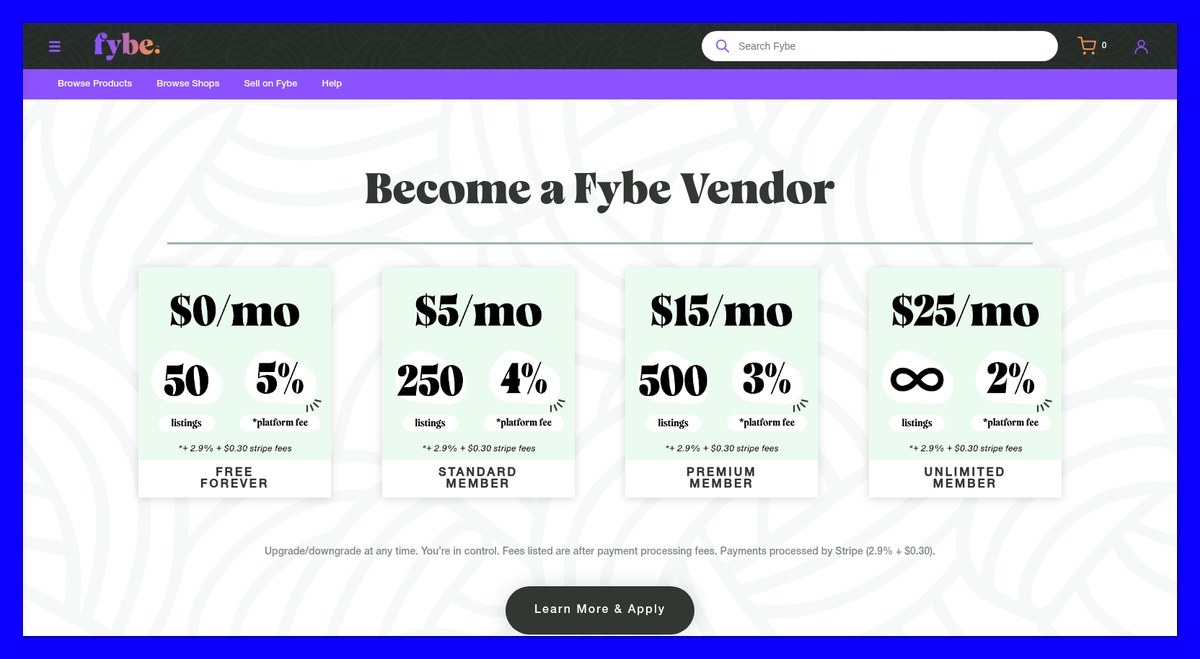
- Free: 50 listings, 5% platform fee.
- $5/month: 250 listings, 4%.
- $15/month: 500 listings, 3%.
- $25/month: Unlimited listings, 2%.
- Stripe: 2.9% + $0.30 per order throughout.
How Does Fybe Compare to Etsy?
- Fees: Lower on the free tier in our example.
- AI: A written restriction instead of express permission.
- My recommendation: Apply for handmade selling, but rule it out for physical orders to restricted destinations.
9. Folksy, INPRNT, Redbubble, Threadless and VGen: For Narrower Niches
Each drew 3 to 6 of the 353 sellers we tracked. Three prohibit AI artwork, but none contractually rules out training on your uploads.
| Platform | Best for | AI-upload rule | Licence, clause and date | Cost to sell |
|---|---|---|---|---|
| Folksy | UK makers | AI artwork banned | Terms, 14/18, undated: “in perpetuity”, including derivative works | 15p + VAT/item, 6% + VAT; Plus £7.50/month or £75/year removes listing fees |
| INPRNT | Prints; application required | AI artwork banned | Artist Agreement, 6, effective February 14, 2023: sublicensable, including “our other business purposes” | Studio earns 15% to 25%; Gallery 30% to 50% |
| Redbubble | Merch and stickers | No general ban publicly documented | User Agreement, I, Intellectual Property Rights and License, updated May 15, 2026: ends “within a commercially reasonable time” after deletion | Platform fee: 50% Standard, 20% Premium, 0% Pro, on earnings |
| Threadless | Print-on-demand merch | No published AI rule | Terms, 7/8, revised January 2024: “sub-licenseable”; termination has sell-through and existing-marketing exceptions | Free shop; base costs include 5% processing |
| VGen | Invite-gated commissions | AI artwork barred by help policy | Terms, 11.A, updated April 9, 2025: “irrevocable, perpetual”, covering service and product improvement | 5% + 2.9% + $0.30 on US commissions |
- Folksy: Only UK sellers can open shops.
- Redbubble: It assigns your tier. Excess-markup fees can also apply; total account fees are capped at $150 per payment period. Ask about its current AI-upload policy before relying on an upload restriction.
- Merch: Threadless and Redbubble handle production. For another creator-merch comparison, read Fourthwall vs Etsy.
How Do I Choose the Right Etsy Alternative?
Choose by the licence you can accept and who brings the buyers. If AI rights prompted your departure, a cheaper subscription doesn’t solve that problem. If fees prompted it, compare processing and platform charges together, using your actual order count and sales volume.
- Does the licence end when you leave?
- Do the terms expressly rule out AI training?
- Is there an opt-out, and what does it actually stop?
- What does your sales volume cost there?
- Does the platform bring buyers, or do you?
Use those answers to eliminate unsuitable options before uploading your catalog.
How to Close or Pause Your Etsy Shop Without Losing Your Customers
Pause before you close your Etsy shop. Vacation Mode hides listings while keeping your shop page and past reviews visible.
- Download your data. Open Shop Manager > Settings > Options > Download Data. Use Download CSV for active listings and the Orders dropdowns for transactions. Under Take your data with you, choose Download Your Reviews. Exports contain image URLs, not files, so save photos separately; request a full export through Account settings > Privacy > Download Data > Request your data for download, with requests expiring after two weeks.
- Leave a compliant announcement. Open Shop Manager > pencil icon next to your shop name under Sales Channels > Announcement. You may link your website and socials, but don’t direct buyers to purchase there, move Etsy transactions off-platform or use QR codes. The same restriction applies to vacation auto-replies. A Vacation Announcement replaces the normal announcement.
- Enable Vacation Mode. Go to Shop Manager > Settings > Options > Vacation Mode, toggle On, then Save. Buyers can message you but can’t purchase. Auto-renewals and subscriptions can continue billing; disable listing auto-renewals if you don’t want those charges.
- Resolve outstanding business. Complete orders, resolve cases and pay overdue fees. Remaining Payment account funds deposit on schedule even after closure.
- Close when ready. Go to Shop Manager > Settings > Options > Close Shop, choose a reason and select Close Shop. Your account becomes buyer-only. You can reopen the shop later, on desktop only, though listings may have expired by then.
Closing doesn’t revoke Etsy’s perpetual licence. Its closure guidance doesn’t explain review retention, so keep your export; the shop name also remains unavailable for reuse.
How We Checked These Platforms
I reviewed every platform against the same three checks. Etsy’s terms are described as of November 22, 2026.
- AI rights: Terms, privacy policies and AI guidance, with clause identifiers and displayed dates.
- Costs: Published pricing and fee schedules, using the comparison assumptions.
- Destinations: Of the 353 sellers we tracked through public departure announcements, counts are approximate, especially own websites. Other sellers named no destination or platforms outside this list.
Shopify comes first as my top pick. The rest follow where sellers went, starting with the most-named destination.
Final Verdict: Which Etsy Alternative Should You Pick?
Shopify is the Etsy alternative I’d pick first, with its AI channels switched off on day one. If its licence is more than you can accept, choose by the terms below.
- Shopify: The most sales tools; turn off the AI channels first.
- Squarespace: Portfolio and shop together; Carrd for one page.
- Ko-fi: Buyers who already follow you.
- Fybe: A marketplace with a qualified contractual no-training commitment.
- Mayhem: Flat platform fees, with processing additional.
- Big Cartel: Small catalogs and clearer post-closure limits.
Set up the replacement before pausing Etsy, using a free plan or trial where available. Re-read clause 5.C when Etsy publishes its promised revision; judge the new wording, not the announcement alone.
FAQs
Does Ko-fi train AI on your work?
Ko-fi says it opposes training on creators’ work and blocks major AI training bots. That position appears in its June 26, 2024 help article, not its July 13, 2026 Terms. I wouldn’t treat the help policy as an equivalent contractual no-training guarantee.
Is Shopify better than Etsy for AI?
Not by default. Eligible Shopify stores share product information with agentic channels automatically, and the supplemental licence survives departure. You can disable Shopify Catalog access through Sales channels > Agentic, but separate Google controls and public web crawling remain relevant.
Can I keep my Etsy reviews?
You can download a copy through Shop Manager > Settings > Options > Download Data > Download Your Reviews. That export doesn’t automatically become verified reviews elsewhere. Etsy’s guidance doesn’t explain transferring verification or what happens to reviews after shop closure.
Can I opt out of Etsy’s AI training and keep selling?
There’s no dedicated setting named in Etsy’s Privacy Policy. It describes regional objection rights, exercisable through support or [email protected], but allows continued processing where compelling legitimate grounds apply. The policy doesn’t name the United States in its regional objection wording.
Can I sell on Etsy and another platform at the same time?
Yes, but don’t divert Etsy transactions. Links to your own website and socials are allowed; telling buyers to purchase your Etsy items elsewhere isn’t. That restriction also applies to shop announcements and vacation auto-replies.
Which Etsy alternatives promise not to train AI on your work?
Among these 13, Fybe and Carrd include contractual commitments. Fybe’s section 9, updated November 16, 2026, qualifies its promise with intentional use. Carrd’s section 5(H), updated November 13, 2026, includes permission and safety/security exceptions. Ko-fi’s position is a help policy.


