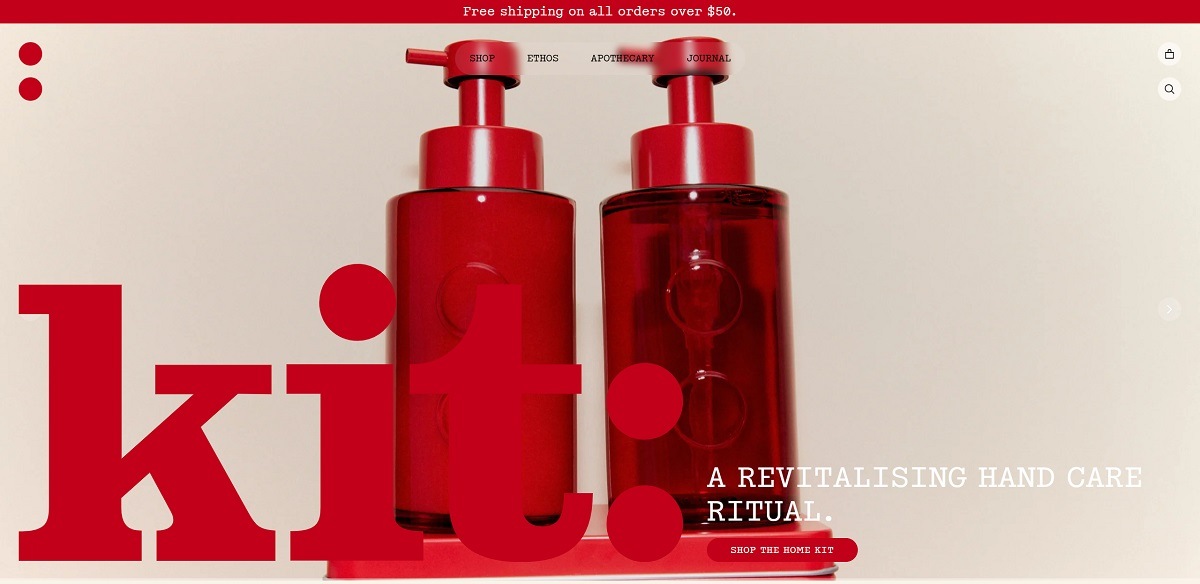
Kit: is an Australian skincare and wellbeing brand selling forty-nine products across face, body, fragrance, sleep and sweat, plus tactile tools such as a gua sha and a facial cup. Prices run from 10 AUD for a tube key to 150 AUD for the Skin Starter Kit, with free shipping over 100 AUD. The line is pitched as “Modern formulas for all skinkind”. Built on Shopify with a custom theme.
Website Design
One typeface, used for everything. The site is set entirely in Kit Simon Mono, a custom monospace in regular and bold, with no second face anywhere. Logo, navigation, product names and legal text share the same letterforms, giving the site an instruction-sheet quality.
Cream grounds and a single red. The stylesheet resolves to a warm cream background at #faf3e8, a lighter cream at #fbf8f4 and an off-white at #f2e9db, with black text. The only saturated colour is a red at #c20019, used for the logotype and the announcement bar.
Counted navigation. Menu items carry their item count as a zero-padded number, so the shop reads as Best Sellers 09, Face 14, Fragrance 06 and All 49, setting expectations before a category opens.
Shopping Experience
Cards that open into a briefing. Every product card carries a small “i” toggle revealing three fixed fields in the same order: “Suited for”, “Application” and “Benefits”. Size variants appear on the card as chips, so a shopper can pick 50ml or 30ml and add to the bag without leaving the grid.
Routines as a second entry point. The all-products page offers Routines, split into Invigorate, Meditate and Treat, alongside the category tabs, and bundles products into named sets such as Sleep Kit and Sweat Kit.
Shipping maths kept visible. The bag drawer states the gap to free delivery, phrased as “Spend another $100 AUD to recieve FREE SHIPPING”, and a WELCOME10 code for ten per cent off a first order runs in the announcement bar.
Product pages written as formulation notes. The Skinkind Face Oil page footnotes its claims to a 2025 independent clinical test on thirty participants, then sets out Key Ingredients, an Aroma section with top, heart and base notes, Application and The Formula.
Brand Storytelling
Skincare framed as a toolbox. The Ethos page describes the range as a toolbox of utilitarian, hard-working parts and states the position in pairs: “Conscious choices over compulsive decisions. Consistency over cultism. Health over hype.” Fragrance is handled the same way, as an ingredient rather than an ornament.
In and out, listed side by side. The same page runs “In Our Kit” against “Out Of Our Kit”, numbering the inclusions and crossing out parabens, phthalates, SLS, mineral oil, silicones, synthetic colourants and animal-derived ingredients.
Notable Features
Packaging given as a figure. The sustainability section states that 95% of products are packaged in glass or aluminium and that virgin plastic is avoided where possible.
Editorial sits level with the shop. The header places Ethos, Apothecary, Kit: Council and Journal beside Shop, so the reading material is not buried in the footer.
Search that suggests before typing. The search overlay pre-loads terms such as Face Oil, RE:SET, Hand Wash and Gift Sets, with a best-seller list and prices underneath.

 By Jibin Kumar