
 By Bogdan Rancea

Best overall

Shopify
See pricing Visit Shopify →$29/month Basic (billed annually)
3-day free trial, then $1/month for 3 months
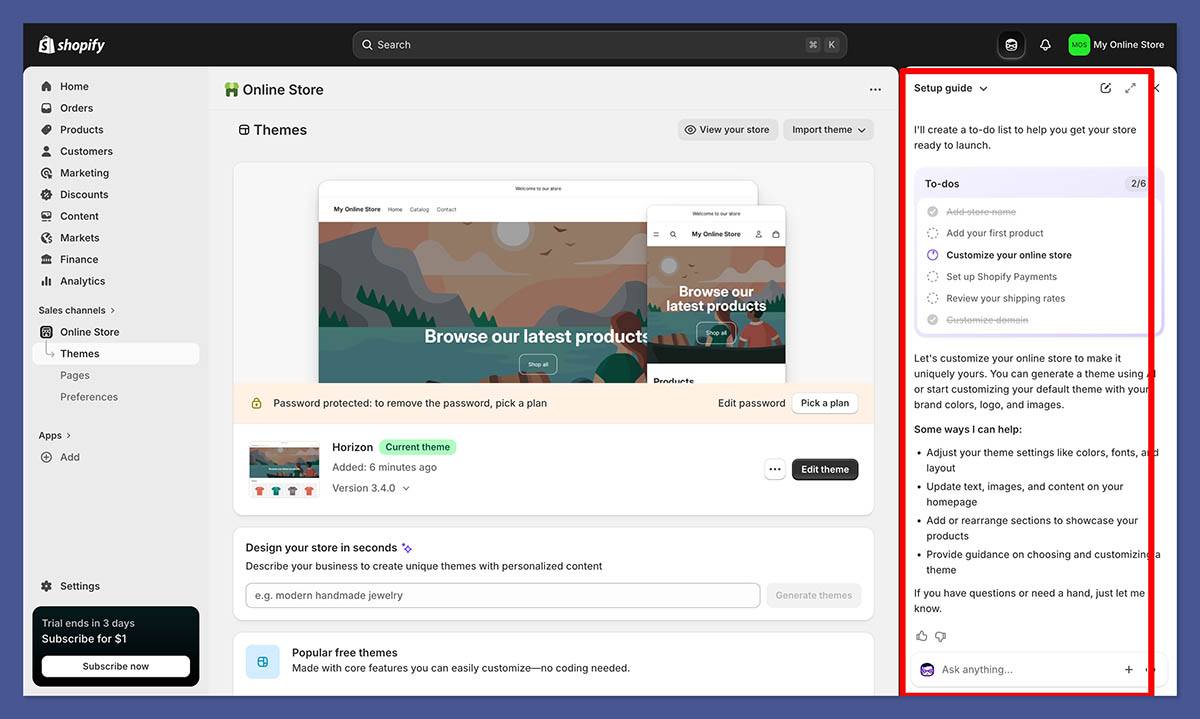
- AI store builder with editable Horizon layouts
- Sidekick takes admin actions with your approval
- Native A/B testing and the biggest app ecosystem
Best AI agent team

Genstore
See pricing Visit Genstore →$25/month Lite (billed monthly)
$1 first month, free plan to build
- AI agents for marketing, SEO, analytics and support
- Built-in dropshipping and print-on-demand
- Manual section editor under the AI draft
Best for design control

Wix
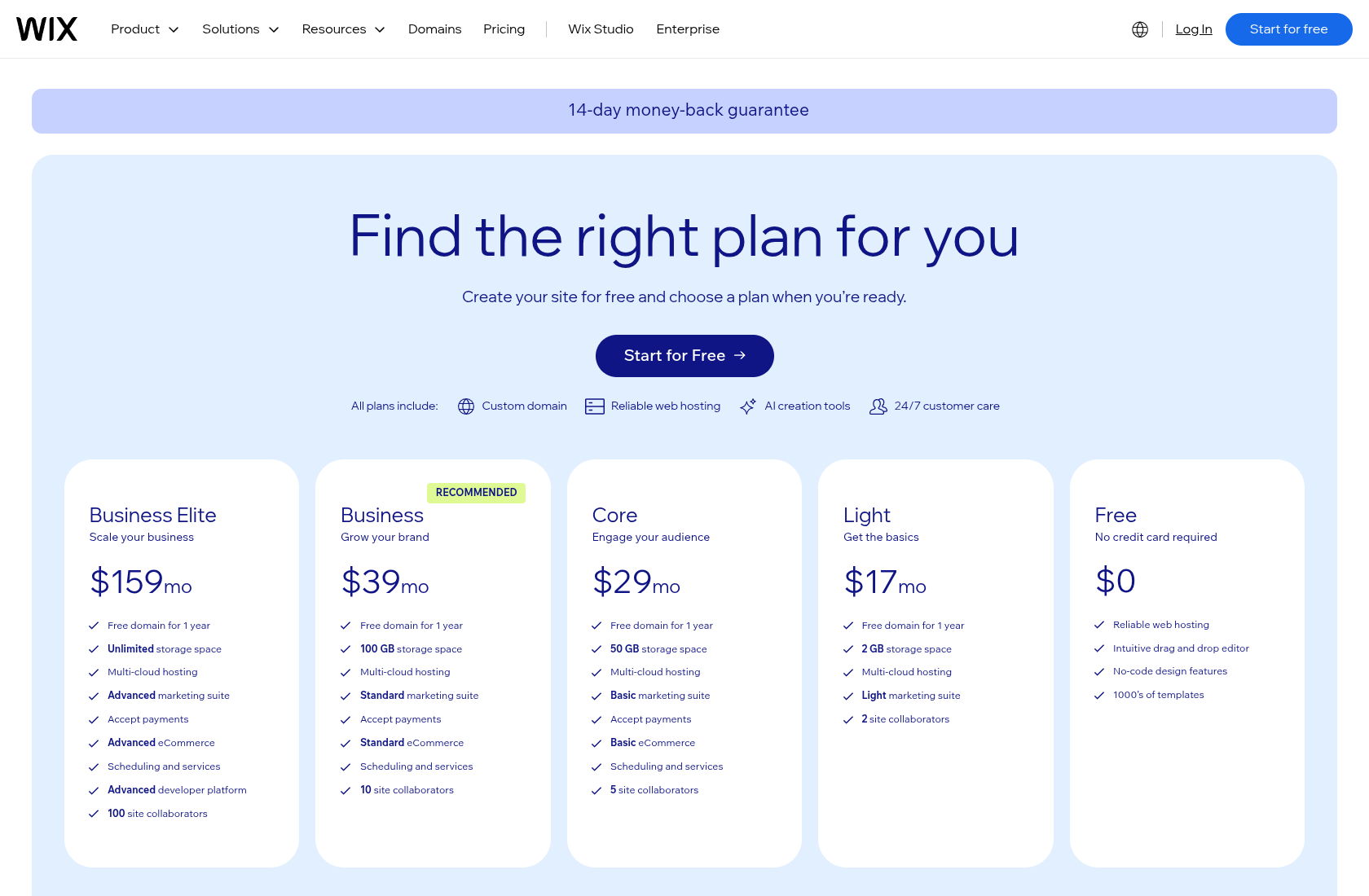
See pricing Visit Wix →$29/month Core (billed annually)
Cheapest Wix plan that takes payments
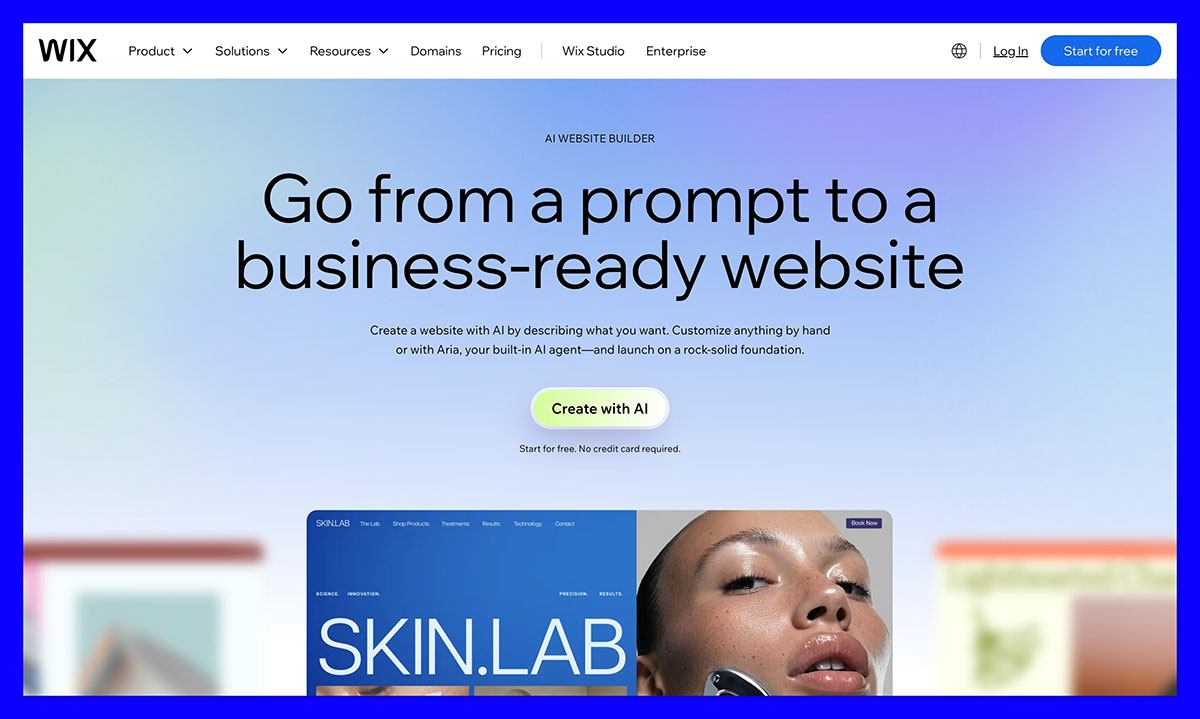
- Aria AI agent builds the store by chat
- Full drag-and-drop editing behind the AI draft
- Agents for marketing, support and automation
Based on our testing of 12 AI store builders, Shopify is the best of the Amboras AI alternatives for 2026 because its AI store builder turns a short prompt into an editable Horizon theme, Sidekick takes real admin actions when you approve them, and native A/B testing sits on top of the biggest app and theme ecosystem.
Amboras still does something clever: it builds a whole store from one sentence and pitches AI that keeps testing it after launch. However, Basic costs $49 per month plus a platform fee on every sale, and the agentic testing only starts on Pro.
I’ll walk you through how each alternative builds your store, how much it keeps doing after launch, how the result looks and what it really costs, so you can pick the AI that fits how hands-off you want to be.
Key Takeaways
- Shopify combines editable AI layouts, Sidekick actions, and native A/B testing
- Genstore is the closest match for ongoing agent-led management
- Hostinger starts at $3.99 monthly on a 48-month commitment; Shopify Basic costs $39 billed monthly
- Wix and Squarespace let you manually refine AI-built designs
- Atlas suits a hero-product store using Shopify’s checkout
We rank AI store builders on six weighted categories: AI that runs the store (25%), AI store generation (20%), design quality and editability (20%), pricing and fees (20%), commerce features and integrations (10%), and support and track record (5%).
I gave each builder the same one-sentence brief for a small skincare brand, then edited the result, set up a product and a discount, and checked what the AI could still do after launch. You can read more about our methodology below.
Our top 6 Amboras AI alternatives:
- Shopify: Best Overall
- Genstore: Best AI Agent Team
- Wix: Best for Design Control
- Squarespace: Best for Visual Brands
- Hostinger: Best Budget Option
- Atlas: Best for One-Product Stores
Amboras AI Alternatives Comparison Table
Compare the plans that actually let you sell, then check whether their AI builds pages or keeps handling store tasks:
| Builder | Best for | Starting price that lets you sell | What the AI keeps doing after launch | Design control | Platform fee on sales |
|---|---|---|---|---|---|
| Amboras, for reference | Prompt-run store | $49/mo monthly; $39.20/mo billed yearly | Agentic experiments and promotions on Pro; continuous autonomous testing on Advanced | Prompt edits only, no theme editor | 1% on Basic and Pro; 0.5% on Advanced |
| Shopify | Overall commerce platform | $29/mo billed annually; $39 monthly | Sidekick admin actions with approval; merchant-controlled Rollouts A/B tests | Horizon theme editor and extensive theme ecosystem | None with Shopify Payments; 2% on external gateways on Basic |
| Genstore | AI agent team | Lite $25/mo; $1 first month | Agents for marketing, SEO, analytics, and support | Manual section editor and theme library | None stated with native payments; 2% on external gateways on Lite |
| Wix | Design control | Core $29/mo billed annually; $36 monthly | Kleo marketing, Juno support, and Omni automation | Chat plus full drag-and-drop editing | None stated; processing applies |
| Squarespace | Visual brands | Basic $19/mo billed annually | AI copy and design assistance, not autonomous management | Designer templates and visual editor | 2% on Basic; 0% from Core |
| Hostinger | Budget stores | Business $3.99/mo on 48 months; renews at $16.99/mo | AI writing, product, and SEO assistance | Drag-and-drop editor | 0% |
| Atlas | One-product Shopify stores | $39/mo app subscription plus Shopify | Store generation, not ongoing management | Shared Bolt theme, editable within Shopify | Shopify’s fees apply |
Prices are US figures before card processing. Compare billing commitments as well as headline prices; promotional rates and renewals appear separately.
1. Shopify: Best Overall
- Shopify pricing: $29 to $359 per month billed annually, or $39 to $399 billed monthly, excluding Plus
- Standout: AI store generation plus Sidekick actions for products, themes, and workflows, with your approval
- Further reading: Our guide to building a Shopify store with AI
Shopify is our best overall choice because it connects prompt-based store creation to a mature commerce platform, rather than stopping at a generated homepage. Horizon gives you an editable starting point, with alternative themes available if the initial direction misses your brand.
However, Sidekick waits for approval, unlike the autonomous optimization Amboras offers on its higher plans. Users also flag incorrect chargeback answers, so check financial guidance before acting.
Pros
- AI store generation: Three layouts from a short prompt
- Sidekick: Admin actions and proactive Pulse suggestions
- Rollouts: Native A/B testing
- Design flexibility: Extensive theme and app ecosystem
Cons
- Approval required: Sidekick doesn’t independently run the store
- Short prompt box: About 100 characters
- External gateways: Additional fee on Basic
- App subscriptions: Extra recurring costs
What’s new with Shopify?
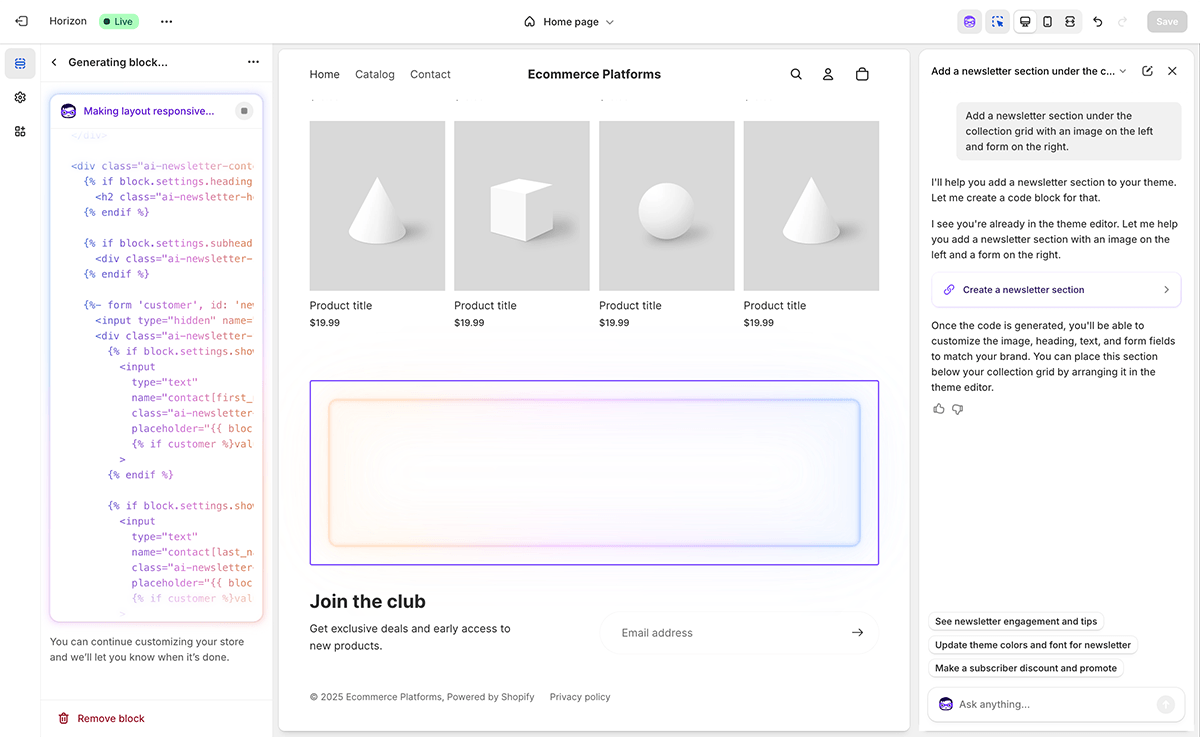
Winter ’26 expanded Sidekick beyond conversational help, adding tools for building and maintaining your store:
- Pulse: Proactive task suggestions
- Theme editing: Natural-language design instructions
- App and workflow generation: Requests become admin tools
- SimGym: Simulated shoppers explore store behavior
- Agentic Storefronts: Product discovery inside AI shopping conversations
Rollouts adds merchant-controlled testing for themes and checkout, reducing reliance on a separate experimentation app.
Why switch to Shopify from Amboras?
Among Amboras AI alternatives, I recommend Shopify for control over changes and your exit route. Export tools and broader integrations leave you less dependent on one platform’s AI.
Basic also costs less when billed monthly, and Shopify Payments adds no platform fee on sales, although card processing still applies. Our Shopify review covers the rest of the platform.
My Shopify testing notes
I had to trim my skincare brief to fit Shopify’s short prompt box, then picked one of the three layouts and refined its sections in the theme editor. After that, I asked Sidekick to rewrite a product description and set up a launch discount, and it drafted both and waited for my approval before changing anything.
The drawback is that the short prompt leaves little room for brand direction, so the first layout looked fairly generic. I got it closer to the brand through follow-up edits, which is fine, but don’t expect one instruction to nail your visual identity.
How Much Does Shopify Cost?
Shopify offers a 3-day free trial, followed by $1 per month for 3 months on most plans. Our Shopify pricing guide breaks down every plan and fee.
| Plan | Monthly price, billed annually | Monthly price, billed monthly | Online card rate |
|---|---|---|---|
| Basic | $29 | $39 | 2.9% + 30¢ |
| Grow | $89 | $105 | 2.7% + 30¢ |
| Advanced | $359 | $399 | 2.5% + 30¢ |
| Plus | From $2,300 | Contract-dependent | 2.25% + 30¢ |
2. Genstore: Best AI Agent Team
- Genstore pricing: Free to $199 per month billed monthly; paid selling plans start at $25
- Standout: 10+ AI agents covering design, products, marketing, SEO, analytics, and support
- Further reading: Our best ecommerce platforms for beginners guide
Genstore is our closest agent-led match because its assistants keep working after the initial store build. Built-in dropshipping and print-on-demand combine product sourcing and store management, making it useful for trying a new product range.
However, its pattern-based designs can feel less distinctive than Wix or Squarespace, especially for a premium skincare brand. A manual editor helps, but credit limits constrain ongoing AI use, even on paid plans.
Pros
- Ongoing agents: Marketing, SEO, analytics, and support
- Lower entry cost: Lite starts at $25 monthly
- Product sourcing: Built-in dropshipping and print-on-demand
- Manual editing: Section controls beneath the AI draft
Cons
- Free plan: Cannot accept live payments
- Lite allowance: 50 AI credits monthly
- Lite dropshipping: Service commission on dropship orders
- Short track record: AI-native platform launched in 2025
What’s new with Genstore?
The full agent release arrived in February 2026, dividing store operations across named assistants:
- Genius: Strategy
- Olivia: Marketing
- Sara: Products
- Harvey: Analytics
- Ella: Customer support
- Luna: SEO
These agents cover more daily tasks than a copy generator. However, available credits still limit how much work you can delegate.
Why switch to Genstore from Amboras?
I recommend shortlisting Genstore if you want a cheaper entry plan and built-in product sourcing. Its combination suits product testing better than a brand whose main distinction is visual identity.
Check the dropshipping service commission on Lite, not just the subscription. Ask how campaign work consumes credits before using your allowance on repeated layout regeneration.
My Genstore testing notes
I gave Genstore the skincare brief and its agents produced homepage sections, a collection and product pages, which I then tidied in the section editor. Once the products were in place, I asked Olivia, the marketing agent, to plan a launch campaign.
The weak spot is differentiation. The layout followed a familiar pattern and the product copy made claims I wouldn’t publish for skincare, so I rewrote most of the text and swapped the images before it felt like a real brand.
How Much Does Genstore Cost?
Genstore’s free plan supports building, while Lite is the entry point for accepting payments.
| Plan | Monthly price, billed monthly | AI credits | Card rate |
|---|---|---|---|
| Free | $0 | 5 initially, plus 5 per day | Cannot sell |
| Lite | $25 | 50/month | 2.8% + 30¢ |
| Growth | $75 | 200/month | 2.6% + 30¢ |
| Scale | $199 | 700/month | 2.5% + 30¢ |
Yearly billing saves about 20%. External gateway fees are 2% on Lite, 1% on Growth, and 0.6% on Scale.
3. Wix: Best for Design Control
- Wix pricing: $17 to $159 per month billed annually; Core at $29 is the first selling plan
- Standout: Harmony combines Aria’s conversational building with drag-and-drop editing
- Further reading: Our Shopify vs Wix comparison for the commerce trade-offs
Wix is our best choice for design control because Harmony lets you move between prompting and direct visual editing. Aria generates the storefront structure, while you retain hands-on control over spacing and typography.
However, Shopify offers deeper commerce capabilities, and Wix’s checkout customization remains restrictive. Choose Wix for its editing flexibility rather than expecting the first generated layout to capture your brand perfectly.
Pros
- Hybrid editing: Chat and drag-and-drop in one workflow
- Post-launch agents: Marketing, support, and automation
- Selling plan: Core accepts online payments
- Template choice: Large library beyond the AI draft
Cons
- Free and Light: Neither accepts payments
- Variant limit: 1,000 per product
- Checkout: Limited customization
- Product exports: CSV files omit image links
What’s new with Wix?
Harmony launched in January 2026, connecting Aria’s conversational design requests to an editable storefront. The wider agent lineup divides ongoing work:
- Kleo: Marketing and SEO
- Juno: Customer support
- Omni: Abandoned-cart and back-in-stock automation
For me, the useful distinction is AI assistance without prompt-only editing. You can correct placement directly instead of repeatedly describing the same visual adjustment.
Why switch to Wix from Amboras?
Wix belongs on your shortlist of Amboras AI alternatives if you want AI to draft the store without becoming your only editing interface. Amboras has no conventional theme editor, making that difference especially relevant for design-conscious founders.
That said, Wix is weaker when portability matters. If you’re weighing other options, see our best Wix alternatives. Its product CSV export omits image links, so maintain your own image library alongside the catalog.
My Wix testing notes
I gave Aria the skincare brief and got a full store back, then used chat for the big changes (new sections, a different hero) and drag-and-drop for spacing and type. That mix is the best part of Wix: I never had to describe a small visual tweak three times.
The drawback is that a complete page isn’t a finished brand. The first layout leaned on stock imagery that didn’t fit, so I regenerated a few sections and replaced the photos, and none of that freedom extends to Wix’s checkout.
How Much Does Wix Cost?
Choose Wix Core or higher to sell online; Light is a website plan that can’t accept payments.
| Plan | Monthly price, billed annually | Monthly price, billed monthly | Sell online |
|---|---|---|---|
| Light | $17 | $24 | No |
| Core | $29 | $36 | Yes |
| Business | $39 | $46 | Yes |
| Business Elite | $159 | $172 | Yes |
4. Squarespace: Best for Visual Brands
- Squarespace pricing: $19 to $99 per month billed annually
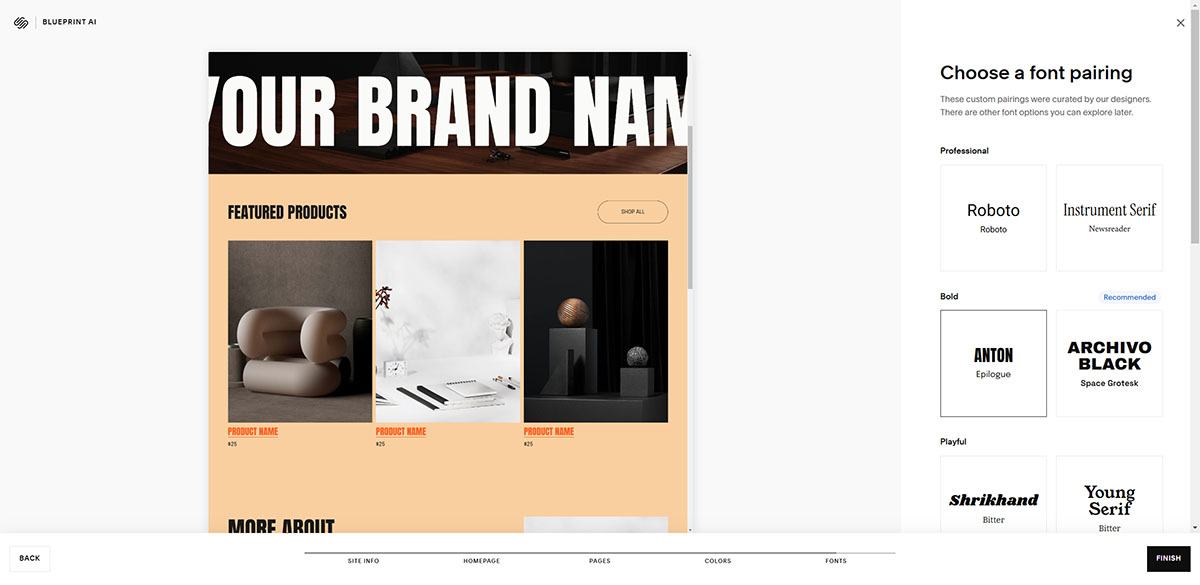
- Standout: Blueprint AI suggests sections, palettes, and font pairings before handing over to the visual editor
- Further reading: Our guide to using Squarespace Blueprint AI
Squarespace is our best pick for visual brands because Blueprint AI coordinates design choices around your brand personality. Its templates provide a cohesive setting for product photography, with manual editing after generation.
However, Genstore offers more ongoing AI management. Squarespace helps with design and copy but doesn’t autonomously run promotions or experiments, and each store displays only one currency at a time.
Pros
- Visual consistency: Coordinated templates and typography
- Blueprint access: Included across plans
- Core and above: No store transaction fee
- Manual refinement: Standard editor after generation
Cons
- No autonomous agent: Ongoing management stays with you
- Basic fee: 2% on store transactions
- Currency display: One at a time
- Blueprint choices: Restricted initial fonts and colors
What’s new with Squarespace?
US prices increased in July 2026 on Basic, Core, and Plus, so older comparisons can understate your subscription. Plans also include monthly AI credits for supported copy and design assistance.
Why switch to Squarespace from Amboras?
I recommend Squarespace when photography matters more than automated experimentation. Our Shopify vs Squarespace comparison shows where it falls behind on commerce. Its standard editor lets you adjust presentation without asking an agent to interpret each change.
For an actively selling store, consider Core rather than Basic because it removes the store transaction fee. Card processing remains separate.
My Squarespace testing notes
Blueprint asked for the skincare brand’s name and personality, suggested pages, a palette and a font pairing, and the store it assembled needed only minor tweaks in the standard editor. For a photo-led brand, that’s the most polished starting point in this list.
That said, the AI copy sounded flat, so I rewrote the headline and product blurbs myself, and Blueprint’s font and color choices are narrower than what the full editor lets you do afterwards.
How Much Does Squarespace Cost?
All four Squarespace plans can sell, but Core removes Basic’s 2% transaction fee. See our Squarespace pricing guide for the full breakdown.
| Plan | Monthly price, billed annually | Store transaction fee |
|---|---|---|
| Basic | $19 | 2% |
| Core | $29 | 0% |
| Plus | $49 | 0% |
| Advanced | $99 | 0% |
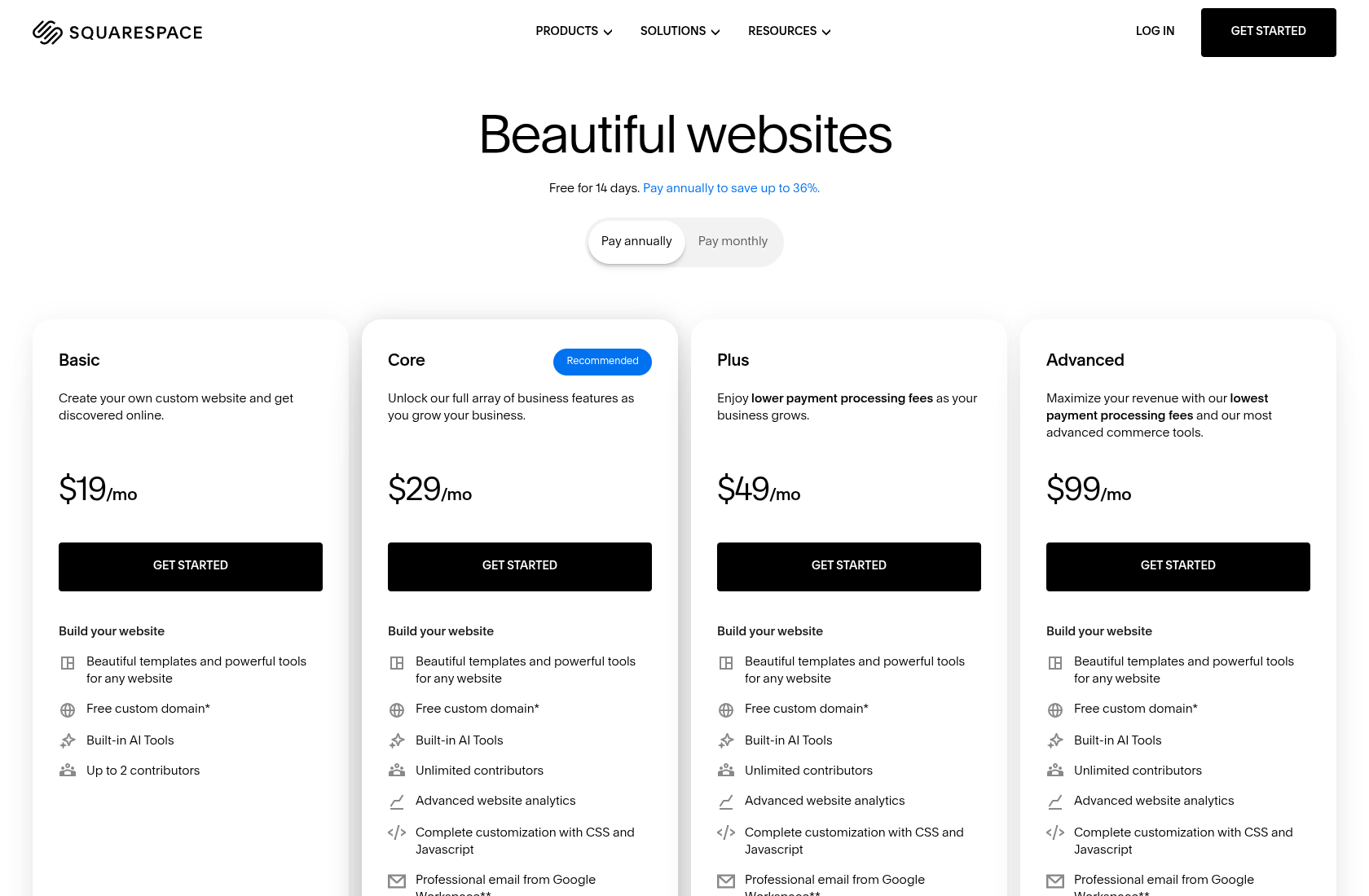
Monthly billing costs more.
5. Hostinger: Best Budget Option
- Hostinger pricing: Business starts at $3.99 per month on a 48-month term, renewing at $16.99
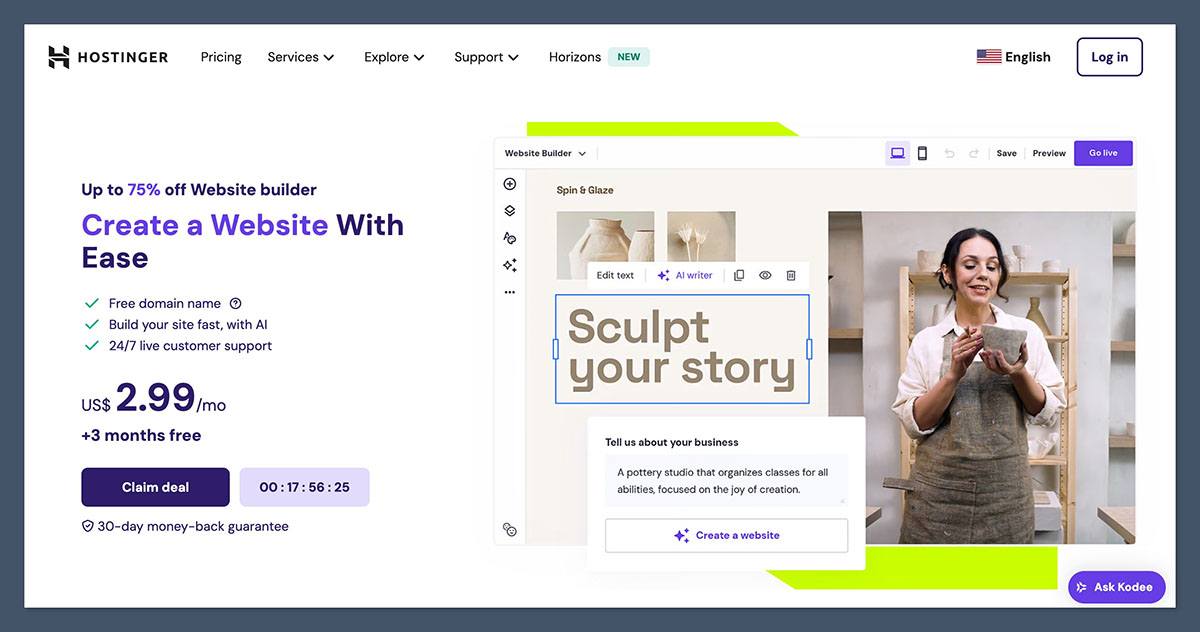
- Standout: AI builder, product generation, and SEO assistance with no platform transaction fee
- Further reading: Our Shopify vs Hostinger comparison
Hostinger is our budget recommendation because Business costs far less than Amboras Basic and takes no platform cut of sales. Its AI draft remains editable through straightforward drag-and-drop controls.
However, Shopify provides more room for complex commerce, while Hostinger suits smaller catalogs. The promotional commitment also means you should compare renewal costs before paying upfront, rather than choosing solely on the opening rate.
Pros
- Entry cost: Lowest starting price among these picks
- Platform fee: 0% on sales
- AI assistance: Product descriptions and SEO
- Visual editing: Simple drag-and-drop controls
Cons
- Promo commitment: Requires 48 months
- Renewal: Business rises to $16.99 monthly
- Catalog size: Approximately 600 products
- Optimization: No autonomous testing agent
What’s new with Hostinger?
Hostinger includes an online-store AI assistant alongside plan-based AI credits. These support store-building tasks, but they don’t make Hostinger an autonomous promotion or experimentation platform.
Why switch to Hostinger from Amboras?
Hostinger stands out among Amboras AI alternatives when you need an affordable store you can manage yourself. Its simple templates suit a small catalog better than a highly art-directed storefront.
You still handle promotions and merchandising. Choose that trade-off when reducing fixed costs matters more than delegating optimization.
My Hostinger testing notes
I generated the skincare store from the brief, adjusted it in the drag-and-drop editor and used the AI product generator to draft a listing. The discount I set up by hand, since there’s no agent to do it for you.
The design looked generic until I changed the fonts and imagery myself, and nothing tests or tweaks the offer after launch. Hostinger’s AI helps you produce content; deciding what to promote stays your job.
How Much Does Hostinger Cost?
Business is the Hostinger plan that can sell; Premium covers websites without an online store.
| Plan | Promo price, 48-month term | Renewal | Sell online |
|---|---|---|---|
| Premium | Not listed here | $10.99/mo | No |
| Business | $3.99/mo | $16.99/mo | Yes |
Business renews at $18.99 per month on monthly billing.
6. Atlas: Best for One-Product Stores
- Atlas pricing: $39 per month after a 7-day trial, plus a Shopify subscription
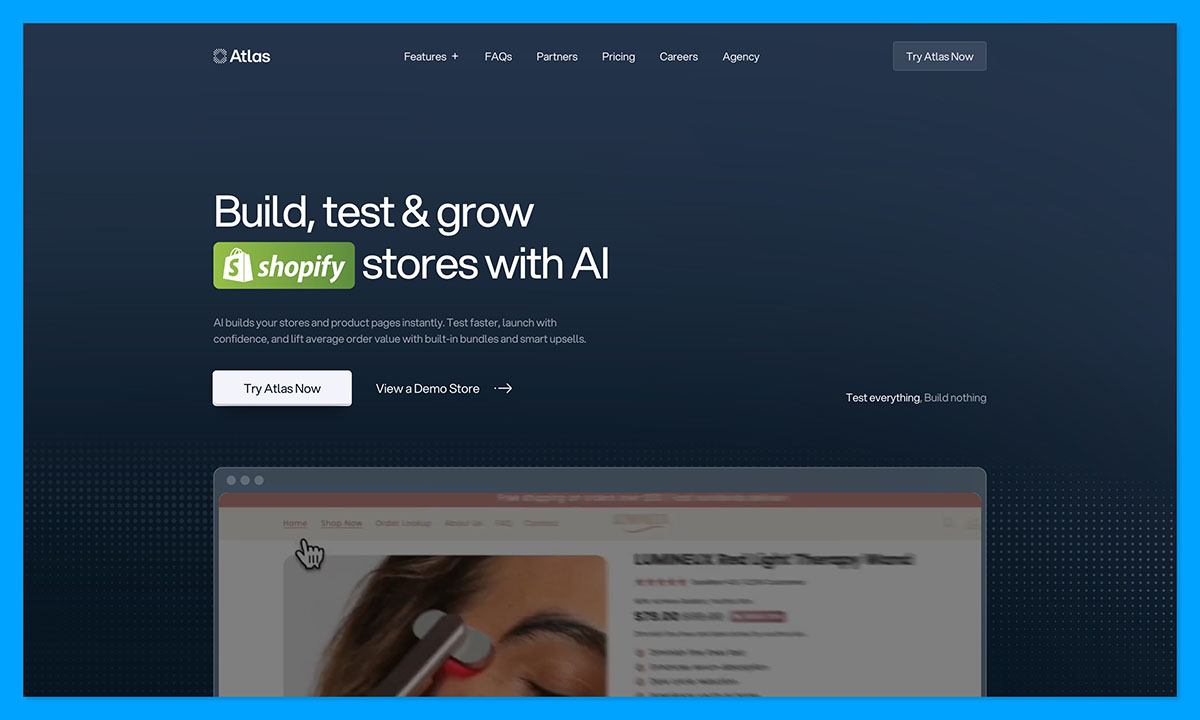
- Standout: Generates a hero-product store from an AliExpress, Amazon, or Alibaba product link
- Further reading: Our Atlas AI Store Builder review
Atlas is our one-product pick because it turns a product link into a focused Shopify storefront with bundles and upsells. Bolt supplies a ready-made sales-page structure, rather than a blank canvas.
However, unlike Amboras or Genstore, Atlas doesn’t keep running the store. You manage it through Shopify after generation, and its shared theme makes distinctive photography particularly important.
Pros
- Product-link input: Builds around an existing listing
- Offers: Bundles and upsells included
- Bolt theme: Polished product-page structure
- Commerce foundation: Shopify checkout underneath
Cons
- Build-only role: No ongoing management agent
- Shared theme: Similar starting appearance across stores
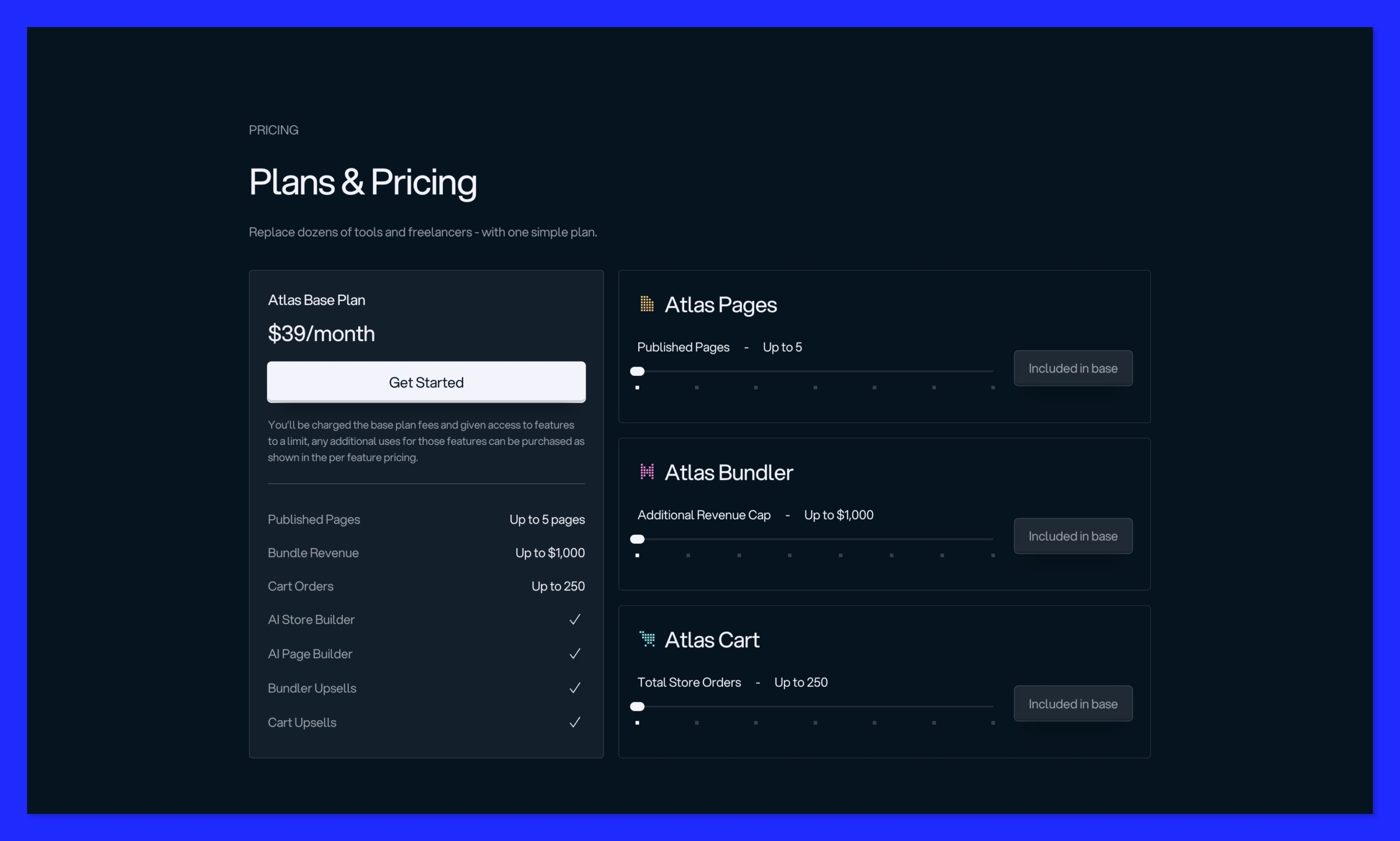
- Page allowance: Around 5 published pages on the base plan
- Combined bill: App subscription plus Shopify
What’s new with Atlas?
Atlas’s current Bolt theme includes product-focused sections and offer blocks. Its appeal remains packaged storefront generation, not a new post-launch management agent.
Why switch to Atlas from Amboras?
Among Amboras AI alternatives, I recommend Atlas for a hero product when Shopify’s checkout and apps are priorities. Compare broader options in our best AI Shopify store builders guide.
Users complain about billing after cancellation, so confirm cancellation within Shopify and keep the confirmation. Our Storebuild.ai vs Atlas comparison shows how it stacks up against the free option.
My Atlas testing notes
Atlas works from a product link rather than a prompt, so I pasted a listing for the skincare hero product and got a full one-product store with bundles in place. I rewrote the headline and benefit sections, since the generated copy was generic.
The weakness is visual repetition: the store looked like other Atlas stores until I changed the images and colors, so budget time for that before launch.
How Much Does Atlas Cost?
Budget for both subscriptions, since the Atlas app doesn’t replace your Shopify plan.
| Item | Price |
|---|---|
| Atlas All-in-One | $39/mo after a 7-day trial |
| Shopify Basic | $29/mo billed annually, or $39 monthly |
| Combined starting cost | About $68/mo with annual Shopify billing; $78 with monthly Shopify billing |
How Do I Choose the Right Amboras AI Alternative?
Decide whether you want AI to build your store or keep running it before comparing subscriptions. Hostinger assists with content, Genstore assigns ongoing tasks to agents, and Shopify requires approval for admin actions.
For a design-led brand, I recommend testing the editor before paying, and our best AI website builders roundup covers more design-first options. A generated layout only helps if you can fix it, particularly the product hierarchy and mobile presentation.
Use these questions to compare Amboras AI alternatives:
- Does the AI only draft the store, or can it act in the admin after launch?
- Does it change things independently, or wait for my approval?
- Can I edit the design manually when the AI gets it wrong?
- Which plan unlocks A/B testing, multi-currency, and upsells?
- What do I pay per sale, including processing and platform fees?
- Can I export products, customers, and orders if I leave?
Treat “free” generation separately from selling costs. Storebuild.ai generates a storefront without charging for the build, but selling requires Shopify, and its fulfillment workflow steers you toward Zendrop.
Can I Switch From Amboras to Another Builder?
Yes, but confirm the export route before committing. Amboras offers free inbound migration on paid plans, including from Shopify, but has no documented bulk export tool for leaving. Ask support how to retrieve your catalog and transaction records.
Shopify and Wix support CSV exports, although Wix’s product export omits image links. Keep image backups separately, and check which customer records transfer before scheduling the move.
Switching also requires rebuilding the design and mapping URL redirects to protect search traffic. Neither migration direction should be treated as a one-click move.
How We Test and Rank Amboras AI Alternatives
We tested 12 AI store builders with the same one-sentence brief for a small skincare brand. In each one, I generated the store, edited the design, added a product, set up a discount and checked what the AI could still do after launch. We then scored every builder on six weighted categories:
- AI that runs the store (25%): Admin actions, autonomy, and approval controls
- AI store generation (20%): Store structure beyond the homepage
- Design quality and editability (20%): Themes and manual brand refinement
- Pricing and fees (20%): Selling plans, credits, processing, and renewals
- Commerce features and integrations (10%): Catalog management and connected tools
- Support and track record (5%): Help options and platform maturity
Other options missed the shortlist for specific reasons:
- GoDaddy Airo: Fragmented plans and expiring credits
- BigCommerce: Strong commerce, less compelling AI generation
- Jotform: Payment-submission caps
- Durable: Not ecommerce-first
- 10Web: WordPress management and higher renewal costs
Prices current as of October 2026.
Final Verdict: Which Amboras AI Alternative Do I Recommend?
I recommend Shopify for most founders comparing Amboras AI alternatives because its AI builder, Sidekick, and native A/B testing sit on a flexible commerce foundation. You retain design control and approve changes instead of delegating the entire storefront to an agent.
Choose Genstore for ongoing agent assistance, or Wix and Squarespace when visual control matters most. Hostinger suits a restricted budget, while Atlas fits a Shopify hero-product store. Start with available trials, give your finalists the same brand brief, and check whether you can comfortably edit the store you actually want to launch. Compare the full selling cost before committing.
FAQs
Is Amboras free to use?
Amboras is free to build and preview, but publishing and selling require a paid plan. Its Free offering includes a 14-day trial and 200 AI credits per month.
To sell, you need Basic at $49 per month, or $39.20 per month billed yearly. Compare the paid selling plan with Amboras AI alternatives, not the free generation offer alone.
Does Amboras charge transaction fees?
Yes. Amboras charges a platform fee of 1% on Basic and Pro, or 0.5% on Advanced, in addition to card processing.
Basic’s card rate starts at 2.9% + 30¢. “No app fees” therefore does not mean fee-free selling: subscription and transaction charges still apply. Shopify Payments avoids an additional Shopify platform fee, while Hostinger also charges no platform transaction fee. Both still have payment-processing costs, so include those when comparing the final bill.
Can AI really run an online store on its own?
Only partly: AI can generate pages and handle store tasks, but you remain responsible for business decisions. Shopify’s Sidekick waits for approval, while Amboras offers agentic experimentation on higher plans.
Verify product claims and supervise customer-facing changes rather than treating automation as unlimited management. For AI apps you can add to any store, see our best AI ecommerce tools. Credit limits matter too: Amboras credits do not roll over, and AI actions pause when they run out. The store stays live and keeps selling, but ongoing optimization pauses.
What’s the cheapest Amboras alternative that can take payments?
Hostinger Business has the lowest starting price among these picks at $3.99 per month, requiring a 48-month commitment. It renews at $16.99 per month, so compare the full commitment rather than the introductory rate alone.
For a shorter commitment, Genstore Lite costs $25 billed monthly. Squarespace Basic costs less when billed annually, but adds a store transaction fee. Choose between them using your expected sales volume and commitment preference, not subscription price alone.


