Founded in 2006, Bailey44 is a women’s contemporary clothing line designed and manufactured in Los Angeles, California.
Bailey44


eCommerce Websites
Founded in 2006, Bailey44 is a women’s contemporary clothing line designed and manufactured in Los Angeles, California.
Performance clothes for the work day.
Specialty Coffee Professionals motivated by ethics & philanthropy in coffee.
An event for UX Designers and Web Developers.
A collective of artist, creatives and individuals coming from different backgrounds – from streetart, photography and filming, through skateporning, snowporning, wakeporning, biking or bboying, to tattoo art and music.
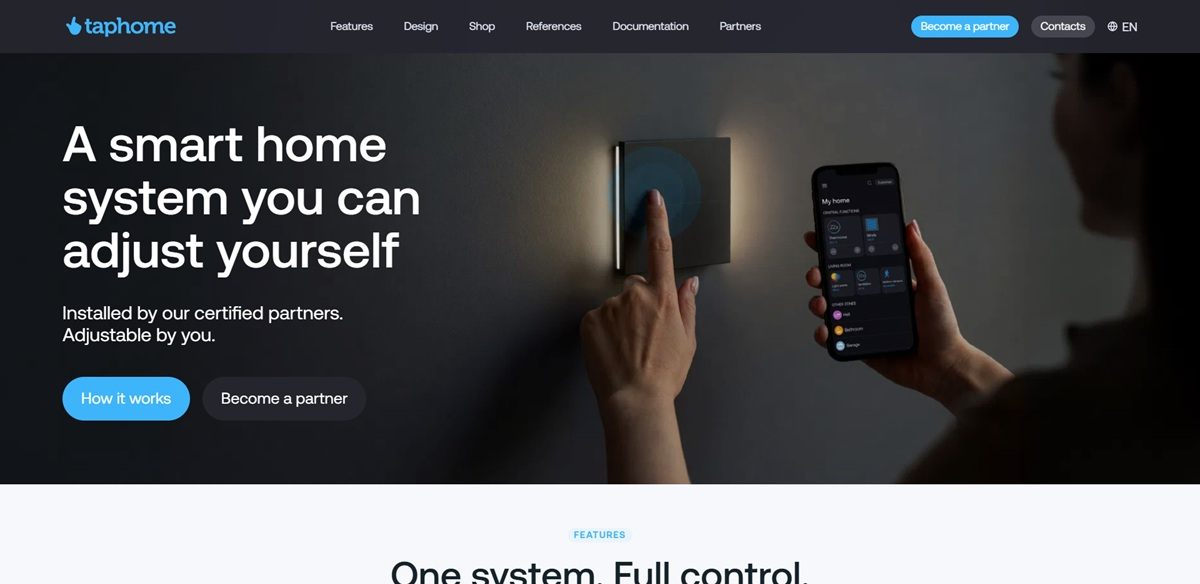
TapHome is a Slovak smart home automation manufacturer selling a controller-based system for heating and cooling, shading, lighting and energy management, together with the hardware that runs it: wall controllers with displays, smart switches, socket frames, sensors and bus IO modules. The audience splits between homeowners and the installation firms that fit the system. taphome.com is the product and documentation site; the transactional storefront runs separately at hardware.taphome.com on Shoptet, with a Hungarian webshop on a third domain.
A blue and grey token system. The palette is nine greys running from near-white to near-black, a primary blue scale anchored on a light cyan-blue, and secondary violet and mint ranges reserved for diagrams and badges.
Aeonik throughout. Both the marketing site and the shop set Aeonik, loaded as a variable font with an italic cut. Small upper case eyebrow labels sit above sentence-case headlines.
Dark panels for hardware, light panels for explanation. Renders of the controllers and switches sit on near-black grounds so the white, anthracite, black and beige finishes read against each other, while feature pages switch to pale grey.
Diagram instead of photograph. The shading section walks a single day as an hour-by-hour timeline, each step tagged as a smart rule and labelled Automatic, Safety or Manual. The site explains itself by animating its logic rather than by showing rooms.
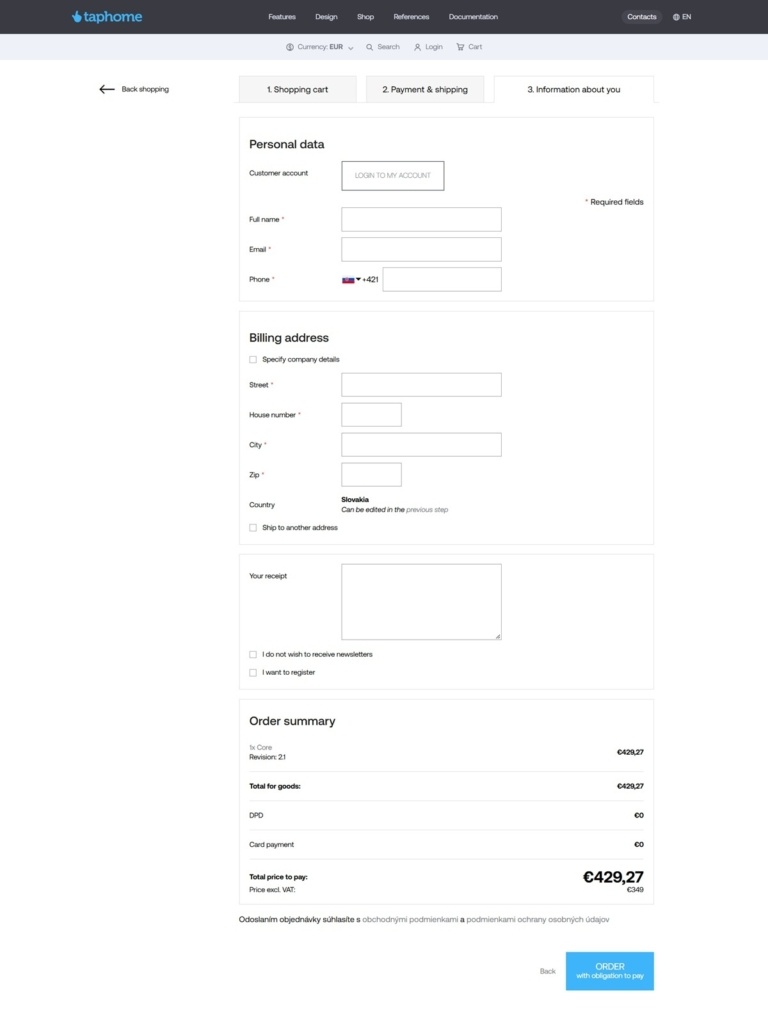
The shop is a different property. Shop in the main navigation leaves for the Shoptet store, and Hungarian visitors are routed to a separate webshop domain. Cart, account and checkout all live off the main site.
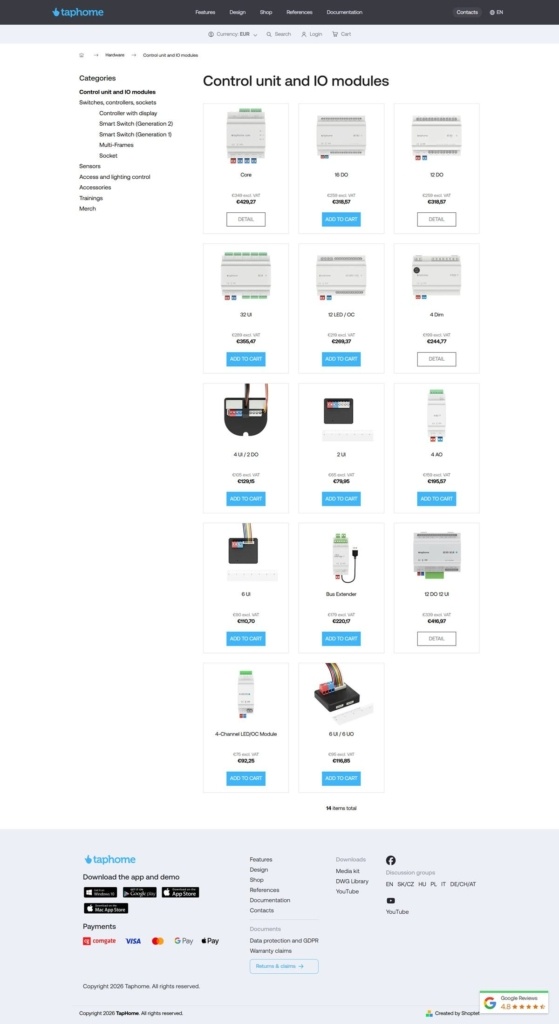
Live stock counts and dual pricing. Listings state units on hand, for example “In stock (96 pcs)”, and show both the price excluding VAT and the gross figure. Currency toggles between EUR and CZK, and the interface runs in five languages.
Categories follow the wiring. Control unit and IO modules, switches, sensors, access and lighting control, accessories, then trainings and merchandise in the same tree, which makes the installer audience explicit.
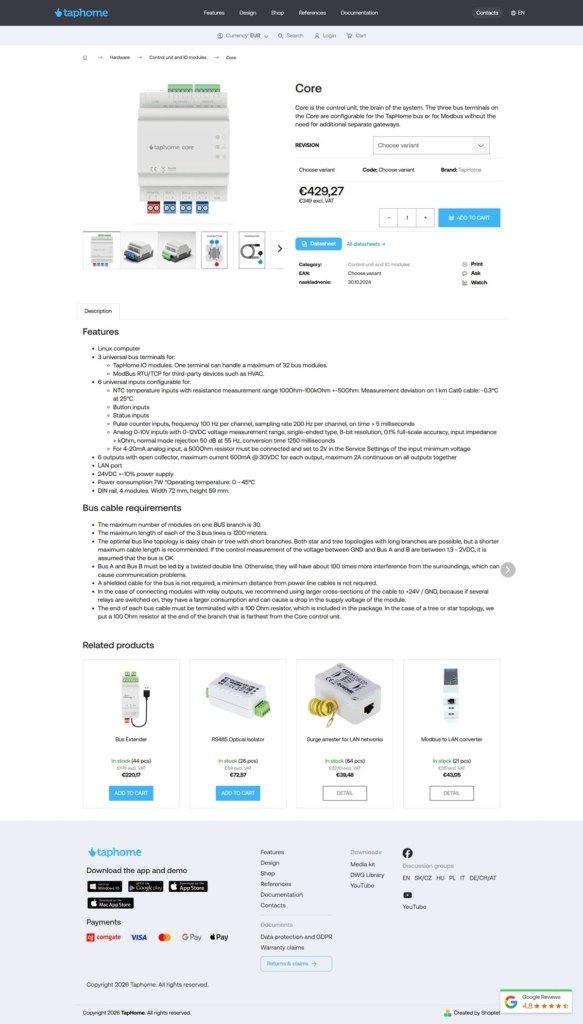
Product pages written as datasheets. Each carries a product code, EAN, brand, category and restock date, then a features list of measurement ranges, accuracies, current draw and operating temperatures. Ask and Watch buttons sit alongside Add to cart.
Configuration is the pitch. The recurring line is “One system. Full control.”, and the feature pages argue for openness and self-configuration rather than for a finished lifestyle.
Reviews pulled straight from Google. Testimonials carry names, dates and star ratings, with the Slovak original held behind a Show original toggle under the English translation.
A partner directory used as a channel. Dozens of installation companies each get a profile page, and a partner portal lets firms generate device templates and publish their own reference projects.
A finish and layout picker on the marketing site. The design page steps through controller variants, button layouts from one to six and four colourways, ending in a link into the store.
Documentation treated as a product. A DWG library, datasheets, pricelist, media kit, troubleshooting guides and integration manuals sit in the footer beside the shop links.
A new genre in men’s jewelry.
PONY was born in Brooklyn, New York in 1972. PONY became one of the most iconic sports brand in 1970’s and 1980’s.
Apeo allows you to quickly and easily create a customized, stylish looking polls.
Schneiderman’s Furniture is a family-owned Minnesota furniture retailer with stores in Lakeville, Plymouth, Roseville, Woodbury, Duluth and Rochester.
Concept store / studio where sincere design happens, based on human experience and nature principles, through our urban modern style.
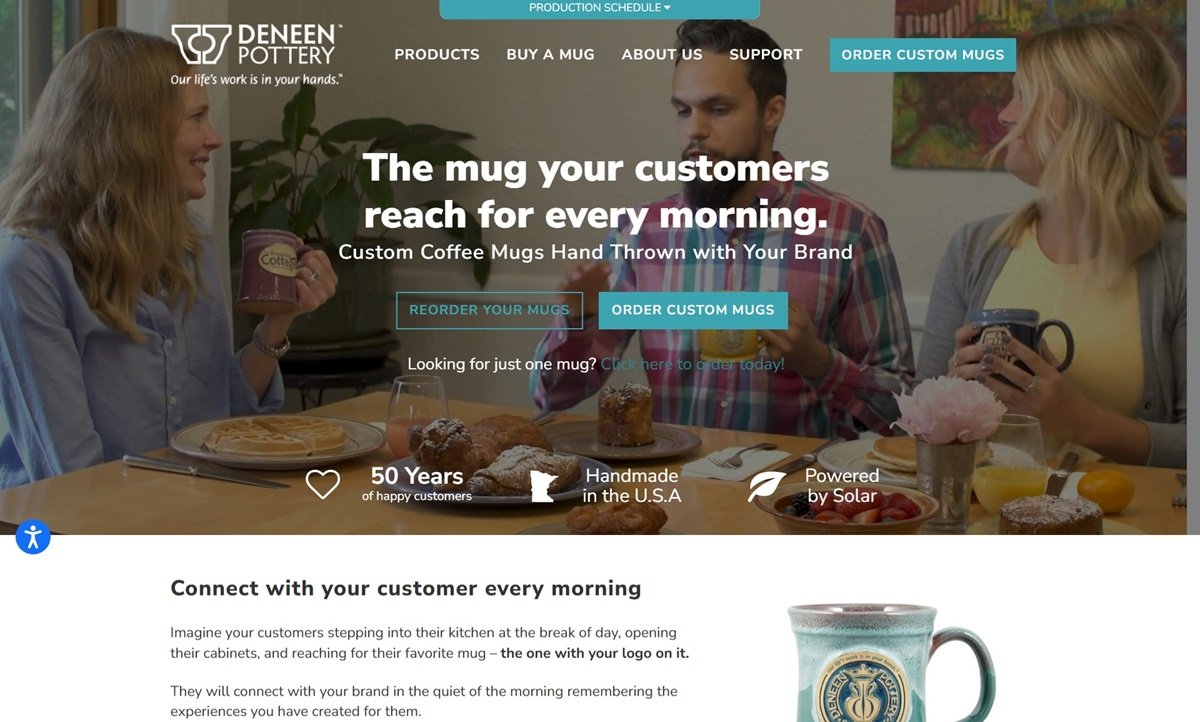
Deneen Pottery specializes in handcrafted, custom ceramic mugs and tableware, offering a variety of styles such as Signature Mugs, Specialty Mugs, and Tankards. Their website features a clean, intuitive design, showcasing products with high-quality imagery and detailed descriptions, providing an engaging and user-friendly shopping experience.


