
 By Bogdan Rancea
Best overall

Shopify
See pricing Visit Shopify →From $29/month billed yearly
Free Oxygen hosting
- Hydrogen works with any JS framework
- Free Oxygen storefront hosting
- Shop Pay and Markets carry over
Best for visual editing

BigCommerce
See pricing Visit BigCommerce →From $29/month billed yearly
Free Catalyst storefront
- Next.js Catalyst storefront
- Makeswift visual page editing
- Multi-storefront from one dashboard
Best open source

Medusa
See pricing Visit Medusa →Free to self-host
Cloud from $29/month
- MIT-licensed open source core
- 0% GMV fee on every Cloud plan
- Official Next.js storefront starter
Of the best headless ecommerce platforms, I rank Shopify first. As of November 2026, we compared 12 platforms using pricing, documentation, licenses and developer feedback. Hydrogen works with any JavaScript framework, and paid plans include free Oxygen hosting and Shopify’s checkout, from $29/month billed yearly ($39 monthly).
You still need developers: Shopify warns, “A headless storefront costs more to build and run than a theme.” I’ll compare storefront starters, editing tools, prices and live brands so you can judge that trade-off. BigCommerce leads for visual page editing; Medusa offers open source without revenue-based platform fees.
See Our Top 8 Headless Ecommerce Platforms
Match these headless commerce platforms to your design priorities and maintenance budget.
- Shopify: Best overall, 4.7/5. Free Oxygen hosting and flexible Hydrogen, from $29/month billed yearly.
- BigCommerce: Best for visual editing, 4.5/5. Catalyst with Makeswift, from $29/month billed yearly.
- Medusa: Best open source, 4.4/5. MIT core; 0% GMV fee (GMV means total sales value).
- Shopware: Best for European brands, 4.1/5. Free core; paid plans from EUR 600/month.
- Swell: Best for subscriptions, 4.0/5. Hosted and headless storefronts from $29/month billed yearly.
- Saleor: Best for global channels, 3.9/5. Lush runs 50+ channels, per Saleor.
- commercetools: Best for enterprise, 3.8/5. Sephora is a customer; prices aren’t published.
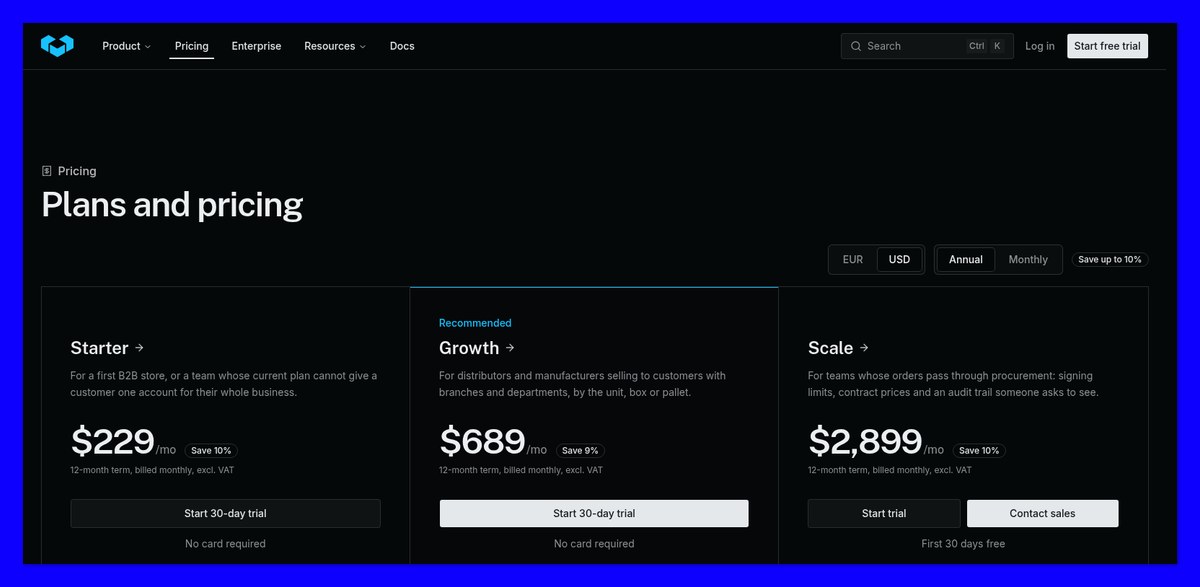
- Vendure: Best for complex B2B (business-to-business sales), 3.7/5. B2B plans from $229/month on a 12-month term.
Headless Commerce Platform Comparison Table
Five picks provide official storefront starters. Compare these headless commerce platforms using prices as of November 2026. SaaS means vendor-run software.
| Platform | Rating | Best for | Starting price | Type and license | Official storefront starter | Storefront hosting | Live brands |
|---|---|---|---|---|---|---|---|
| Shopify | 4.7 | Overall | $29/mo yearly ($39 monthly) | SaaS; Hydrogen MIT | Hydrogen; any JS framework | Free Oxygen or elsewhere | Nour Hammour, Chubbies |
| BigCommerce | 4.5 | Visual editing | $29/mo yearly ($39 monthly) | SaaS; Catalyst MIT | Catalyst + Makeswift | Vercel; native hosting beta | K2 Sports, Burrow |
| Medusa | 4.4 | Open source | Free; Cloud from $29/mo | Open source, MIT | Next.js dtc-starter | Cloud or self-host | Wipertech, Tekla |
| Shopware | 4.1 | European brands | Free; Rise from EUR 600/mo | MIT + paid plans | Vue/Nuxt Frontends | Your host; Vercel-ready | asambeauty, Villeroy & Boch |
| Swell | 4.0 | Subscriptions | $29/mo yearly | SaaS | Hosted storefront; custom API build | Confirm custom hosting | Spinn Coffee, Smashing Magazine |
| Saleor | 3.9 | Global channels | Free; Cloud $1,599/mo | BSD-3 core; FSL storefront | Paper, Next.js 16 | Cloud or self-host | Lush, Rough Trade |
| commercetools | 3.8 | Enterprise | Unpublished; five to six figures/year | Enterprise SaaS | Separate build | Your host | Sephora, Ulta Beauty |
| Vendure | 3.7 | Complex B2B | Free; B2B from $229/mo | GPLv3 or commercial | Custom API build; B2B storefront on Scale | Self-host; Cloud closed beta | IBM, Hemglass |
Customer names do not all confirm headless usage; the picks below distinguish them. Storefront builds cost extra: see the real-cost table under “How Do I Choose.”
1. Shopify Hydrogen: Best Headless Platform Overall
- Pricing: Basic from $29/month billed yearly ($39 monthly); Plus from $2,300/month.
- Storefront starter: Hydrogen 2026-10, with React Router and Next.js starters; supports any JavaScript framework.
- Hosting: Free Oxygen on paid plans, or another host.
- Overall rating: 4.7/5.
- Further reading: Our Shopify review.
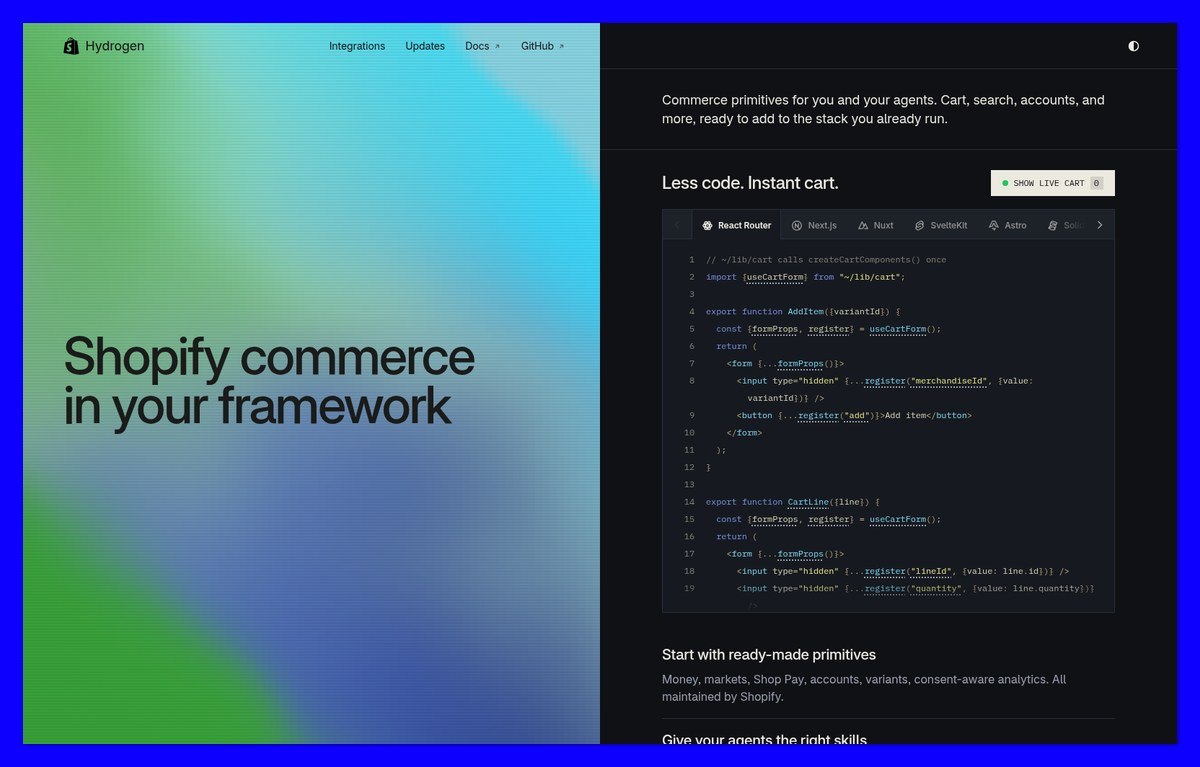
Shopify is the best headless ecommerce platform for most brands because it combines framework freedom, free hosting and an established agency ecosystem. Hydrogen handles shopping features while Shopify runs your checkout and back office. But headless Shopify means maintaining custom storefront code, not upgrading a theme.
Pros
- Free hosting: Oxygen adds nothing to your platform bill; Vercel deployment is also supported.
- Framework freedom: Hydrogen supports React and Vue, with a core library for other JavaScript frameworks.
- Commerce carries over: Shop Pay and Markets remain available, alongside customer accounts and hosted checkout.
- AI compatibility: Shopify Catalog supports discovery through ChatGPT and Perplexity; Oxygen supports on-site shopping agents.
Cons
- Theme apps need rebuilding: Embedded widgets require an API or SDK, meaning a developer kit.
- No theme editor: Add a content management system, or CMS, for marketer-controlled pages.
- Checkout limits: Advanced customization remains Plus-only.
- Storefront caps: You get 1 on Basic through Advanced, versus 25 on Plus.
How Headless Works on Shopify
The Hydrogen channel deploys to Oxygen; the Headless channel lets you host elsewhere. The Storefront API is the data feed your custom design reads products and cart from.
- Prototyping: Designers can use mock.shop demo data before connecting a store.
- Design control: Layouts and interactions are yours; checkout retains Shopify’s structure. Commerce-UI pairs Hydrogen with Sanity for Lady Gaga and Carhartt WIP.
- Live brands: Shopify reports a 63% year-over-year conversion lift for Nour Hammour. Chubbies also uses Hydrogen; explore the biggest brands using Shopify for inspiration.
How Much Does Shopify Cost?
| Plan | Price | Headless storefronts | Checkout customization |
|---|---|---|---|
| Basic | $29/mo billed yearly ($39 monthly) | 1 | Standard |
| Grow and Advanced | Between Basic and Plus; see live pricing | 1 | Standard |
| Plus | From $2,300/mo | 25 | Advanced |
New stores receive a 3-day trial, then $1/month for three months on most plans. Our Shopify pricing guide explains wider costs.
Best for: Bespoke design backed by Shopify’s checkout. Skip if: You need visual editing without adding a CMS, or your theme already solves the problem.
2. BigCommerce Catalyst: Best for Visual Page Editing
- Pricing: Core from $29/month billed yearly ($39 monthly); Performance from $1,499/month billed yearly.
- Storefront starter: Free, MIT-licensed Catalyst, paired with Makeswift.
- Hosting: Vercel or compatible hosts; native Cloudflare hosting is in beta.
- Overall rating: 4.5/5.
- Further reading: BigCommerce vs Webflow.
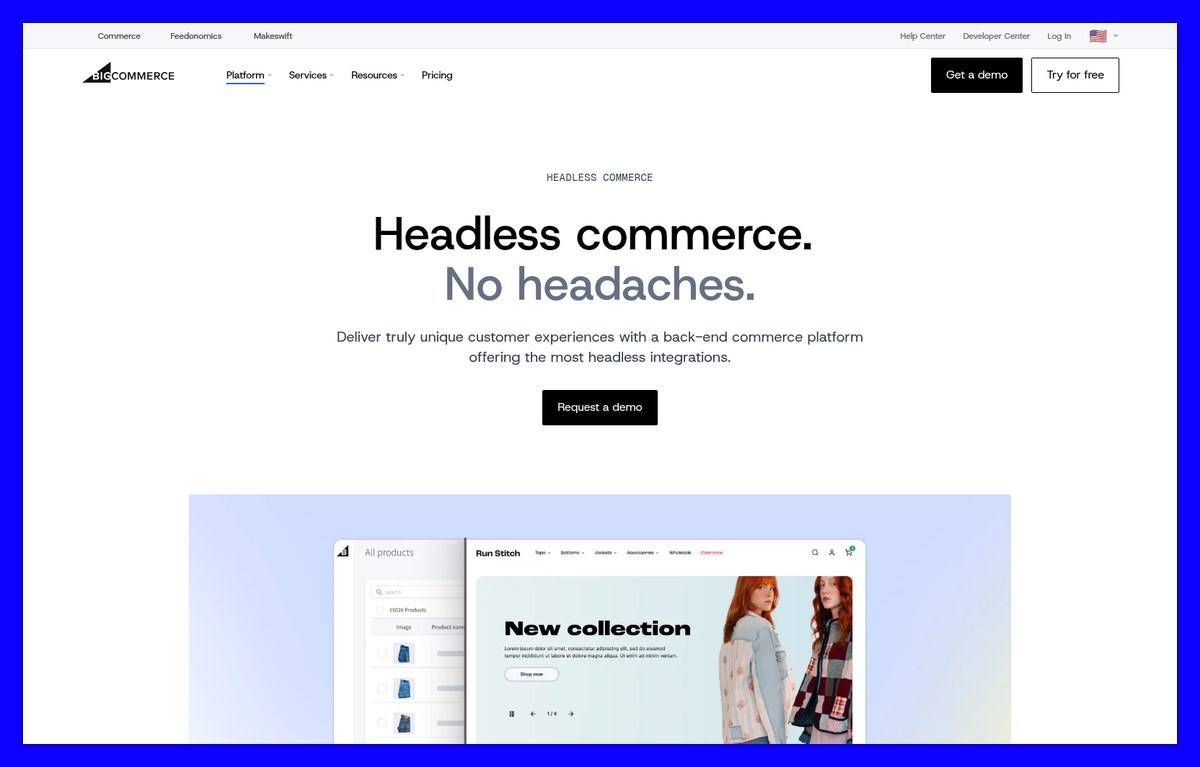
BigCommerce is the best option for keeping visual page editing, thanks to Catalyst and Makeswift. Catalyst became production-ready in July 2025, but its ecosystem remains younger than Hydrogen’s. Sales caps can also force plan upgrades.
Pros
- Visual editing: Makeswift lets marketers change pages without sending every request to developers.
- Free starter: Catalyst includes Next.js foundations and a B2B edition.
- Multi-storefront: Manage separate storefronts from one dashboard.
- Embedded payments: Orders through embedded providers carry $0 additional platform payment-provider fee.
Cons
- Sales caps: Core and Growth automatically upgrade beyond their trailing-year thresholds.
- External gateway fees: Open payment provider fees range from 2.0% to 0.6%.
- Young ecosystem: Few publicly named stores are confirmed Catalyst builds.
- Hosting maturity: Native hosting remains beta.
How Headless Works on BigCommerce
Catalyst reads the catalog through its GraphQL Storefront API. GraphQL is the query language the API speaks.
- Design control: Developers own the code; Makeswift supplies visual editing.
- Product names: The parent became Commerce.com, Inc.; BigCommerce, Catalyst and Makeswift keep their names.
- Live brands: K2 Sports and Burrow are headless examples, not confirmed Catalyst builds.
How Much Does BigCommerce Cost?
| Plan | Monthly, billed yearly | Billed monthly | Sales cap | Open payment provider fee |
|---|---|---|---|---|
| Core | $29 | $39 | $30K, trailing 12 months | 2.0% |
| Growth | $79 | $105 | $100K, trailing 12 months | 1.0% |
| Scale | $299 | $399 | $33,333/month, then 0.9% above | 0.6% |
| Performance | From $1,499 | Custom | Contracted | None |
Card processing on BigCommerce’s own payments starts at 2.89% + $0.29, separate from provider fees. See our BigCommerce pricing breakdown.
Quick comparison: BigCommerce keeps visual editing; Shopify offers free hosting and Shop Pay. Our Shopify vs BigCommerce comparison covers broader differences.
3. Medusa: Best Open Source Headless Platform
- Pricing: Free MIT core; Cloud from $29/month, with 0% GMV fees.
- Storefront starter: Next.js dtc-starter, including cart, checkout and accounts.
- Hosting: Cloud hosts storefront and backend together; self-hosting is optional.
- Overall rating: 4.4/5.
- Further reading: Shopify vs Medusa.
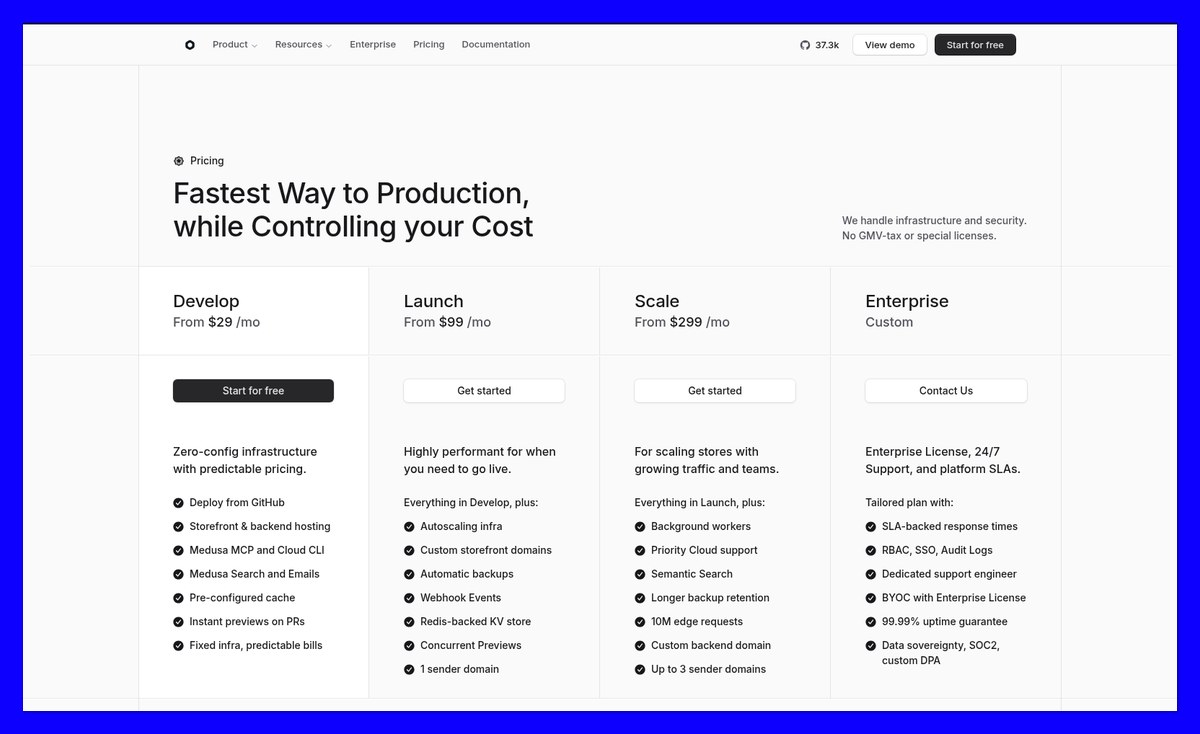
Every Medusa Cloud plan includes unlimited orders and products, without revenue-based platform fees. Medusa is my top open source headless commerce choice because its MIT core combines an official starter with affordable managed hosting. Its roughly 37.3K stars represent the largest GitHub following among these open source picks. You still build more yourself than on Shopify.
Pros
- No revenue share: Every Cloud plan charges a 0% GMV platform fee.
- Accessible starting point: A developer on Reddit comparing four backends reported the fastest initial setup with Medusa.
- Combined hosting: Cloud runs both halves of your store and supports cached Next.js pages.
- Modular features: Adopt individual commerce modules rather than replacing everything simultaneously.
Cons
- Production additions: A YouTube comparison by 306 Technologies reported missing variant images and basic analytics in the base project.
- Regional complexity: The Reddit comparison encountered multi-currency and localized-pricing difficulties.
- Metered extras: Additional requests and data transfer cost extra; Enterprise materials have separate licensing.
How Headless Works on Medusa
The backend uses Node/TypeScript; dtc-starter replaces Medusa’s deprecated Next.js starter.
- Design control: Your code controls layouts. Add a CMS for marketer-editable content.
- Live brands: Wipertech’s case describes 6,000+ variants. Tekla self-reports a 70% conversion increase; PortAventura World runs commerce for parks and hotels.
How Much Does Medusa Cost?
| Option | Price | What you get |
|---|---|---|
| Self-hosted | $0 license; estimated $84-$106/mo production hosting | You manage infrastructure |
| Develop | From $29/mo | Combined hosting, deploys, previews |
| Launch | From $99/mo | Custom domains, autoscaling, backups |
| Scale | From $299/mo | Workers, priority support, semantic search |
| Enterprise | Custom | Access controls, audit logs, 99.99% uptime SLA |
Extra storefront requests cost $0.30 per million; additional transfer costs $0.125/GB. The self-hosting estimate comes from an independent cost guide and excludes developer time.
My recommendation: Start with Develop if you have TypeScript support. Budget for Launch at $99/month when you need a custom storefront domain.
4. Shopware: Best for European Brands
- Pricing: Free Community Edition; Rise from EUR 600/month, Evolve from EUR 2,400/month.
- Currency: Shopware lists prices in euros.
- Storefront starter: Official Vue/Nuxt Shopware Frontends, with Vercel-ready templates.
- License: MIT core.
- Overall rating: 4.1/5.
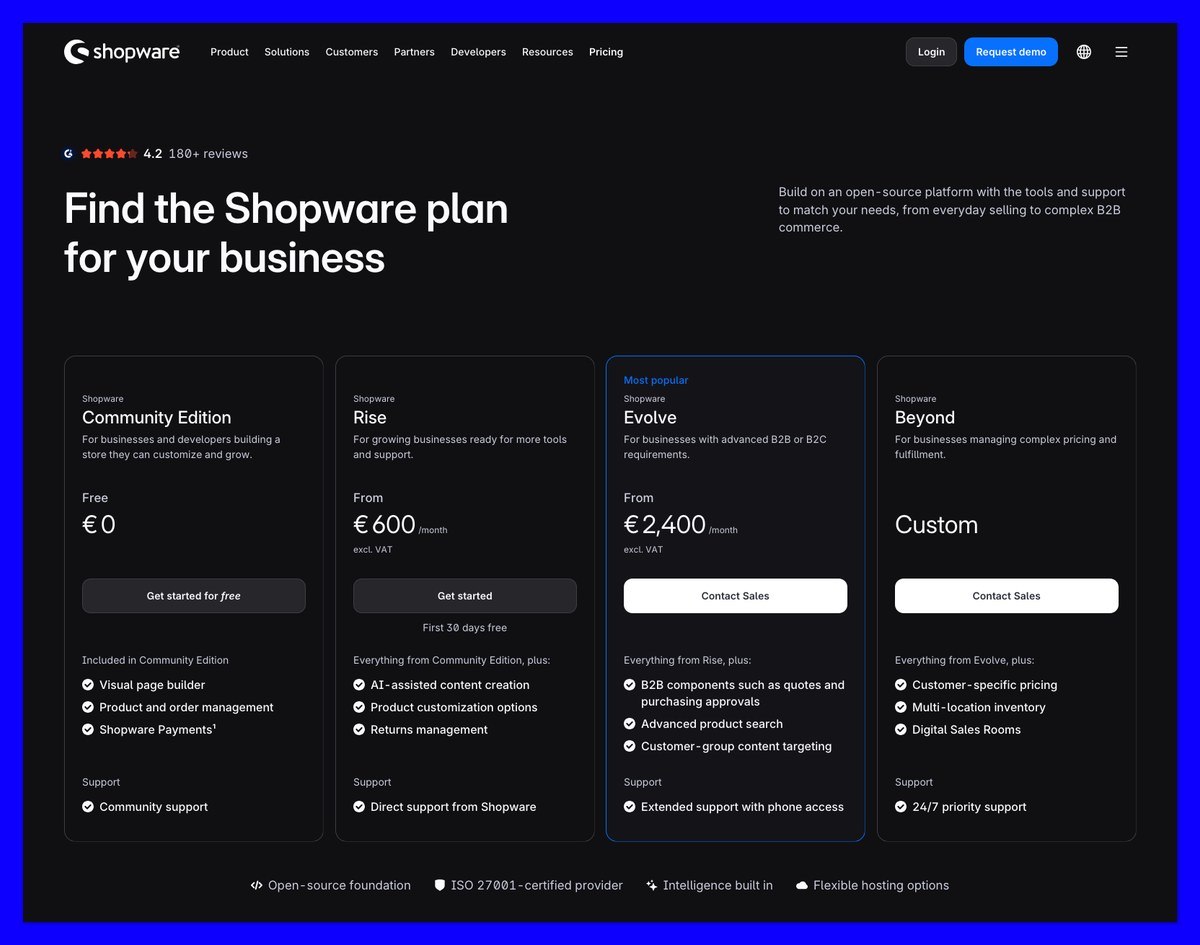
Want an official storefront framework without choosing React? Shopware is the strongest fit for European brands, particularly those working with Vue/Nuxt agencies. Its EUR 1M GMV fair-usage threshold restricts access to Shopware’s services, though the software remains MIT-licensed.
Pros
- Free core: Community Edition has no software license charge.
- Vue/Nuxt support: Shopware Frontends supplies official storefront building blocks.
- B2B upgrade path: Evolve adds quotes and approvals.
Cons
- Fair-usage restriction: Above EUR 1M GMV over 365 days, Account and Store access require a paid plan.
- Variable pricing: Paid quotes depend partly on sales value.
- Longer implementation: Published estimates put new headless builds at 3-6 months.
How Headless Works on Shopware
- Design control: Frontends supplies Vue/Nuxt components; choose your own hosting.
- Live brands: asambeauty has a documented Frontends headless build. Acro Commerce describes Villeroy & Boch’s build as “decoupled but not fully composable.”
- Customer distinction: ARMEDANGELS and Skins are Shopware customers, not confirmed headless examples.
How Much Does Shopware Cost?
| Plan | Price (EUR) | What it adds |
|---|---|---|
| Community Edition | Free, MIT | Core software; fair-usage service restrictions apply |
| Rise | From EUR 600/mo | AI content, customization, returns; first 30 days free |
| Evolve | From EUR 2,400/mo | B2B approvals, quotes, Advanced Search |
| Beyond | Custom | Customer-specific pricing, inventory integrations |
The verdict: Pick Shopware when your European agency knows its stack. Get a GMV-based quote before committing. Leaving Magento? Our Magento alternatives guide covers other routes.
5. Swell: Best for Subscription Brands
- Pricing: $29-$2,250/month billed yearly.
- Storefronts: Hosted and headless options on every plan, plus Swell Checkout.
- Built in: Subscriptions, B2B and wholesale.
- Overall rating: 4.0/5.
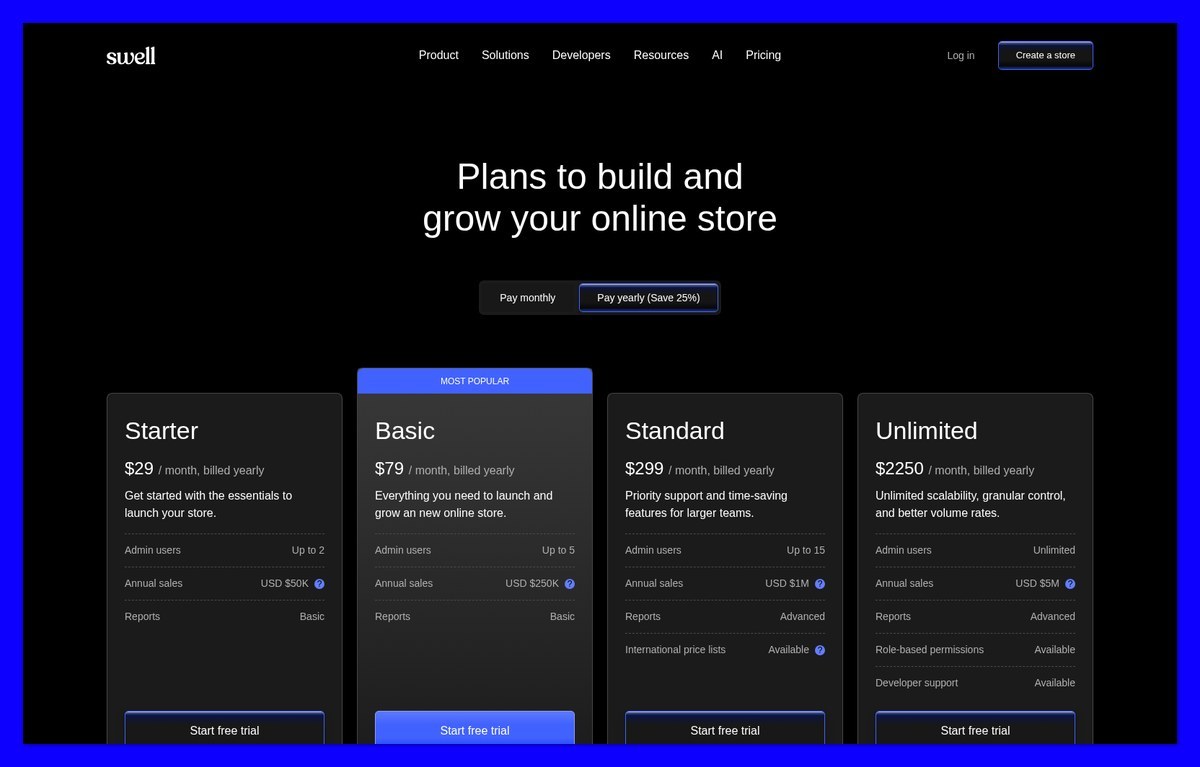
Don’t want separate subscription and wholesale tools? Swell is the best fit for subscription brands seeking both inside one platform. The trade-off is a smaller ecosystem, plus percentage fees when sales exceed your plan’s ceiling.
Pros
- Two storefront routes: Keep a hosted storefront alongside a custom build.
- Subscriptions included: No separate subscription app is needed.
- Published overages: Extra API requests cost $5 per 100,000.
Cons
- Revenue fees: Above-ceiling charges range from 2% to 0.4%.
- Support restrictions: Developer support and a service-level agreement require the top plan.
- Small ecosystem: Fewer agencies and public examples than Shopify; use Swell’s own pricing page when comparison sites disagree.
How Headless Works on Swell
- Design control: A developer builds against Swell’s API; buyers use Swell Checkout. Confirm custom frontend hosting responsibilities before commissioning it.
- Live brands: Swell lists Spinn Coffee and Smashing Magazine, but their stories don’t establish headless usage.
How Much Does Swell Cost?
| Plan | Monthly, billed yearly | Admin users | Revenue ceiling | Fee above ceiling |
|---|---|---|---|---|
| Starter | $29 | 2 | $50K | 2% |
| Basic | $79 | 5 | $250K | 1.5% |
| Standard | $299 | 15 | $1M | 1% |
| Unlimited | $2,250 | Unlimited | $5M | 0.4% |
Brands above $10M annual sales receive custom pricing.
Best for: One backend for recurring and wholesale sales. Skip if: A large app marketplace is essential. Our best Shopify alternatives guide includes broader hosted options.
6. Saleor: Best for Multi-Channel Global Brands
- Pricing: Free BSD-3 core; Cloud from $1,599/month.
- Storefront starter: Paper, built with Next.js 16 under an FSL license.
- Hosting: Saleor Cloud or self-hosting.
- Overall rating: 3.9/5.
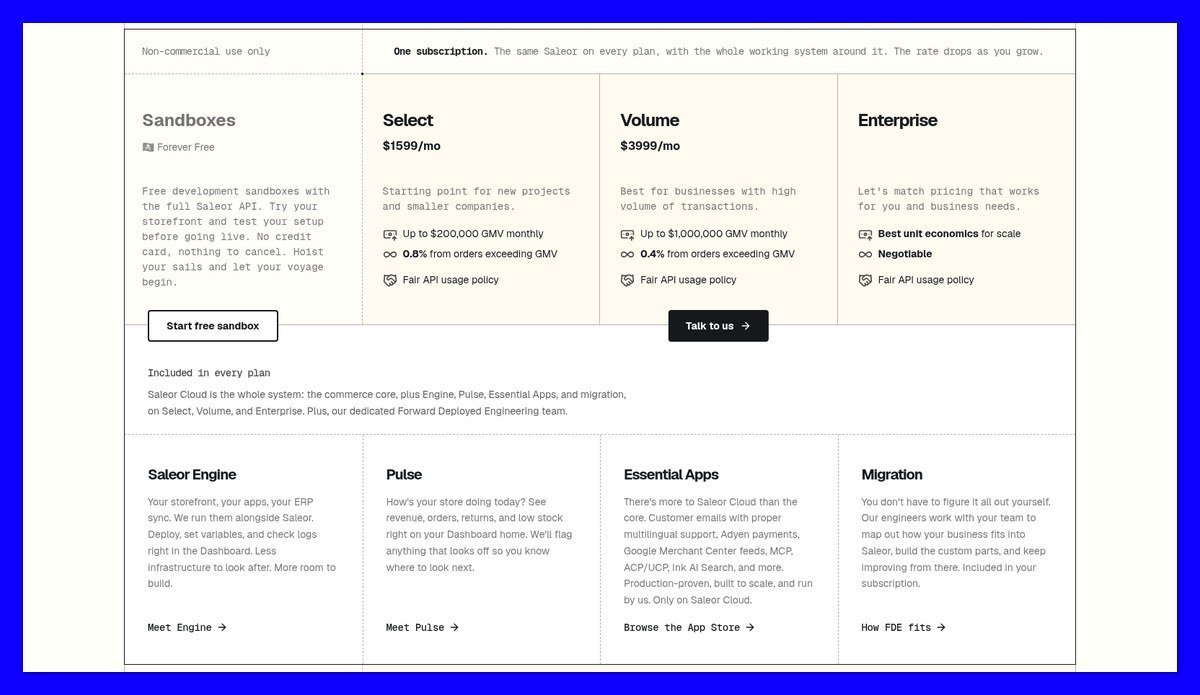
Lush runs 50+ sales channels, per Saleor. Saleor is the best pick for brands spanning many channels and countries, with an API organized around that complexity. Managed plans include migration support and engineering help. At $1,599/month, Cloud is difficult to justify for a small store.
Pros
- Channel-first architecture: Serve multiple markets and storefronts from one backend.
- Design-conscious customers: Saleor lists Breitling, Rough Trade and Colophon Foundry alongside Lush.
- Managed assistance: Cloud includes Essential Apps and migration support.
Cons
- Revenue overages: Select charges 0.8% above its monthly allowance.
- Separate customization: Custom logic runs in apps outside the core, adding deployment work.
- Heavier self-hosting: You maintain Python, Redis and a Celery worker.
How Headless Works on Saleor
Design control: Paper supplies the storefront foundation, but its FSL-1.1-ALv2 license differs from the core’s BSD-3 license. Agencies reusing it should read those terms first. The FSL converts to Apache 2.0 later.
How Much Does Saleor Cost?
| Plan | Price | Included GMV | Fee above |
|---|---|---|---|
| Self-hosted | $0 license | Unlimited | None |
| Select | $1,599/mo | $200,000/month | 0.8% |
| Volume | $3,999/mo | $1,000,000/month | 0.4% |
| Enterprise | Negotiable | Custom | Custom |
Free sandboxes are non-commercial only. Optional prepaid engineering packages are credited against subscriptions over 12 months.
Quick comparison: Choose Saleor when global channels and assisted onboarding justify the bill. Medusa starts at $29/month, or $99/month for Launch with custom domains.
7. commercetools: Best for Enterprise Brands
- Pricing: Unpublished; expect a five to six figure annual contract.
- Model: Order-based pricing, with unlimited catalogs, channels and storefronts.
- Storefront: A separate custom build.
- Overall rating: 3.8/5.
Why is Sephora’s platform seventh? commercetools is best for enterprise brands with a platform team, not small teams seeking a straightforward launch. A developer on Reddit comparing four backends reported the longest route to a working checkout.
Pros
- Enterprise customers: Sephora, Ulta Beauty and Bang & Olufsen provide established examples.
- Unlimited storefronts: Pricing follows orders rather than GMV.
- Modular adoption: Standalone cart, order management and catalog offerings launched in July 2026.
Cons
- Enterprise contracts: Budget beyond the storefront build itself.
- Upfront modeling: Developers define how commerce data works before assembling pages.
- Team requirements: Excessive complexity for a straightforward mid-size direct-to-consumer business.
How Headless Works on commercetools
Design control: Your team designs the storefront and data model separately. That suits unusual catalogs, but adds decisions Shopify handles for you.
What Does commercetools Cost?
| Price signal | Figure | Source type |
|---|---|---|
| List price | Not published | Vendor pricing page |
| Pricing model | Order-based; unlimited storefronts | Vendor pricing page |
| Entry estimate | $50,000/12 months, a floor, not a typical contract | AWS Marketplace listing |
| Median estimate | About $151,200/year | Buyer deal data, Vendr |
commercetools doesn’t publish pricing; expect a five to six figure annual contract. The storefront build is additional.
My recommendation: Shortlist this composable commerce platform only with a platform team and multi-month implementation budget. Otherwise, start with Shopify or BigCommerce. Our best composable commerce platforms guide covers the wider category.
8. Vendure: Best for Complex B2B
- Pricing: Free GPLv3 framework; B2B plans from $229/month on a 12-month term.
- Currency: Vendure shows prices in dollars or euros, excluding VAT.
- Hosting: Self-host; Cloud is closed beta, with general availability planned for Q1 2027.
- Overall rating: 3.7/5.
Need contract pricing rather than another theme? Vendure is the best option for complex B2B, with TypeScript foundations and specialized wholesale capabilities. It adopted GPLv3 with v3.0 in July 2024. A storefront using its API doesn’t become GPL; paid plans include a commercial license.
Pros
- No platform usage fees: No GMV, per-order or per-user charges.
- B2B depth: Company accounts, quotes and contract pricing are plan capabilities.
- Active development: The platform includes a new React dashboard.
Cons
- Engineering-first: Developers build the storefront against its GraphQL API.
- Smaller following: Roughly 8.6K GitHub stars, compared with Medusa’s 37.3K.
- Hosting limitation: Managed Cloud isn’t generally available yet.
How Headless Works on Vendure
- Design control: Your developer supplies the storefront, not a visual page-building workflow. A ready-made B2B storefront comes only with Scale.
- Live brands: Vendure reports IBM’s multi-tenant platform and Hemglass click and collect for 28 franchisees.
How Much Does Vendure Cost?
| Option | Price | Notes |
|---|---|---|
| Framework | Free | GPLv3 |
| Starter | $229/mo | Company accounts, quotes; 30-day trial |
| Growth | $689/mo | Branch and department accounts; 30-day trial |
| Scale | $2,899/mo | Approvals, contract pricing, B2B storefront; 30-day trial |
| Enterprise | From EUR 60,000/year | Custom contract |
Plan prices are per month on a 12-month term, excluding VAT. Vendure quotes Enterprise in euros.
The verdict: Choose Vendure for complex B2B rules and TypeScript expertise. Co-founder Michael Bromley recommends building one small extension in Vendure and Medusa before deciding. Our guide explains how to choose a B2B ecommerce platform.
How Do I Choose the Right Headless Ecommerce Platform?
Blackbelt Commerce describes a $6M apparel brand that spent $140,000 on a delayed Hydrogen build and still needed developers to change banners. Choose your headless ecommerce platform around everyday operations, not just launch-day design.
- Budget for maintenance: Shopify explicitly requires ongoing developer support. Include it alongside the initial build.
- Assign page-editing responsibility: BigCommerce offers Makeswift; elsewhere, consider Sanity or Storyblok. Include editing in your ecommerce tech stack before commissioning designs.
- Audit what you lose: Theme widgets and visual editing don’t automatically transfer. Commerce-UI distinguishes surviving backend integrations from storefront features needing rebuilding.
- Check whether speed is the problem: Shopify’s own September 2023 data showed 59.5% of Liquid stores passing all Core Web Vitals, versus 35% of Hydrogen storefronts. This historical comparison isn’t a current benchmark or evidence of automatic speed gains. Better ecommerce design principles may solve the issue more cheaply.
- Assign backend responsibility: SaaS handles it for you. Self-hosting requires infrastructure and patching; vendor clouds reduce that burden. Compare the best open source ecommerce platforms.
- Model growing fees: Include sales caps and revenue overages. Medusa’s 0% GMV fee differs from Swell’s ceiling-based charges.
What Does a Headless Store Really Cost?
| Cost item | Typical range | Basis |
|---|---|---|
| Platform | $0 license, $29/mo, up to five or six figures annually | Vendor prices; enterprise estimates |
| Storefront build | Hydrogen $20,000-$100,000; Plus DTC $80,000-$200,000 | Agency estimates, including Aureate Labs and Blackbelt Commerce |
| Timeline | Shopify 4-7 months; Shopware 3-6 months | Published implementation estimates |
| Maintenance | $2,000-$5,000/mo | Agency and app-vendor estimates |
| App re-integration | $2,000-$5,000 per app | Easysell estimate |
| Medusa self-hosting | Approximately $84-$106/mo | Independent production-cost guide |
These aren’t survey averages. Commerce-UI puts its initial headless builds around 20% above theme projects, with higher maintenance afterward. Scope requirements using our ecommerce website development guide before comparing quotes.
Can I Go Headless Later, or Switch Back?
You can go headless selectively, then replace the storefront again without necessarily changing backends.
- Go hybrid: Blackbelt Commerce recommends retaining theme pages while building a custom B2B portal or a configurator with 100+ variants where justified.
- Keep the backend: Retain Shopify’s products, orders and payments while rebuilding only the frontend, rather than migrating every system.
- Plan your exit: One Reddit commenter described eight-figure brands reversing headless projects within 18 months. That’s an anecdote, not a failure rate. Separately, a seven-figure brand reported moving from Saleor to headless Shopify because systems weren’t syncing.
- Customize without headless: You can turn a Figma design into a Shopify theme without maintaining a separate frontend.
I’d keep a theme until a specific requirement rules it out. Our best ecommerce platforms guide covers those options.
How We Research and Rank Headless Commerce Platforms
These are research-based ratings, not hands-on build scores. As of November 2026, we compared 12 headless ecommerce solutions using vendor pricing, docs, changelogs, license files, GitHub activity, customer stories, and developer and merchant feedback.
- Storefront build path, 25%: Starters, frameworks and documentation.
- Total cost, 20%: Plans, hosting, usage and implementation.
- Design and editing control, 20%: Designer freedom and marketer independence.
- What you keep or lose, 15%: Apps, checkout and integrations.
- Ecosystem and live brands, 10%: Agencies, communities and stores.
- Momentum and license, 10%: Releases and reuse restrictions.
Platforms That Missed the Cut
- Adobe Commerce: Unpublished prices. Folio3’s estimates start near $22,000/year for smaller on-premise licenses and reach $190,000+ on Cloud. Compare our best enterprise ecommerce platforms.
- Wix Headless: Free to connect; payments require a plan. Better for existing Wix teams; see our Wix Studio review.
- Crystallize: Free pay-as-you-go tier, then Atom at $949/month plus metering, substantially above Medusa’s entry price.
Final Verdict: Which Headless Platform Do I Recommend?
Shopify is the best headless commerce platform for most design-led brands. With ongoing developer support, start with Basic at $29/month billed yearly, Hydrogen and free Oxygen hosting.
- BigCommerce: Choose it for visual page editing.
- Medusa: Choose it for code ownership and no GMV fee.
- Shopware: Choose it for a European team familiar with its stack.
- Saleor, commercetools or Vendure: Match global channels, enterprise complexity or B2B requirements respectively.
Your build partner matters as much as your backend. Review the Shopify free trial terms, then Try Shopify with your developer.
FAQs
Is Shopify a headless ecommerce platform?
Yes, on every paid plan. Shopify includes its Storefront API, Hydrogen toolkit and free Oxygen hosting. Basic through Advanced allow one headless storefront; Plus allows 25. Your developer builds the customer-facing design, while checkout remains hosted by Shopify.
How much does a headless ecommerce site cost?
The build typically outweighs the subscription. Open source headless commerce can have a $0 license, while hosted plans start around $29/month. Agency build estimates span roughly $20,000-$200,000, plus maintenance. See “What Does a Headless Store Really Cost?” before budgeting.
Is headless commerce better for SEO and site speed?
Not by default. You control URLs and structured data, but implementation decides performance. Shopify’s own September 2023 data showed 35% of Hydrogen storefronts passing Core Web Vitals, versus 59.5% of Liquid stores. Those figures aren’t a benchmark for today’s toolkit.
Can my marketing team still edit pages on a headless store?
Yes, with the right editing tool. BigCommerce pairs Catalyst with Makeswift for visual editing. Other setups can use a CMS such as Sanity or Storyblok. Without an editing layer, page changes need developer support, so include that requirement in your brief.
What is the difference between headless and composable commerce?
Headless separates the storefront from its commerce backend. A composable commerce platform supports separately chosen services across the wider stack, rather than only replacing the frontend. MACH describes related architecture principles. Our guide to what composable commerce is explains the distinction.


