Everyday objects should be designed well and manufactured to last a long time. We believe good design means beautiful aesthetics and well-chosen materials for products that are built for functionality and durability. Most of our products are handmade, and we never sell cheaply made alternatives. A well-made object can be passed down, and shouldn’t have to be replaced, so there’s one less thing in the landfills.
At tonlé, we see fashion differently – from the way it’s made to the way it’s worn. We see it as encouraging the unique in everyone who touches our clothing, from maker to wearer.
Titania Inglis is an independent womenswear label selling dresses, tops, bottoms, outerwear, swim, bridal, leather bags and jewellery, cut and sewn in New York and now shipped from Los Angeles. Pieces run from $160 for a choker to $995 for a bias dress, with sale items shown against their original price. The store is built on Squarespace, with the in-stock shop serving as the landing page.
Website Design
White ground, black type, no chrome. The stylesheet runs on white with black and near-black text, three greys for secondary copy and a hairline rule for dividers. There is no accent colour anywhere in the interface, so garment photography supplies the only contrast.
One sans throughout. Proxima Nova carries headings, body copy, product names and prices, with Helvetica Neue and Arial as fallbacks. No display or serif face appears, and size and weight do all the hierarchy work.
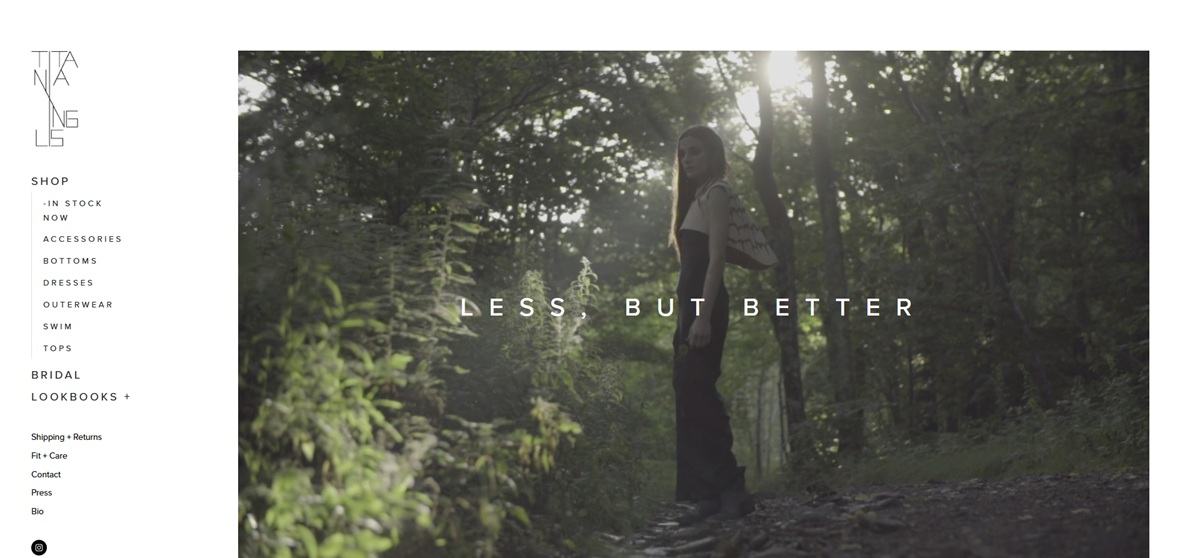
The shop is the homepage. A single line, LESS, BUT BETTER, sits above four entry points, SHOP DARK, SHOP SOFT, SHOP LIGHT and SHOP STRUCTURED, and the In Stock Now grid begins immediately beneath.
Shopping Experience
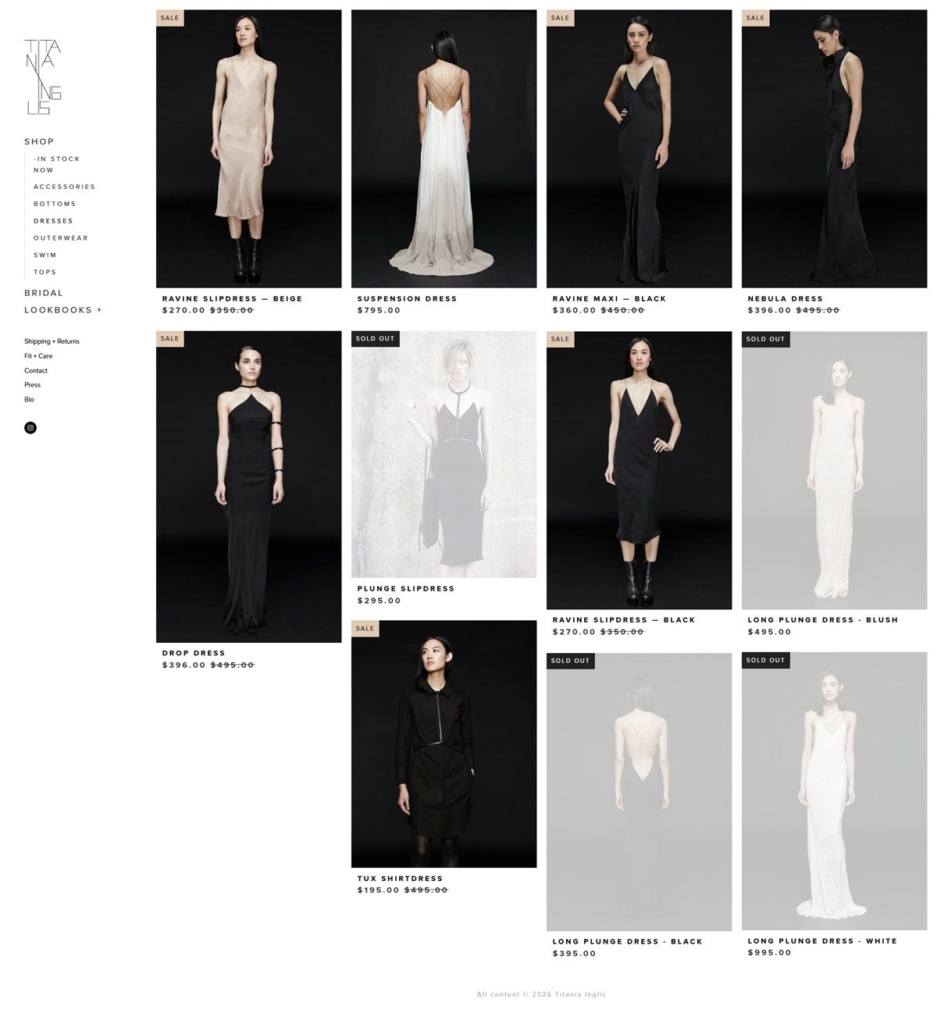
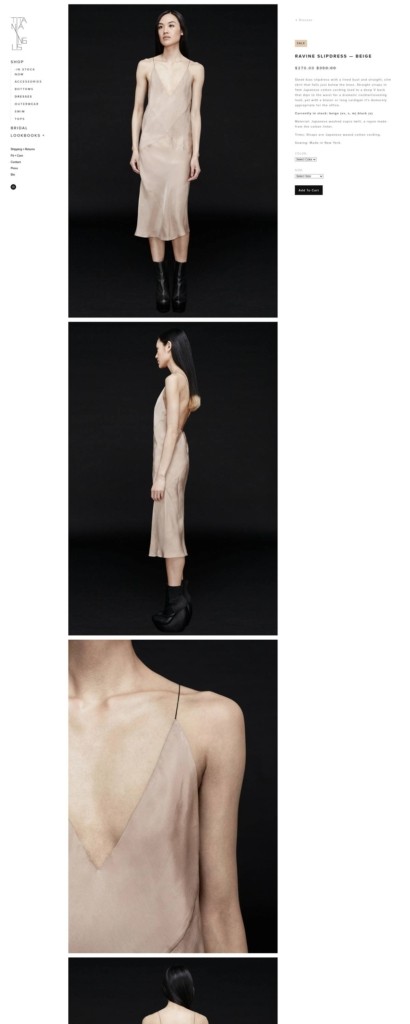
Full product copy on the index. Every item in the landing grid carries its complete description, fabric, dye, hardware and assembly notes, plus colour and size selectors and an Add to cart button. The listing page and the product page are the same surface.
Stock state printed inside the size menu. Options read XS – In stock now or M – Out of stock rather than greying out, and several items state a lead time in the body copy, such as a two week turnaround while a new round of ceramic pendants is made.
Sale prices shown as a pair. Discounted items print Sale Price above Original Price, so a dress at $396.00 sits directly under its $495.00 original, and separates carry the same treatment.
Made to order handled as a mode, not an exception. Items not marked in stock ship two to four weeks out, mixed orders ship together unless the buyer asks otherwise, and the shipping page invites buyers to note an event date at checkout.
Brand Storytelling
A philosophy page rather than an about page. The Bio page opens on the phrase “Less, but better” and describes the line as lush minimalism, garments engineered to be visually striking yet easy to wear.
Sourcing named item by item. Descriptions list Japanese washed cupro twill, Italian vegetable-tanned lambskin, dead stock cotton twill, aniline dyes applied in Italy and rivets made in Connecticut, with assembly credited to New York.
Styling notes as internal links. Copy names the models by first name and links out to the other garments worn with the piece, so the grid cross-references itself.
Notable Features
A lookbook archive in the navigation. Six seasons are kept as standing menu items alongside a Videos section.
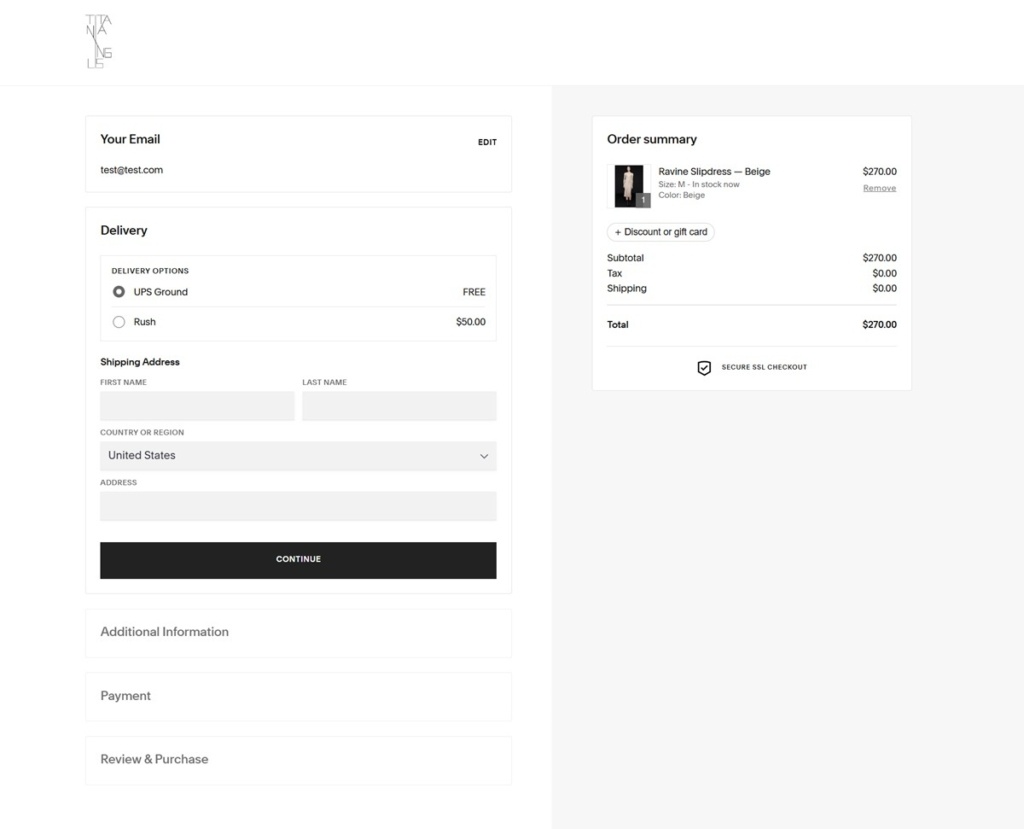
Shipping on a stated schedule. Orders go out Mondays and Thursdays, US ground shipping is free, a Rush option upgrades to two-day, and international orders ship at a flat $50.
Alterations offered before returns. Fit problems are routed to an email exchange about alteration or a size swap, and discounted items are final sale.
SVILU is a collection of mindfully made™, effortless staples for women. Responsibly sourced and ethically produced pieces set a woman apart without speaking louder than she does.
Our philosophy is simple. To design and deliver beautiful, high-quality apparel made with sustainable manufacturing practices directly to you at an affordable price point.
After many years living and style watching in San Francisco, and seeing the flip-flop and sneaker epidemic reach critical proportions, we arrived at the idea of Rothy’s.
Reformation’s design mission is to make effortless silhouettes that celebrate the feminine figure. The design process starts with us thinking about what we really want to wear right now. We source the most beautiful and sustainable fabrics possible to bring those designs to life quickly.
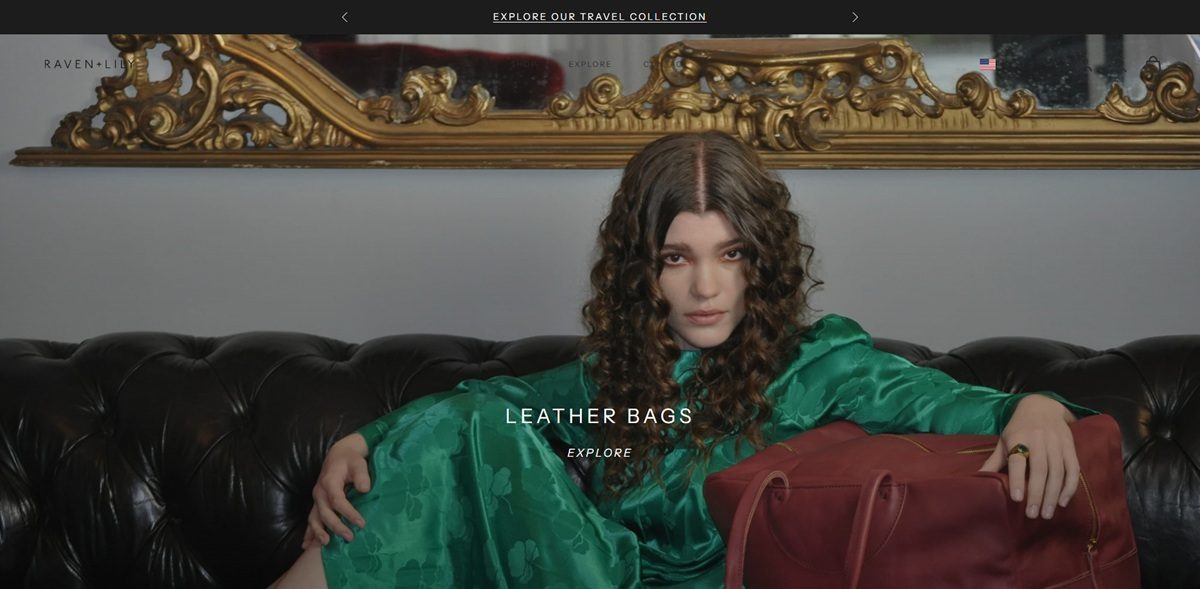
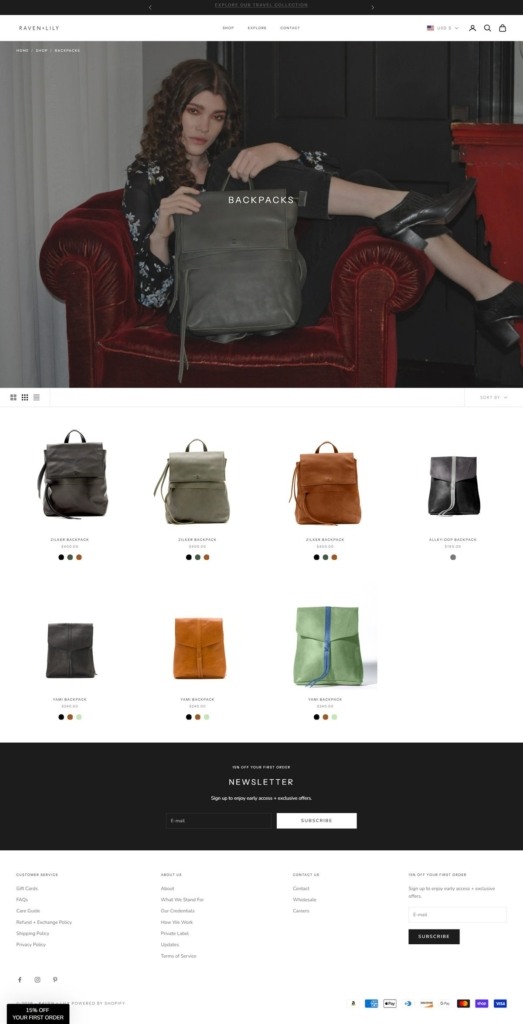
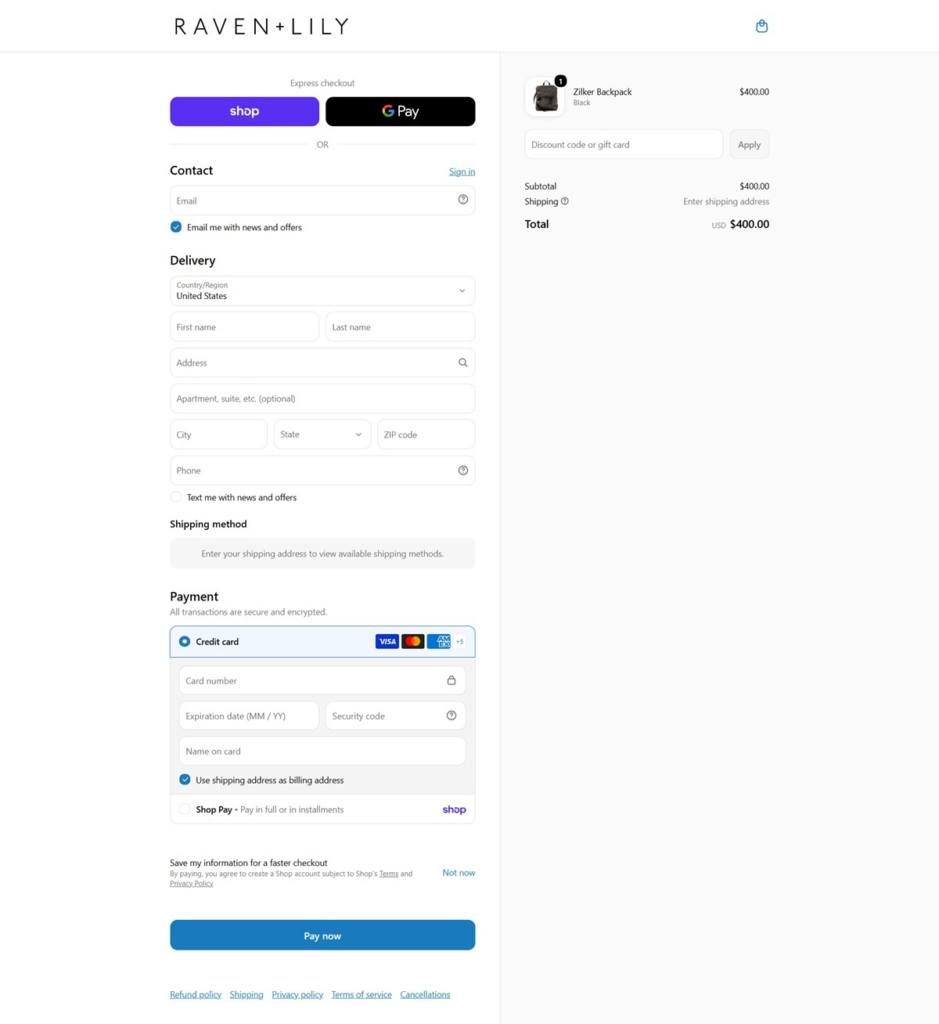
Raven + Lily is an Austin, Texas accessories brand selling leather bags and a small jewellery range: backpacks, totes, crossbodies, travel bags, small leather goods, rings, earrings and bag charms. The about page states the credentials directly, a Certified B Corporation and member of the Fair Trade Federation, 100% women-led, with designs led from Austin and made by women artisans sourcing regional materials. Bags run from $140 to $615. Built on Shopify.
Website Design
Instrument Sans over Nunito. Headings take Instrument Sans at a single regular weight, body copy runs in Nunito, and both sit at rgb(28,28,28) on white. There is no display serif and no second accent colour, so the leather photography supplies all the warmth.
Hairline rules and generous air. Borders are light greys and section breaks are thin lines rather than filled bands. Headings overlaid on imagery flip to white, the only inversion in the system.
A homepage of paired carousels. Rather than a single hero, the page stacks slider sections of two slides each: leather bags and a men’s shelf, two Austin City Limits slides, then a who-we-are panel and an as-seen-in strip. Each slide carries one line of copy and one link.
Shopping Experience
Colour names as merchandising. Variants are listed as words under each card rather than as swatch dots, and the names carry the brand voice: Cuoio, Climbing Ivy, Rhubarb, Nebulous Blue, Dijon, Cactus Flower, Wisteria, Menta, Inca Gold, Deep Sea and Grenadine Patchwork.
Choose options on the card. Multi-colour products open a variant picker from the grid, while single-variant items add straight to cart, so the grid handles most of the decision before a product page is opened.
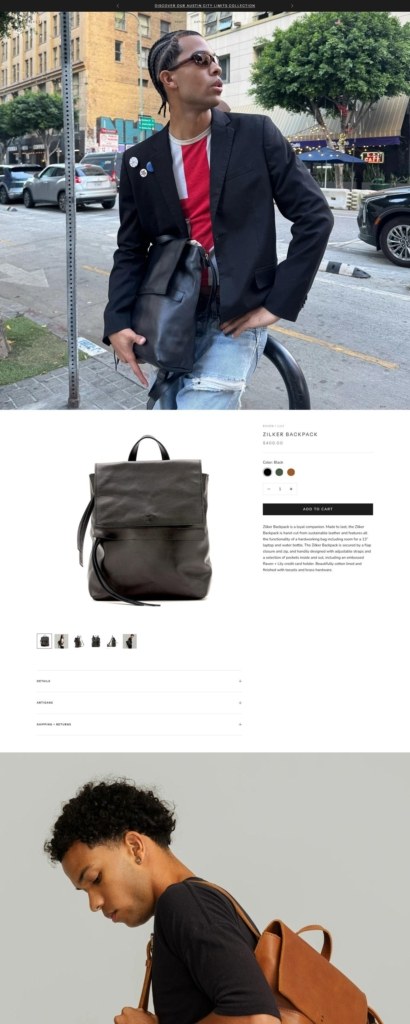
A short, legible catalogue. All Bags holds a few dozen styles grouped by family, with names drawn from Austin landmarks: Zilker backpacks and weekenders, Barton carryalls and hobos, Lady Bird totes and crossbodies, Bonnell travel bags and dopp kits.
Prices shown as sale price only. Every card labels its figure as a sale price with no compare-at value beside it, which flattens the grid but removes any discount signalling.
Brand Storytelling
Provenance offered as a promise. The about page states that for every style produced the company can tell you its origin story, then walks from Austin design team to artisan makers to finished piece.
Longevity over trend. The same page argues the range favours longevity over fleeting trends and that each piece has a purpose and lasting appeal.
Credentials given their own pages. A B Corp block sits in the footer alongside What We Stand For, Our Credentials, How We Work and a metrics page, so the claims are separated from the marketing copy.
Notable Features
A festival capsule. The Austin City Limits collection has its own nav entry and homepage slides, covering a sling bag, belt bag, pouch and mini pouch, some in patchwork colourways not used elsewhere.
Private label and wholesale. Both have footer pages, positioning the company as a manufacturer as well as a retailer.
A care guide and an updates archive. Leather care instructions and a dated archive of company notes sit in the footer, preserving older announcements rather than deleting them.
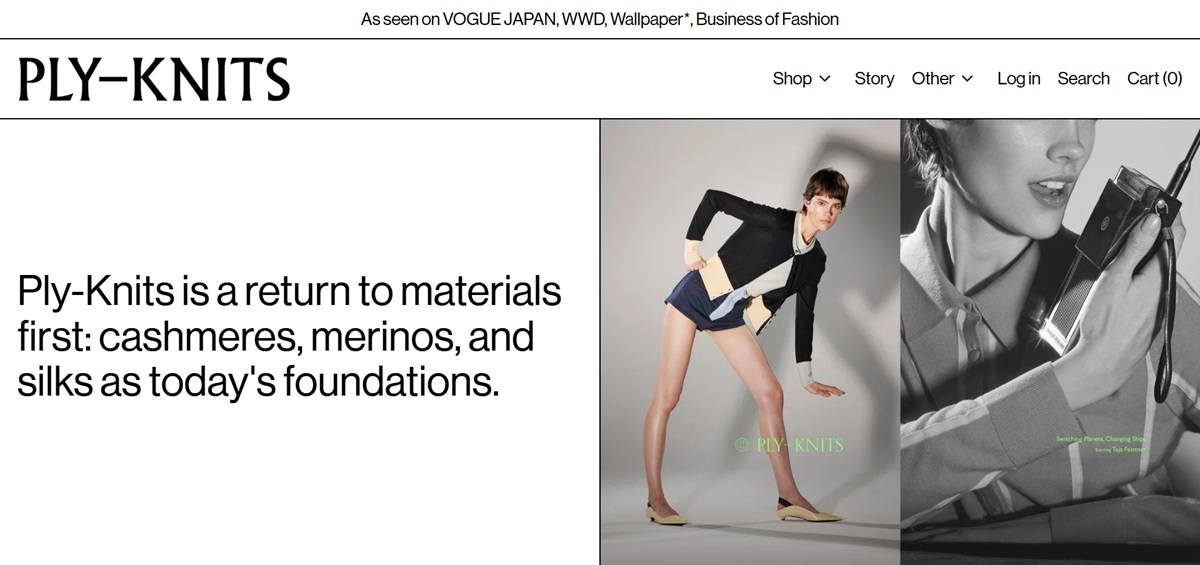
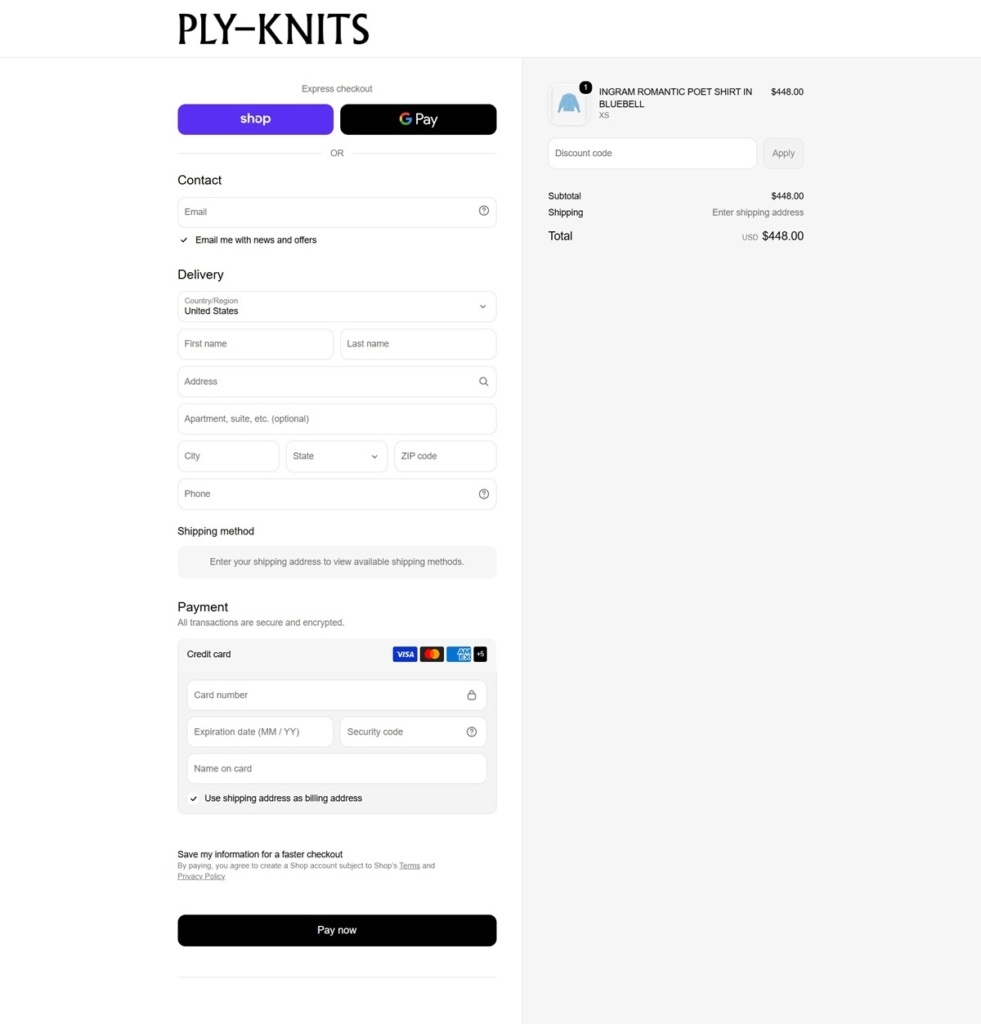
Ply-Knits sells premium knitwear, cardigans, shirts and polos, tees and tanks, leggings, pullovers and bralettes, positioned under the line Ply-Knits is a return to materials first: cashmeres, merinos, and silks as today’s foundations. The brand is based between New York City and Hong Kong and has drawn press coverage from Vogue Japan, WWD, Wallpaper and Business of Fashion. Prices run from about 298 to 528 dollars. Built on Shopify.
Website Design
Pure black on white. The interface runs on a black rgb(0,0,0) text and accent color against a plain white background, with no secondary neutral in between; a red rgb(235,50,35) is reserved for sale pricing and meta labels.
A single sans throughout. Both headings and body copy are set in Instrument Sans, giving the site one consistent typographic voice rather than a paired display and text face.
No hero image, text-first opening. The homepage leads with the materials-first tagline as text rather than a photographic banner, moving quickly into a New In grid of four items followed by a Best-Sellers grid of four more.
Shopping Experience
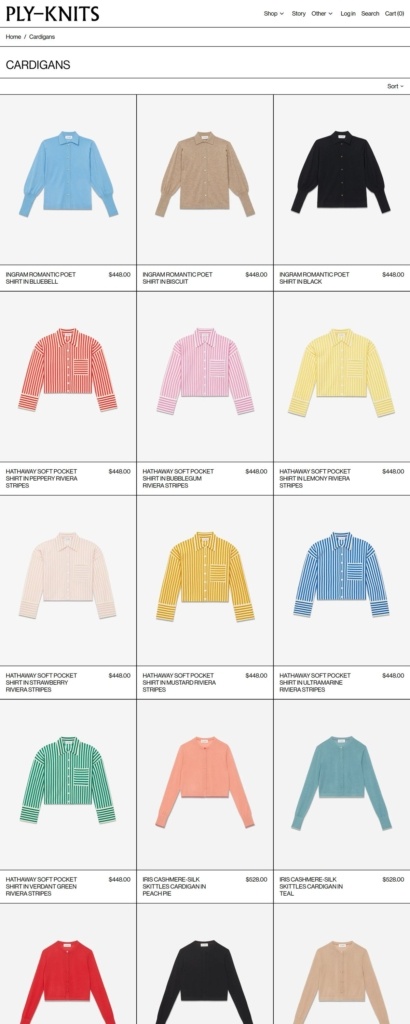
Prices and stock status on the grid. Product cards show price directly, 298.00 to 528.00 dollars, with sale items marked against their original price, for example the Gino Resort-Sort-Of Shirt at 298.00 dollars down from 318.00, and stock labels such as Sold Out where relevant.
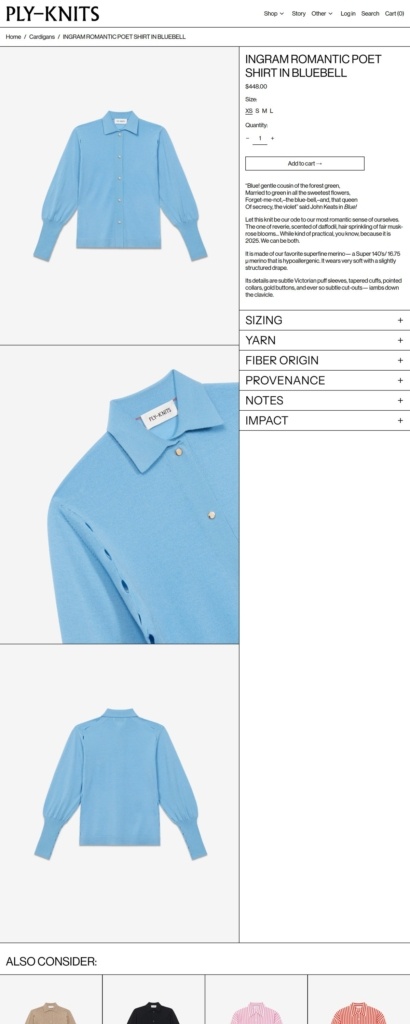
Named, not just numbered, pieces. Products carry individual names, Giselle Relaxing Shirt, Ingram Romantic Poet Shirt, Hathaway Soft Pocket Shirt, rather than generic style numbers, alongside broader category names like Galen and Garcon.
A stated sale tier. A Sale section runs discounts described as 40 to 70 percent off, separate from the regular New In and Best-Sellers browsing paths, and is called out in the main navigation rather than buried in a banner.
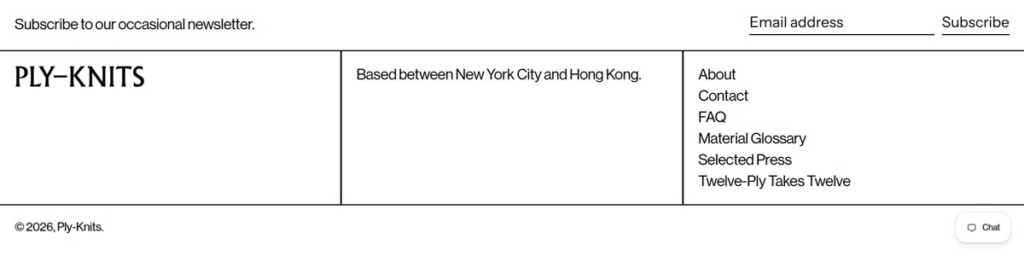
Material Glossary link. The footer links out to a Material Glossary page, indexing the fiber terms, cashmere, merino, silk, used across the product descriptions.
Brand Storytelling
Materials as the entire pitch. The homepage’s core line frames cashmere, merino and silk as todays foundations, making fiber choice rather than silhouette or history the stated reason to buy, ahead of any claim about cut, fit or design lineage.
Portraits as a separate editorial thread. A numbered Portraits series, currently up to Portraits V, runs in the footer navigation as linked content pieces distinct from the shop, functioning as a storytelling supplement to the product catalogue.
Notable Features
Twelve-Ply Takes Twelve. A footer link by this name sits alongside standard About, Contact and FAQ pages, though its content is not summarized in the catalogue itself.
Understated newsletter framing. Email signup is described as an occasional newsletter rather than a discount-driven prompt.
Two-city sourcing note. The footer states the company operates based between New York City and Hong Kong, tying the design and production story to two named locations rather than a single headquarters.
People Tree works closely with local, national and international media interested in fashion, Fair Trade, sustainability and social business. For all information, images or inquiry please contact the People Tree Press Office.
Join our community for the latest trends and ecommerce tips.