
 By Bogdan Rancea
Best overall

Shopify
See pricing Visit Shopify →From $29/month billed yearly
Agentic plan: $0/month + card fees
- Sidekick runs multi-step admin tasks
- Sells in ChatGPT, Gemini and Copilot
- No separate AI fee
Best for small stores

Wix
See pricing Visit Wix →From $29/month billed yearly
AI agents run on credits
- Aria, Juno and Kleo AI agents
- Site MCP and llms.txt on every site
- Agent selling rolling out
Best for multichannel

BigCommerce
See pricing Visit BigCommerce →From $29/month billed yearly
$39 billed monthly
- Storefront MCP on every store
- PayPal Store Sync for AI channels
- Feedonomics catalog feeds
Shopify ranks first among the best agentic AI platforms for ecommerce: Sidekick runs multi-step admin tasks, while Agentic Storefronts connects eligible stores to AI shopping channels by default. As of November 2026, we compared 11 platforms on those two capabilities, with Shopify Basic starting at $29/month billed yearly.
This list ranks store platforms, not standalone agents; our best ecommerce platforms for LLMs guide covers AI visibility separately. Wix suits small stores wanting operational agents, while BigCommerce leads for open agent access and catalog feeds. I’ll show you what each platform can do today, which channels are live versus announced, and what you’ll pay.
Key Takeaways
- Shopify: 4.8/5. Sidekick and default-on AI channels lead; Basic costs $29/month billed yearly, or use the $0 Agentic plan.
- Wix: 4.5/5. Aria, Juno and Kleo handle operations, support and marketing. Core costs $29/month billed yearly.
- BigCommerce: 4.4/5. Every store can enable Storefront MCP. Core starts at $29/month billed yearly.
- Enterprise means quote-only. Salesforce has 3 generally available agents; commercetools has generally available AI Hub with Gemini checkout.
- ChatGPT changed in March 2026. Shoppers now use your store’s checkout. Copilot checkout is US-only; Shopify’s Google rollout covers 3 countries.
- AI orders remain small but growing. Shopify reports AI-referred orders increased 3.3x year over year in Q3 2026.
Agentic Commerce Platforms Compared
Among these agentic commerce platforms, only Shopify combines a live merchant agent with default-on AI shopping channels for eligible stores. Checkout availability varies. Statuses are as of November 2026.
| Platform | Rating | Best for | Starting price | Built-in merchant agent | AI shopping channels | AI cost model |
|---|---|---|---|---|---|---|
| Shopify | 4.8 | Overall | $29/month billed yearly; $39 monthly; Agentic $0 | Sidekick: live | ChatGPT: store checkout; Google: rolling out; Copilot: US checkout; Meta: channel | No separate AI fee |
| Wix | 4.5 | Small stores | $29/month billed yearly | Aria, Juno, Kleo: live | Stripe: rolling out to eligible merchants; Perplexity through PayPal | Credits; agents pause at zero |
| BigCommerce | 4.4 | Multichannel | $29/month billed yearly; $39 monthly | Companion: beta | PayPal Store Sync: live; Storefront MCP: Early Access setting | Not mapped by plan |
| Salesforce Commerce Cloud | 4.2 | Enterprise retail | Quote-only | Merchant, Shopper, Buyer: generally available | ChatGPT catalog: generally available; Google: announced | Flex Credits: $0.10 per standard action |
| commercetools | 4.0 | Composable stores | Quote-only | None for non-technical staff | AI Hub: generally available; Gemini checkout, ChatGPT sync, Stripe | AI Hub add-on: quote-only |
| WooCommerce | 3.9 | WordPress | $0 core; $25-$350/month hosting | Bring your own | Stripe Link checkout: live; Stripe suite: announced | Pay for your own assistant |
| Shopware | 3.7 | European brands | Free Community Edition; Rise from EUR 600/month | Copilot: live | Agentic Commerce channel: experimental | Not priced separately |
| Adobe Commerce | 3.5 | Magento stores | Quote-only | Developer Agent: coming soon | Google and OpenAI protocols: announced | Quote-only |
| VTEX | 3.4 | Enterprise B2B | Quote-only | AI Workspace: announced | Google AI Mode and Gemini, US: announced | Quote-only |
MCP is a standard way for AI assistants to read and act on your store data. See “How Do I Choose an Agentic AI Ecommerce Platform?” below for regional details.
1. Shopify: Best Agentic AI Platform Overall
Pricing: Basic from $29/month billed yearly; Agentic plan $0/month.
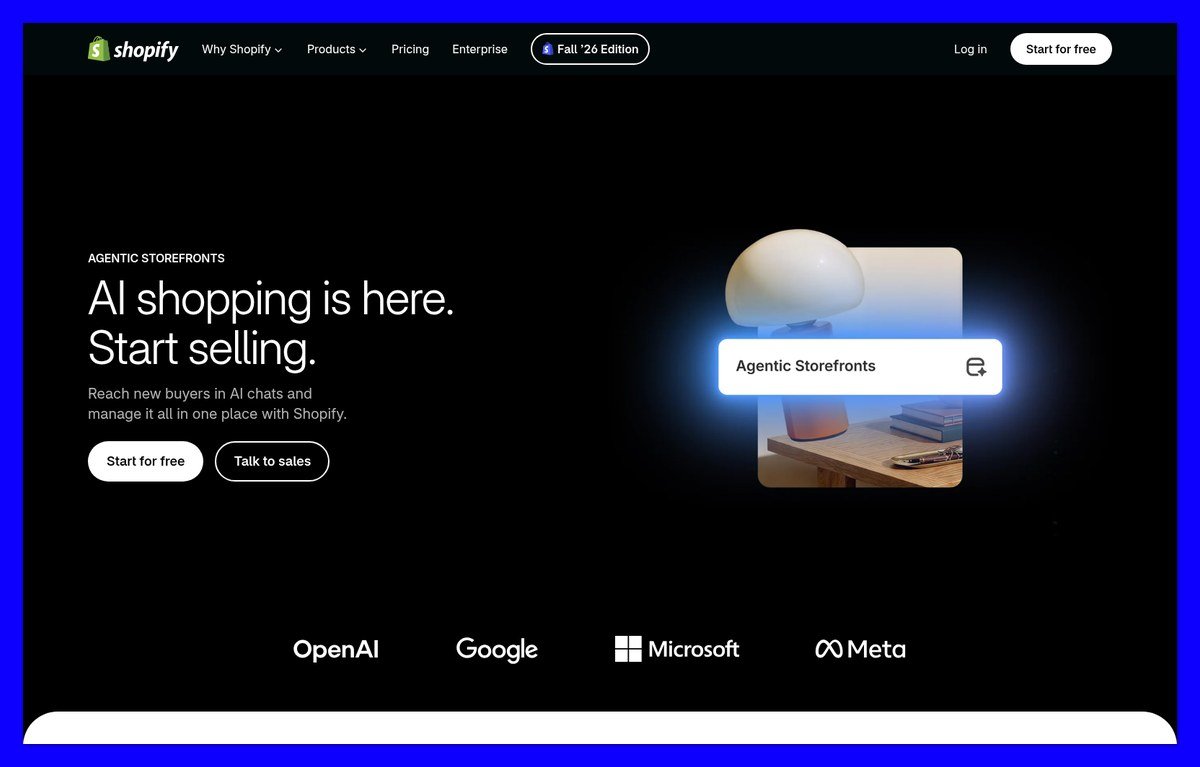
- Agentic AI: Sidekick and Agentic Storefronts are live, with channels enabled by default for eligible stores.
- Overall Rating: 4.8/5.
- Who it’s for: Stores wanting admin help and AI sales channels without a developer project.
- Full assessment: Read our Shopify review.
Key Agentic Features:
- Sidekick: Plans background tasks, builds Flow automations and analyzes data, presenting changes for approval. Learn to build a Shopify store with AI.
- Fall ’26 updates: Sidekick supports batch approvals, collection-wide descriptions and draft-order editing. Theme markdown files teach it your storefront’s structure.
- Shopify agentic storefronts: Connects eligible products to ChatGPT, Google AI Mode and Gemini, Copilot and Meta. Orders retain channel attribution.
- Direct checkout: Google is rolling out to US, Canada and Australia shoppers, requiring Merchant Center, Google’s product feed account. Copilot is US-only. ChatGPT sends shoppers to your checkout.
- Shop Pay: Personal AI agents can use it as a wallet for brands on or off Shopify; Shopify reports 400M+ accounts.
Pros:
- Both halves live: You get merchant automation alongside default-on AI shopping channels.
- No separate AI fee: Sidekick and Agentic Storefronts have no add-on price.
- Reported adoption: Shopify says Sidekick built two-thirds of Flow automations in Q3; daily sessions grew 4.2x year over year.
- No migration required: The $0 Agentic plan supports stores hosted elsewhere.
Cons:
- Mistakes and slowdowns: Shopify Community threads report hallucinated technical advice and long conversations locking up.
- Checkout limitations: Bundles and subscription-only products aren’t supported; custom pixels and checkout blocks, including upsells and trust badges, disappear.
- Regional restrictions: Copilot is US-only; Google checkout remains a gradual rollout.
- Plan limits on app generation: Sidekick’s custom app generation may need Grow or higher, so confirm it in your admin before choosing a plan.
Pricing Plans:
- Basic: $29/month billed yearly ($39 billed monthly).
- Grow: $105/month billed monthly.
- Advanced: $399/month billed monthly.
- Shopify Plus: From $2,300/month.
- Agentic plan: $0/month, card rates from 2.9% + 30 cents online.
New stores get 3 days free, then $1/month for 3 months. See our Shopify pricing guide.
Our Take: Shopify’s Q3 2026 earnings call reported AI-referred orders growing 3.3x, versus 2.6x for traffic, with AI shoppers converting 64% more often. I rank it first because both sides work without a developer project. Best for most stores. Skip it if subscription-only products or bundles must work through agent checkout.
2. Wix: Best for Small Stores
Pricing: $29-$159/month billed yearly for plans that take payments.
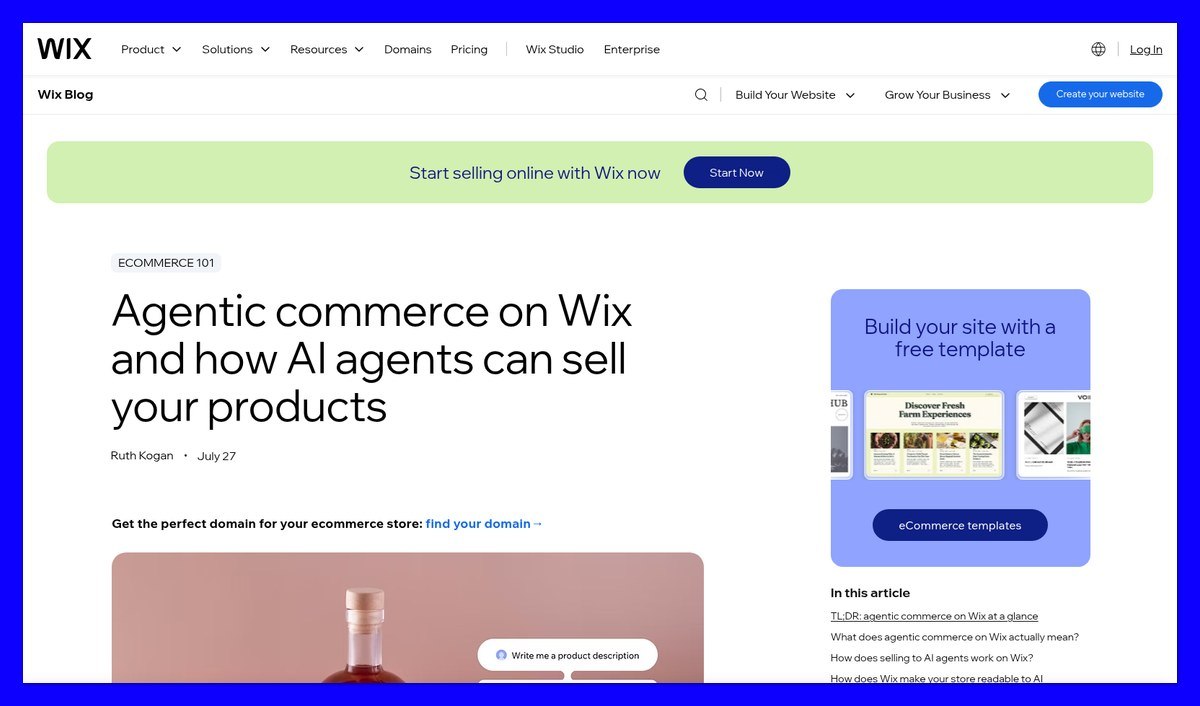
- Agentic AI: Aria, Juno and Kleo are live; agent selling through Stripe is rolling out to eligible merchants.
- Overall Rating: 4.5/5.
- Who it’s for: Solo founders and designers wanting operational help.
- Designers: Read our Wix Studio review.
Key Agentic Features:
- Aria: Edits pages and runs store tasks. Wix’s examples include applying a 20% discount to summer items and pulling last week’s sales report.
- Symphony: Juno handles support; Kleo handles SEO and social marketing. Smart Chat answers storefront shoppers.
- Automatic readiness: Sites receive structured product data, Site MCP and llms.txt. Eligible sites get NLWeb for plain-language product queries.
- Agent selling: Wix signed ACP, OpenAI and Stripe’s checkout protocol. Stripe integration is rolling out to eligible merchants; PayPal connects catalogs to Perplexity.
- AI Visibility Overview: Shows how often ChatGPT, Gemini, Perplexity and Claude cite your site.
Pros:
- Action-taking agents: Aria changes your store rather than merely suggesting changes.
- Automatic setup: Structured data and agent-access files require no manual configuration.
- Design plus operations: One agent edits pages and handles store work.
Cons:
- Restricted rollout: Wix hasn’t announced direct Google or Copilot checkout, or a live-for-all Stripe date.
- Credit limits: Background tasks pause at zero credits; Wix can change credit costs.
- Pricing variation: Published prices use yearly billing, vary by location and often show a temporary sale price.
Pricing Plans:
- Light: $17/month billed yearly, but it can’t accept payments.
- Core: $29/month billed yearly, the first plan that takes payments.
- Business: $39/month billed yearly.
- Business Elite: $159/month billed yearly.
- AI agents: Credit-based, with a free allowance.
Our Take: Wix’s Rebecca Tomasis calls agentic AI “the difference between having a website and having a digital business partner.” I think its operational agents make that proposition appealing for solo stores. Quick comparison: Wix combines site editing with admin help; Shopify reaches more AI shopping channels today. Our Shopify vs Wix comparison covers the broader choice.
3. BigCommerce: Best for Multichannel Selling
Pricing: $29-$299/month billed yearly; Performance from $1,499/month.
- Agentic AI: Storefront MCP for every store through an Early Access setting; Companion is beta.
- Overall Rating: 4.4/5.
- Who it’s for: Multichannel brands needing open catalog access.
Key Agentic Features:
- Storefront MCP: Live for every store. Enable Settings > Early Access so assistants can find products and build carts.
- PayPal Store Sync: Live catalog synchronization connects products to PayPal’s shopping services.
- Feedonomics Agentic Catalog Exports: Announced April 2026, these format product feeds for AI channels.
- Agentic Checkout Kit: Announced April 2026 for other platforms; PacSun on Salesforce is the example.
- Protocol partnerships: BigCommerce partners with Google UCP and Stripe’s suite. UCP is Google’s protocol that lets its AI checkout run on your store.
Pros:
- Open access: Storefront MCP isn’t restricted to one plan.
- Feed expertise: Feedonomics handles catalog feeds within the same company.
- Embedded providers: BigCommerce adds no payment-provider fee for embedded partners.
Cons:
- Immature merchant agents: Companion is beta; Purchase Order Agent is early alpha.
- Unclear packaging: The pricing page doesn’t map AI features to plans.
- Sales caps: Plans automatically upgrade above $30K Core and $100K Growth trailing annual sales.
- Outside gateways: Open Payment Provider fees are 2.0% Core, 1.0% Growth and 0.6% Scale.
Pricing Plans:
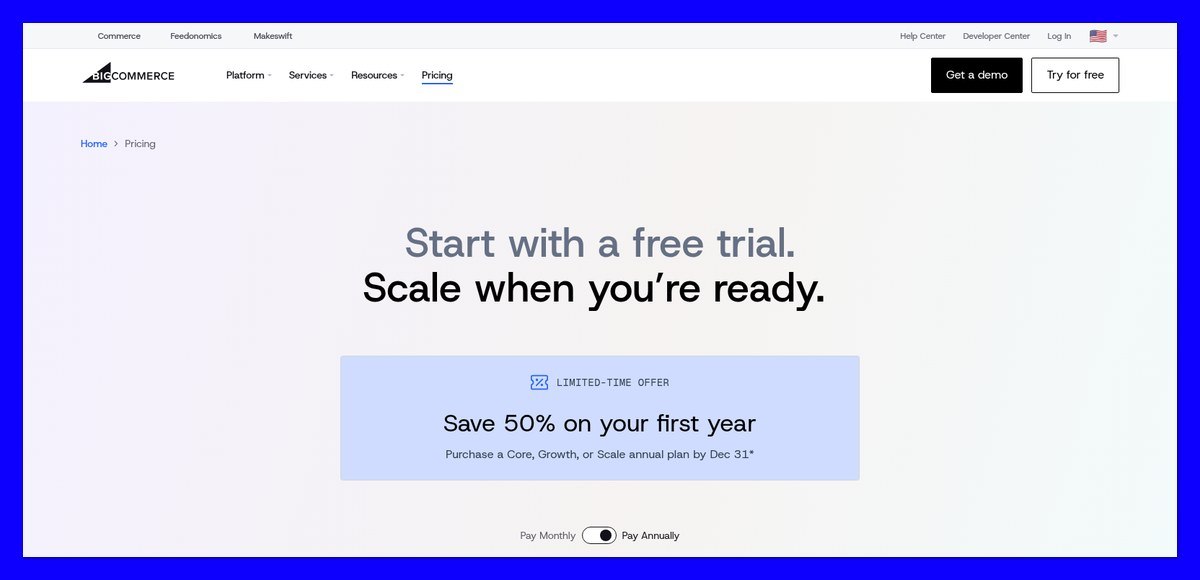
- Core: $29/month billed yearly ($39 monthly).
- Growth: $79/month billed yearly ($105 monthly).
- Scale: $299/month billed yearly ($399 monthly).
- Performance: From $1,499/month.
Card processing starts at 2.89% + $0.29 through BigCommerce’s payments. See our BigCommerce pricing breakdown.
Our Take: BigCommerce warns that stale prices and missing variants can send agents to competitors. Its feed-plus-MCP approach suits hand-off checkout, which it says remains more common than in-chat purchasing. My recommendation: Start on Core if you fit its sales cap, then enable MCP. Compare the broader trade-offs in Shopify vs BigCommerce.
4. Salesforce Commerce Cloud: Best for Enterprise Retailers
Pricing: Quote-only; standard Agentforce actions $0.10 each.
- Agentic AI: Merchant, Shopper and Buyer Agents generally available since the July 2026 release.
- Overall Rating: 4.2/5.
- Who it’s for: Enterprise retailers already using Salesforce.

Key Agentic Features:
- Merchant Agent: Organizes catalogs and merchandising rules. Salesforce says early customers reduced time to task by 88%.
- Shopper Agent: Handles storefront discovery through checkout and service, including inventory and delivery questions.
- Buyer Agent: Supports B2B ordering through WhatsApp and SMS.
- ChatGPT channel: Generally available catalog integration from Business Manager. You remain merchant of record, meaning you stay the seller. Google integration is announced.
- Agentic Commerce Search: Comes from the Cimulate acquisition and also works on non-Salesforce sites.
Pros:
- Mature agent coverage: Three generally available agents cover merchants, shoppers and B2B buyers.
- ChatGPT connection: You connect your catalog directly from Business Manager.
- Vendor-reported results: Salesforce says retailers with shopper agents grew sales 59% faster during the 2025 holidays.
Cons:
- Forecasting difficulty: Budget for metered actions and request credit-use forecasts before committing.
- Google pending: Salesforce hasn’t confirmed a launch date; ask your account team.
- Enterprise implementation: GMV-based pricing and substantial setup suit larger teams.
Pricing Plans:
- Commerce Cloud: Salesforce doesn’t publish pricing; you get a quote.
- Flex Credits: $500 per 100,000 credits; $0.10 per standard action, $0.15 per voice action.
- Conversation option: $2 per conversation, a model Salesforce moved away from after pushback.
Our Take: Salesforce’s Nitin Mangtani says “commerce itself will happen predominantly on owned and operated properties.” Its Shopper Agent follows that logic. Quick comparison: Salesforce goes deeper into storefront conversations; Shopify Plus starts at $2,300/month with default-on channels. Consider whether Shopify is ready for enterprise alongside our best enterprise ecommerce platforms.
5. commercetools: Best for Composable Commerce
Pricing: Quote-only, including the AI Hub add-on.
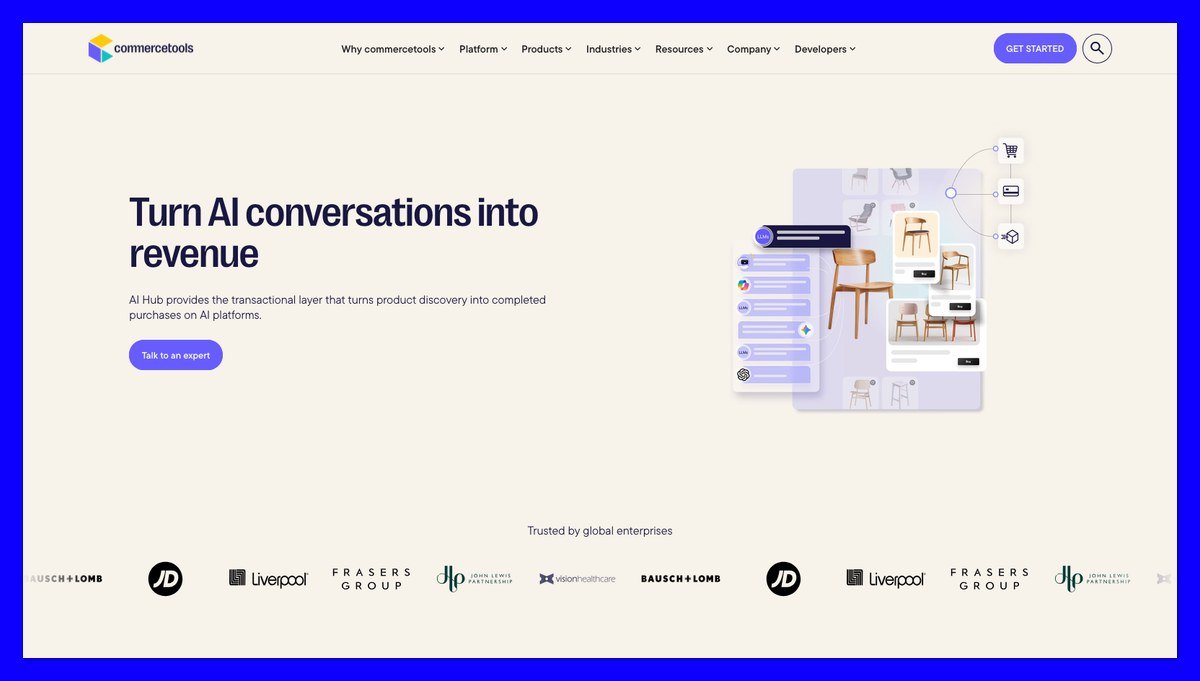
- Agentic AI: AI Hub generally available since July 30, 2026.
- Overall Rating: 4.0/5.
- Who it’s for: Developer-led enterprises using a composable, or mix-and-match, commerce stack.
Key Agentic Features:
- AI Hub: Connects individual stores to supported AI channels through its Agentic Channels add-on.
- Google Gemini: Synchronizes products and supports UCP checkout with carts.
- ChatGPT and Stripe: ChatGPT gets product synchronization; Stripe’s suite adds order import.
- Commerce MCP: Exposes catalog and transaction capabilities while retaining existing pricing, tax, promotion and inventory rules. You remain the seller.
Pros:
- Live Google checkout: Shoppers can use cart-supported checkout through Gemini.
- Consistent business rules: Your existing commerce rules still apply to agent orders.
- Named adopter: JD Sports announced adoption of Agentic Jumpstart with Stripe’s suite.
Cons:
- No staff agent: Nothing equivalent to Sidekick or Aria serves non-technical users.
- Developer-heavy setup: Your developers must connect channels to your commerce stack.
- ChatGPT product sync only: ChatGPT shoppers complete checkout on your own site.
Pricing Plans:
- Platform: commercetools doesn’t publish pricing; you get a quote.
- AI Hub: commercetools doesn’t publish pricing; you get a quote. Enable this add-on through your Customer Success Manager.
Our Take: Why does a platform with live Gemini cart checkout rank fifth? It lacks the merchant-side assistant that helps non-technical staff run a store. The verdict: Choose commercetools when AI channels must connect to a stack your developers already manage. Compare its architecture in our best composable commerce platforms guide.
6. WooCommerce: Best for WordPress Stores
Pricing: Free core; WooCommerce puts typical hosting at $25-$350/month.
- Agentic AI: Bring your own assistant through MCP; Stripe Link agent checkout is live.
- Overall Rating: 3.9/5.
- Who it’s for: WordPress stores wanting control over their AI provider.
Key Agentic Features:
- Stripe Link checkout: Agents paying with Link can buy from stores using WooPayments or Stripe for WooCommerce, with no setup.
- MCP Adapter: Assistants can create, read, update and delete products and orders. Requires WooCommerce 10.9+ and WordPress 6.9’s Abilities API.
- Google visibility: A Merchant Center synchronization extension supplies product data to Google.
- Stripe suite: Announced, with native checkout inside agents described as “next.”
Pros:
- No platform fee: WooCommerce charges neither a platform fee nor revenue share.
- Assistant choice: You aren’t locked to one platform’s AI vendor.
- Existing checkout support: Link-paying agents can transact through supported payment integrations today.
Cons:
- No built-in merchant agent: You supply and pay for your assistant.
- Changing connections: WooCommerce 11.3 removed the old MCP endpoint; existing connections must move to the MCP Adapter default server.
- Ongoing upkeep: Hosting, plugins and updates remain your responsibility.
Pricing Plans:
- WooCommerce core: $0.
- Hosting: $25-$350/month for most stores, per WooCommerce.
- Extensions: $29-$299/year each.
- WooPayments: WooCommerce’s stated range is 2.5%-2.9% + 30 cents per transaction.
Our Take: WooCommerce lets you connect an assistant you already use instead of adopting a platform’s own agent. Best for WordPress teams with a developer on call, particularly given the recent MCP changes. Skip it if you want operational AI ready out of the box; see our WooCommerce alternatives.
7. Shopware: Best for European Brands
Pricing: Free Community Edition; Rise from EUR 600/month. Shopware prices in euros.
- Agentic AI: Copilot and native MCP live; sales channel experimental.
- Overall Rating: 3.7/5.
- Who it’s for: European mid-market and B2B brands.
Key Agentic Features:
- Copilot: Runs multi-step workflows inside your store’s admin.
- Native MCP: Included since 6.7.11.0; the feature flag disappeared in 6.7.14.0.
- Experimental channel: Added in 6.7.10.0. Shopware says feeds and PayPal StoreSync reach ChatGPT, Gemini, Perplexity, Meta ads and PayPal.
- Readiness Scanner: Shows where agents can already discover your products.
Pros:
- Open-source core: You can host the free MIT-licensed core with MCP.
- Governance emphasis: Shopware recommends human oversight, “not just a conversational interface.”
- Free assessments: Use the scanner and Agentic Commerce Alliance maturity assessment.
Cons:
- Experimental selling: The agentic sales channel remains experimental, not a mature rollout.
- Unconfirmed channel dates: Ask your agency what is live for your shop.
- GMV-based pricing: Paid plans use euros and depend on sales volume.
Pricing Plans:
- Community Edition: Free.
- Rise: From EUR 600/month, first 30 days free.
- Evolve: From EUR 2,400/month; paid prices depend on GMV.
Our Take: Wix also offers MCP, but Shopware puts it inside an open-source core you can host yourself. My recommendation: Existing Shopware 6.7 stores should update to 6.7.14.0 or later and run the scanner first. Compare ownership options in our best open source ecommerce platforms guide.
8. Adobe Commerce: Best for Existing Magento Stores
Pricing: Quote-only; agency Cloud estimates of $40,000-$190,000+/year.
- Agentic AI: UCP, ACP and Commerce MCP announced; Developer Agent coming soon.
- Overall Rating: 3.5/5.
- Who it’s for: Existing Adobe Commerce, formerly Magento, stores.
Key Agentic Features:
- Protocol commitments: Adobe plans UCP and ACP support, plus AP2 payment authorization.
- Commerce MCP: Announced access would connect agents to catalogs, carts and orders.
- AI-ready feeds: Product feeds and pages won’t require storefront changes.
- PayPal partnership: Adobe plans access to Perplexity and Copilot through PayPal.
Pros:
- Both ecosystems planned: Adobe’s commitments cover both Google’s and OpenAI’s protocols.
- Market evidence: Adobe reports 31% higher conversion and 254% more revenue per visit from AI referrals in January 2026. These aren’t Adobe Commerce performance results.
Cons:
- Announced, not live: Adobe says it is “moving towards” protocol support.
- No merchant agent: Its Developer Agent targets developers and remains coming soon.
- Opaque pricing: You need a quote to establish platform costs.
Pricing Plans:
- License: Adobe doesn’t publish pricing; you get a quote.
- Agency estimates: Cloud $40,000-$190,000+/year; self-hosted $22,000-$125,000+/year. Agencies put licensing at 20%-40% of total spend.
Our Take: Adobe’s protocol commitments don’t yet provide Shopify’s live-channel certainty. The verdict: Existing merchants should follow the rollout, but announcements aren’t a reason to migrate. Ask your partner what your edition supports; our Adobe Commerce guide covers the broader platform.
9. VTEX: Best for Enterprise B2B
Pricing: Quote-only.
- Agentic AI: AI Workspace and US Google checkout announced April 2026.
- Overall Rating: 3.4/5.
- Who it’s for: Enterprise B2B and B2C sellers prioritizing Google.
Key Agentic Features:
- AI Workspace: VTEX announced autonomous agents for commerce operations.
- AI Personal Shopper: VTEX announced an assistant for its storefronts.
- AI Quotation: VTEX announced an agent for B2B quoting.
- Google UCP: Announced US discovery and checkout includes native cart sync and an AI Developer Toolkit.
Pros:
- Cart synchronization: VTEX plans Google cart synchronization at platform level.
- Enterprise adoption: Digital Commerce 360 counts 24 Top 2000 retailers, representing $5.55B in 2025 ecommerce sales.
Cons:
- US restriction: The announced Google integration targets US shoppers only.
- ChatGPT gap: VTEX hasn’t announced ACP or ChatGPT support.
- Limited proof: Request merchant examples before budgeting around announced features.
Pricing Plans:
- Platform: VTEX doesn’t publish pricing; you get a quote.
Our Take: VTEX is one of the few picks building B2B quotation into its agent suite. Best for enterprise B2B sellers focused on Google, provided availability meets your timeline. Skip it if ChatGPT is essential. Start with our guide to how to choose a B2B ecommerce platform.
How Do I Choose an Agentic AI Ecommerce Platform?
OpenAI withdrew Instant Checkout in March 2026, five months after launch. Choose AI agents for ecommerce for operational value and channel reach, not one integration.
- Actions with approval: Choose agents that show proposed changes. Sidekick does; Shopware recommends human oversight.
- Regional availability: Copilot checkout is US-only; Shopify’s Google rollout covers US, Canada and Australia. Stripe Shared Payment Tokens have a US and Canada public preview.
- Checkout control: Confirm you remain the seller and whether subscriptions, bundles or upsell blocks survive agent checkout.
- Product data: Shopify requires titles, images and prices above $0, plus policies. Complete every attribute an agent might filter.
- Open access: MCP connects assistants to store capabilities; UCP and ACP address different shopping ecosystems.
- AI billing: Shopify includes AI; Wix credits can pause work; Agentforce charges $0.10 per standard action.
For standalone agents layered onto a platform, including Gorgias and Sierra, see our best AI ecommerce tools.
Where Can AI Shopping Agents Buy From Your Store?
Availability as of November 2026:
- ChatGPT: Product feeds drive discovery; shoppers go to your site by default, with no OpenAI fee on those purchases. Instant Checkout is gone; ACP remains for integrated retailers.
- Google AI Mode and Gemini: UCP supports checkout. Cart, Catalog and Identity Linking were added March 19, 2026. Merchant Center is required; platform and regional eligibility apply.
- Microsoft Copilot: US checkout launched in January 2026. Shopify and Etsy merchants enroll automatically; PayPal and Stripe merchants apply.
- Perplexity: PayPal’s Instant Buy launched in November 2025. Wix and Shopware connect through PayPal; Adobe’s route is planned.
- Meta: Shopify lists it among Agentic Storefronts channels. Don’t assume its checkout behavior matches Google’s or Copilot’s.
Do You Need to Switch Platforms to Sell Through AI Agents?
Usually not. An agent-ready ecommerce platform can be your existing store with better feeds and supported connections.
- Shopify Agentic plan: $0/month, with external product URLs required. Direct checkout starts off; card rates begin at 2.9% + 30 cents online.
- BigCommerce Agentic Checkout Kit: Announced for other platforms; PacSun on Salesforce is its example.
- OpenAI product feeds: Share data from existing systems. ChatGPT sends shoppers to your website.
- Stripe Agentic Commerce Suite: Rolling out through Wix, WooCommerce, BigCommerce, Squarespace and commercetools, sometimes via waitlist. Stripe’s agentic commerce page is marked US-only; platform availability differs.
- Fix product data: Keep titles, images, prices, variants and attributes accurate.
- Publish policies: Include terms, privacy, returns and shipping timelines.
- Connect channels: Configure Google Merchant Center and your platform’s supported AI channel or MCP setting.
- Track AI orders: Review channel attribution to identify connections generating purchases.
Consider switching only if you also need a built-in merchant agent your platform lacks. If you add tools instead, decide where they belong in your ecommerce tech stack.
How We Research and Rank Agentic Commerce Platforms
As of November 2026, we compared 11 platforms using vendor documentation and pricing, release notes, earnings calls and merchant feedback. Five weighted criteria determine the ranking:
- Built-in merchant agent (30%): Actions, availability and approval controls.
- AI shopping channel reach (30%): Supported channels and geographic coverage.
- Open access and data (15%): Protocol support, feeds and structured data.
- Pricing transparency and AI costs (15%): Published prices and metered charges.
- Proof and maturity (10%): Named merchants, reported results and complaints.
Live features score fully; beta and rolling-out features partially; announcements receive little credit.
Platforms That Missed the Cut
- Squarespace: No confirmed live native agentic checkout, AI channel or merchant agent. Stripe suite access is a waitlist; plans cost $19-$99/month billed yearly.
- Square Online: Its ChatGPT app and Claude plugin have been live since July 1, 2026, but only for US food and beverage sellers using Square Online Ordering.
For a broader comparison beyond AI, see our best ecommerce platforms guide. If Google rankings matter more to you than agents, compare the best ecommerce platforms for SEO.
Final Verdict: Which Agentic AI Platform Do I Recommend?
Shopify is the best ecommerce platform for AI agents for most stores. Start on Basic at $29/month billed yearly and review the Agentic admin page, or use the $0 Agentic plan for an existing store. Explore the Shopify free trial, then Try Shopify.
- Wix: Choose it for small-business agents handling everyday store work.
- BigCommerce: Prioritize its open MCP access and catalog feeds.
- Salesforce Commerce Cloud or commercetools: Consider these for enterprise budgets and teams.
- WooCommerce: Bring your own assistant to a WordPress store.
I’d recheck channel status every few months. In March 2026 alone, OpenAI withdrew Instant Checkout and Google added UCP cart support.
FAQs
What is agentic commerce?
Agentic commerce lets AI agents find, compare and sometimes buy products for shoppers. Assistants in ChatGPT, Gemini, Copilot or a store’s own interface can take these roles. Unlike a chatbot that only answers, an agent plans steps, checks inventory and builds a cart.
What do ACP, UCP, MCP and AP2 mean?
- UCP: Google-led Universal Commerce Protocol covers discovery through post-purchase.
- ACP: OpenAI and Stripe’s Agentic Commerce Protocol covers checkout and payment.
- MCP: Model Context Protocol gives assistants access to store tools and data.
- AP2: Google’s Agent Payments Protocol proves a shopper authorized payment.
Is it safe to let AI agents buy from my store?
Use supported payment flows and approval controls, not unrestricted access. Tokenized, single-use credentials keep raw card numbers out of agents’ hands. You remain the seller. Shopify lets you disable direct checkout or remove channel access; review merchant-agent changes before applying them.
How much of my sales will come from AI agents?
Expect a small share initially, not a fixed percentage. Adobe forecasts AI-referred US retail traffic rising 130% for November-December 2026 and reports 90% better conversion in September. Shopify’s president describes the volume as “small relative to our massive GMV.” Growth rates don’t establish your likely sales share.
Did BigCommerce become Commerce.com?
The company did; the store platform didn’t. Its parent renamed itself Commerce.com in 2025, trading as Nasdaq: CMRC and grouping BigCommerce, Feedonomics and Makeswift. BigCommerce remains the platform name, so the plans and agent features discussed above still belong to BigCommerce.


