This piece, Jacob Delafon reinvents it for more than 125 years, putting his unique expertise at the service of this moment at the origin of the “je-ne-sais-quoi” that makes the French so desirable. A special place where elegance and audacity meet, innovation and design, know-how and exceptional materials.
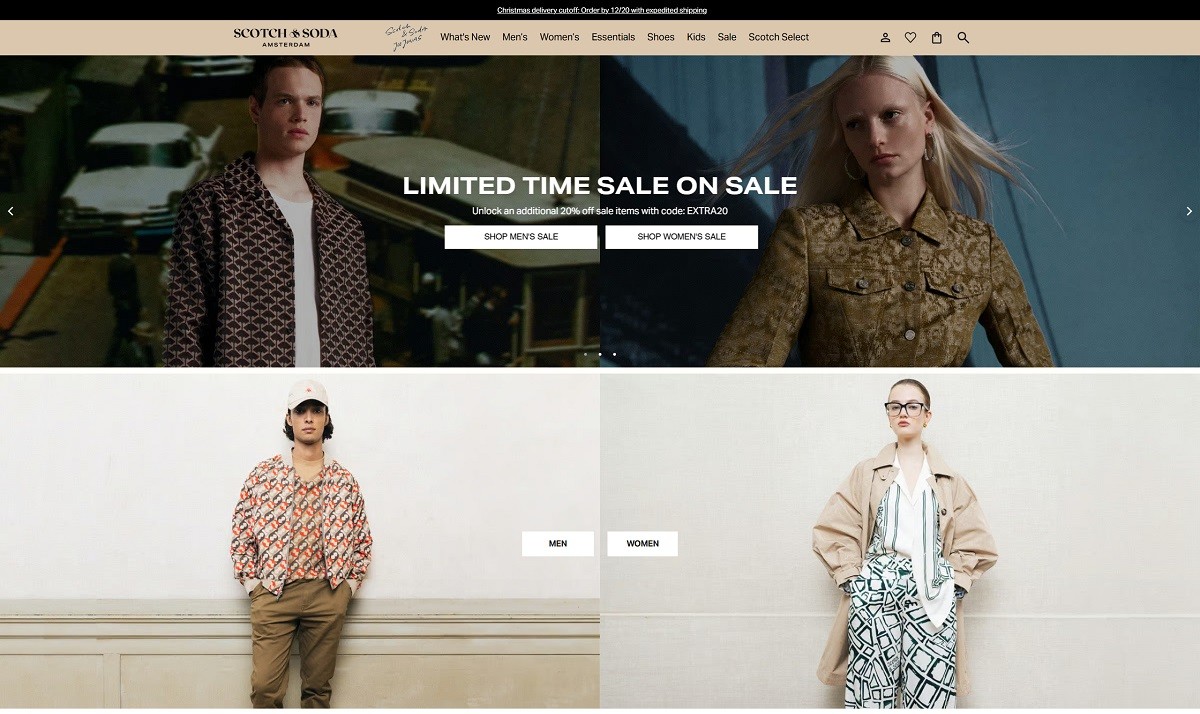
Scotch & Soda is a Dutch fashion brand celebrated for its eclectic designs that blend classic and contemporary styles, offering high-quality apparel and accessories for men, women, and children. Their collections are known for unexpected fabric combinations, vibrant prints, and meticulous detailing, reflecting the free-spirited essence of Amsterdam. The website features a clean, user-friendly interface with intuitive navigation, high-quality imagery, and detailed product descriptions, providing a seamless shopping experience. Overall, Scotch & Soda combines innovative design with functionality, offering a diverse range of fashion-forward products through an engaging online platform.
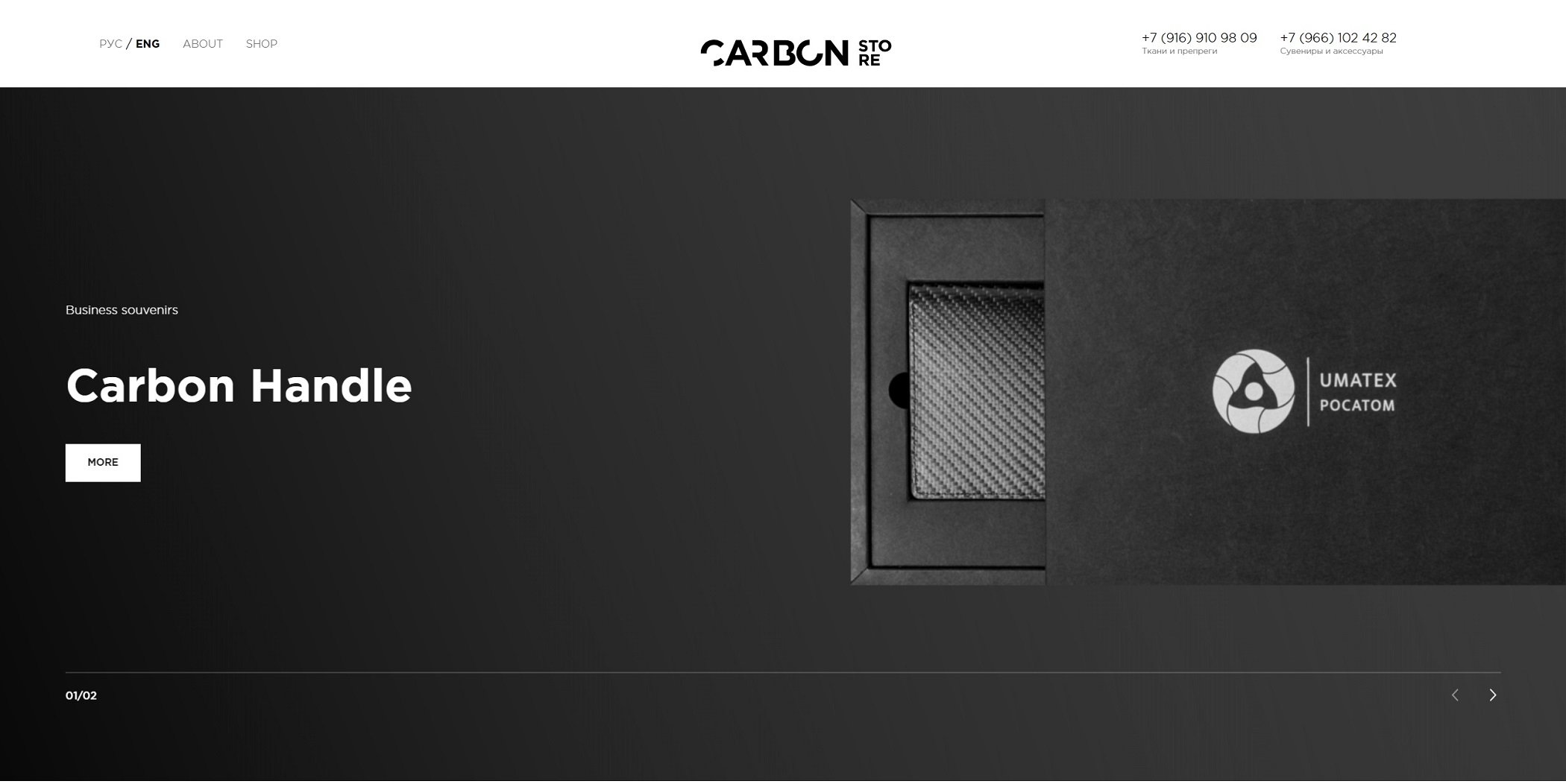
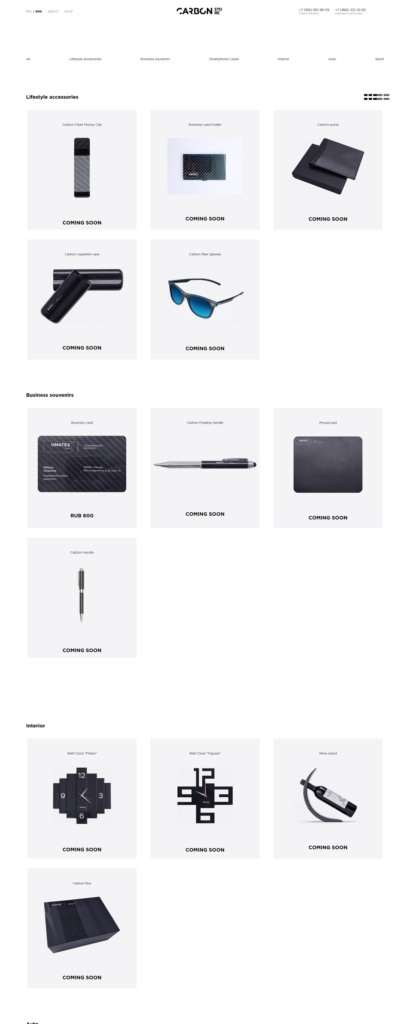
Carbon Store sells carbon fiber lifestyle goods made in Russia, priced in rubles for a business and tech-focused audience. The catalogue spans RFID-blocking wallets and card holders, phone cases, power banks, a decorative lamp, auto parts such as license plate frames and valve caps, plus raw carbon fabrics and prepregs sold to other manufacturers. The homepage states the mission directly: “Carbon Store unites producers of carbon products” and aims to introduce the material into everyday life. Built on the Bitrix content platform rather than Shopify.
Website Design
Black, white and the weave itself. The site uses a near-monochrome palette of black, white and light gray backgrounds, leaving the visual interest to close-up photography of the carbon fiber weave pattern on the products themselves rather than to added color.
Gotham for headings and interface. Type is set in Gotham, a geometric grotesque, giving labels and prices a clean, technical look that matches the material-first products.
A grid you can toggle. Product listing pages offer a switch between a denser six-item grid and a larger four-item grid, letting shoppers choose between browsing quickly or seeing bigger product photography.
Shopping Experience
Two catalogues in one store. Consumer goods (wallets, cases, lamps, auto parts) sit alongside a business-facing Fabrics and Prepregs section aimed at other manufacturers, each with its own dedicated contact phone number in the footer.
Prices set per item, not ranges. A card holder runs 6,000 rubles, a travel wallet 9,000, a phone case 5,700 and a decorative lamp 95,000, so the site prices each object individually rather than grouping by a shared range.
A black Add to Cart bar. The primary call to action on product pages is a full black bar with white text, kept consistent across the catalogue rather than varying by category.
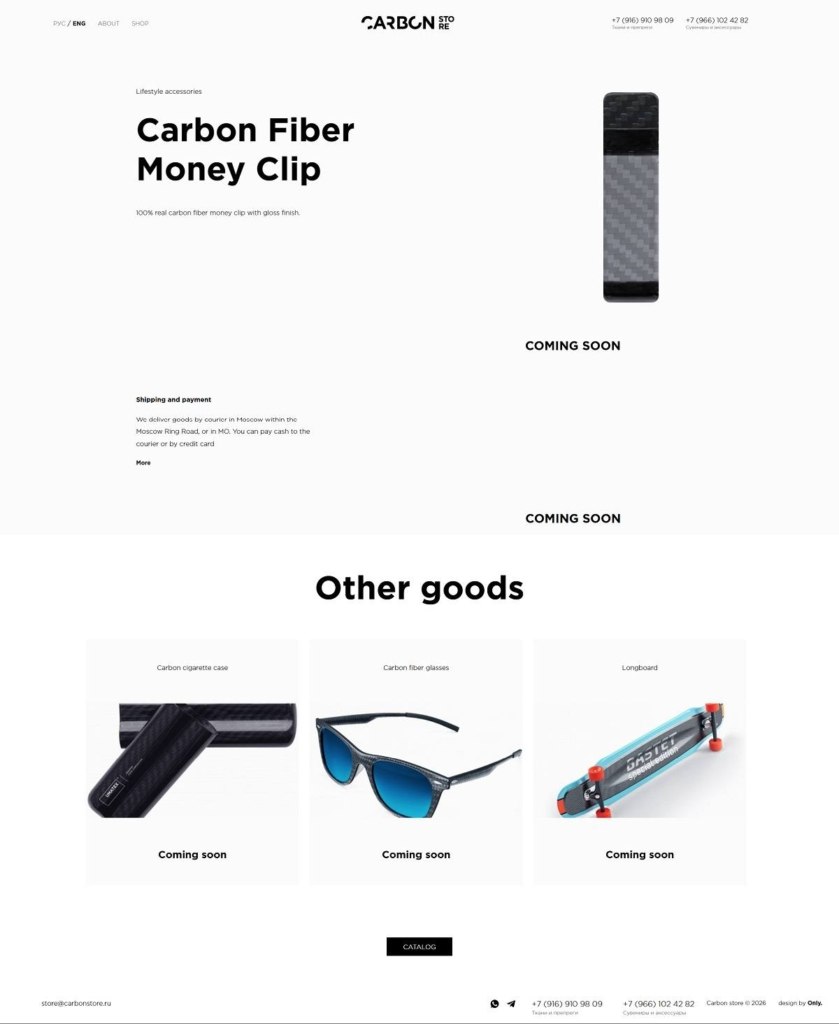
Coming soon as a stated status. Several categories, including rings, designer furniture and the longboard line, are marked “Coming soon” directly on the category grid instead of being hidden until launch.
Brand Storytelling
A stated industry mission. The brand frames itself as connecting carbon product makers and expanding what carbon fiber is used for, rather than describing itself only as a shop.
Split contact lines for split audiences. The footer lists one phone number for fabrics and prepregs buyers and a separate number for gifts and accessories customers, a small but direct signal that the business treats B2B and consumer shoppers differently.
Material as the whole story. There is no separate brand history or founder narrative on the homepage; the carbon fiber material itself, shown in close detail across every product photo, carries the positioning.
Notable Features
A cookie and user-agreement footer. Links to a cookie policy and user agreement sit in the footer, standard for a Russian ecommerce site operating under local data rules.
Corporate gifting as a named category. Business Gifts is listed as its own top-level section, with branded items positioned specifically for corporate buyers rather than folded into general accessories.
Delivery and payment as a dedicated page. Rather than a short shipping note, delivery and payment terms get their own linked page from the main navigation.
The Rug Company sells luxury handmade rugs, cushions and wallhangings for designers, homeowners and trade buyers, with prices seen from about $2,400 into the tens of thousands for large or bespoke pieces. The site serves both a retail audience and a separate trade channel for hospitality, corporate, real estate and retail projects. Product tiers span in-stock pieces to made-to-order and fully custom work.
Website Design
Berthold Akzidenz Grotesk throughout. The typeface is a classic grotesque, set in a near-black, #333333, on a warm off-white ground, #f6f4f2, giving the site a restrained, editorial feel rather than a bright retail one.
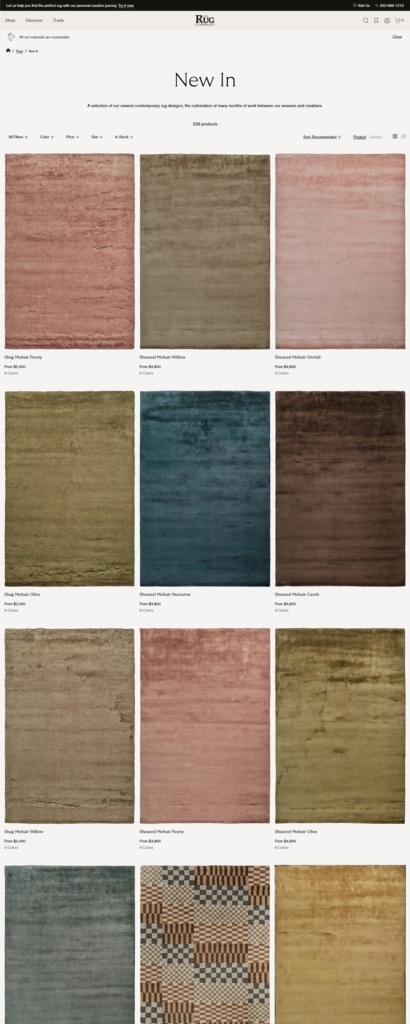
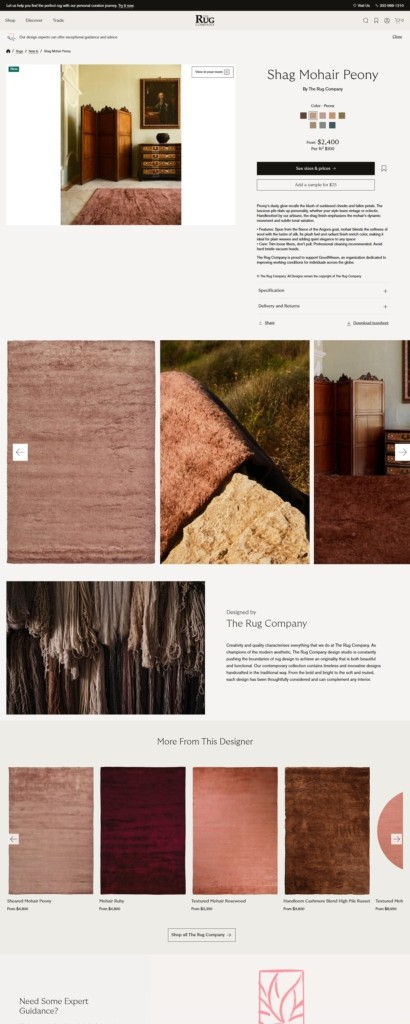
Photography carries the design. Rather than heavy colour blocking, pages lean on large rug photography, styled room settings and close-up texture shots, with the interface itself staying quiet and neutral around them.
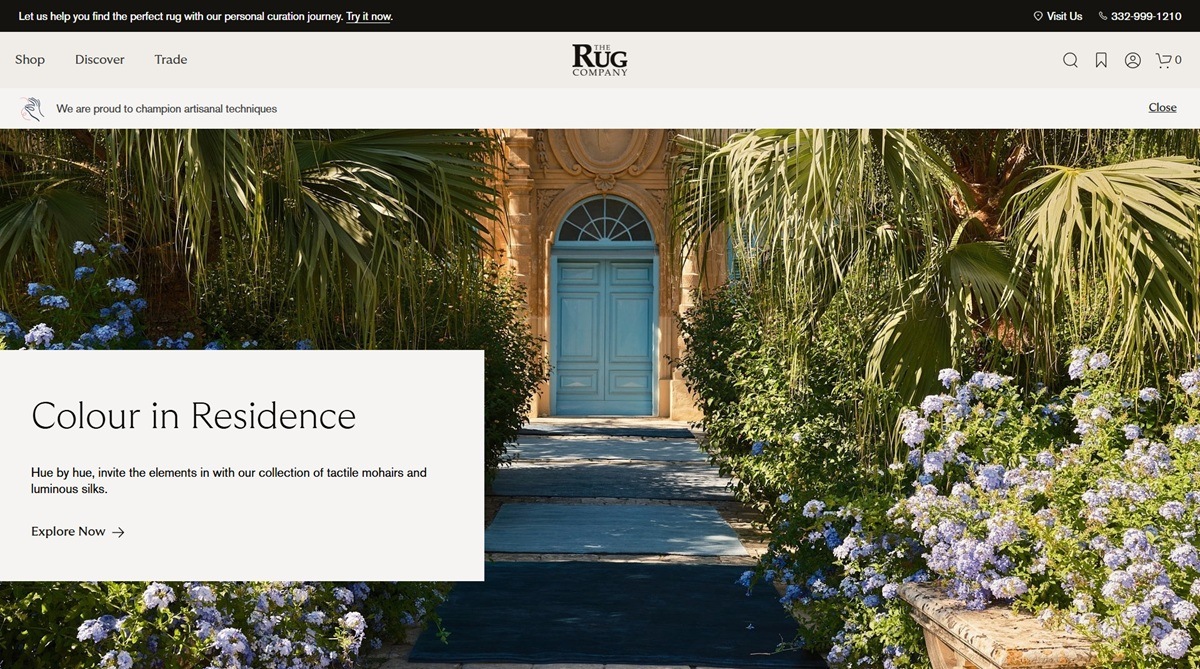
A campaign banner up top. The homepage opens on “Colour in Residence,” inviting shoppers to “invite tactile silks and mohairs to make themselves at home,” a seasonal editorial push rather than a discount banner.
Shopping Experience
Five ways to browse. The Shop menu splits into By Category, By Product, By Style, By Size and By Lead Time, the last of these separating In Stock (1-2 weeks), Made to Order (10-22 weeks) and Custom and Bespoke (22-plus weeks) so delivery expectations are set before a shopper opens a product.
A wide price range in view. Rugs seen on the site range from roughly $2,400 to more than $40,000, reflecting a catalogue that runs from smaller ready pieces to large custom commissions.
Quick view and wishlist. Product grids support a quick view overlay and saving items to a wishlist, plus account features for orders, addresses and payment methods.
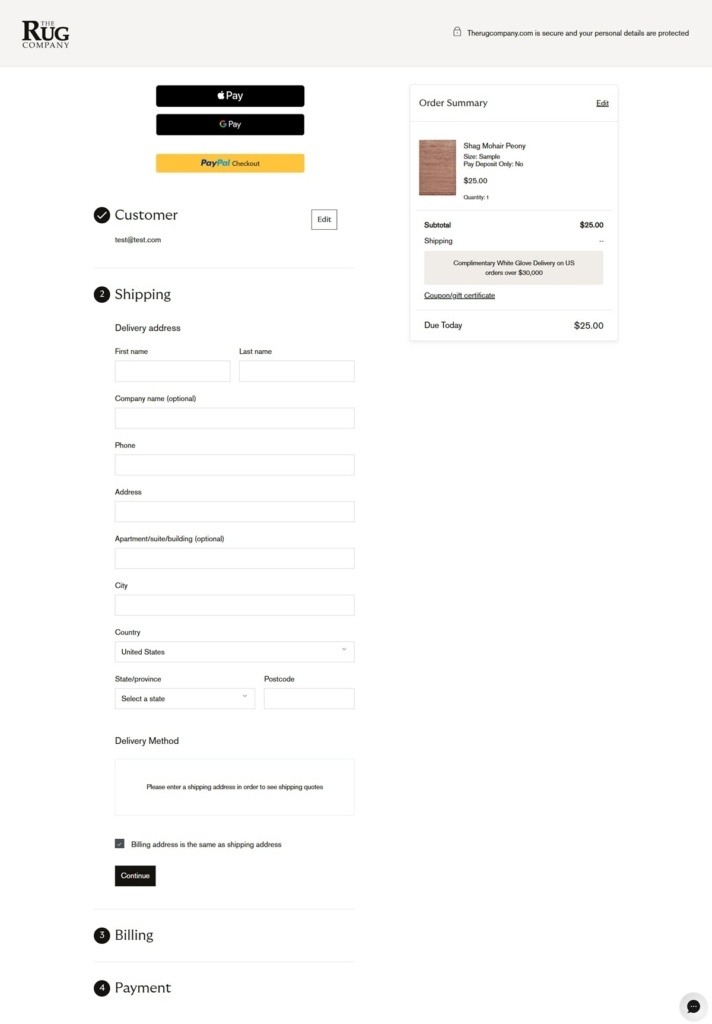
Klarna and Afterpay alongside standard checkout. Installment payment options sit next to card and standard Shopify payment methods at checkout.
Brand Storytelling
A separate identity for trade. Trade, Contract and Environments sit in their own top-level menu, split further into Hospitality, Corporate, Real Estate and Retail, with a dedicated trade account and sign-in, treating design professionals as a distinct audience from retail shoppers.
Craft stated as a value, not a slogan. Copy on the homepage reads “Our design experts can offer exceptional guidance and advice” and “We are proud to champion artisanal techniques,” framed as short standalone lines rather than long brand copy.
Notable Features
A blog under Discover. “The Thread” runs as a dedicated editorial section alongside Our Collections and Our Designers, giving the brand a content channel separate from the shop.
Designer collaborations as their own line. Collaborations appears as its own category under By Category, distinct from the in-house collections.
Sustainability named directly. A homepage line states “All our materials are sustainable,” placed among the same short trio of brand statements as the craft and design-guidance lines.
Quaker Marine Supply (QMS) is a brand steeped in the grit and pleasures of life on the water. We make quality clothing for paddlers and navigators, dune walkers and wave runners; yachtsmen, anglers, islanders, and beach bums.
Founded in Philadelphia in 1949 by a Coast Guard veteran named Joe Kadison, QMS has a long history of serving the sea-loving crowd. The company began as an outfitter specializing in marine hardware and clothing. Starting in the sixties, QMS became known for its long-brimmed caps, notably the Swordfish and the Oysterman, with its patent-leather bill. The latter was a favorite of Ernest Hemingway, who wore it duck hunting in Idaho and sport fishing in Cuba and Key West.
Designed to withstand the elements, these iconic canvas caps prioritized functionality but created an unmistakable look in the process. The new QMS—based in Brooklyn, New York—takes a similar tack, with clothing that will both turn heads at a pool party and stand up to years of saltwater adventuring.
We offer a distinctive, irreverent take on classic East Coast summer style. For those who should be so lucky, QMS suits the aquatic life year-round. We salute the authenticity and tangibility of that life and the quality of experience that it represents, whether those moments close to the water are solitary or shared with friends and family. We try not to take ourselves too seriously. But QMS products and the QMS legacy are another story.
Baum und Pferdgarten is a Copenhagen-based fashion house founded in 1999 by the creative directors Rikke Baumgarten and Helle Hestehave. The name of the brand was created as an interplay between Helle and Rikke’s surnames.
Through their long-time collaboration, Rikke and Helle continually compliment and push each other resulting in the creation of many coveted collections full of beautiful materials, memorable prints and bold colours. As one of the leading Danish fashion brands Baum und Pferdgarten’s design identity can best be described as ageless, exclusive and unexpected.
In 2014, Maître Patissier, Chocolatier and Wine Connoisseur Deniz Karaca and his wife Kylie founded Cuvee Chocolate from their kitchen base, right at the fringe of the Mornington Peninsula in Victoria.
The illo Xmas mini market is a fun studio project created by illo.tv. It’s a temporary online store where we have been free to play with illo’s most iconic colors and shapes, to create our own version of some classic objects of every Xmas: wish cards, decorations, candles and recipes. The result? Something that you could totally find in one of our videos or illustrations. Starting in August 2018, we tried to put to the test our skills in graphic/web/set design – but also developed some new ones in carpentry, painting and packaging assembly.
The Australian Emu is an exclusive collector’s item. The coin’s sole worldwide distributor is Metal Market Europe – a leader of investment metals trading in Central and Eastern Europe that cooperates with the most famous and prestigious mints in the world.
The Istanbul based luxury handbag brand Misela was founded in 2008 in New York by Serra Turker, a Rhode Island School of Design graduate. Turker mastered her Textiles design skills through exploring her cultural heritage and created an unique world of accessories that blends the taste of the West with the feel of the East. This eclectic brand known for its bold prints and colorful combinations is inspired by the global woman who cherishes timeless designs that accompany her through her journey.
Inspired by the vast history of Istanbul, Misela’s first boutique opened in 2012 in Pera, one of the most historic neighborhoods of the city. The boutique is the place to explore the colorful world of Misela and to experience its timeless journey. The in-house produced accessory brand found its second home in 2014 with the opening of the Palmarina boutique, in Bodrum and expanded its outreach to both the locals and the visitors from all over the world.
What started as a fun project has turned into a dream of investing in shelters to help dogos in need. We’re pledging 10%+ of all profits to local shelters.
We want every mutt to find their special humans and experience the amazing ancient bond between our two species.
We believe that mutts are unique and wonderful. While we love all dogos, there is a special place in our hearts for all rescued mixed breeds who will never find their breed on a bumper sticker.
Join our community for the latest trends and ecommerce tips.